On May 24, 2022, a Border Patrol Tactical Unit fatally shot 18-year-old Salvador Ramos inside a classroom in Robb Elementary School in Uvalde, 77 minutes after Ramos had entered the building to commit the third-deadliest school shooting in American history. Ramos, a former student at Robb, had purchased two high-powered rifles and hundreds of rounds of ammunition just days before he killed 19 students and two teachers. In the aftermath, several victims’ families pushed for gun control at the state level. Their efforts failed in Austin, but they won the support of Republican Congressman Tony Gonzales, who voted for the first federal gun-control legislation enacted in two decades.
Now, four long years later, those families and the rest of their southwest Texas city of 15,000 may soon be represented in the U.S. House by a gunmaker, Second Amendment absolutist, and edgy YouTube personality by the name of Brandon Herrera. A man who has discussed, on camera, the relative merits of mass killers using the sort of rifle deployed in Uvalde rather than other weaponry; spread memes associated with an extremist movement; and rationalized or made light of lethal violence against people with certain political beliefs.
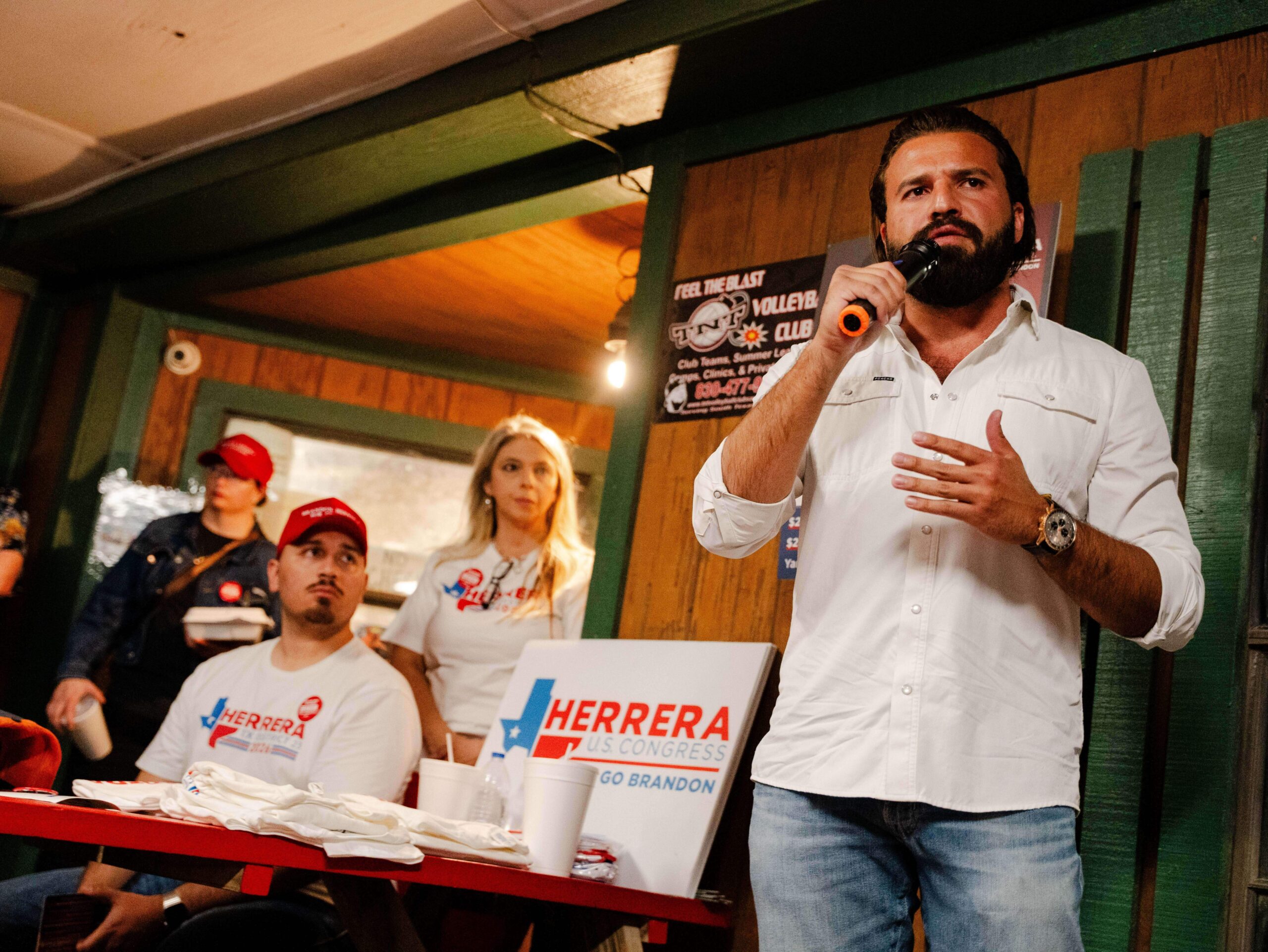
Also known as the “AK Guy”—a reference to his penchant for the Avtomat Kalashnikova (AK) rifle platform—the bearded 30-year-old is a celebrity in an online gun culture that has emerged on platforms including YouTube, where “gunfluencers” like him have amassed millions of followers through firearm reviews, meme roundups, gun-history content, and Second Amendment commentary. A relative newcomer to politics, Herrera first ran for office in the 2024 GOP primary against Gonzales, citing the latter’s vote for modest gun control as inspiration, as Herrera himself has said he’d oppose any new firearms restrictions, including red flag laws. He cast Gonzales then as an out-of-touch, too-moderate incumbent and forced him into a runoff, which Gonzales narrowly won.
Vowing to “finish what we started,” Herrera announced in August 2025 that he would challenge Gonzales a second time. Again, Herrera forced Gonzales into a runoff, but this time, an explosive scandal was brewing around the incumbent congressman, who’d had an affair with a staffer who later committed suicide by self-immolation. Under pressure from House leadership, Gonzales suspended his reelection campaign soon after the March primary, clearing the path to the nomination for Herrera, and, in April, Gonzales resigned. That sets up a special election, the timing of which is set by Governor Greg Abbott.
Herrera in Somerset in February (AP Photo/Brenda Bazán)
Now endorsed by major Republicans, including President Donald Trump, Herrera promotes an “America First” platform centered on gun-rights absolutism, antiabortion policy, border security, term limits, opposition to (some) foreign wars, and tax cuts. Despite his self-described libertarian leanings, he has largely aligned with the hard-right faction of the Republican party on most issues—including the Trump administration’s immigration agenda and “qualified support” for military action in Iran.
The district that Gonzales represented for three terms and Herrera now seeks to claim is Texas’ 23rd, the state’s largest by area, stretching from El Paso to San Antonio. It used to be Texas’ swingiest U.S. House seat, until Republicans redrew it firmly into their column at the outset of this decade. The district, which changed little in the most recent round of Trump-mandated gerrymandering, is 60 percent Hispanic and plus-15 for Trump based on the November 2024 election.
On the Democratic side, voters in March nominated Katy Padilla Stout, a lawyer and former schoolteacher from San Antonio running on economic affordability, healthcare access, reproductive rights, voting rights, climate, gun safety, opposition to a Big Bend border wall (Herrera opposes this too), and the proliferation of data centers. As Republicans seek to wring another five House seats out of Texas in their desperate bid to hold on to the chamber in November, the 23rd wasn’t a district they planned on worrying about.
But now, both sides see a battleground. Polling shows that Democrats have an edge nationally (pending the outcomes of an ongoing nationwide redistricting war), and a majority of Hispanic voters disapprove of Trump. And, in the 23rd, the GOP finds itself running a neophyte with a colorful past rather than an incumbent Navy veteran. Herrera himself has even said that he may be trailing, while Stout has seen an influx of campaign donations.
“Brandon Herrera is probably the exact opposite of the type of candidate that most people want going into a competitive race in this election,” said Matt Angle, a longtime Democratic strategist and the director of the Lone Star Project. “His campaign is not about anything that people really care about.”
University of Texas at San Antonio political scientist Jon Taylor echoed the sentiment that Herrera’s nomination has created an opening for Democrats if they’re willing to invest.
“Stout has at least a puncher’s chance, if not better,” Taylor said. “Brandon Herrera is so radical compared to other candidates that there is an opening. … She is building a grassroots effort and a get-out-the-vote effort. It’s just simply a case of this race seems to still be a little bit under the radar.”
As the contest unfolds, Herrera is facing renewed scrutiny on his influencer past, which, according to the Texas Observer’s review of Herrera’s online footprint, includes patterns that have gone largely unnoticed: dissemination of memes associated with the “Boogaloo” movement that advocates for a second American Civil War and has inspired acts of terrorism; rationalization of and joking about violent deaths of people whose politics he describes as communist; and sanitization of the Confederacy’s stance on slavery—in addition to his discussion of the comparative accuracy of weapons used in mass shootings.
Herrera and his campaign manager, Kimmie Gonzalez, did not ultimately agree to an interview for this story, despite initially agreeing to set one up when asked in-person at the Conservative Political Action Conference in March.
“Brandon has no association with [the Boogaloo movement] or any group like that and condemns political violence,” Gonzalez said in an emailed statement. “Especially violence inspired by lies told by left-wing journalists that has resulted in the murder of Charlie Kirk and multiple assassination attempts on President Trump.”
Born in Fort Bragg, North Carolina, and raised in a military family, Herrera began making YouTube videos and building guns as a teenager in Fayetteville, where he was active in a local chapter of the Sons of Confederate Veterans. In since-deleted videos from a little more than a decade ago, Herrera—who has described himself as being of Mexican and German descent—wore a shirt referencing the group with a Confederate flag as he described the Civil War as both the “war of Northern aggression” and “the war for Southern independence.” According to Jewish Insider, he remained active with the organization until at least 2019.
Herrera launched his current YouTube channel in 2014, and he formed his own gun-manufacturing business, The AK Guy Inc., the following year. He briefly studied prelaw at Campbell University in North Carolina before dropping out in 2016. By the end of 2018, his YouTube channel had more than 33,000 followers. His first big breakout came the following year, when one of his videos—about how AK owners are more masculine than AR owners—reached millions of views and his follower count surged to 100,000. In 2020, as his viewership further multiplied, he relocated to the San Antonio area (he’s currently registered to vote in a far northwest part of the city, near Boerne), where other YouTube gunfluencers with whom Herrera collaborates live. Within a year, his channel had more than 1 million followers.
“The algorithms have rewarded Herrera videos and his use of rhetoric that appeals to specific online in-groups,” said Taylor Lorenz, a journalist who has long covered internet culture and publishes the newsletter User Mag. “But I’m not sure if it’s politically expedient.”
Herrera’s early YouTube content was largely apolitical: gun reviews, updates on his development of the “AK-50,” and travelogues. Over time, Herrera sought to be more humorous, including with a parody music video of Eminem’s “Without Me.” Then, in 2019, the tone began to shift.
Following several shootings that year, Herrera said in a video—titled “Mass Shootings: An Unpopular Opinion”—that “With these terrible mass shootings that have happened for a good little while, you should be really glad that some of these people are using guns to do this,” arguing specifically that AR-style rifles are “pinpoint instruments” of violence compared to trucks or bombs. “Sorry for the dark video, guys. … Every time something like this happens, I think about doing it, and then I think better of it, but hopefully this was valuable,” he concluded.
In an emailed statement to the Observer, Padilla Stout called the comments “simply unfathomable coming from someone running to represent a district that includes the community of Uvalde.”
After the beginning of the COVID-19 pandemic, Herrera’s videos increasingly provided a window into his political views, social media diet, and the sensibilities of his audience. Couched in plausibly deniable “dark humor,” he began to spotlight memes about the pandemic, political violence, and the “Boogaloo” movement—a loosely organized far-right trend whose adherents, referred to as “Boogaloo Bois,” espouse pro-gun, anti-government, and accelerationist sentiments in preparation for a hypothetical second American Civil War, which they call the “boogaloo” or other derived nicknames.
“Today, we’re going over a topic that you guys have wanted us to talk about for a very long time,” Herrera said in a January 2020 meme review video. “This … is the Virginia Boogaloo special. I don’t even know if we could say Boogaloo anymore. Apparently the [Anti-Defamation League] says that that is a hate word, to which I reply: It’s only a hate word if they lose.”
The Boogaloo movement emerged from online message board culture around 2012, gained significant traction in 2019, and appeared on the streets in early 2020. Boogaloo Bois—often identifiable by their Hawaiian shirts, military fatigues, and distinct insignia or flags—attended a January 2020 gun-rights rally in Richmond, Virginia, and protests against COVID precautions across the country.
“I know I’m one of the people that talks about all the Boogaloo memes,” Herrera said in a March 2020 video. “This is humor, guys. Just try to settle down on things that could actually be, like, actual actionable threats on real people. Please don’t go to jail. I don’t get any of your views from jail. But now that I’ve thrown that disclaimer out there … back to the boogaloo memes.”
Following the murder of George Floyd in May of that year, a 26-year-old Boogaloo Boi from Texas named Ivan Harrison Hunter traveled to Minneapolis, where he shot 13 rounds at a police station and helped set it ablaze. Two hours later, Hunter texted Steven Carillo, an active-duty Air Force staff sergeant and fellow Boogaloo adherent in California, to “go for police buildings.” Carillo then carried out two ambush-style attacks against security officers and law enforcement officers in California, killing two. At least 36 Boogaloo members were arrested in 2020 for various acts of terrorism, attempts to incite riots, and a scheme to kidnap Michigan Governor Gretchen Whitmer.
Herrera’s last video on the topic, titled “STOP SIMPING FOR COMMUNISTS,” came in August 2020 after the killing of Garrett Foster, who was shot during an interaction with a driver while openly carrying a rifle during a Black Lives Matter protest in Austin. Foster, who did not fire his weapon, was a Libertarian Party member who had reportedly made Boogaloo-coded posts on social media, leading Herrera to critique the meme’s spread beyond its origin.
“For some people, [Boogaloo is] just a joke and we like wearing Hawaiian shirts and plate carriers and shooting things on the weekends,” Herrera said. “On a philosophical level, it’s more of a stance against government tyranny. … For some reason, it seems to have transformed online into a bunch of angsty teenagers who are simping for communists and want to shoot cops.”
Herrera later said he believes that the lives of communists “don’t count.”
Herrera reading and displaying a meme mocking Foster’s killing (YouTube screenshot)
This was the start of a pattern in Herrera’s videos about political violence: dehumanizing certain people and treating lethal violence against leftists or protesters as darkly comic, deserved, or at least understandable.
In a subsequent video, Herrera made similar statements about Kyle Rittenhouse, who’d then recently killed two men during unrest at a Black Lives Matter protest in Kenosha, Wisconsin. “Good luck, kid. You minted some good commies,” Herrera said in a video, clarifying: “I am not encouraging anybody to go get themselves into some shit. … It’s not worth it.”
During Rittenhouse’s criminal trial, Herrera replied jokingly to an X user who asked whether Rittenhouse would “get off” of the charges: “I mean I’d get off on stacking felonious commies too.”
Herrera’s embrace of Rittenhouse corresponded with his increasing involvement in politics. In 2021, he gave a pro-gun speech at the annual convention of Young Americans for Liberty (YAL), a libertarian student activist organization based in Austin, and in 2022, Herrera and Rittenhouse shot machine guns from a helicopter in a National Rifle Association video. Meanwhile, Herrera continued to publish videos that would later draw controversy.
In one 2022 video about the MP-40, a World War II-era German submachine gun, Herrera goose-stepped in Nazi uniform to a Nazi marching song and described the firearm as “the original ghetto blaster.” In another, from 2023, about a rifle associated with Rhodesia—a brief-lived white-supremacist state in Africa— Herrera expressed affinity for the defeated Rhodesians: “Long story short, the side that was sympathetic with communism won, and now Zimbabwe doesn’t have food.” Rhodesia has become a totem for extremist white supremacists, including the Charleston, South Carolina, church shooter.
Luke Baumgartner, a research fellow at the Program on Extremism at George Washington University, told the Observer that Herrera’s tongue-in-cheek delivery shouldn’t alleviate concern.
“Guys like him have been using the ‘It’s only jokes’ and ‘edgy’ line as a way of masking what they really believe,” Baumgartner said. “Richard Spencer summed it up when he told people in the alt-right to ‘hide their power levels.’ If Herrera is flirting with admiring the SS, Rhodesian light infantry, and the Confederacy, it tells me he’s a semi-closeted white supremacist.”
Herrera (middle) (YouTube screenshot)
Herrera has dismissed such criticism as bad-faith smear attempts. “According to the left, they think I’m apparently the brown face of white supremacy,” Herrera wrote on X.
Hispanic ancestry and identity are not mutually exclusive with white supremacy, as shown by the prominent neo-Nazi Nick Fuentes and the Allen mall shooter, Mauricio Garcia, among others.
The Observer found no evidence that Herrera has explicitly advocated racist political ideas, fascism, or neo-Nazism. But, beyond his many ostensible jokes, Herrera has earnestly expressed views on the Civil War that tend toward the historical revisionism associated with the Lost Cause Myth, which sanitizes the Confederacy and valorizes Confederate leaders and symbols.
In February 2023, Herrera falsely stated in posts on X that “The Confederacy already had a provision with a plan to phase out slavery in their constitution” and that “[The] war didn’t actually become about slavery until 2 years into it.” (The Confederacy in fact seceded to protect slavery, and the institution was shielded in its constitution.)
Four months after that post, signaling a growing political engagement, Herrera testified in a congressional hearing about limiting the powers of the Bureau of Alcohol, Tobacco, Firearms and Explosives (ATF), the agency that regulates the firearms he promotes.
Two months after testifying at the ATF hearing, Herrera again spoke at the annual YAL conference, where he announced his first congressional campaign, which counted Rittenhouse as a volunteer.
Herrera saw an opening: Gonzales had recently been sanctioned by the state Republican Party over his votes to protect same-sex marriage and enact those modest gun reforms after the Uvalde mass shooting, and major GOP donors were pushing to purge more-moderate Republicans from office. Having voted for a commission to investigate the January 6 insurrection, Gonzales was also left running without the backing of Trump.
Herrera’s first entry into electoral politics didn’t dull the edginess of his YouTube content.
In November 2023, Herrera published a video about an incident in Panama where a man fatally shot climate protesters who were blocking a roadway. The video description states that the victims “got their carbon reduced” and promotes links to his merch store and a chance to win a spot at a gun-range day.
“While not a clean shooting, these guys are definitely the winners of the ‘fuck around and find out’ award,” Herrera said, clarifying: “Lethal force against unarmed people that are not posing an active threat to you, it’s not OK; however, if I needed to defend myself in a protest, well… I’m putting together a team.”
Despite scrutiny of his online history, and despite being vastly outraised, Herrera forced his opponent into a runoff. Gonzales then called Herrera a “known neo-Nazi” in an interview with CNN, which Herrera referred to as the congressman “cry[ing] to his liberal friends about me.” Gonzales prevailed by just a few hundred votes.
Following his loss, Herrera spoke at the 2024 YAL convention, where he used terminally online language popular among anti-Semitic conspiracy theorists. “I know it’s easy to take the black pill and assume that nothing we do ever makes a difference, that George Soros and his lizard kids are going to make us eat the bugs and live in the pod and marry the gay frogs,” he said. “But God’s honest truth is that the people in this room … genuinely have the power to shape the direction of this country.”
Herrera continued to produce YouTube content, including a review of a second Nazi-era firearm, reenactments of historical assassinations, and tests of the guns used in attempts on President Trump’s life (though he declined to re-create the assassination of far-right influencer Charlie Kirk). He also made increasingly critical videos about the ATF while gunning, unsuccessfully, to be appointed director of the bureau, which he said he wants to abolish.
Last August, the same month that he was praised by a mass shooter in Minneapolis, Herrera announced his rematch against Gonzales at the annual Gun Owners of America summit. Gonzales had earned Trump’s backing this time around, and the incumbent might have been in the clear—until the San Antonio Express-News confirmed initial reporting by Current Revolt about the congressman’s affair. Herrera pounced, hammering Gonzales online, and the Youtube star, now enjoying more than 4 million followers, narrowly bested Gonzales in the March primary and soon secured the nomination when the incumbent bowed out. As of early June, Abbott had not announced the timing of a special election to fill the seat.
(AP Photo/Brenda Bazán)
Jesse Rizo, board president of the Uvalde Consolidated Independent School District and uncle to 9-year-old Jackie Cazares who was killed at Robb Elementary, told the Observer he was dismayed that a gun-rights absolutist could be Uvalde’s congressional representative.
“If I was having a conversation with somebody that’s thinking about voting for Herrera or for somebody that extreme, I would caution that person,” Rizo said. “You never know when it’s going to affect you.”
As the GOP establishment, including Trump, has increasingly embraced Herrera, at least one conservative Jewish group that once called him a “goose-stepping extremist” has decided to sit out the fight. In its place, Democratic PACs and politicians have used Herrera’s controversial content as fuel for attacks. In March, the Democratic House Majority PAC resurfaced Herrera’s Nazi submachine gun video, leading Democratic Senator Chris Murphy of Connecticut to accuse Herrera of being “an open Nazi enthusiast.” That same month, media outlets and liberal influencers highlighted a podcast clip in which Herrera said he owned a 1939 edition of Hitler’s Mein Kampf. Herrera and his campaign have defended his content on X, describing it as “funny as hell,” while saying he is not anti-Semitic and that he actually intended to mock Nazis.
“The accusations against Brandon Herrera are bizarre, desperate, and false,” Herrera’s campaign manager said in a statement to Politico in March. “Brandon has never done or said anything antisemitic, and he has earned the support of leaders in the Jewish community. In Brandon’s work as a historical firearms educator, he has simulated the execution and poisoning of Adolf Hitler. The misleading clip about Brandon’s rare book collection omits his comments ridiculing and condemning Hitler’s book.”
Throughout his career as an edgy conservative gunfluencer, Herrera has walked the line between sincerity and irony while maintaining some distance from political extremists. Now under the national spotlight, he seems to be further tempering his image. In a March Washington Post article, he distanced himself from prior remarks about the Confederacy, saying that the “war of Northern aggression” was a “historic term” but that “nowadays we call it the American Civil War.”
Yet, even as he distanced himself from one extremist view, he took one step closer to another extremist group.
During the 2026 Conservative Political Action Conference in Grapevine, where he was a featured speaker, Herrera also spoke at a private satellite event held by the Republicans for National Renewal (RNR). Months earlier, Arizona GOP lawmakers had dropped out of an RNR event after they were informed that the group’s leaders had respectively hosted a podcast with a member of a white nationalist group and attended a 2024 conference hosted by Fuentes. That didn’t stop Herrera from speaking at the event, where he was introduced as a “RINO hunter.” Herrera’s campaign manager told the Observer in her May statement that Herrera “has no affiliation or knowledge of the group.”
Whether Herrera’s most controversial choices will hurt his chances in November remains to be seen. As the El Paso Herald-Post editorial board wrote in April, assuming that his track record will render him unelectable may be a misreading of the electorate. “In many parts of Texas, these types of displays do not necessarily disqualify a candidate,” the board wrote. “In fact, in this particular case, they might even serve to signal ideological alignment and mobilize voters on Herrera’s behalf.”
Still, there’s reason to believe Herrera could be the first Republican to lose District 23 since 2012. House Dems believe they are within striking distance, as shown in an April Democratic-aligned poll, and Herrera himself has agreed.
“You always have to fight like you’re behind,” he said at the RNR event. “Right now, based on how the midterms are looking, we might actually be behind.”
With favorable winds at her back, Padilla Stout, Herrera’s Democratic counterpart, believes she can flip enough votes to win.
“Every day, I talk to Republican and independent-minded voters who say they could never vote for a candidate as extremist as Brandon Herrera,” Padilla Stout said in her written statement. “They know that Brandon is a one-issue internet celebrity who is only interested in expanding his national platform and getting more YouTube views. He is not interested in the real issues that are facing families like mine and others across this district.”
The post How a Gun-Rights Extremist Could Soon Represent Uvalde in Congress appeared first on The Texas Observer.