Judge blocks Trump’s birthright citizenship restrictions in third ruling since high court decision

posted in: All news | 0

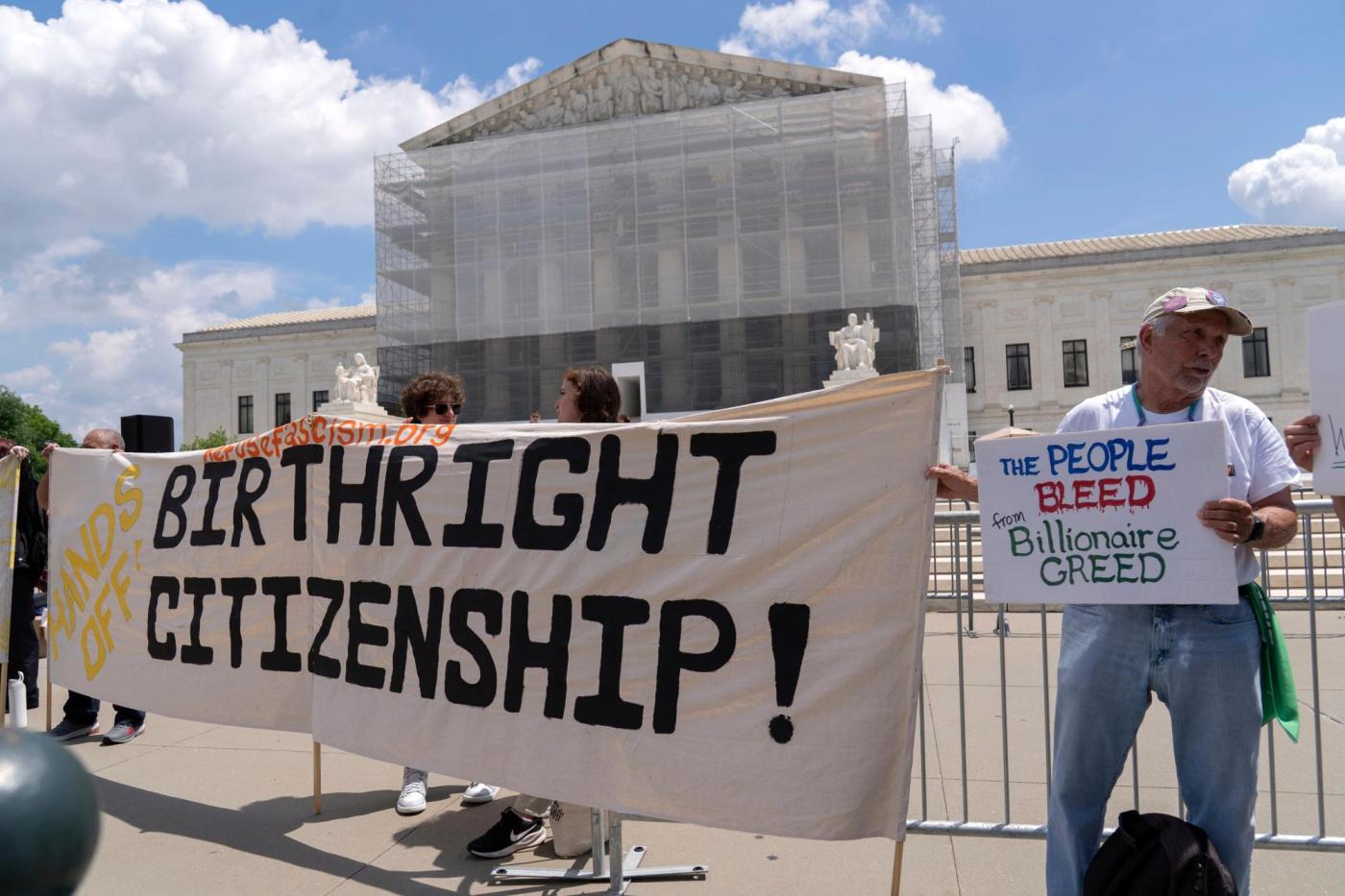
BOSTON — A federal judge on Friday blocked the Trump administration from ending birthright citizenship for the children of parents who are in the U.S. illegally, issuing the third court ruling blocking the birthright order nationwide since a key Supreme Court decision in June.

Related Articles


FACT FOCUS: Trump claims cashless bail increases crime, but data is inconclusive


Epstein ex-girlfriend Ghislaine Maxwell finishes interviews with Justice Department officials


Trump administration investigates Oregon’s transgender athlete policies


In Epstein furor, Trump struggles to shake off a controversy his allies once stoked


Education Department says it will release billions in remaining withheld grant money for schools

U.S. District Judge Leo Sorokin, joining another district court as well as an appellate panel of judges, found that a nationwide injunction granted to more than a dozen states remains in force under an exception to the Supreme Court ruling. That decision restricted the power of lower-court judges to issue nationwide injunctions.

The states have argued Trump’s birthright citizenship order is blatantly unconstitutional and threatens millions of dollars for health insurance services that are contingent on citizenship status. The issue is expected to move quickly back to the nation’s highest court.

New Jersey Attorney General Matthew Platkin, who helped lead the lawsuit before Sorokin, said in a statement he was “thrilled the district court again barred President Trump’s flagrantly unconstitutional birthright citizenship order from taking effect anywhere.”

“American-born babies are American, just as they have been at every other time in our Nation’s history,” he added. “The President cannot change that legal rule with the stroke of a pen.”

Lawyers for the government had argued Sorokin should narrow the reach of his earlier ruling granting a preliminary injunction, saying it should be “tailored to the States’ purported financial injuries.”

Sorokin said a patchwork approach to the birthright order would not protect the states in part because a substantial number of people move between states. He also blasted the Trump administration, saying it had failed to explain how a narrower injunction would work.

“That is, they have never addressed what renders a proposal feasible or workable, how the defendant agencies might implement it without imposing material administrative or financial burdens on the plaintiffs, or how it squares with other relevant federal statutes,” the judge wrote. “In fact, they have characterized such questions as irrelevant to the task the Court is now undertaking. The defendants’ position in this regard defies both law and logic.”

Sorokin acknowledged his order would not be the last word on birthright citizenship. Trump and his administration “are entitled to pursue their interpretation of the Fourteenth Amendment, and no doubt the Supreme Court will ultimately settle the question,” Sorokin wrote. “But in the meantime, for purposes of this lawsuit at this juncture, the Executive Order is unconstitutional.”

The administration has not yet appealed any of the recent court rulings. Trump’s efforts to deny citizenship to children born to parents who are in the country illegally or temporarily will remain blocked unless and until the Supreme Court says otherwise.

An email asking for the White House’s response to the ruling was sent Friday.

A federal judge in New Hampshire issued a ruling earlier this month prohibiting Trump’s executive order from taking effect nationwide in a new class-action lawsuit. U.S. District Judge Joseph LaPlante in New Hampshire had paused his own decision to allow for the Trump administration to appeal, but with no appeal filed in the last week, his order went into effect.

On Wednesday, a San Francisco-based appeals court found the president’s executive order unconstitutional and affirmed a lower court’s nationwide block.

A Maryland-based judge said this week that she would do the same if an appeals court signed off.

The justices ruled last month that lower courts generally can’t issue nationwide injunctions, but it didn’t rule out other court orders that could have nationwide effects, including in class-action lawsuits and those brought by states. The Supreme Court did not decide whether the underlying citizenship order is constitutional.

Plaintiffs in the Boston case earlier argued that the principle of birthright citizenship is “enshrined in the Constitution,” and that Trump does not have the authority to issue the order, which they called a “flagrantly unlawful attempt to strip hundreds of thousands of American-born children of their citizenship based on their parentage.”

They also argue that Trump’s order halting automatic citizenship for babies born to people in the U.S. illegally or temporarily would cost states funding they rely on to “provide essential services” — from foster care to health care for low-income children, to “early interventions for infants, toddlers, and students with disabilities.”

At the heart of the lawsuits is the 14th Amendment to the Constitution, which was ratified in 1868 after the Civil War and the Dred Scott Supreme Court decision. That decision found that Scott, an enslaved man, wasn’t a citizen despite having lived in a state where slavery was outlawed.

The Trump administration has asserted that children of noncitizens are not “subject to the jurisdiction” of the United States and therefore not entitled to citizenship.

Associated Press reporter Mark Sherman in Washington contributed.

Intel cuts back spending, workforce as struggling chip maker mounts comeback

posted in: All news | 0

By BARBARA ORTUTAY

Intel Corp. is shedding thousands of workers and cutting expenses as its new CEO works to revive the fortunes of the struggling chipmaker that helped launch Silicon Valley but has fallen behind rivals like Nvidia Corp. and Advanced Micro Devices Inc.

Related Articles


US stocks coast toward the finish of a record-setting week


The 7 mistakes I made when refinancing my mortgage


MPR’s parent company announces layoffs, citing cuts in government support


Federal regulators approve Paramount’s $8 billion deal with Skydance, capping months of turmoil


Millions of HydroTech hoses recalled after hundreds burst, leaving at least 29 people injured

In a memo to employees Thursday, CEO Lip-Bu Tan said Intel plans to end the year with 75,000 “core” workers excluding subsidiaries, through layoffs and attrition. That’s down from 99,500 core employees at the end of last year. The company previously announced a 15% workforce reduction.

“I know the past few months have not been easy. We are making hard but necessary decisions to streamline the organization, drive greater efficiency and increase accountability at every level of the company,” Tan wrote.

In addition, Intel will scrap previously planned projects in Germany and Poland and also move assembly and test operations in Costa Rica to larger sites in Vietnam and Malaysia. Costa Rica will remain a “home to key engineering teams and corporate functions,” Tan said in the memo.

In the U.S., the company said it will “further” slow construction of a semiconductor plant in Ohio.

Founded in 1968 at the start of the PC revolution, Intel missed the technological shift to mobile computing triggered by Apple’s 2007 release of the iPhone, and it’s lagged more nimble chipmakers. Intel’s troubles have been magnified since the advent of artificial intelligence — a booming field where the chips made by once-smaller rival Nvidia have become tech’s hottest commodity.

The Santa Clara, California-based company’s market cap was $98.71 billion as of the market close on Thursday, compared with Nvidia’s $4.24 trillion.

Tan said Intel is focusing on its “core product portfolio” and artificial intelligence offerings to better serve customers.

“There are no more blank checks,” Tan wrote. “Every investment must make economic sense.”

For the second quarter, Intel reported a loss of $2.9 billion, or 67 cents per share, down from a loss of $1.6 billion, or 38 cents per share, a year earlier. Excluding one-time items, the company posted a loss of 10 cents a share.

Revenue was flat at $12.9 billion. Analysts, on average, were expecting adjusted earnings of 1 cent per share on revenue of $12 billion, according to a poll by FactSet.

FACT FOCUS: Trump claims cashless bail increases crime, but data is inconclusive

posted in: All news | 0

BY MELISSA GOLDIN

As his administration faces mounting pressure to release Justice Department files related the Jeffrey Epstein sex trafficking case, President Donald Trump is highlighting a different criminal justice issue — cashless bail.

Related Articles


Epstein ex-girlfriend Ghislaine Maxwell finishes interviews with Justice Department officials


Trump administration investigates Oregon’s transgender athlete policies


In Epstein furor, Trump struggles to shake off a controversy his allies once stoked


Education Department says it will release billions in remaining withheld grant money for schools


‘Why isn’t he paying?’ Trump’s golf visit to cost Scottish taxpayers

He suggested in a Truth Social post this week that eliminating cash bail as a condition of pretrial release from jail has led to rising crime in U.S. cities that have enacted these reforms. However, studies have shown no clear link.

Here’s a closer look at the facts.

TRUMP: “Crime in American Cities started to significantly rise when they went to CASHLESS BAIL. The WORST criminals are flooding our streets and endangering even our great law enforcement officers. It is a complete disaster, and must be ended, IMMEDIATELY!”

THE FACTS: Data has not determined the impact of cashless bail on crime rates. But experts say it is incorrect to claim that there is an adverse connection.

“I don’t know of any valid studies corroborating the President’s claim and would love to know what the Administration offers in support,” said Kellen Funk, a professor at Columbia Law School who studies pretrial procedure and bail bonding. “In my professional judgment I’d call the claim demonstrably false and inflammatory.”

Jeff Clayton, executive director of the American Bail Coalition, the main lobbying arm of the cash bail industry, also pointed to a lack of evidence.

“Studies are inconclusive in terms of whether bail reforms have had an impact on overall crime numbers,” he said. “This is due to pretrial crime being a small subset of overall crime. It is also difficult to categorize reforms as being ‘cashless’ or not, i.e., policies where preventative detention is introduced as an alternative to being held on bail.”

Different jurisdictions, different laws

In 2023, Illinois became the first state to completely eliminate cash bail when the state Supreme Court upheld the constitutionality of the law abolishing it. The move was part of an expansive criminal justice overhaul adopted in 2021 known as the SAFE-T Act. Under the change, a judge decides whether to release the defendant prior to their trial, weighing factors such as their criminal charges, if they could pose any danger to others and if they are considered a flight risk.

Loyola University of Chicago’s Center for Criminal Justice published a 2024 report on Illinois’ new cashless bail policy, one year after it went into effect. It acknowledges that there is not yet enough data to know what impact the law has had on crime, but that crime in Illinois did not increase after its implementation. Violent and property crime declined in some counties.

A number of other jurisdictions, including New Jersey, New Mexico and Washington, D.C., have nearly eliminated cash bail or limited its use. Many include exceptions for high-level crimes.

Proponents of eliminating cash bail describe it as a penalty on poverty, suggesting that the wealthy can pay their way out of jail to await trial while those with fewer financial resources have to sit it out behind bars. Critics have argued that bail is a time-honored way to ensure defendants released from jail show up for court proceedings. They warn that violent criminals will be released pending trial, giving them license to commit other crimes.

A lack of consensus

Studies have shown mixed results regarding the impact of cashless bail on crime. Many focus on the recidivism of individual defendants rather than overall crime rates.

A 2024 report published by the Brennan Center for Justice saw “no statistically significant relationship” between bail reform and crime rates. It looked at crime rate data from 2015 through 2021 for 33 cities across the U.S., 22 of which had instituted some type of bail reform. Researchers used a statistical method to determine if crime rates had diverged in those with reforms and those without.

Ames Grawert, the report’s co-author and senior counsel in the Brennan Center’s Justice Program, said this conclusion “holds true for trends in crime overall or specifically violent crime.”

Similarly, a 2023 paper published in the American Economic Journal found no evidence that cash bail helps ensure defendants will show up in court or prevents crime among those who are released while awaiting trial. The paper evaluated the impact of a 2018 policy instituted by the Philadelphia’s district attorney that instructed prosecutors not to set bail for certain offenses.

A 2019 court decree in Harris County, Texas, requires most people charged with a misdemeanor to be released without bail while awaiting trial. The latest report from the monitoring team responsible for tracking the impact of this decision, released in 2024, notes that the number of people arrested for misdemeanors has declined by more than 15% since 2015. The number of those rearrested within one year has similarly declined, with rearrest rates remaining stable in recent years.

Asked what data Trump was using to support his claim, the White House pointed to a 2022 report from the district attorney’s office in Yolo County, California, that looked at how a temporary cashless bail system implemented across the state to prevent COVID-19 outbreaks in courts and jails impacted recidivism. It found that out of 595 individuals released between April 2020 and May 2021 under this system, 70.6% were arrested again after they were released. A little more than half were rearrested more than once.

A more recent paper, published in February by the IZA Institute of Labor Economics, also explored the effects of California’s decision to suspend most bail during the COVID-19 pandemic. It reports that implementation of this policy “caused notable increases in both the likelihood and number of rearrests within 30 days.” However, a return to cash bail did not impact the number of rearrests for any type of offense. The paper acknowledges that other factors, such as societal disruption from the pandemic, could have contributed to the initial increase.

Many contributing factors

It is difficult to pinpoint specific explanations for why crime rises and falls.

The American Bail Coalition’s Clayton noted that other policies that have had a negative impact on crime, implemented concurrently with bail reforms, make it “difficult to isolate or elevate one or more causes over the others.”

Paul Heaton, a law professor at the University of Pennsylvania who studies criminal justice interventions, had a similar outlook.

“Certainly there are some policy levers that people look at — the size of the police force and certain policies around sentencing,” he said. “But there’s a lot of variation in crime that I think even criminologists don’t necessarily fully understand.”

Find AP Fact Checks here: https://apnews.com/APFactCheck.

What Happened This Week in NYC Housing? July 18, 2025

posted in: All news | 0

Each Friday, City Limits rounds up the latest news on housing, land use and homelessness. Catch up on what you might have missed here.

A proposal up for a vote this fall would speed up approvals for affordable housing in neighborhoods that have produced the least over the last five years. Here’s where the rule would apply if it went into effect today. (Patrick Spauster/City Limits)

Welcome to “What Happened This Week in NYC Housing?” where we compile the latest local news about housing, land use and homelessness.

Know of a story we should include in next Friday’s roundup? Email us.

ICYMI, from City Limits:

Among the ballot proposals New Yorkers will be asked to vote on this fall: A measure to accelerate affordable housing production in the parts of the city that have produced the least, which has drawn criticism from councilmembers and community boards. City Limits crunched the numbers to see which neighborhoods would be subject to the “fast track” rule if it took effect today.

Among the usually moderate public housing voters who helped power Eric Adams to the mayoralty, Zohran Mamdani outperformed expectations in last month’s Democratic primary. Here how every NYCHA-adjacent election district voted in first-round ballots.

Catch the latest episode of the “Hear Our Voices” podcast, which shares stories and resources related to family homelessness.

“Mitchell-Lama was one of New York’s most successful projects, and the time has come for us to do it again,” write New York City Assemblymembers Harvey Epstein and Grace Lee.

ICYMI, from other local newsrooms:

Did Mayor Adams really build more housing than the Bloomberg and de Blasio administrations combined? The Real Deal fact-checks the claim. (Subscription required)

A long-shuttered former hospital in Forest Hills will be converted to 144 apartments for low-income seniors, Gothamist reports.

The task force charged with voting on a controversial plan to develop a swath of the Red Hook waterfront around the Brooklyn Marine Terminal delayed its decision for the fifth time, according to The City.

New York State plans to slash a program that helps low- and moderate-income homeowners lower their energy usage and costs, New York Focus reports.

The post What Happened This Week in NYC Housing? July 18, 2025 appeared first on City Limits.