William C. Hine: America didn’t become great because we were perfect …

posted in: All news | 0

As we approach the 250th anniversary next year of the adoption of the Declaration of Independence and the Revolutionary War that ensued, many Americans will look to the past, eager to understand how fewer than 3 million people residing in 13 colonies along the East Coast would, in two and a half centuries, become a vibrant and thriving nation of more than 330 million people in 50 far-flung states.

In accumulating knowledge of our past, which historic episodes and people provide us with a deeper understanding of what it means to be an American in the 21st century? What are the most significant events in our nation’s complex history?

In March, President Donald Trump mandated a prescription for what should and should not be essential to comprehending the American past when he issued Executive Order 14253: “Restoring Truth and Sanity to American History.” He explained and complained that recent historical accounts created a “distorted narrative” that is “inherently racist, sexist, oppressive or otherwise irredeemably flawed” and “fosters a sense of national shame.”

Trump directed the National Park Service and the Smithsonian Institution to make changes to exhibits, monuments, statues and markers that depict “divisive narratives that distort our shared history.” He insisted that historical content “that inappropriately disparages Americans past or living” should be revised or removed. History should, the president proclaimed, instill “pride in the hearts of all Americans.”

Trump and his supporters prefer a happy history, a pleasant history that arouses patriotism by overlooking disagreeable people and despicable events that sully the nation’s reputation and mar the magnificence of the American story.

What are the implications of the president’s order? Can history be sanitized and still offer an accurate and authentic account of what has transpired on this continent since the 17th century? By excising or substantially revising episodes of cruelty and brutality, acts of terror, violence, and intolerance, will we gain a better understanding of our past?

For example, should the Smithsonian Institution’s Museum of African-American History and Culture keep Chuck Berry’s red Cadillac on display but remove the cabin from South Carolina’s Edisto Island that housed generations of enslaved people under inhumane conditions? Should the museum maintain the case showing football great Jim Brown’s No. 32 jersey but dismantle the exhibit depicting the horrors of the Middle Passage that brought millions of Africans across the Atlantic Ocean to endure centuries of enslavement in the Western Hemisphere?

How should the National Park Service implement the president’s order? Will the NPS continue to welcome visitors to the Statue of Liberty in New York harbor that greeted millions of immigrants and thousands of service men and women returning from Europe after World Wars I and II? At the same time, the Park Service closes the Stonewall Historic Monument that marks the 1969 Stonewall uprising in New York’s Greenwich Village that helped instigate the Gay Liberation movement? Will the Park Service shut down the site of the 1848 Women’s Rights convention in Seneca Falls, N.Y., as overtly sexist?

Should the NPS maintain the Vicksburg National Military Park in Mississippi, where Gen. Ulysses S. Grant’s Union army laid siege to a Confederate army that finally surrendered on July 4, 1863, while the NPS abandons the Emmett Till National Monument in Mississippi that is devoted to the brutal lynching of a 14-year-old boy in 1955?

What about Independence Hall in Philadelphia, where the Second Continental Congress adopted the Declaration of Independence containing Thomas Jefferson’s eloquent words that “all men are created equal” and that “they are endowed by their Creator with certain inalienable rights, that among these are life, liberty, and the pursuit of happiness”? Should mention also be made that Jefferson was an avid slave owner who had children by an enslaved woman, who happened to be the half-sister of Jefferson’s late wife?

Surely, we want to maintain the Pearl Harbor National Memorial and the sunken USS Arizona, dedicated to the loss of 2,300 service people and civilians on December 7, 1941. Should the NPS also keep open California’s Manzanar National site, one of the locations where more than 110,000 Japanese-Americans (most of them American citizens) were forcibly relocated to concentration-like conditions during World War II?

One of the most popular National Park Service locations is Fort Sumter in the Charleston, S.C., harbor, where Confederate artillery opened fire on the federal government’s military post in April 1861 and began a bloody Civil War that cost 700,000 lives before Union forces reclaimed the fort in April 1865. If Fort Sumter is important to our history, what about the nearby Mother Emanuel AME Church, where nine African-Americans were murdered by a white racist in 2015?

The list of significant sites and exhibits is a long one. These places and the people they represent are our history. This nation did not become great because it was perfect; it became great because Americans recognized their imperfections as they sought to overcome the many instances of violence and intolerance.

We will continue to become a better country if we come to a more complete reckoning with our past rather than trying to fabricate a one-sided, Pollyannish view of our history.

William C. Hine is a professor emeritus of history at South Carolina State University and author of “South Carolina State University: A Black Land-Grant College in Jim Crow America.” He wrote this for InsideSources.com.
Erik Menendez is in hospital for a medical condition. His attorney seeks his release

posted in: All news | 0

By JAIMIE DING

LOS ANGELES (AP) — An attorney is seeking Erik Menendez’s release from prison because of a medical condition after he was taken to a hospital.

Related Articles


In-N-Out Burger CEO to join the list of high-profile business figures to leave California


Army’s head of aviation, who faced questions over deadly midair collision, has new role


US Olympic and Paralympic officials bar transgender women from competing in Olympic women’s sports


US organ donation system faces scrutiny and changes after reports of disturbing near-misses


OpenAI’s Sam Altman warns of AI voice fraud crisis in banking

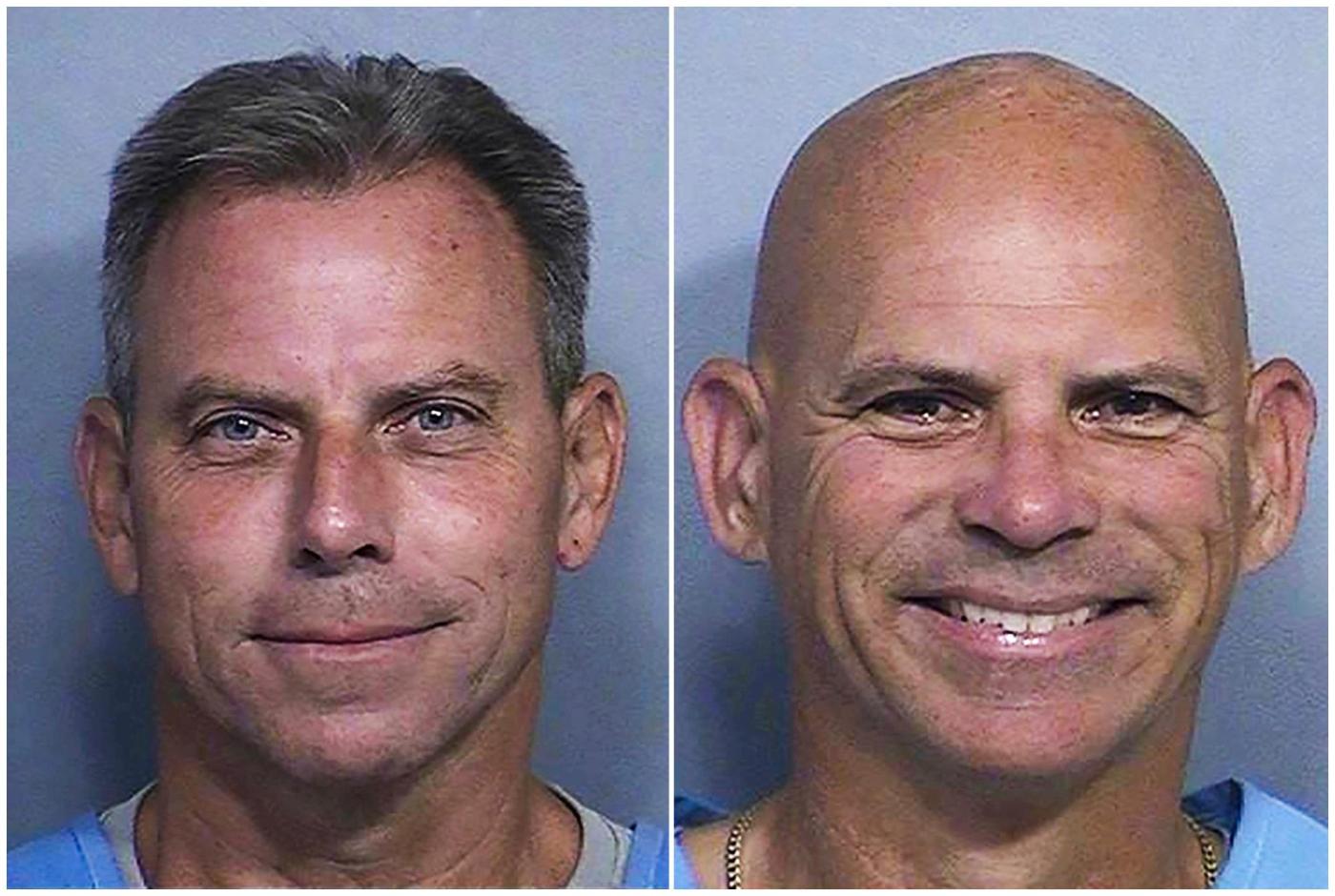
The 57-year-old has been serving a life without parole sentence along with his brother Lyle Menendez after being convicted of murdering their parents in their Beverly Hills, California, home in 1989. A judge recently resentenced the brothers to 50 years to life, making them immediately eligible for parole. They will appear in front of the state parole board Aug. 21 and 22.

The California Department of Corrections and Rehabilitation confirmed Erik Menendez was taken to an outside medical facility Friday and remained there Tuesday “in fair condition.”

His lawyer, Mark Geragos, told TMZ that Menendez was having a “serious medical condition” and should receive a prison furlough, something the governor granted some inmates during the COVID-19 pandemic.

Geragos did not elaborate on the condition, but he said releasing Menendez was the “only fair and equitable thing to do” so he had time to prepare for his parole hearing properly.

Geragos’ office confirmed his comments to TMZ but did not make him available for an interview.

California Gov. Gavin Newsom’s office and a representative for the family declined to comment.

A judge last week ordered Los Angeles prosecutors to explain why Erik and Lyle Menendez’s murder convictions should not be reexamined in light of new evidence supporting their claims of sexual abuse by their father.

While defense attorneys at the time argued the brothers acted out of self-defense after years of sexual abuse by their father, prosecutors said the brothers killed their parents for a multimillion-dollar inheritance.

The order was in response to a habeas corpus petition filed by the Menendez brothers in May 2023 seeking a review of their convictions in a process separate from their resentencing bid.

Trump likes renaming people, places and things. He’s not the first to deploy that perk of power

posted in: All news | 0

By LAURIE KELLMAN

History, it has been said, is written by the winners. President Donald Trump is working that lever of power — again.

Related Articles


Trump says a China trip is ‘not too distant’ as trade tensions ease


Columbia University says it has suspended and expelled students who participated in protests


Senate considering nomination of ex-Trump defense lawyer for lifetime appointment to appeals court


Pam Bondi says judge-picked New Jersey prosecutor succeeding Alina Habba has been removed


What’s happening with forgiveness for student loans on income-based repayment plans?

This time, he’s insisting that Washington’s NFL team change its name from the Commanders back to the Redskins, a name that was considered offensive to Native Americans. Predictably, to Trump’s stated delight, an internet uproar ensued.

It’s a return to the president’s favorite rebranding strategy, one well-used around the world and throughout history. Powers-that-be rename something — a body of water, a mountain in Alaska, St. Petersburg, Istanbul, Mumbai, various places in Israel after 1948 — in line with “current” political and cultural views. Using names to tell a leader’s own version of the nation’s story is a perk of power that Trump is far from the first to enjoy.

A name, after all, defines identity and even reality because it is connected to the verb “to be,“ says one brand strategist.

“A parent naming a child, a founder naming a company, a president naming a place … in each example, we can see the relationship of power,” Shannon Murphy, who runs Nameistry, a naming agency that works with companies and entrepreneurs to develop brand identities, said in an email. “Naming gives you control.”

Trump reignited a debate on football and American identity

In Trump’s case, reviving the debate over the Washington football team’s name had the added effect of distraction.

“My statement on the Washington Redskins has totally blown up, but only in a very positive way,” he wrote on his social media platform, adding a threat to derail the team’s deal for a new stadium if it resisted.

FILE – Native American leaders protest against the Redskins team name and logo outside U.S. Bank Stadium before an NFL football game between the Minnesota Vikings and the Washington Redskins in Minneapolis on Oct. 24, 2019. (AP Photo/Bruce Kluckhohn, File)

In fact, part of the reaction came from people noting that Trump’s proposed renaming came as he struggled to move past a rebellion among his supporters over the administration’s refusal to release much-hyped records in Jeffrey Epstein’s sex trafficking investigation. Over about two weeks, Trump had cycled through many tactics — downplaying the issue, blaming others, scolding a reporter, insulting his own supporters, suing the Wall Street Journal and finally authorizing the Justice Department to try to unseal grand jury transcripts.

Trump’s demand that the NFL and the District of Columbia change the team’s name back to a dictionary definition of a slur against Native Americans reignited a brawl in miniature over race, history and the American identity.

Trump’s reelection itself can be seen as a response to the nation’s reckoning with its racial history after the 2020 police killing of George Floyd. That year, Americans elected Democratic President Joe Biden, who championed diversity. During his term, Washington’s football team became first the Washington Football Team, then the Commanders, at a widely estimated cost in the tens of millions of dollars. And in 2021, The Cleveland Indians became the Cleveland Guardians.

In 2025, Trump has ordered a halt to diversity, equity and inclusion programs through the federal government, universities and schools, despite legal challenges. And he wants the Commanders’ name changed back, though it’s unclear if he has the authority to restrict the nearly $4 billion project.

Is Trump’s ‘Redskins’ push a distraction or a power play?

What’s clear is that names carry great power where business, national identity, race, history and culture intersect.

FILE – People stand at the Eielson Visitor Center with a view of North America’s tallest peak, Denali, in the background, Sept. 2, 2015, in Denali National Park and Preserve, Alaska. (AP Photo/Becky Bohrer, File)

Trump has had great success for decades branding everything from buildings he named after himself to the Gulf between Mexico, Cuba and the United States to his political opponents and people he simply doesn’t like. Exhibit A: Florida’s governor, dubbed by Trump “Meatball Ron” DeSantis, who challenged him for the 2024 GOP presidential nomination.

And Trump is not the first leader to use monikers and nicknames — branding, really — to try to define reality and the people who populate it. Naming was a key tool of colonization that modern-day countries are still trying to dislodge. “Naming,” notes one expert, “is never neutral.”

“To name is to collapse infinite complexity into a manageable symbol, and in that compression, whole worlds are won or lost,“ linguist Norazha Paiman wrote last month on Medium.

”When the British renamed places throughout India or Africa, they weren’t just updating maps,” Paiman wrote. “They were restructuring the conceptual frameworks through which people could relate to their own territories.”

This is not Trump’s first rebranding push

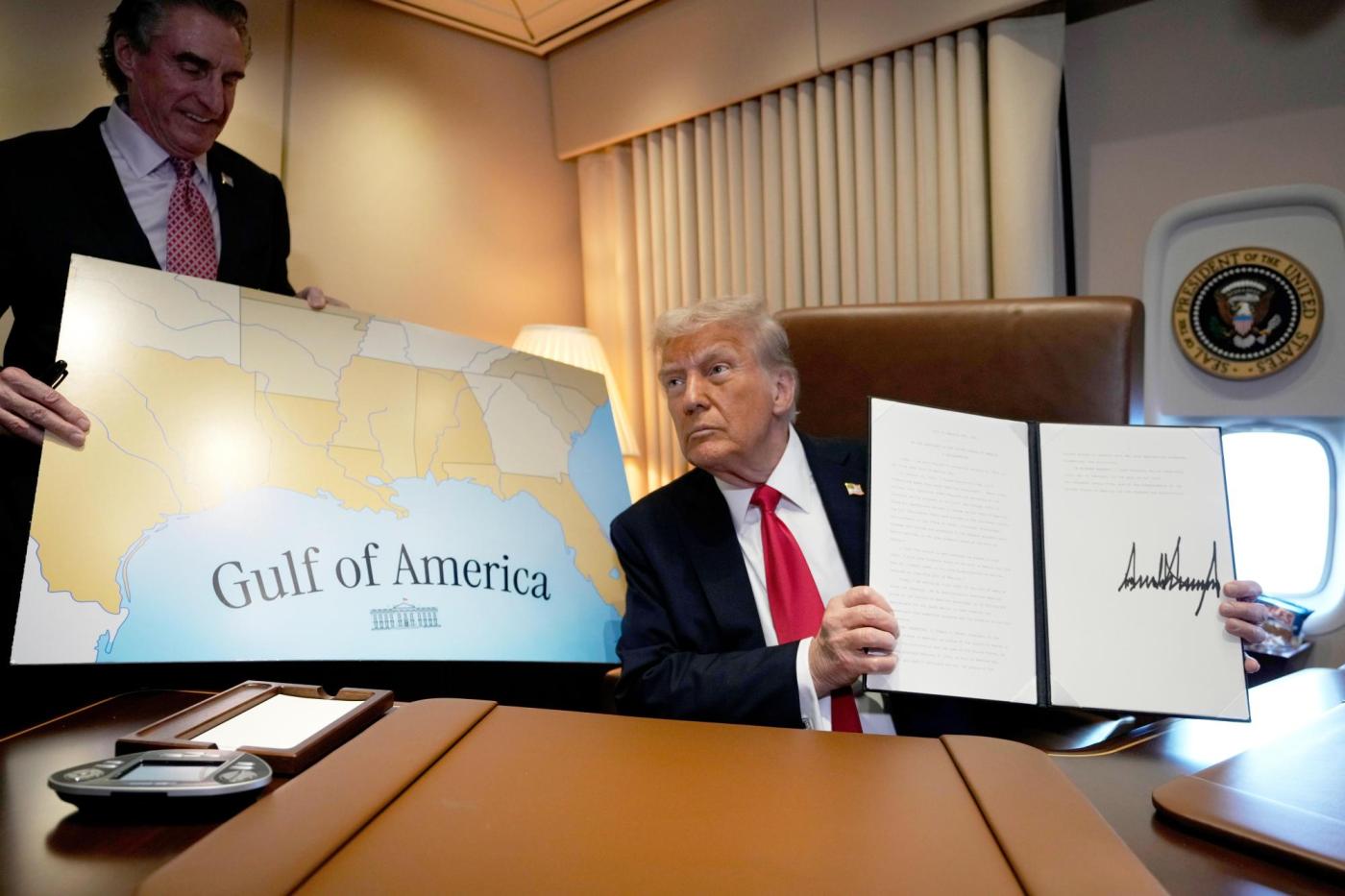
Trump’s order to rename the Gulf of Mexico as the Gulf of America is perhaps the best-known result of Executive Order 14172, titled “Restoring Names That Honor American Greatness.”

The renaming sent mapmakers, search engines and others into a flurry over whether to change the name. And it set off a legal dispute with The Associated Press over First Amendment freedoms that is still winding through the courts. The news outlet’s access to events in the Oval Office and Air Force One was cut back starting in February after the AP said it would continue referring to the Gulf of Mexico in its copy, while noting Trump’s wishes that it instead be renamed the Gulf of America.

This photo provided by the U.S. Navy shows the Military Sealift Command’s fleet replenishment oiler USNS Harvey Milk (T-AO 206) in Norfolk Va., on Sept. 24, 2024. (LaShawn Sykes/U.S. Navy via AP)

It’s unclear if Trump’s name will stick universally — or go the way of “freedom fries,” a brief attempt by some in the George W. Bush-era GOP to rebrand french fries after the Sept. 11, 2001, attacks.

But there’s evidence that at least for business in some places, the “Gulf of America” terminology has staying power. Chevron’s earnings statements of late have referred to the Gulf of America, because “that’s the position of the U.S. government now,” CEO Mike Wirth said during a Jan. 31 call with investors.

And along the Gulf Coast in Republican Louisiana, leaders of the state’s seafood industry call the body of water the Gulf of America, in part, because putting that slogan on local products might help beat back the influx of foreign shrimp flooding American markets, the Louisiana Illuminator news outlet reported.

Renaming is a bipartisan endeavor

The racial reckoning inspired by Floyd’s killing rippled across the cultural landscape.

Quaker retired the Aunt Jemima brand after it had been served up at America’s breakfast tables for 131 years, saying it recognized that the character’s origins were “based on a racial stereotype.” Eskimo Pies became Edy’s. The Grammy-winning country band Lady Antebellum changed its name to Lady A, saying they were regretful and embarrassed that their former moniker was associated with slavery.

And Trump didn’t start the fight over football. Democratic President Barack Obama, in fact, told The Associated Press in 2013 that he would “think about changing” the name of the Washington Redskins if he owned the team.

Trump soon after posted to Twitter: “President should not be telling the Washington Redskins to change their name-our country has far bigger problems! FOCUS on them, not nonsense.”

Fast-forward to July 20, 2025, when Trump posted that the Washington Commanders should change their name back to the Redskins.

“Times,” the president wrote, “are different now.”

Photos: Filipino couple marry in typhoon-flooded church

posted in: All news | 0

By AARON FAVILA and HARUKA NUGA

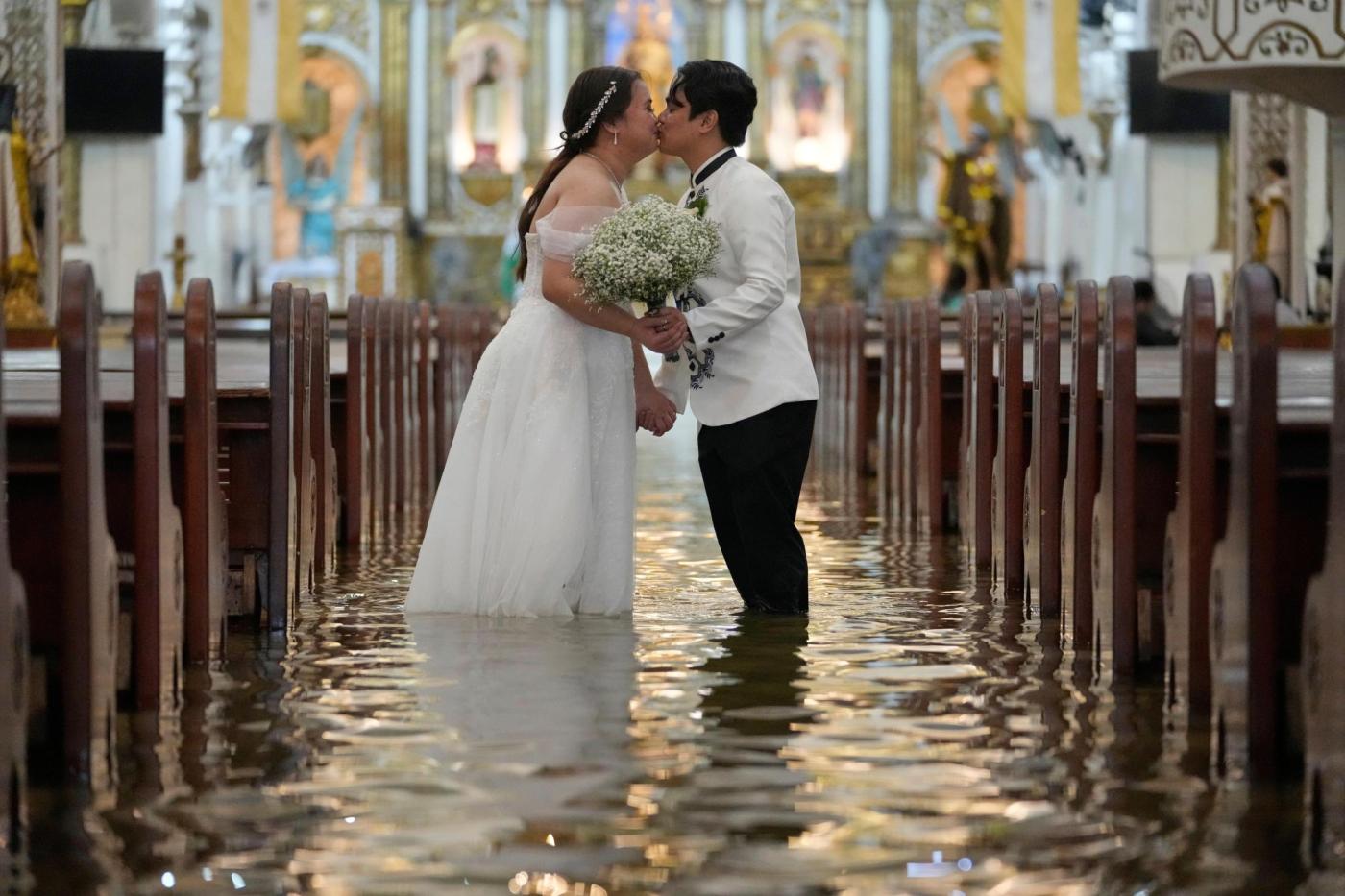
MALOLOS, Philippines (AP) — Jade Rick Verdillo and Jamaica Aguilar were determined to walk down the aisle on their wedding day. Even if it meant walking down a flooded one.

Related Articles


Trump envoy Steve Witkoff to visit the Middle East in push for a ceasefire in Gaza


Lawyers say Venezuelan migrant ordered returned to US sent to home country under prisoner exchange


Swarms of Russian drones attack Ukraine nightly as Moscow puts new emphasis on the deadly weapon


UN body says over 1,000 have been killed seeking food in Gaza since May as hunger crisis worsens


Zelenskyy renews offer to meet with Putin as officials say Russian attacks kill a child in Ukraine

On Tuesday, the Barasoain church in Malolos, Bulacan province, Philippines flooded due to heavy rain. Typhoon Whipa had intensified seasonal monsoon rains in the Philippines, bringing widespread flooding.

The couple anticipated the risk of flooding, but instead of letting the weather dampen the mood, they decided to push through, as all marriages have their challenges.

“We just mustered enough courage,” said Verdillo. “We decided today because it is a sacrifice in itself. But there will more sacrifices if we don’t push through today.”

Aguilar waded down the aisle with her white dress and wedding train floating behind her through waters almost up to her knees. At the altar, Verdillo was waiting to receive her while wearing an embroidered shirt called a Barong Tagalog, worn during special occasions.

The newlyweds have been together for 10 years. The groom said, “I feel that challenges won’t be over. It’s just a test. This is just one of the struggles that we’ve overcome.”

Despite the turbulent weather, some family and friends made it to the wedding.

“You will see love prevailed because even against weather, storm, rains, floods, the wedding continued,” said Jiggo Santos, a wedding guest. “It’s an extraordinary wedding.”