What to know about the brain-eating amoeba that killed a boy swimming in a lake

posted in: All news | 0

By JEFFREY COLLINS

COLUMBIA, S.C. (AP) — A 12-year-old boy died from a brain-eating amoeba two weeks after a holiday weekend on a popular South Carolina lake.

The brain-eating amoeba enters the body when water is forced up the nose, like when someone jumps or dives in the water.

It causes an infection that swells the brain and destroys tissue. Fewer than 10 cases are reported each year in the U.S., but almost all are fatal.

Here are some things to know about the amoeba, its latest victim and other dangers on freshwater lakes:

What is the brain-eating amoeba?

The amoeba’s scientific name is Naegleria fowleri and it is most dangerous in water that stays for a while over 77 degrees Fahrenheit (25 degrees Celsius), including in lakes and rivers in the southern part of the U.S. and other places with hot, sometimes dry summers like Pakistan and Australia.

The amoeba enters the brain through the olfactory nerve in the nose. Once inside, it causes an infection called primary amebic meningoencephalitis.

Symptoms start as a fairly standard headache and nausea. By the time the pain becomes severe, it is almost always too late to save the infected person. Of the 167 cases reported in the U.S. between 1962 and 2024, only four people have survived, according to the U.S. Centers for Disease Control and Prevention. Most of the deaths happened within five days of getting sick, according to the CDC.

One infection in a body of water doesn’t increase the chances of another infection in the same body of water, the agency said. The amoeba cannot move from one person to another.

It was the first death from the amoeba in South Carolina since 2016, the CDC said.

What happened?

Jaysen Carr went swimming at Lake Murray about 15 miles (24 kilometers) west of Columbia over the July Fourth weekend.

He got sick several days later and died on July 18.

This family photo shows Clarence Carr and his son Jaysen at his middle school football game in Columbia, S.C. (Carr Family via AP)

His father and mother had never heard of the amoeba before a doctor in tears told them what tests of his spinal fluid had found.

Clarence Carr said he was shocked to learn South Carolina, like most other U.S. states, has no law requiring public reporting of deaths or infections from the amoeba. The lake wasn’t closed and no water testing was performed.

“My son was a very smart individual. If he had one warning, he would have thought swimming in the lake was a bad idea,” Carr said.

The amoeba is fairly common and is most dangerous when the water is warm.

Researchers are trying to figure out why the infections are so rare. Some people have been found to have had antibodies, signalling they may have survived exposure. Others may die from brain swelling and other problems without the amoeba ever being detected.

“My son lost his life swimming. We assumed it was safe,” Carr said.

The amoeba can show up in hot springs, rivers and, on rare occasions, in tap water. That’s why doctors recommend using sterile water for cleaning nasal passages with a neti pot.

The only way to be completely safe is to not swim in lakes or rivers and, if you do, keep your head above water. Pinching your nose or using nose clips when diving or swimming can keep water out of your nose.

Lake Murray in South Carolina is seen in this photo on July 29, 2025, in Chapin, S.C. (AP Photo/Meg Kinnard)

Other dangers lurking in lakes and rivers

There are other dangers in swimming in lakes and rivers instead of pools, where chemicals can kill off dangerous bacteria and other organisms.

A mouthful of water could contain E.coli bacteria. And while the bacteria normally live in the intestines of healthy people and animals, some strains can cause a range of conditions, including urinary tract infection, cystitis, intestinal infection and vomiting, with the worst cases leading to life-threatening blood poisoning, according to the Mayo Clinic.

Related Articles


Lawyers for Epstein’s former girlfriend say she’s open to interview with Congress, if given immunity


What Americans think about Israel’s military action in Gaza, according to a new Gallup poll


A DACA recipient accidentally drove into Mexico. Now he’s being fast-tracked for deportation


NTSB hearings will focus on fatal Army helicopter-passenger jet crash. Here’s what to know


What to know about the shooting at a New York City office tower that killed 4

Algae can also cause illnesses. Cyanobacteria — also referred to as blue-green algae — are plant-like organisms that live in water.

The algae can look like foam, scum, mats, or paint on the surface of the water and can grow underneath it.

The organisms can quickly grow out of control, or “bloom,” in warm weather, helped along by excessive nutrients in fertilizers and pet waste carried along by stormwater.

Some of the algae produce toxins that can cause symptoms including skin irritation, stomach cramps, vomiting, nausea, diarrhea, fever, sore throat, headache, muscle and joint pain, mouth blisters, seizures, and acute liver damage, according to the U.S. Centers for Disease Control and Prevention.

‘The Search Committee’ Is a Subtle Rebuke of the Border Literary Canon

posted in: All news | 0

The opening pages of José Skinner’s new novel The Search Committee seem to promise readers a merciless academic satire set in Texas’ Rio Grande Valley. The first character introduced is a cringey assistant professor, William Quigley, originally from Minnesota and presently decked out in what he calls “his best tierra caliente outfit”—linen pants, guayabera, Panama hat, and huaraches. Quigley teaches a sophomore-level course on English-language novels about Mexico and likes to refer to his adopted home region as “Greene-land,” a nod to Graham Greene’s depictions of tropical outposts where no one can be trusted. 

As we meet him, Quigley is waiting at the airport  to greet a prospective departmental hire, the PhD student Minerva Mondragón, whose abstruse dissertation on the Mexican comic book series La Familia Burrón he amusingly deconstructs in his head. Then, just as we’re settled in for a spicy takedown of petty campus egos in the land of Border Studies, Skinner reveals that he has something else in mind. 

Before heading back to campus, Quigley and Mondragón decide to slip across the border to the Mexican city of La Reina—a fictional stand-in for the cartel-violence-plagued Reynosa—in pursuit of a more authentic margarita. She gets kidnapped, and he gets in over his head trying to find her and bring her back without risking his tenure. Suddenly, the academic satire has shifted to a new register, taking on much heavier subject matter. It’s a risky gambit with real pitfalls to dodge, but Skinner pulls it off. 

Along the way, The Search Committee paints, scene by scene, a rich regional landscape as the story twists and turns through various settings and milieus. Skinner’s breezy lack of pretense is refreshing for a book taking on such fraught topics as narco-violence and the U.S.-Mexico border, but his humility disguises real sophistication. Skinner knows this material inside and out, and he’s delivered a convincing vision of the Texas-Mexico borderlands in these dark times. 

Skinner was born in Puerto Rico, raised in Mexico City, and earned a graduate degree from the famed Iowa Writer’s Workshop. For many years, he directed the bilingual MFA at the University of Texas-Pan American, later renamed the University of Texas-Rio Grande Valley, in Edinburg—clearly the model for the fictional Bravo University in The Search Committee. He has previously published two volumes of short fiction, The Tombstone Race and Flight and Other Stories, but this is his first novel. In 2023, he co-founded the Alienated Majesty bookstore in Austin, which has quickly become the city’s most reliable outlet for literature in translation and sought-after small-press books, not to mention a key space for lefty events in an era of political clampdown at the nearby UT-Austin campus.

Skinner’s biographical advantages make him an ideal candidate to take on his material. Yet it’s typical of his approach that his main protagonist is not some self-assured reflection of his own qualifications, but rather Quigley, a dopey gringo vacillating between colonial-gaze fascination and fear of a world he doesn’t understand. 

Quigley also serves, conveniently, as a way in for readers hoping to learn something about both the Rio Grande Valley and the inner workings of cartels. At every twist, Skinner doles out nuggets of local knowledge, often with a dash of political commentary. For example, Mondragón’s kidnappers are discussed as ni nis, young men who ni trabajan ni estudian, bottom-caste border kids who get by on cartel payouts. When Quigley returns to Bravo University alone and turns for advice to his students, they school him on the types of kidnapping he might be dealing with: levantón (disappearance), express (quick tour of ATM machines with immediate release), secuestro (holding for ransom), and virtual (fake attempt to ransom a person not actually kidnapped).  

As it becomes clear Mondragón is being held in secuestro, Quigley increasingly comes to rely on one of his cartel-savvy undergraduates not only for advice but as a go-between. Through this character, Omar, we’re treated to a glimpse of how American-side smuggling operations work, with the sort of peaceful, top-down corruption that once prevailed in Mexico but was lost to the spiral of violence in the post-2006 era: “Busts of safe houses hiding drugs or people happened regularly, but hardly ever violently, and often without arrests, the smugglers having been tipped off and fled. … As long as the smugglers got to move a reasonable amount of product and the authorities were able to replenish their coffers with a reasonable number of forfeitures, everybody was reasonably happy.”

As the stakes of the novel rise, we’re treated to inside views of both upper cartel management and U.S. intelligence services on border-region college campuses. We also get to hear various characters’ analyses of what’s gone wrong to cause the explosion of violence—from NAFTA killing corn as a cash crop for Mexican farmers to a “fragmented criminal landscape” resulting from the War on Drugs-era targeting of cartel leaders.

The book’s 101-level course in Cartel Studies alone is worth the price of admission, but The Search Committee’s subtlest charms lie in Skinner’s ongoing critique of literary writing in English about Mexico and the border. Alongside Greene, William S. Burroughs and Malcolm Lowry come in for ridicule for essentializing Mexico, respectively, as “a sinister place” and a land with “an underlying ugliness, a sort of squalid evil.” Do these tequila-soaked Anglos know enough to pass such judgments, Skinner seems to ask, or are they just filling in the blanks of their local expertise with portentous nonsense?

Skinner reserves his best jibes for Cormac McCarthy, the dearly departed dean of Texas border literature. Midway through the novel, another professor character drives alone through the scrubland northwest of the Valley, what he calls “No Country for Old Men territory.” As he drives, he unfurls in his head gobs of overwrought border prose: “The sun deployed in unmoved moving above the barren ungodded unsaged despoblado drawing forth tottering crenulations of towered heat…” 

It’s a good McCarthy spoof. For Skinner, though, it’s also a gauntlet thrown to remind us of what he’s not doing: covering for a lack of nuanced local knowledge with pseudo-visionary, inherited notions of the innate violence of the borderlands. Instead, he walks us through the region as one gives a tour of one’s hometown.

Maybe the most memorable scene in the book is a minor one, set in a bar on the U.S. side of the border devoted to movimiento alterado, or the middle-class cosplaying of narco culture. There’s a Santa Muerte in a grotto by the bar; no one leaves her any money. The bartender complains that he’s similarly treated: “The tips aren’t that great here. If these guys were the real thing, I’d get a Benjamin every now and then.”

I see a hint of Skinner, the under-appreciated novelist, in that bartender. The author’s light-as-a-feather comedy is powerful enough to make us reconsider what “the real thing” is, when it comes to English-language literature about narcos and the border, and to convince us that he might know better than his more famous peers how to get it right.

The post ‘The Search Committee’ Is a Subtle Rebuke of the Border Literary Canon appeared first on The Texas Observer.

Trump administration wants Harvard to pay far more than Columbia as part of settlement

posted in: All news | 0

By COLLIN BINKLEY, AP Education Writer

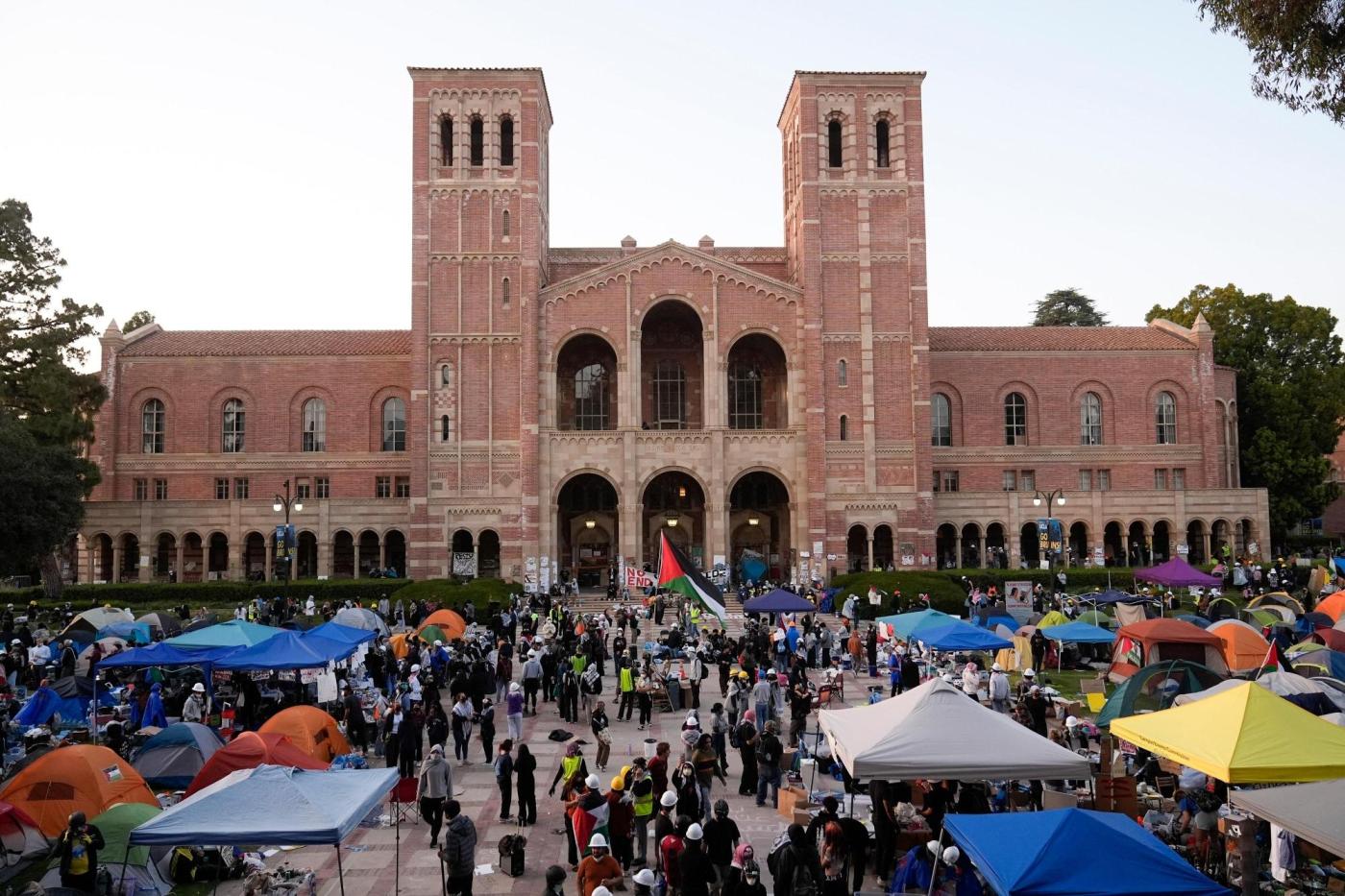
WASHINGTON (AP) — The Trump administration is pressing for a deal with Harvard University that would require the Ivy League school to pay far more than the $200 million fine agreed to by Columbia University to resolve multiple federal investigations, according to two people familiar with the matter.

Harvard would be expected to pay hundreds of millions of dollars as part of any settlement to end investigations into antisemitism at its campus, said the people, who spoke on the condition of anonymity to discuss internal deliberations. Harvard leaders have been negotiating with the White House even as they battle in court to regain access to billions in federal research funding terminated by the Trump administration.

The White House’s desire to get Harvard to pay far more than Columbia was first reported by The New York Times, which said the school has signaled a willingness to pay as much as $500 million.

Harvard did not immediately comment.

The Trump administration plans to use its deal with Columbia as a template for other universities, with financial penalties that are now seen as a staple for future agreements. Last week, Columbia leaders agreed to pay $200 million as part of a settlement to resolve investigations into alleged violations of federal antidiscrimination laws and restore more than $400 million in research grants.

Columbia had been in talks for months after the Trump administration accused the university of allowing the harassment of Jewish students and employees amid a wave of campus protests over the Israel-Hamas war. Harvard faces similar accusations but, unlike Columbia, the Cambridge, Massachusetts, school challenged the administration’s funding cuts and subsequent sanctions in court.

Last week, President Donald Trump said Harvard “wants to settle” but he said Columbia “handled it better.”

The Trump administration’s emphasis on financial penalties adds a new dimension for colleges facing federal scrutiny. In the past, civil rights investigations by the Education Department almost always ended with voluntary agreements and rarely included fines.

Even when the government has levied fines, they’ve been a small fraction of the scale Trump is seeking. Last year, the Education Department fined Liberty University $14 million after finding the Christian school failed to disclose crimes on its campus. It was the most the government had ever fined a university under the Clery Act, following a $4.5 million fine dealt to Michigan State University in 2019 for its handling of sexual assault complaints against disgraced sports doctor Larry Nassar.

Related Articles


Changes to federal student loans leave aspiring medical students scrambling to cover costs


Baby boomers now live next to 18-year-olds at colleges across US


These tips from experts can help your teenager navigate AI companions


Teens say they are turning to AI for friendship


For some employees, education benefits such as tuition assistance prove life-changing

The University of Pennsylvania agreed this month to modify school records set by transgender swimmer Lia Thomas, but that school’s deal with the Trump administration included no fine.

The Trump administration has opened investigations at dozens of universities over allegations of antisemitism or racial discrimination in the form of diversity, equity and inclusion policies. Several face funding freezes akin to those at Harvard, including more than $1 billion at Cornell University and $790 million at Northwestern University.

Last week, Education Secretary Linda McMahon called the Columbia deal a “roadmap” for other colleges, saying it would “ripple across the higher education sector and change the course of campus culture for years to come.”

The Associated Press’ education coverage receives financial support from multiple private foundations. AP is solely responsible for all content. Find AP’s standards for working with philanthropies, a list of supporters and funded coverage areas at AP.org.

Honolulu’s lawsuit against fossil fuel companies leads climate change legal fight

posted in: All news | 0

By JENNIFER SINCO KELLEHER

HONOLULU (AP) — Honolulu is not alone in its effort to sue fossil fuel companies to hold them accountable for climate change harms, but the city’s lawsuit is further along than similar litigation across the country. A hearing on Tuesday will indicate how these fights play out in court.

In 2020, Hawaii’s capital city sued major oil companies, including ExxonMobil, Shell and Chevron, arguing they knew for nearly half a century that fossil fuel products create greenhouse gas pollution that warms the planet and changes the climate. The companies have also profited from the consumption of oil, coal and natural gas while deceiving the public about the role of their products in causing a global climate crisis, the lawsuit says.

Honolulu’s lawsuit blames the companies for the sea level rise around the island of Oahu’s world-famous coastline. It also warns that hurricanes, heatwaves and other extreme weather will be more frequent, along with ocean warming that will reduce fish stocks and kill coral reefs that tourists love to snorkel over.

The lawsuit seeks an unspecified amount of damages. Attorneys and media representatives for most of the companies didn’t immediately respond to emails and phone messages from The Associated Press seeking comment on the lawsuit.

FILE – The AES Corporation coal-fired power plant in Kapolei, Hawaii, is seen during a ceremony to mark the closure of the facility on Aug. 18, 2022. (AP Photo/Caleb Jones, File)

ConocoPhillips and Phillips 66 representatives sent emails saying they don’t comment on pending litigation.

A hearing is scheduled in state court on Tuesday for a defense motion that argues the lawsuit should be dismissed because the state’s two-year statute of limitations expired. Honolulu’s claims are based on allegations that have been publicly known for decades, the defense motion for summary judgment says.

“The issue of climate change and how to tackle it has long been part of public discussion and ongoing scientific research and debate for many decades,” a Shell spokesperson said in an email. “There is a vast public record of media articles, scientific journals and government reports for well over 50 years that make this clear. The suggestion that the plaintiffs were somehow unaware of climate change is simply not credible.”

While the case is still far from trial, it’s much closer than some 30 similar lawsuits nationwide brought by other states, cities and counties. Lawyer arguments and the judge’s questions on Tuesday will give a sense of how both sides will present their cases, said Michael Gerrard, founder and faculty director of the Columbia University Sabin Center for Climate Change Law.

“The first trial in any of these cases will be very significant,” he said. “It will get a large amount of nationwide or even global attention because the oil companies have not yet had to take the stand and defend themselves in a trial.”

Related Articles


With AI plan, Trump keeps chipping away at a foundational environmental law


Trump Environmental Protection Agency moves to repeal finding that allows climate regulation


Trump’s AI plan calls for massive data centers. Here’s how it may affect energy in the US


Philanthropist Wendy Schmidt insists science and immersive media can inspire action for the planet


Smoky air from Canadian wildfires descends on Minnesota through Friday

Honolulu’s lawsuit has reached this hearing stage, partly because the Hawaii Supreme Court denied motions to dismiss it, and the U.S. Supreme Court refused to take it on.

Meanwhile, a similar lawsuit by Maui County, where a massive wildfire nearly two years ago burned down most of Lahaina and killed 102 people, is on hold.

The state of Hawaii has also filed a similar suit, despite the U.S. Department of Justice in May suing Hawaii and Michigan over their plans for legal action against fossil fuel companies, claiming their climate actions conflict with federal authority and President Donald Trump’s energy dominance agenda.

Hawaii’s attorney general’s office filed a motion last week seeking to stop the Department of Justice’s federal lawsuit: “Allowing this case to proceed would give the United States license to wield the federal courts as a weapon against any litigation between nonfederal parties that an incumbent presidential administration dislikes.”

Honolulu’s lawsuit has drawn the attention of Naomi Oreskes, a prominent Harvard University science history professor, who submitted a declaration in a motion opposing the defendants’ motion for summary judgment.

Oreskes drew parallels between the fossil fuel and tobacco industries. “The fossil fuel industry and its allies and surrogates created an organized campaign to foster and sustain doubt about anthropogenic global warming and prevent meaningful action,” she wrote. “They did this by influencing consumers and the general public.”

Soon before a lawsuit by a group of youths against Hawaii’s transportation department was scheduled to go to trial, both sides settled the case last year, agreeing on an ambitious requirement to achieve zero greenhouse gas emissions across all transportation modes no later than 2045.