By Rick VanderKnyff, NerdWallet
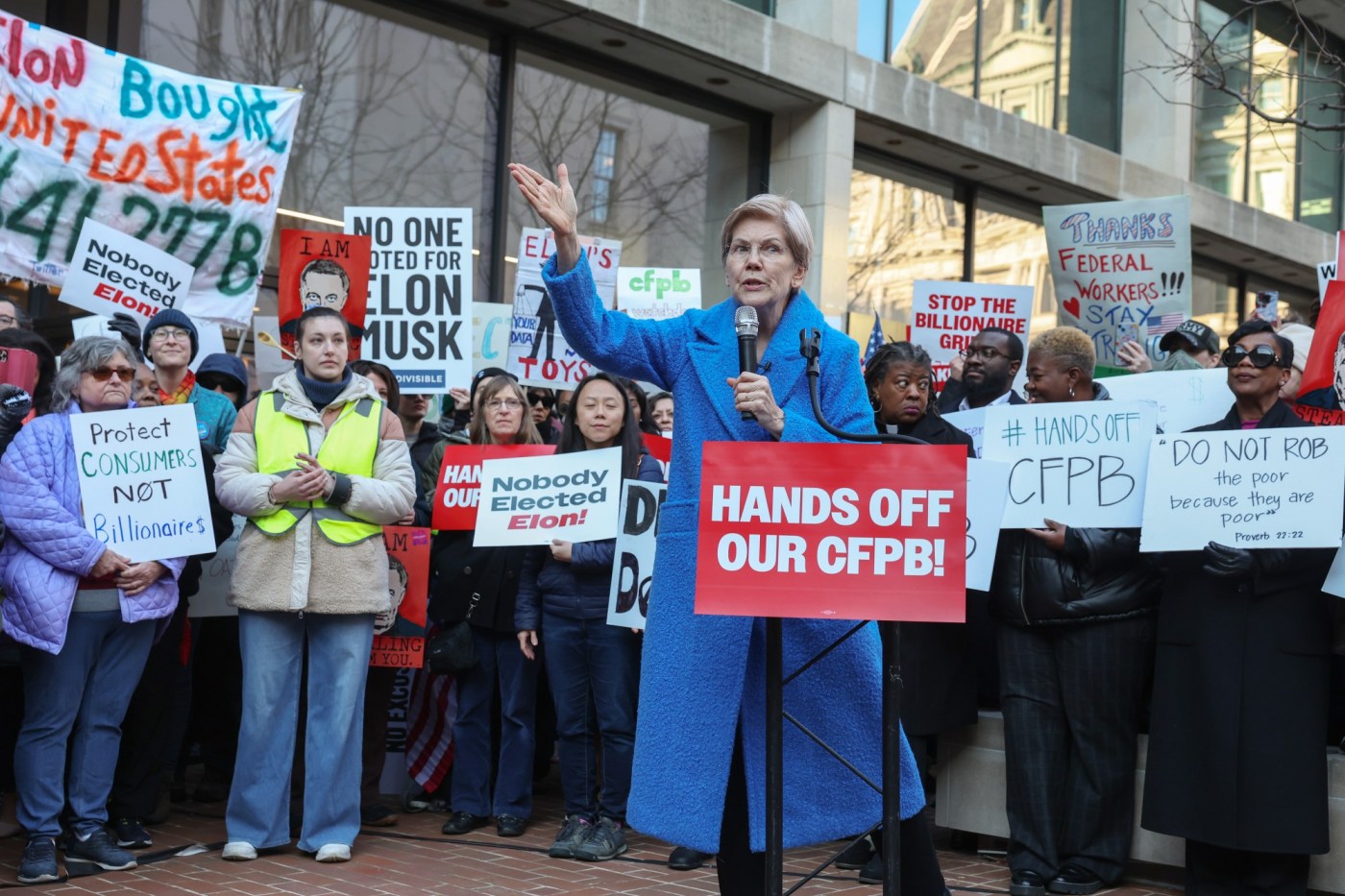
“CFPB RIP” was Elon Musk’s tweet on Feb. 7, when the billionaire was slashing his way through federal agencies at the behest of his then-ally, President Donald Trump.
Rohit Chopra, former director of the Consumer Financial Protection Bureau, had been fired Feb. 1. By Feb. 3, new acting director (and also, new Treasury Secretary) Scott Bessent had ordered CFPB staff to stop all rule-making and enforcement actions, among other activities.
A second acting director, Russell Vought — who also leads the Office of Management and Budget under Trump — took over the agency days later. Vought was a co-author of Project 2025, the conservative governing blueprint, which stated that “the next conservative President should order the immediate dissolution of the agency.”
Congress established the CFPB with the Dodd-Frank Act in 2010, in the wake of the 2008 economic crisis. One of its goals was to strengthen and consolidate consumer protection powers that had been spread across multiple government agencies, and the bureau was structured to be shielded from political interference.
“The consumer bureau’s statutory obligations are designed to make markets for consumer financial products and services work in a fair, transparent, and competitive manner,” Sen. Elizabeth Warren, who was instrumental in the bureau’s formation, wrote in 2011.
Since its creation, the watchdog agency has brought about the return of more than $21 billion to more than 200 million consumers who were found to be victims of malfeasance by financial service companies.
Republicans and many banking officials, though, have long accused the agency of overreach.
Criticism spiked under Chopra’s leadership during former President Joe Biden’s administration. In a 2022 letter to Chopra, members of the Senate Committee on Banking, Housing, and Urban Affairs called the CFPB “a lawless and unaccountable agency” that was “pursuing a radical and highly-politicized agenda unbounded by statutory limits.”
The Project 2025 “Mandate for Leadership,” in calling for the CFPB’s elimination, characterized it as “a shakedown mechanism to provide unaccountable funding to leftist nonprofits politically aligned with those who spearheaded its creation.”
In the weeks after Trump’s return to the presidency, it looked like critics might finally see the agency fully dismantled. But the agency still stands, at least in name. Its immediate and long-term future remain cloudy at best, however, to the concern of consumer advocates.
“We are at a pivotal moment for all that was, all that has been and what could be,” says Amanda Jackson, director of consumer campaigns for Americans for Financial Reform, a nonprofit group focused on financial equity. “The CFPB has done tremendous work since its inception.”
“We’re seeing the agency pull back from prior commitments and that hurts everyone,” Jackson continues. “So it is a concerning moment. It’s what we spend a lot of time calling attention to — the integrity of the bureau, the fact that the bureau has done so much work — and all that, we are seeing, is being chipped away.”
The CFPB media office did not respond to multiple requests for comment from NerdWallet.
What’s keeping the CFPB on life support?
Soon after Trump took office, the CFPB issued layoff notices to more than 1,400 staffers, which would have left a staff of about 200. The CFPB’s union quickly filed suit to block the action, and in April, a U.S. District Court judge paused the layoffs. The Trump administration quickly appealed the ruling. For now, the pause remains in place.
In May, the U.S. Supreme Court rejected a challenge to the CFPB’s funding mechanism, reversing an earlier decision by an appeals court in Louisiana.
When the CFPB was established, Congress opted to have it funded via allocation from the Federal Reserve. This was a move to shield it from politicization in the annual congressional budget cycle. But critics have long called the funding mechanism unconstitutional.
Asked on Reddit: How do I recover from a big money mistake?
Grad school debt holding you back? How to get it under control
8 major student loan changes from Trump’s budget bill: Next steps for borrowers
For some employees, education benefits such as tuition assistance prove life-changing
Ready to retire in 5 years? Here’s your checklist
Congress did manage to trim the bureau’s funding cap by almost half in the “big, beautiful bill” passed and signed into law in early July. The bill cut the CFPB’s available funding to 6.5% of the Federal Reserve’s operating expenses, down from 12%, the limit that has been in place since the agency’s founding.
The cut has no immediate effect, as CFPB’s current leadership has shown no inclination to request funding even at the new limit, and at one point explored returning the bureau’s current balance to the Federal Reserve. But the cut will hamstring the ability of future administrations to restore the CFPB’s previous regulatory and investigative functions.
“Slashing the CFPB’s budget nearly in half will severely compromise its ability to stand up for consumers and take on big banks and unscrupulous financial firms when they cheat working families out of their hard-earned money,” said Chuck Bell, advocacy program director at Consumer Reports, in a prepared statement.
Meanwhile, House Republicans forwarded bills aiming to limit numerous aspects of the CFPB’s work, and more broadly aspects of the 2010 Dodd-Frank Act that created the bureau. Americans for Financial Reform helped organize opposition to the legislation with a detailed letter signed by 68 civic and community organizations, and in the end, the bills did not advance before the House went into summer recess.
“So the wins are incremental, but they are there,” Jackson, of Americans for Financial Reform, says.
What about the consumer complaint database?
By statute, the CFPB receives and responds to complaints from consumers about financial products and services. To date, the CFPB has received more than 2.8 million complaints in 2025, and all signs indicate that CFPB staff continue to monitor and respond to these complaints.
The CFPB site shows the following status for 2025 complaints filed through July 22:
Closed with explanation: 1,133,034.
Closed with non-monetary relief: 982,712.
Closed with monetary relief: 11,648.
In progress: 694,300.
Untimely response: 6,517.
Those percentages are roughly in line with figures reported for 2024.
The complaint database “is still active,” says Jackson. “It is something we too are trying to make sure remains active. We have not heard of reports from actual consumers that counter that.”
But the status of the complaint process and database is something her organization is monitoring.
The CFPB began receiving and acting on consumer complaints in 2011. Complaint volume began to accelerate during the pandemic and continues to spike in 2025. Volume did drop temporarily in February of this year — after the CFPB posted a 404 error on its home page for several weeks, at the behest of Vought — but recovered in March.
The vast majority of complaints to the CFPB in 2025 involve credit reporting, mirroring figures in 2024.
What else has the CFPB done in 2025?
The more appropriate question might be: What has the CFPB undone?
Under Vought, the CFPB has dropped numerous lawsuits against financial services companies. Those cases were dismissed “with prejudice,” which means the CFPB forfeited the right to sue over the same claims again in the future.
This has included cases against such companies as: payment company Zelle and three of its owners (Bank of America, JPMorgan and Wells Fargo); Capital One; student loan servicer Pennsylvania Higher Education Assistance Agency; and credit reporting agency TransUnion.
Most recently, on July 1, the CFPB moved to withdraw from a $95 million settlement reached in 2024 with Navy Federal Credit Union related to overdraft fees. Under the settlement, the credit union would have refunded $80 million to affected service members, in addition to paying a $15 million fine.
This came despite an April 16 memo to staff stating that the bureau would “focus its enforcement and supervision resources on pressing threats to consumers, particularly service members and their families, and veterans.”
That memo announced that the agency would refocus its attention on banks and other depository institutions rather than “nonbanks.” The memo also said the agency would deprioritize medical debt, student loans, digital payments and peer-to-peer platforms and lending, areas that the Biden-era CFPB had focused on.
In May, the CFPB took a slew of actions to rescind rules set under the previous administration, and to withdraw more than 60 guidance documents, including policy statements and advisory opinions, some of which dated to the bureau’s inception.
Other earlier CFPB rule changes have been undercut by court decisions and congressional action, including a rule finalized in the waning days of the Biden administration but never put into effect that would have banned the inclusion of medical debt on credit reports. A judge ruled against the medical-debt ban on July 11, likely sealing its fate.
The CFPB under Biden had also finalized a rule to limit the overdraft fees that banks can charge. Likewise, the rule never went into effect and was reversed in April by Congress. And, the CFPB had moved in May 2024 to treat “Buy Now, Pay Later” lenders as credit card providers, extending greater protection to consumers of those products. The current CFPB announced in May that it would not prioritize enforcement actions against BNPL providers.
On July 11, the current CFPB did announce a settlement with FirstCash, Inc., a pawnshop operator, which is alleged to have issued loans exceeding the maximum annual rate of 36%. Under the agreement, the defendants will pay $4 million to the CFPB victim’s relief fund and set aside an additional $5 million to address future claims.
The CFPB still has no permanent director. Trump had nominated attorney Jonathan McKernan in early May, but withdrew the nomination days later. Vought continues to serve as acting director.
What does it all mean for consumers?
For now at least, the CFPB’s complaint database remains a viable way for consumers to address issues. In addition, states may pick up some of the work that the current CFPB is walking away from.
In the end, though, consumers may need to do more to advocate on their own behalf as federal oversight of the financial services industry erodes.
Jackson worries, however, that the diminution of the CFPB’s watchdog role will fall hardest on communities that are already at greater risk of financial predation.
“I want to name what that means for communities of color and our military personnel,” Jackson says. “This attack on the bureau is an attack on those people.”
Rick VanderKnyff writes for NerdWallet. Email: rvanderknyff@nerdwallet.com.
The article The CFPB Is Still Standing … Barely. But Is It Doing Anything? originally appeared on NerdWallet.