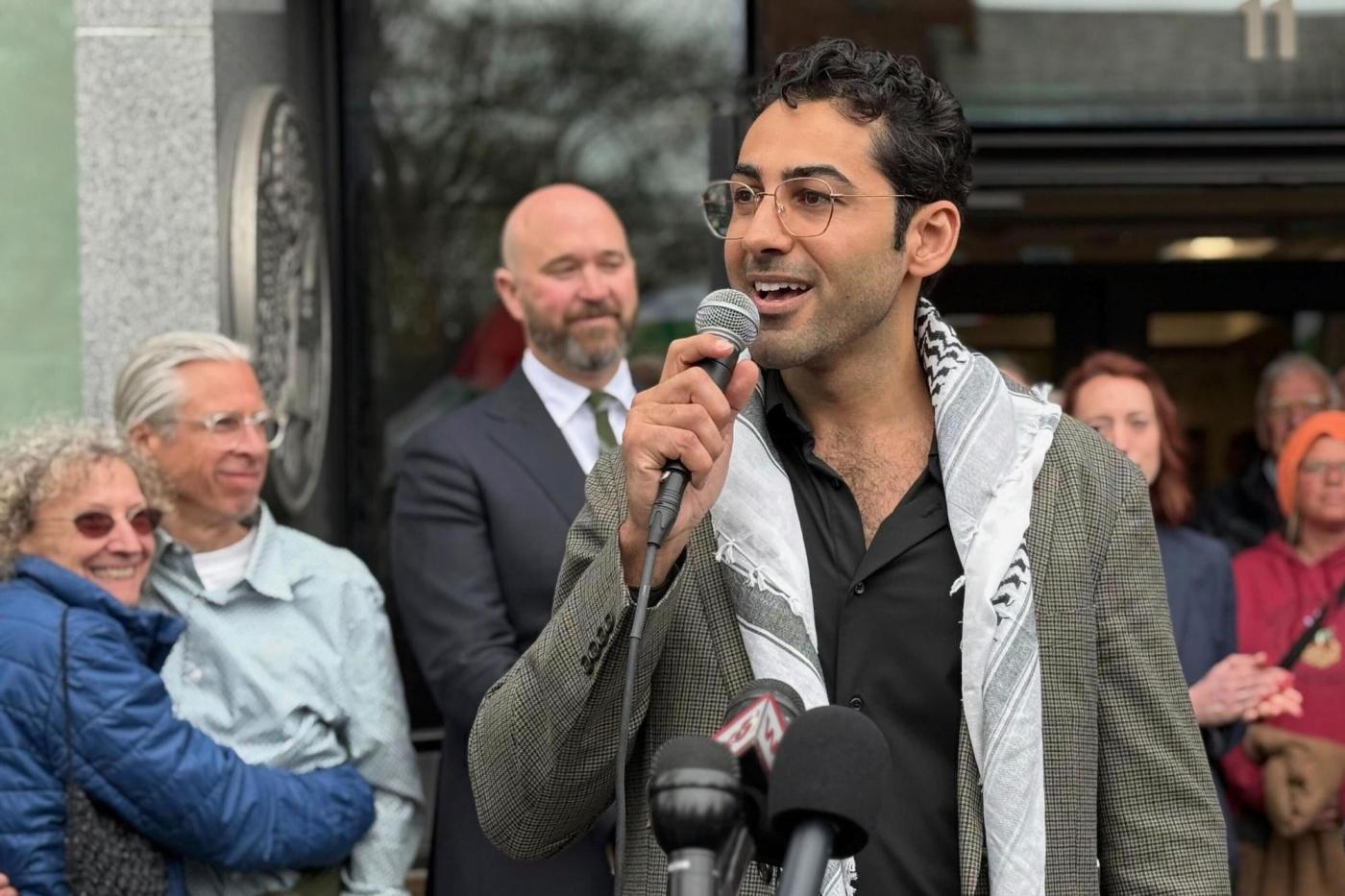
Everything Zohran Mamdani Did on Housing During His First Days as Mayor

posted in: All news | 0

Following his inauguration Thursday, Mayor Zohran Mamdani issued an executive order to revitalize the Mayor’s Office to Protect Tenants and announced a series of upcoming public hearings for renters across the city to air their grievances.

Mamdani in the lobby of an apartment building in Brooklyn on his first day in office, where he announced plans to restore the Mayor’s Office to Protect Tenants. (Michael Appleton/Mayoral Photography Office).

Housing was the first item on Mayor Zohran Mamdani’s checklist after he was sworn into office Thursday.

Standing in the lobby of a Brooklyn apartment building—where residents have been organizing for the city to intervene on their behalf, after their violation-riddled homes went up for bankruptcy auction—the new mayor pledged “to champion the cause of tenants too long ignored and homes too expensive.”

“On the day where so many rent payments are due, we will not wait to deliver action,” said Mamdani, speaking on Jan 1. “And we will stand up on behalf of the tenants of this city.”

It was a fitting first-day press conference for the new mayor, who campaigned for the last year on a promise to freeze rents for tenants in the city’s roughly 1 million rent stabilized apartments.

Here’s a rundown of what Mamdani did on housing during his first five days in office:

Revamping the Mayor’s Office to Protect Tenants

The new mayor signed an executive order to “revive” the office, which was launched by former Mayor Bill de Blasio in 2019 but was largely dormant during Mayor Eric Adams’ administration, according to reporting from the Real Deal.

Under his administration, the Mayor’s Office to Protect Tenants will serve as a coordinating body to defend tenants rights and ensure habitable building conditions, Mamdani said. He appointed tenant organizer Cea Weaver to lead the office.

“The affordability agenda starts with the rent,” said Weaver, who emphasized that 70 percent of New Yorkers are renters.

Weaver previously ran the nonprofit Housing Justice for All, and helped lead the fight to pass the Housing Stability and Tenant Protection Act in 2019, which strengthened New York’s rent regulation laws.

She gave City Limits some insight into how she might lead the office during an interview last month.

“We are going to hold you accountable to operating [affordable housing] alongside the housing maintenance code. If you can’t do that, we are going to offer you money so that you can do it, but you have to make the homes affordable,” Weaver said. “And if you still don’t do it, we’re going to take it away from you. Making that pipeline more clear is what I hope the Mayor’s Office of Tenant Protection can do.”

Task forces focused on housing production

Mamdani signed two other executive orders on his first day establishing new task forces to help speed up residential construction, as the city faces its worst housing shortage in several decades.

Newly-appointed Deputy Mayor for Housing and Planning Leila Bozorg will oversee both efforts. The first will spend the next six months reviewing all city-owned properties to identify those where new housing could go. This will be “a deeper dive into the entire city’s inventory,” than previous, similar efforts, Bozorg said.

“Especially for sites that aren’t clearly available for housing right now,” she said. “So they may already have other city facilities on them, other public facilities or even private facilities that we’re in contract for.”

The second task force will work to remove bureaucratic and permitting barriers that increase housing costs and slow construction, according to the mayor.

Mamdani announcing Dina Levy, right, as his housing commissioner on Sunday. (Ed Reed/Mayoral Photography Office)

Citywide public hearings for renters

On Sunday, Mamdani announced a series of upcoming public hearings focused on getting feedback from renters across the five boroughs.

“New Yorkers will be invited to participate and to share the realities that animate their daily lives,” he said. “I want these hearings to expose the ugly underbelly of our city. The rats that scurry through hallways. The children that shiver in their beds in the dead of winter because the heat is off.”

The so-called “Rental Ripoff” hearings will take place over roughly the next three months—the new administration’s first 100 days. They will be led by the city’s Department of Housing Preservation and Development (HPD) alongside several other agencies, and officials will use what they hear “to craft policy recommendations that we will then implement and deliver across the city,” Mamdani said.

“These are hearings that will give New Yorkers an opportunity to testify in person as to the struggles that they have had to deal with, oftentimes in isolation,” he told reporters.

At the same Sunday press conference, Mamdani announced the appointment of Dina Levy as the new commissioner at HPD, the agency that oversees both the city’s new affordable housing production and enforces the housing maintenance code in existing buildings.

Levy, a longtime housing and tenant organizer, most recently served as the Senior Vice president of homeownership and community development at Homes and Community Renewal (HCR), New York State’s affordable housing agency. 

“The work ahead will be hard,” Levy said Sunday. “We will need to increase the resources to build more affordable housing. We will need to try new innovative and sometimes scary innovations in order to overcome this crisis. And in many respects, we will need to embrace a willingness to rethink how we do business.”

Intervening on behalf of Pinnacle Tenants

Mamdani’s first press conference as mayor last week was hosted at a Prospect Lefferts Gardens building owned by Pinnacle Group, part of portfolio of 93 rent stabilized buildings that are in bad condition and up for a bankruptcy auction.

As City Limits previously reported, Pinnacle tenants have been calling for the city to preserve their buildings’ affordability and help them address dire maintenance issues, including 5,000 open housing code violations.

Mamdani tours an apartment at a Brooklyn building previously owned by the Pinnacle Group, and now in bankruptcy. (Michael Appleton/Mayoral Photography Office)

Mamdani promised to answer that call, directing Steve Banks—the new administration’s recently appointed top lawyer, who previously served as the homeless services commissioner under de Blasio—to intervene in the auction on behalf of both tenants’ and the city’s interests.

How exactly that might play out isn’t entirely clear yet. Banks pointed to an earlier bankruptcy case he worked on in the late 1980s and early 1990s on behalf of the city and the Legal Aid Society, which involved two Manhattan buildings being used as homeless shelters. They were able to convert those properties into two permanently affordable apartment buildings, he said.

“That kind of creativity resides within the Law Department,” Banks told reporters. “We will be working with the Law Department lawyers to do what is in the best interest of New Yorkers in that bankruptcy case, the same as so many years ago, we came up with a pathway forward when people said it was not possible.”

To reach the reporter behind this story, contact Patrick@citylimits.org. To reach the editor, contact Jeanmarie@citylimits.org

Want to republish this story? Find City Limits’ reprint policy here.

The post Everything Zohran Mamdani Did on Housing During His First Days as Mayor appeared first on City Limits.

EPA says it will propose drinking water limit for perchlorate, but only because court ordered it

posted in: All news | 0

By MICHAEL PHILLIS

WASHINGTON (AP) — The Environmental Protection Agency on Monday said it would propose a drinking water limit for perchlorate, a harmful chemical in rockets and other explosives, but also said doing so wouldn’t significantly benefit public health and that it was acting only because a court ordered it.

The agency said it will seek input on how strict the limit should be for perchlorate, which is particularly dangerous for infants, and require utilities to test. The agency’s move is the latest in a more than decade-long battle over whether to regulate perchlorate. The EPA said that the public benefit of the regulation did not justify its expected cost.

“Due to infrequent perchlorate levels of health concern, the vast majority of the approximately 66,000 water systems that would be subject to the rule will incur substantial administrative and monitoring costs with limited or no corresponding public health benefits as a whole,” the agency wrote in its proposal.

Perchlorate is used to make rockets, fireworks and other explosives, although it can also occur naturally. At some defense, aerospace and manufacturing sites, it seeped into nearby groundwater where it could spread, a problem that has been concentrated in the Southwest and along sections of the East Coast.

Perchlorate is a concern because it affects the function of the thyroid, which can be particularly detrimental for the development of young children, lowering IQ scores and increasing rates of behavioral problems.

Based on estimates that perchlorate could be in the drinking water of roughly 16 million people, the EPA determined in 2011 that it was a sufficient threat to public health that it needed to be regulated. Under the Safe Drinking Water Act, this determination required the EPA to propose and then finalize regulations by strict deadlines, with a proposal due in two years.

It didn’t happen. First, the agency updated the science to better estimate perchlorate’s risks, but that took time. By 2016, the nonprofit Natural Resources Defense Council sued to force action.

During the first Trump administration, the EPA proposed a never-implemented standard that the NRDC said was less restrictive than any state limit and would lead to IQ point loss in children. It reversed itself in 2020, saying no standard was necessary because a new analysis had found the chemical was less dangerous and its appearance in drinking water less common than previously thought.

That’s still the agency’s position. It said Monday that its data shows perchlorate is not widespread in drinking water.

Related Articles


How Trump’s first year reshaped U.S. energy and climate policy


A study is retracted, renewing concerns about the weedkiller Roundup


DNR approves exploratory drilling near Boundary Waters


Christmas is over, but what to do with the tree? These landfill alternatives can also help your garden


Save money, get organized, live better: Common New Year’s resolutions can also cut climate impact

“We anticipate that fewer than one‑tenth of 1% of regulated water systems are likely to find perchlorate above the proposed limits,” the agency said. A limit will help the small number of places with a problem, but burden the vast majority with costs they don’t need, officials said.

The NRDC challenged that reversal and a federal appeals court said the EPA must propose a regulation for perchlorate, arguing that it still is a significant and widespread public health threat. The agency will solicit public comment on limits of 20, 40 and 80 parts per billion, as well as other elements of the proposal.

“Members of the public deserve to know whether there’s rocket fuel in their tap water. We’re pleased to see that, however reluctantly, EPA is moving one step closer to providing the public with that information,” said Sarah Fort, a senior attorney with NRDC.

EPA Administrator Lee Zeldin has sought massive rollbacks of environmental rules and promoted oil and gas development. But on drinking water, the agency’s actions have been more moderate. The agency said it would keep the Biden administration’s strict limits on two of the most common types of harmful “forever chemicals” in drinking water, while giving utilities more time to comply, and would scrap limits on other types of PFAS.

The Associated Press receives support from the Walton Family Foundation for coverage of water and environmental policy. The AP is solely responsible for all content. For all of AP’s environmental coverage, visit https://apnews.com/hub/climate-and-environment

Stillwater man sentenced for sexually assaulting vulnerable adult

posted in: All news | 0

ROCHESTER — A Stillwater man was given probation for sexually assaulting a vulnerable adult in 2021.

Harold David Short, 60, pleaded guilty to a felony charge of fifth-degree criminal sexual conduct on Jan. 23, 2024.

According to court records, a witness contacted the Rochester Police Department and said Short had picked up the woman from a group home in Burnsville and brought her to St. Paul, Stillwater, Rochester and Alma, Wisconsin. The woman later told investigators Short had injected her with methamphetamine and then sexually assaulted her at a home in southwest Rochester in late December 2021.

Short later dropped the victim off at the Southeast Regional Crisis Center on Dec. 30, 2021.

The woman’s guardian told law enforcement that the woman has the mental capacity of someone between 11 and 14 years old.

Felony charges of third-degree criminal sexual conduct and using drugs to facilitate a crime were dismissed in the plea. Short was scheduled to be sentenced in April 2024, but failed to appear for the hearing.

Short was given four years of probation with a suspended sentence of 16 months in prison and credited with 72 days in jail.

Related Articles


Maduro and his wife to be arraigned in Manhattan Federal Court


Erwin Chemerinsky: The Supreme Court finally pushed back against Trump


Second man sentenced in St. Paul shooting death apparently sparked by jealousy


Strip citizenship, deport fraudsters? UMN professor says process lengthy, up to courts


Bitcoin Depot ATM network sues St. Paul, Stillwater for banning cryptocurrency kiosks

PFF grades from the Vikings’ win over the Packers: J.J. McCarthy didn’t finish the game

posted in: All news | 0

What did Pro Football Focus think of how the Vikings performed on Sunday afternoon at U.S. Bank Stadium? Here’s a look at the player grades from the Vikings’ 16-3 win over the Green Bay Packers:

Top 3 on offense (minimum 20 snaps)

Ben Yurosek … 90.4

Justin Jefferson … 88.8

Jordan Mason … 73.7

Analysis: It’s no surprise that Jefferson scored very high across his snaps considering he was a focal point of the offense. The fact that Yurosek finished with the highest grade on offense in an increased role speaks to his potential. It wasn’t a horrible showing from J.J. McCarthy (61.4). He just wasn’t able to finish the game, which, in turn, left a sour taste in everybody’s mouth given his continued struggles with staying on the field.

Bottom 3 on offense (minimum 20 snaps)

Max Brosmer … 35.7

Jordan Addison … 56.1

Ty Chandler … 59.3

Analysis: If anything is clear about Brosmer, is that he can’t be the backup moving forward. He’s very much a project that needs more time to learn the ropes. He lost a fumble in the game in egregious fashion. He fell to the ground, thought he was down, then got the ball knocked out after standing up. As for Addison, he finished a disappointing campaign on a low note, which is fitting considering his body of work from this season.

Top 3 on defense (minimum 20 snaps)

Andrew Van Ginkel … 89.8

Byron Murphy Jr. … 77.4

Theo Jackson … 74.9

Analysis: The standout performances from Van Ginkel, Murphy, and Jackson were highlights from a dominant display on defense. It’s hard to put too much stock into the game itself, however, because it was mostly backups and reserves on the other end.

Bottom 3 on defense (minimum 20 snaps)

Levi Drake Rodriguez … 37.0

Eric Wilson … 52.8

Javon Hargrave … 57.4

Analysis: It feels aggressive to give anybody as low of a grade as Rodriguez given the way the defense played. It was deemed that he wasn’t up to the task as a run defender. As for Wilson, he struggled in coverage, even if he continued to be a beast as a pass rusher.

Related Articles


Takeaways from the Vikings’ 16-3 win over the Packers


Here’s who the Vikings will play during the 2026 season


Shipley: J.J. McCarthy didn’t make a good case to be the Vikings’ starter


Vikings beat undermanned Packers to finish above .500


Vikings star Justin Jefferson eclipses 1,000 yards to keep his streak alive