Overtime and shootout rules at the Olympics change as the tournament unfolds

posted in: All news | 0

By STEPHEN WHYNO, AP Hockey Writer

MILAN (AP) — Three of the four men’s hockey quarterfinal games Wednesday going past regulation provided a reminder of how overtime rules work at the Olympics.

Canada beat Czechia 82 seconds into 3-on-3 overtime. Finland also tied it late and needed more than three minutes to defeat Switzerland. The U.S. allowed a goal with 91 seconds left in the third period before beating Sweden on Quinn Hughes’ OT goal.

Switzerland’s Leonardo Genoni (63) concedes the second goal during a men’s ice hockey quarterfinal game between Finland and Switzerland at the 2026 Winter Olympics, in Milan, Italy, Wednesday, Feb. 18, 2026. (AP Photo/Petr David Josek)

U.S. coach Mike Sullivan and his staff talked to players about International Ice Hockey Federation overtime rules.

“We did address overtime at the start of this tournament because we felt at some point it was going to play a role,” Sullivan said. “As a coaching staff, we prepared for that. We had a video session on it.”

The rules to decide games change as the tournament unfolds.

Group play is like the NHL

All of the round-robin games on the men’s and women’s sides follow NHL rules: 5 minutes of 3-on-3 OT, followed by a shootout. One change is that the shootout is five rounds at a minimum, whereas the NHL has three.

American T.J. Oshie’s shootout heroics to beat host Russia in Sochi is among the most memorable moments of it since the league began participating in 1998. That year, Czech goaltender Dominik Hasek also famously eliminated Canada in a shootout, in which coach Marc Crawford infamously did not choose Wayne Gretzky as one of his five shooters.

There was only one group play shootout in Milan: Switzerland’s women’s team beating Czechia.

The knockout round brings longer overtime

In the single-elimination knockout round from the qualification playoff and the quarterfinals into the semifinals and the bronze medal game, teams play 10 minutes of 3 on 3 before going to a shootout, also with a minimum of five skaters each.

Related Articles


Olympic curling: Team Peterson hammers home first medal-round berth


Hockey star Laila Edwards’ family cheers at Olympic debut, thanks to Kelce brothers and a GoFundMe


US hockey star Haley Winn’s three older brothers are her biggest fans online and at the rink


Olympic men’s hockey: Wild’s Hughes is OT hero as U.S. beats Sweden


Olympic women’s hockey: Dream final ahead between U.S., Canada

Mitch Marner won it for Canada on Wednesday skating through three defenders before backhanding the puck into the net.

“I don’t know what favors us or doesn’t favor us, we’ve obviously got some pretty good speed and skill,” Canada’s Tom Wilson said. “If it’s 5 on 5, I hope that would play to our skills, but also, I mean it doesn’t matter to me. I’m not paid to do the rules. I’m here to play hockey and help this country win any way I can.”

Gold medal game can no longer be decided by a shootout

When the U.S. beat Canada in the women’s final in 2018 in South Korea, they did so in a thrilling shoutout. That’s no longer possible.

The gold medal game now moves closer to what the NHL uses: sudden-death, until someone scores a goal, but 3 on 3 instead of 5 on 5 like the Stanley Cup playoffs.

___

AP Winter Olympics: https://apnews.com/hub/milan-cortina-2026-winter-olympics

Former South Korean president receives life sentence for imposing martial law in 2024

posted in: All news | 0

By KIM TONG-HYUNG

SEOUL, South Korea (AP) — Former South Korean President Yoon Suk Yeol was found guilty of leading an insurrection on Thursday and sentenced to life in prison for his brief imposition of martial law in 2024, a ruling that marks a dramatic culmination of the country’s biggest political crisis in decades.

The conservative leader was ousted from office after he declared martial law and sent troops to surround the National Assembly on Dec. 3, 2024, in a baffling attempt to overcome a legislature controlled by his liberal opponents.

Judge Jee Kui-youn of the Seoul Central District Court said he found Yoon, 65, guilty of rebellion for mobilizing military and police forces in an illegal attempt to seize the Assembly, arrest political opponents and establish unchecked power for an indefinite period.

Martial law crisis recalled dictatorial past

Yoon’s martial law imposition, the first of its kind in more than four decades, recalled South Korea’s past military-backed governments when authorities occasionally proclaimed emergency decrees that allowed them to station soldiers, tanks and armored vehicles on streets or in public places such as schools to prevent anti-government demonstrations.

As lawmakers rushed to the National Assembly, Yoon’s martial law command issued a proclamation declaring sweeping powers, including suspending political activities, controlling the media and publications, and allowing arrests without warrants.

The decree lasted about six hours before being lifted after a quorum of lawmakers managed to break through a military blockade and unanimously voted to lift the measure.

Yoon was suspended from office on Dec. 14, 2024, after being impeached by lawmakers and was formally removed by the Constitutional Court in April 2025. He has been under arrest since last July while facing multiple criminal trials, with the rebellion charge carrying the most severe punishment.

Yoon’s lawyers reject conviction

An expressionless Yoon gazed straight ahead as the judge delivered the sentence in the same courtroom where former military rulers and presidents have been convicted of treason, corruption and other crimes over the decades.

Yoon Kap-keun, one of the former president’s lawyers, accused the judge of issuing a “predetermined verdict” based solely on prosecutors’ arguments and said the “rule of law” had collapsed. He said he would discuss whether to appeal with his client and the rest of the legal team.

Former President Yoon claimed in court that the martial law decree was only meant to raise public awareness of how the liberals were paralyzing state affairs, and that he was prepared to respect lawmakers if they voted against the measure.

Related Articles


The former Prince Andrew went from helicopter pilot to trade envoy to royal pariah


Trump gets pledges for Gaza reconstruction and troop commitments at inaugural Board of Peace talks


Iran holds more drills and US carrier nears Mideast in latest preparations for possible war


Clashes in the West Bank kill a 19-year-old Palestinian-American, Palestinian officials say


UK’s former Prince Andrew arrested: Read the statements in full from the police and King Charles

Prosecutors said it was clear Yoon was attempting to disable the legislature and prevent lawmakers from lifting the measure through voting, actions that exceeded his constitutional authority even under martial law.

The court also convicted and sentenced five former military and police officials involved in enforcing Yoon’s martial law decree. They included ex-Defense Minister Kim Yong Hyun, who received a 30-year jail term for his central role in planning the measure, mobilizing the military and instructing military counterintelligence officials to arrest 14 key politicians, including National Assembly speaker Woo Won-shik and current liberal President Lee Jae Myung.

In announcing Yoon and Kim’s verdicts, Jee said the decision to send troops to the National Assembly was key to his determination that the imposition of martial law amounted to rebellion.

“This court finds that the purpose of (Yoon’s) actions was to send troops to the National Assembly, block the Assembly building and arrest key figures, including the National Assembly speaker and the leaders of both the ruling and opposition parties, in order to prevent lawmakers from gathering to deliberate or vote,” Jee said. “It’s sufficiently established that he intended to obstruct or paralyze the Assembly’s activities so that it would be unable to properly perform its functions for a considerable period of time.”

Protesters rally outside court

As Yoon arrived in court, hundreds of police officers watched closely as Yoon supporters rallied outside a judicial complex, their cries rising as the prison bus transporting him drove past. Yoon’s critics gathered nearby, demanding the death penalty.

There were no immediate reports of major clashes following the verdict.

A special prosecutor had demanded the death penalty for Yoon Suk Yeol, saying his actions posed a threat to the country’s democracy and deserved the most serious punishment available, but most analysts had expected a life sentence since the poorly-planned power grab did not result in casualties.

South Korea has not executed a death row inmate since 1997, in what is widely seen as a de facto moratorium on capital punishment amid calls for its abolition.

Jung Chung-rae, leader of the liberal Democratic Party, which led the push to impeach and remove Yoon, expressed regret that the court stopped short of the death penalty, saying the ruling reflected a “lack of a sense of justice.”

Song Eon-seok, floor leader of the conservative People Power Party, to which Yoon once belonged, issued a public apology, saying the party feels a “deep sense of responsibility” for the disruption to the nation.

The office of current President Lee Jae Myung did not immediately comment on the ruling.

Other officials sentenced for enforcing martial law

Last month, Yoon was sentenced to five years in prison for resisting arrest, fabricating the martial law proclamation and sidestepping a legally mandated full Cabinet meeting before declaring the measure.

The Seoul Central Court had previously convicted two other members of Yoon’s Cabinet in connection with the martial law debacle. That includes Prime Minister Han Duck-soo, who received a 23-year prison sentence for attempting to legitimize the decree by forcing it through a Cabinet Council meeting, falsifying records and lying under oath. Han has appealed the verdict.

Yoon is the first former South Korean president to receive a life sentence since former military dictator Chun Doo-hwan, who was sentenced to death in 1996 for his 1979 coup, a bloody 1980 crackdown on pro-democracy protesters in Gwangju that left more than 200 people dead or missing, and corruption.

The Supreme Court later reduced his sentence to life imprisonment, and he was released in late 1997 under a special presidential pardon. He died in 2021.

Olympic curling: Team Peterson hammers home first medal-round berth

posted in: All news | 0

The U.S. women’s curling team went down to the wire in their attempt to advance to the Olympics medal round for the first time, taking a three-point lead into the 10th end and beyond.

In the end, the destination was reached.

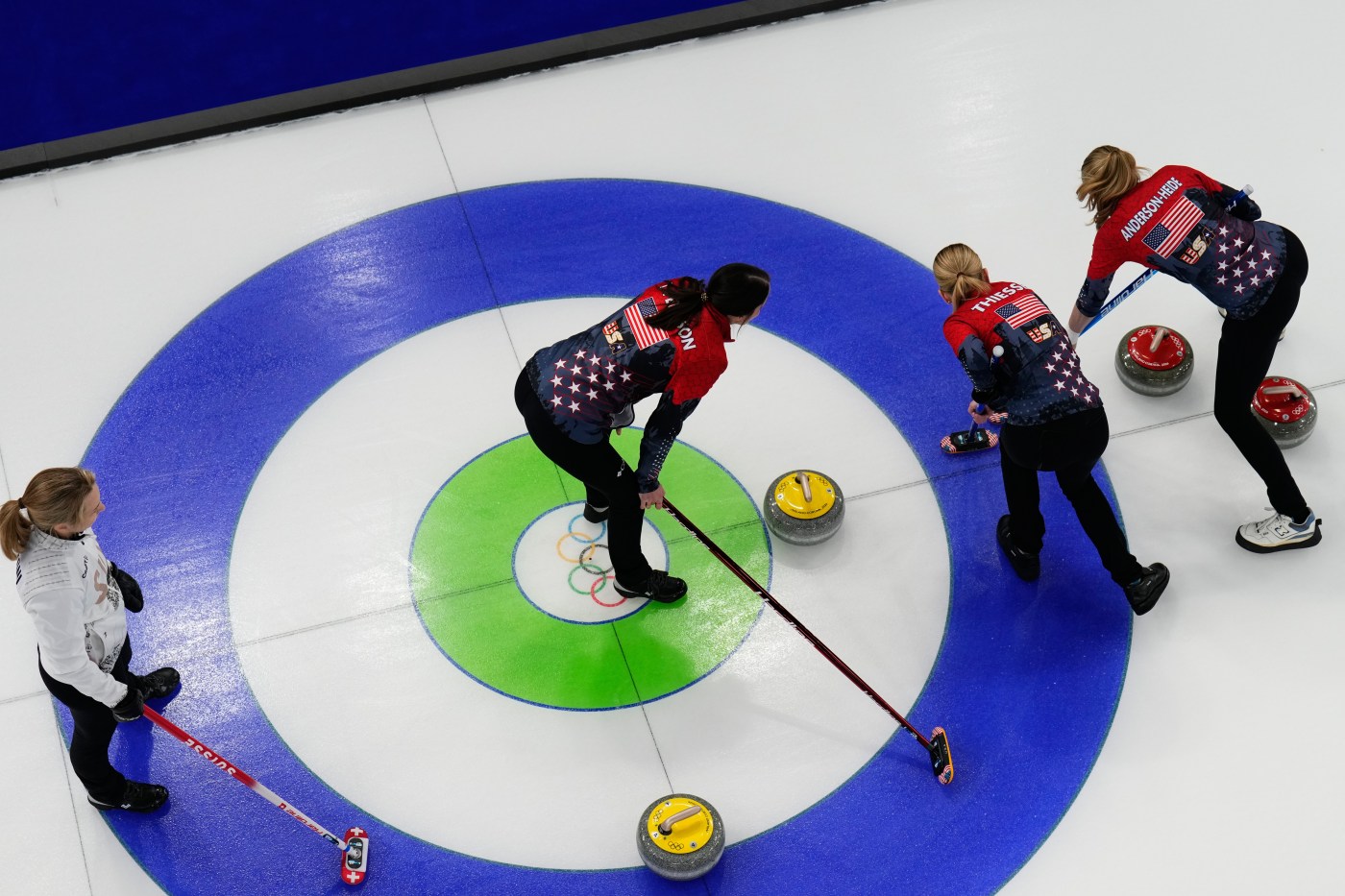
United States’ Tabitha Peterson in action during the women’s curling round robin session against Switzerland, at the 2026 Winter Olympics, in Cortina d’Ampezzo, Italy, Thursday, Feb. 19, 2026. (AP Photo/Misper Apawu)

Switzerland used a four-point swing in the 10th end to send the match into an extra frame, but U.S. skip Tabitha Peterson used the hammer to curl a shot around three Swiss stones and rest it closest to the button to end the U.S. into the Olympic semifinals for the first time with a 7-6 victory.

The U.S. (6-3) and Switzerland (6-3) will meet again Friday for a chance to play for gold. The loser will move on to Friday’s bronze medal match.

It was a difficult task for the Americans, perhaps more difficult than it appeared it would be after their 4-1 start in round-robin play. But a surprise loss to previously winless Italy changed the trajectory.

A dominant win over Denmark gave Team Peterson — which also includes Tara Peterson, Cory Thiesse and Taylor Anderson-Heide — a chance to clinch a medal round spot with a victory in their last two pool play matches.

They had Great Britain on the ropes, up one in the 10th before skip Rebecca Morrison pulled off a two-point bank shot off a blocking stone for a 9-8, and were up by three on the Swiss before fourth Alina Paetz tied the game with a three-point hammer throw.

But Tabitha Peterson, as she has throughout round-robin play, came through in the end with a difficult winning shot, edging a pair of Swiss stones by inches to send the Americans into their first semifinal.

Because Great Britain beat Italy on Thursday, the U.S. had to beat Switzerland or be thrown into a tiebreaker situation to advance.

Related Articles


Hockey star Laila Edwards’ family cheers at Olympic debut, thanks to Kelce brothers and a GoFundMe


US hockey star Haley Winn’s three older brothers are her biggest fans online and at the rink


Olympic men’s hockey: Wild’s Hughes is OT hero as U.S. beats Sweden


Olympic women’s hockey: Dream final ahead between U.S., Canada


Women’s curling: U.S. stunned by Great Britain. Here are two paths left to medal round

Tariffs paid by midsized US firms tripled last year, new analysis from JPMorganChase Institute shows

posted in: All news | 0

By JOSH BOAK

WASHINGTON (AP) — Tariffs paid by midsized U.S. businesses tripled over the course of last year, new research tied to one of America’s leading banks showed on Thursday — more evidence that President Donald Trump ‘s push to charge higher taxes on imports is causing economic disruption.

The additional taxes have meant that companies that employ a combined 48 million people in the U.S. — the kinds of businesses that Trump had promised to revive — have had to find ways to absorb the new expense, by passing it along to customers in the form of higher prices, employing fewer workers or accepting lower profits.

Related Articles


Millions of eligible filers didn’t use Free File


US applications for jobless aid fall to 206,000 last week as layoffs remain low


US trade deficit declined in 2025, but gap for goods hits a record despite Trump tariffs


US stocks drift as oil prices rise on worries about a potential US-Iran conflict


Walmart delivers another quarter of impressive sales but offers a muted outlook

“That’s a big change in their cost of doing business,” said Chi Mac, business research director of the JPMorganChase Institute, which published the analysis on Thursday. “We also see some indications that they may be shifting away from transacting with China and maybe toward some other regions in Asia.”

The research doesn’t say how the additional costs are flowing through the economy, but it indicates that tariffs are being paid by U.S. firms. It’s part of a growing body of economic analyses that counter the administration’s claims that foreigners pay the tariffs.

The JPMorganChase Institute report used payments data to look at businesses that might lack the pricing power of large multinational companies to offset tariffs, but may be small enough to quickly change supply chains to minimize exposure to the tax increases. The companies tended to have revenues between $10 million and $1 billion with fewer than 500 employees, a category known as “middle market.”

The analysis suggests that the Trump administration’s goal of becoming less directly reliant on Chinese manufacturers has been occurring. Payments to China by these companies were 20% below their October 2024 levels, but it’s unclear whether that means China is simply routing its goods through other countries or if supply chains have moved.

The authors of the analysis emphasized in an interview that companies are still adjusting to the tariffs and said they plan to continue studying the issue.

The White House did not immediately respond to questions about the analysis, which showed that U.S. companies are paying tariffs that the president had previously claimed would be paid by foreign entities.

Trump imposed a series of tariffs last year for the ostensible goal of reducing the U.S. trade imbalance with other countries, so that America was not longer importing more than it exports. But trade data published Thursday by the Census Bureau showed that the trade deficit climbed last year by $25.5 billion to $1.24 trillion. The president on Wednesday posted on social media that he expected there would be a trade surplus “during this year.”

The Trump administration has been adamant that the tariffs are a boon for the economy, businesses and workers. Kevin Hassett, director of the White House National Economic Council, lashed out on Wednesday at research by the New York Federal Reserve showing that nearly 90% of the burden for Trump’s tariffs fell on U.S. companies and consumers.

“The paper is an embarrassment,” Hassett told CNBC. “It’s, I think, the worst paper I’ve ever seen in the history of the Federal Reserve system. The people associated with this paper should presumably be disciplined.”

Trump increased the average tariff rate to 13% from 2.6% last year, according to the New York Fed researchers. He declared that tariffs on some items like steel, kitchen cabinets and bathroom vanities were in the national security interest of the country — and declared an economic emergency to bypass Congress and impose a baseline tax on goods from much of the world last April at an event he called “Liberation Day.”

The high rates provoked a financial market panic, prompting Trump to walk back his rates and then engage in talks with multiple countries that led to a set of new trade frameworks. The Supreme Court is expected to rule soon on whether Trump surpassed his legal authority by declaring an economic emergency.

Trump was elected in 2024 on his promise to tame inflation, but his tariffs have contributed to voter frustration over affordability. While inflation has not spiked during Trump’s term thus far, hiring slowed sharply and a team of academic economists estimate that consumer prices were roughly 0.8 percentage points higher than they would otherwise be.