London’s secret tunnels that helped inspire James Bond will open to the public, complete with a bar

posted in: All news | 0

By JILL LAWLESS, Associated Press

LONDON (AP) — There is a history-rich part of London that few people have seen, where the city braced for the Blitz, James Bond’s creator got inspiration and secret Cold War messages passed between Washington and Moscow.

It’s a network of tunnels 100 feet below the streets that was secret for decades — but could be the city’s next big tourist destination. Local authorities have approved plans to fill the 90,000 square-foot site with an intelligence museum, an interactive World War II memorial and one of the world’s deepest underground bars.

“It’s an amazing space, an amazing city,” said Angus Murray, chief executive of The London Tunnels, as subway trains rattled overhead. “And I think it tells a wonderful story.”

Angus Murray, CEO of The London Tunnels, gestures as he shows photos and diagrams relating to the history of the tunnels speaking during a press tour in London, Thursday, June 19, 2025. (AP Photo/Joanna Chan)

A vast bomb shelter

The tunnels lie directly below London Underground’s Central Line in the city’s Holborn area. Work to dig them began in secret in 1940, when Britain feared invasion by Nazi Germany. They were designed to shelter up to 8,000 people in a pair of parallel tunnels 16½ feet wide and 1,300 feet long.

The tunnels were never used for that purpose; by the time they were finished in 1942 the worst of the Blitz was over, and Underground bosses had opened up subway stations as air raid shelters for Londoners.

Instead, the tunnels became a government communications center and a base for the Special Operations Executive, a clandestine unit that sent agents — many of them women — on perilous sabotage missions in Nazi-occupied territory under orders from Prime Minister Winston Churchill to “set Europe ablaze.”

Skittles left in one of the tunnels are seen during a press tour in London, Thursday, June 19, 2025. (AP Photo/Joanna Chan)

A naval officer named Ian Fleming was a liaison officer to the SOE, and the subterranean HQ may have provided inspiration for the world of secret agent 007 that he went on to create.

“This truly is the Q Branch of James Bond,” said Murray, referring to the thrillers’ fictional MI6 quartermaster and gadget-maker.

After the war, more tunnels were added to the complex and the site became a secure telephone exchange. From the mid-1950s it was a terminus of the first trans-Atlantic undersea telephone cable. After the Cuban Missile Crisis brought the world to the brink of nuclear war in 1962, a “red telephone” hotline between the Pentagon and the Kremlin was established and ran through here.

Up to 200 people worked underground, bound to secrecy but with the compensation of an onsite canteen and bar. For a time, the site also housed a bunker to be used by the government in the event of nuclear war.

By the 1980s, technology had moved on and British Telecom moved out. The tunnels lay largely forgotten until BT sold them in 2023 to Murray’s private equity-backed group.

Plans include a memorial to the more than 40,000 civilians killed by German bombing in the war, cultural exhibitions and a nightspot that Murray boasts will be “the deepest bar in the world in a city.”

Bottles and glasses left on the counter of one of the bars that operated from the 1980s, are seen during a press tour in London, Thursday, June 19, 2025. (AP Photo/Joanna Chan)

Secret wartime history

It also will house Britain’s Military Intelligence Museum, which is currently tucked away on a military base north of London with limited public access. Museum bosses have agreed to move a collection covering more than 300 years of history to the tunnels, bringing a much higher profile for a story they believe needs to be told.

”It’s not targeted at people who already have an interest in military topics,” said the chair of the museum’s board of trustees, who gave only his first name, Alistair, because of the museum’s connection to Britain’s armed forces.

“A heavy theme that will run through the new museum is that there are skills and tools that military intelligence has developed over years and centuries … and the fundamental one is, how do you tell truth from lies?” he said. “That’s a very big theme of now.”

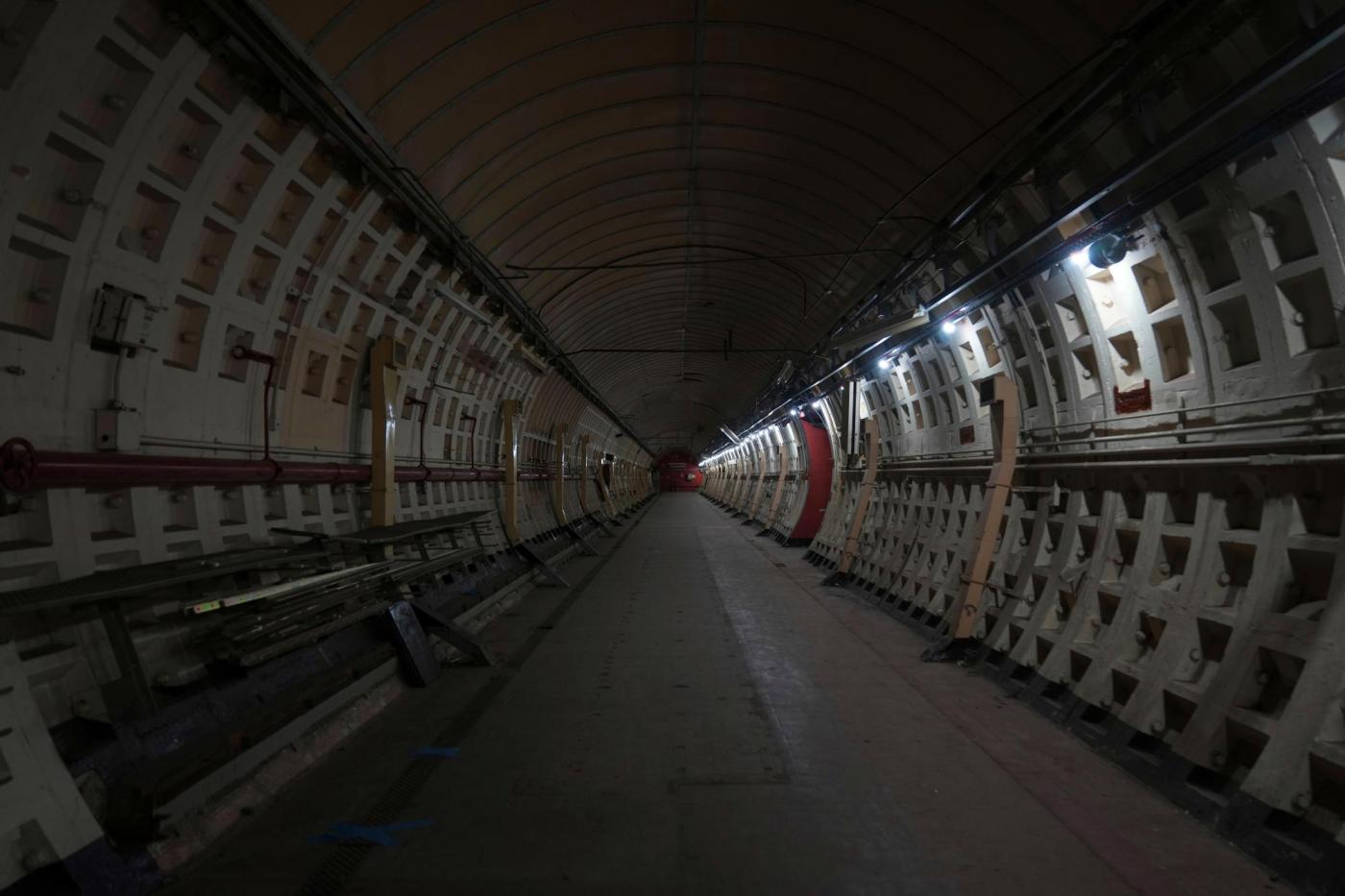
A general view of one of the tunnels during a press tour London, Thursday, June 19, 2025. (AP Photo/Joanna Chan)

The museum also will flesh out the secret story of the Special Operations Executive. The museum’s collection contains agent messages, supplies, weapons and sabotage equipment from the SOE’s wartime adventures.

“Most of the people that worked in SOE never talked about it, either at the time or afterwards, and many of the records have disappeared,” Alistair said. “So a lot is known about SOE, but we don’t know everything, and the chances are we will never know everything.”

Related Articles


Surging travel in Europe spikes concerns over tourism’s drawbacks


How the humble water gun became the symbol of Barcelona’s anti-tourism movement


Could you eat this much ice cream after walking 1,100 miles? Some Appalachian Trail hikers try


Trump bans ‘negative’ signage at national parks, asks visitors to snitch on unpatriotic text


Smaller amusement parks hope for a strong summer under the shadow of tariffs

A unique attraction

For now, the tunnel entrance is through an unmarked door in an alley, and walking the cool, dim corridors brings the thrill of discovering a hidden corner of history. Within the thick steel and concrete walls are chunky old generators and telecoms equipment, a staff canteen with its kitchen still intact, and the bar, its 1960s orange and brown décor giving off retro “Austin Powers” vibes

Here and there are graffiti tags and a few items left by urban explorers who snuck in over the years, including a set of bowling pins with ball, and — incongruously — a bear costume.

London Tunnels aims to open in 2028, and to attract up to 4.2 million tourists a year. That may sound ambitious, but Murray says the site’s mix of “history and heritage and novelty” makes it a unique draw.

“If you go home and say, ‘I went to this really cool tunnel today,’ then we’re halfway there,” he said. “If what’s inside of it is even better, you’re going to go ‘Oh that’s fantastic.’”
Should the U.S. ban drug advertising to consumers?

posted in: All news | 0

The U.S. is rare among Western nations because it allows pharmaceutical advertising. But a new effort aims to stop it.

A bill was introduced in Congress recently that would ban pharmaceutical manufacturers from using direct-to-consumer advertising, from TV to social media, to promote their products.

Prescription drug advertising employs a lot of people, directly and indirectly. Billions are spent on advertising each year, employing advertising workers, and 24.4% of ad minutes were for prescription drugs across evening news programs on ABC, CBS, CNN, Fox News, MSNBC and NBC this year through May, according to data from iSpot analyzed by The Wall Street Journal.

Proponents of the bill say advertising drives up the cost of prescription goods. Pharmaceutical trade groups have said advertisements serve public health by increasing disease awareness and educating consumers about treatment options.

Question: Should the U.S. ban drug advertising to consumers?

Economists

Alan Gin, University of San Diego

YES: Advertising is supposed to give consumers more information about products, but are consumers really in a position to make an informed decision about pharmaceuticals? Those decisions are best left to physicians, who probably have more knowledge about the effectiveness of medications. Consumers can be swayed by slick and repetitive ads into wanting products that might not be the best for them. The money spent on the ads will add to the already high price of the drugs.

James Hamilton, UC San Diego

NO: Proponents of a ban argue that ads cause people to request unnecessary drugs. But advertisements helped several of my friends learn about options that they didn’t know were available. I’m also concerned any time the government dictates what companies are allowed to talk about. It’s appropriate to ensure ads do not make inaccurate claims. And doctors should always say no if patients request a prescription that the doctor does not believe is going to help them.

Caroline Freund, UC San Diego School of Global Policy and Strategy

YES: Advertising specific drugs leads to overprescribing, higher drug and insurance prices, and creates bad incentives, like promoting the most profitable drugs. Because insurance limits consumer costs, more prescription drugs are purchased than needed or used. If the goal is to share important information, industry groups can promote a range of treatments for a condition, leaving discussions of individual products to medical professionals. Drugs also carry risks that are not easily captured in 30 seconds.

Kelly Cunningham, San Diego Institute for Economic Research

NO: Firms do not advertise to raise costs but engage in marketing to inform the public (especially doctors writing prescriptions) of the drug’s usefulness. Without marketing, firms would be unable to get information out necessary to make a drug salable in the first place. The drug’s value is decided by the marketplace with consumers driving the entire process. Value of advertising is derived from the value consumers place on the drug, not the other way around.

Norm Miller, University of San Diego

NO: While most physicians try to keep up on the latest drug research, some do not, thus the need for public information about new drugs. What should be mandatory in ads are their efficacy, side effects and potential for addiction, using FDA verified stats. Lies and exaggerations should be illegal. It should also be illegal for drug manufacturers to incentivize or pay doctors for prescribing any drug, and physicians that take such gifts should lose their license.

Ray Major, economist

YES: Every ad starts with or ends with “ask your doctor if this drug is right for you.” Prescription drug advertisement targets consumers hoping they ask their doctor for a specific brand of drug. Consumers are not qualified to self diagnose symptoms and prescribe drugs to themselves based on information from a commercial. Doctors should be prescribing drugs based on a patients’ needs and not influenced by patients who have seen an ad for a prescription drug.

David Ely, San Diego State University

NO: Commercial speech by pharmaceutical companies that is truthful and informative should be protected. A ban on drug advertising goes too far. A better option is enhanced regulation by the FDA and FTC to ensure that the risks and effectiveness of prescription drugs are accurately communicated in advertising to the public. Under a ban, resources would be shifted to increased promotional efforts targeting health care providers so the cost of prescription goods may not decline.

Executives

Gary London, London Moeder Advisors

NO: I am not a big fan of drug advertisements, but unlike cigarette ads, which clearly promoted sickness for generations, at least drugs are lifesaving. The government should not get involved. However, I have never fully understood why pharmaceutical companies promote directly to patients rather than physicians. They complicate medical care. Be that as it may, these advertisements certainly prop up the cable channels, who need the revenue.

Bob Rauch, R.A. Rauch & Associates

YES: The U.S. and New Zealand are the only countries that allow pharmaceutical companies to advertise directly to consumers. Drug ads often downplay the risks, leading to uninformed decisions. Ads can push consumers toward brand-name drugs, even when cheaper alternatives exist. Also, patients may request unnecessary medications, pressuring doctors to prescribe them. Sure, ads can educate, lead to earlier diagnosis, and boost the economy! But let’s limit ads during the first few years of release.

Phil Blair, Manpower

NO: They are a product like any other. With artificial intelligence, clients and patients can educate themselves on various options just like they do with other products. Of course, they should heed their doctors’ advice.

Austin Neudecker, Weave Growth

YES: Drugmakers spent $10 billion on direct-to-consumer ads last year. These costs are ultimately reflected in the world’s highest per-capita health care bill, with relatively poor health outcomes. Slick spots encourage viewers to “ask your doctor” for brands even when cheaper generics accomplish the same goal. Treatment decisions should be based on clinical evidence, not marketing budgets. Pharma could shift a fraction of this outreach to physician education so that patients will still learn about therapies from an informed source.

Chris Van Gorder, Scripps Health

YES: Absolutely. The cost of pharmaceuticals has become prohibitive to patients and providers like hospitals, and the huge cost of advertising is wrapped into those costs. While we want informed patients, pharmaceutical education should be handled by patients’ physicians, not a jingle on TV.  Advertising also can be misleading and increase the cost of drugs to taxpayers – which is why many countries prohibit advertising.

Jamie Moraga, Franklin Revere

NO: While I don’t enjoy watching the litany of drug advertisements consistently shown on family programming, I don’t support a blanket ban. Instead, drug advertising should follow the model currently allowed to cigarette advertising: prohibit ads on TV and radio but allow other forms of advertising with appropriate limitations and regulations. While raising awareness of available treatments can be beneficial, the current barrage of drug advertising is excessive and likely leads to over prescription and increased health care costs.

Have an idea for an Econometer question? Email me at phillip.molnar@sduniontribune.com. Follow me on Threads: @phillip020


Q&A: Pulitzer Prize winner Robin Givhan chronicles Virgil Abloh’s rise to fashion fame

posted in: All news | 0

By BEATRICE DUPUY, Associated Press

NEW YORK (AP) — With his calm and cool demeanor, fashion disruptor and multi-hyphenate Virgil Abloh artfully challenged the fashion industry’s traditions to leave his mark as a Black creative, despite his short-lived career.

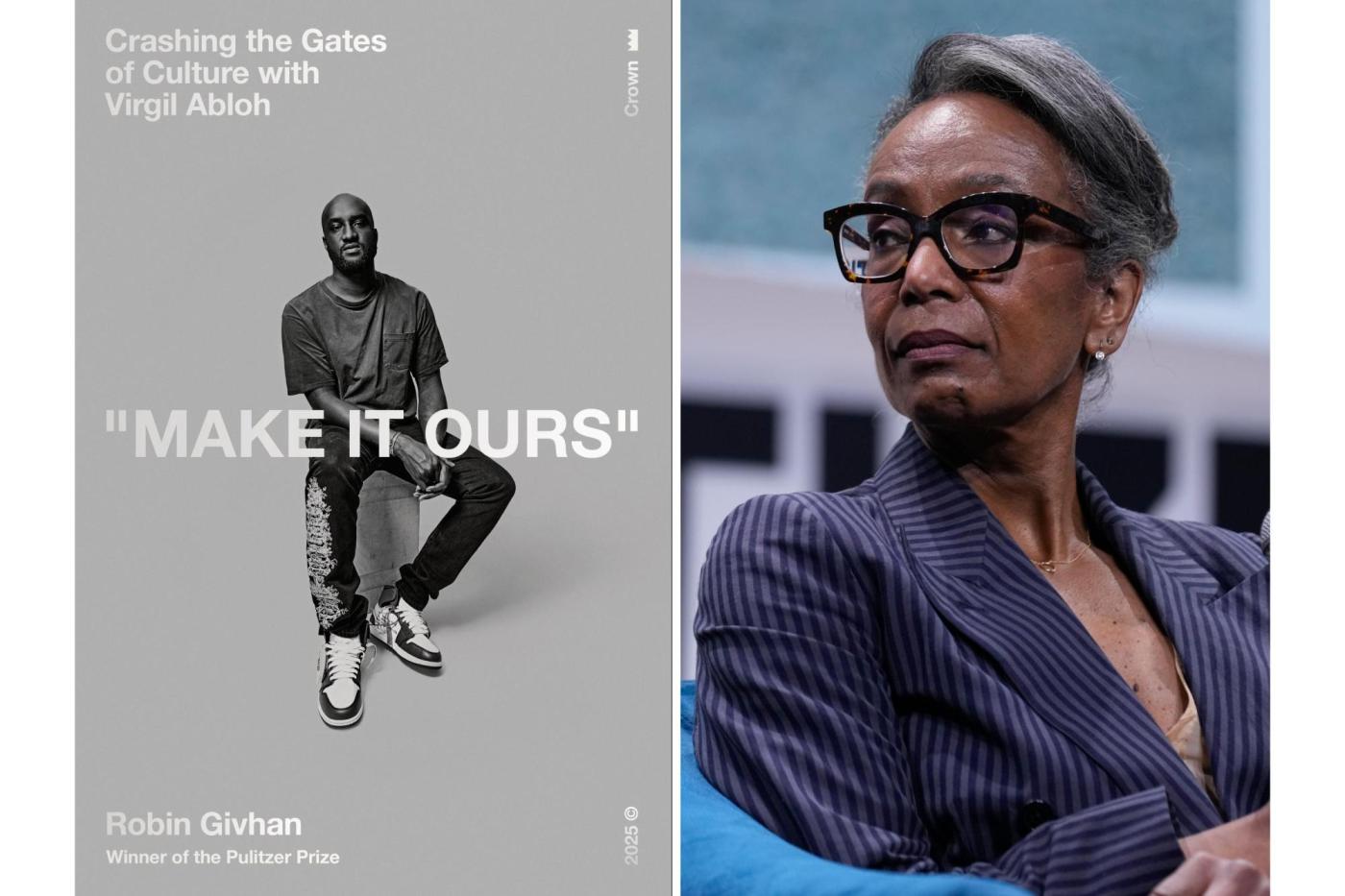
In the years since his 2021 death at just 41, his vision and image still linger. Pulitzer Prize-winning writer Robin Givhan sheds new light on how Abloh ascended the ranks of one of the top luxury fashion houses and captivated the masses with her latest book, “Make It Ours: Crashing the Gates of Culture with Virgil Abloh.”

In the book out Tuesday, Givhan documents Abloh’s early life growing up as the son of Ghanaian immigrants in Rockford, Illinois, his days as graduate student studying architecture and his working relationship and friendship with Kanye West.

Before taking the helm of Louis Vuitton as the house’s first Black menswear creative director, Abloh threw himself into his creative pursuits including fine art, architecture, DJing and design. Abloh remixed his interests with his marketing genius and channeled it into fashion with streetwear labels like Been Trill and Pyrex Vision.

These endeavors were the launchpad for his luxury streetwear label Off-White, known for its white diagonal lines, quotation marks, red zip ties and clean typeface. Off-White led to Abloh’s collaboration with Ikea, where he designed a rug with “KEEP OFF” in all-white letters and also with Nike where he deconstructed and reenvisioned 10 of Nike’s famous shoe silhouettes.

Throughout his ventures, Abloh built a following of sneakerheads and so-called hypebeasts who liked his posts, bought into his brands and showed up in droves outside his fashion shows. Social media made Abloh accessible to his fans and he tapped into that.

Off-White had built a loyal following and some critics. Givhan, a Washington Post senior critic-at-large, openly admits that she was among the latter early on. Givhan said she was fascinated that Abloh’s popularity was more than his fashion.

“For me, there was something of a disconnect really,” she said. “That here was this person who had clearly had an enormous impact within the fashion industry and outside of the fashion industry, and yet it wasn’t really about the clothing. It was about something else.”

For her latest project, Givhan spoke with The Associated Press on how she approached each of Abloh’s creative undertakings and his legacy during a period of heightened racial tension in America. This interview has been edited for brevity and clarity.

AP: Tell me why you felt it was important to include the context of what was happening at the time Abloh was growing up as well as on his rise up through the fashion industry, with him ultimately ending up at Louis Vuitton.

GIVHAN: Fashion doesn’t just sort of happen in a vacuum. People are the product of their parents, their family, their environment, their timing, their interests, all of those things.

I always like to see, what is swirling around people when they make certain decisions? What is sort of in the water that you’re absorbing, that you are not even conscious that you’re absorbing it.

AP: Can you talk about the process of writing about all of his creative endeavors and how they shaped his career?

GIVHAN: The skater culture — in part because it was such a sort of subculture that also had a very specific aesthetic and was such a deep part of the whole world of streetwear — and then the DJing part intrigued me because so much of his work as a designer seems to reflect a kind of DJ ethos, where you’re not creating the melody and you’re not creating the lyrics. You’re taking these things that already exist and you’re remixing them and you’re responding to the crowd and the crowd is informing you. And so much of that, to me, could also be used to describe the way that he thought about fashion and the way that he designed.

AP: What role would you say that Virgil has had in the fashion industry today?

GIVHAN: He certainly raised the question within the industry of what is the role of the creative director? How much more expansive is that role? … And I do think he has really forced the question of how are we defining luxury? Like what is a luxury brand? And is it something that is meant to sort of have this lasting impact? Is it supposed to be this beautifully crafted item? Or is it really just a way of thinking about value and beauty and desirability? And if it’s those things, then really it becomes something that is quite sort of quite personal and can be quite based on the community in which you live.

AP: How did he use social media to his advantage and to help catapult his career?

GIVHAN: He really used social media as a way of connecting with people as opposed to just sort of using it as kind of a one-way broadcast. He was telling his side of things, but he was also listening to other people. He was listening to that feedback.

That’s also what made him this larger-than-life person for a lot of people, because not only was he this creative person who was in conversation with fans and contemporaries, but he was this creative person inside. He was this creative person at the very top of the fashion industry. For a lot of people, the idea that you could ostensibly have a conversation with someone at that level, and they would seemingly pull back the curtain and be transparent about things — that was really quite powerful.

AP: You write about his relationship to Kanye in the book. Were you able to get any input from him on their relationship for the book?

GIVHAN: Their individual ambitions, aesthetic ideas and curiosity kind of propelled them forward in separate directions. I did reach out to Kanye after a lot of the reporting because he obviously is this thread that is woven throughout the book. And, ultimately, he elected not to engage.

But I was lucky enough to get access to an unpublished conversation that Virgil had had around, I think it was 2016-ish, where he talked at length about his working relationship with Kanye and sort of the differences between them and the similarities and the ways in which … Kanye inspired him and sort of the jet fuel that he got from that relationship.

More than anything, because Virgil’s personality was in so many ways kind of the opposite of Kanye’s, that for every door that Kanye was kind of pounding on, Virgil was able to politely sort of walk through.

AP: Why do you think his legacy continues to persist?

GIVHAN: For one, he had such an enormous output of work. I think there’s a lot of it to consider. Also, sadly, because his career was cut so short that there is this sense of someone who sort of stops speaking mid-sentence.

I’ve been thinking about how Virgil might have responded, how his creativity might have responded to this moment because so much shifted post-George Floyd that like this is another inflection point and it makes me wonder, “OK, how would he have responded today?” And with the person who said, “I’m not a rebel and I’m not a flame thrower,” would he have picked up some matches? I don’t know.

Gaza health authorities say Israel kills 44 waiting for aid as war’s death toll passes 56,000

posted in: All news | 0

By WAFAA SHURAFA and SAMY MAGDY

DEIR AL-BALAH, Gaza Strip (AP) — Israeli forces and drones opened fire toward hundreds of Palestinians waiting for aid in separate incidents in southern and central Gaza early Tuesday, killing at least 44, witnesses and hospitals said, as health authorities announced the number of Palestinians killed in the war has risen above 56,000.

Related Articles


Trump says whether he’ll commit to NATO mutual defense guarantee ‘Depends on your definition’


NATO chief praises Trump for making Europe ‘pay in a BIG way’ on defense ahead of a key summit


As US cities heighten security, Iran’s history of reprisal points to murder-for-hire plots


Trump says Israel-Iran ceasefire is in effect after deal initially faltered


Trump says Israel-Iran ceasefire ‘is in effect’ and Israeli planes won’t attack anymore

The new food distribution sites run by an American contractor, with U.S. and Israeli government support, have been plagued by scenes of violence and chaos since opening last month.

Palestinian witnesses and health officials say Israeli forces have repeatedly opened fire on crowds heading to the sites for desperately needed food, killing hundreds in recent weeks. The military says it has fired warning shots at people it said approached its forces in a suspicious manner while going to the sites.

In central Gaza, three witnesses told The Associated Press that Israeli forces opened fire as people advanced east toward aid trucks south of Wadi Gaza.

“It was a massacre,” said Ahmed Halawa. He said tanks and drones fired at people, “even as we were fleeing. Many people were either martyred or wounded.”

Hossam Abu Shahada said drones were flying over the area, watching the crowds, then there was gunfire from tanks and drones as people were moving eastward. He described a “chaotic and bloody” scene as people tried to escape.

He said he saw at least three people lying motionless and many others wounded.

Israel’s military said it was reviewing the incident, which took place near the Netzarim corridor, a road that separates northern and southern Gaza.

Displaced Palestinians live in a tent camp in Gaza City, Monday, June 23, 2025. (AP Photo/Jehad Alshrafi)

The Awda hospital in the urban Nuseirat refugee camp, which received the victims, confirmed 25 deaths and said 146 others were wounded. It said 62 were in critical condition and transferred to other hospitals.

In the central town of Deir al-Balah, the Al-Aqsa Martyrs hospital said it received the bodies of six people from the same incident.

In the southernmost city of Rafah, witnesses said Israeli troops opened fire as crowds tried to reach another food distribution site run by the Gaza Humanitarian Foundation.

At least 19 were killed and 50 others wounded, according to Nasser hospital and Gaza’s Health Ministry.

Two witnesses said Israeli troops started firing as thousands of Palestinians massed at the Shakoush area, several hundred meters (yards) from the distribution site.

The Israeli military did not immediately return a request for comment.

Salem Ismail was in the crowd and was shot in a leg. He said he saw forces firing towards the crowd who were moving north toward the site.

Ayman Abu Joda said he saw heavy gunfire from Israeli tanks and that many people were shot. He said he helped evacuate three wounded people, one hit in the chest and two in the legs.

“It was the same tragedy every day: We seek food and the occupation opens fire and kills many,” he said.

Hamam Al-Farani, sits along with other family members as the body of his father, Alaa, killed in an Israeli army strike that also injured the boy, is prepared for burial at Shifa hospital in Gaza City, Tuesday, June 24, 2025. (AP Photo/Jehad Alshrafi)

The casualty toll was confirmed to The Associated Press by Zaher al-Waheidi, head of the Health Ministry’s records department.

The GHF said on social media its hub there opened Tuesday at 10 a.m. and closed after finishing food distribution. It called on people not to head to the hub.

Israel wants the GHF to replace a system coordinated by the United Nations and international aid groups. Along with the United States, it accuses Hamas of stealing aid, without offering evidence. The U.N. denies there is systematic diversion of aid.

The GHF sites are in Israeli military zones where independent media have no access.

Death toll in Gaza over 56,000

Meanwhile, Gaza’s Health Ministry said Israel’s 21-month military operation in Gaza has killed 56,077 people. The war was sparked by Hamas’ surprise attack on southern Israel on Oct. 7, 2023, that killed around 1,200 people dead, mostly civilians, and took 251 others hostage. Many have been released by ceasefire or other agreements.

The death toll is by far the highest in any round of Israeli-Palestinian fighting.

The ministry said the dead include 5,759 who have been killed since Israel resumed fighting on March 18, shattering a two-month ceasefire.

The ministry doesn’t distinguish between civilians and combatants but says more than half of the dead were women and children.

Israel says it only targets combatants and blames civilian deaths on Hamas, which operates in heavily populated areas. Israel says over 20,000 Hamas fighters have been killed, though it has provided no evidence to support that claim. Hamas — which has been designated a terrorist organization by the United States, Canada, and European Union — has not commented on its casualties.