“Heat-related incidents have definitely been on the rise,” said Josiah Haken, CEO of the homeless outreach group City Relief. “The people we serve are often the ones who feel the impact of these changes most, and they can’t escape it.”
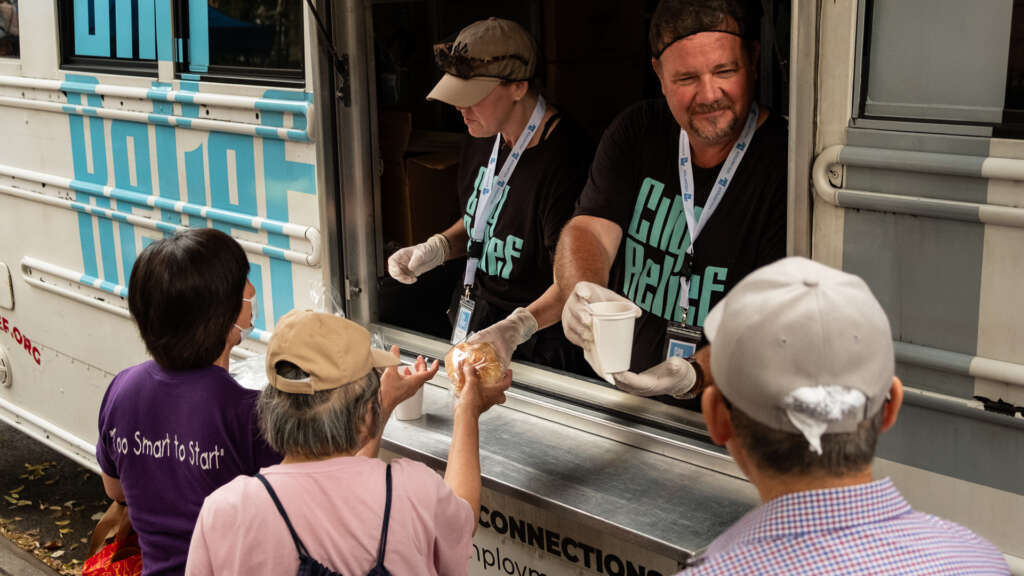
City Relief volunteers serving food and drink on 28th Street near Ninth Avenue in Manhattan’s Chelsea neighborhood, on Aug. 6, 2025. (Adi Talwar/City Limits)
On the corner of 28th Street and 9th Avenue, a line stretches halfway down the block in front of Chelsea Park. People holding empty shopping carts and reusable bags patiently wait under the beaming sun, inching forward every minute as they near their turn to receive a hot meal and a cold cup of lemonade.
Every Wednesday, the team from City Relief, a mobile outreach program serving people experiencing homelessness across New York City, station their van in front of Chelsea Park to provide nutritional support to a group of individuals who often face uncertainty about where their next meal is coming from.
City Relief’s CEO, Josiah Haken, wants to help his friends who live on the street stay hydrated and fed since they can’t escape the elements, especially during a summer marked by multiple heat advisories.
“Today, we’re hosting one of our weekly pop-up events. We’re offering emergency relief to the people that we meet in the street through a meal and some lemonade because people are struggling with dehydration and fatigue,” Haken told City Limits on Aug. 6.
According to the NYC Department of Health’s 2025 Heat-Related Mortality Report, each summer more than 500 New Yorkers die from heat-related conditions. Black New Yorkers are twice as likely to die from heat stress compared to white New Yorkers, and people experiencing homelessness are 200 times more likely to die from extreme heat.
In response to this summer’s sweltering weather, City Relief launched the LemonAID campaign, an outreach initiative aimed at addressing the heightened vulnerability of people experiencing homelessness during heat waves by offering cold water, fresh lemonade, and hot meals.
City Relief volunteers serving clients at their LemonAID table on 28th Street near 9th Avenue. (Adi Talwar/City Limits)
“Over the last few months, it’s been 100 degrees one day, and then 70 degrees the next,” Haken said. He worries how the fluctuating temperatures affect unhoused people, highlighting how their core body temperatures can be negatively impacted by constant ups and downs. “If someone is in the heat and they sweat through the only shirt they own, and then are outside at night when the temperature drops 30 degrees, that’s where it gets really dangerous.”
Daily temperature variation, or how many degrees the temperature swings within a day, poses a number of health risks because the body struggles to adapt to sudden changes. Studies have found that dramatic weather changes increase hospitalizations for respiratory and cardiovascular diseases. Low-income and minority communities are disproportionately impacted by these temperature swings, and it’s expected that these variations will only get more dramatic over time.
“Heat-related incidents have definitely been on the rise. The people we serve are often the ones who feel the impact of these changes most, and they can’t escape it,” Haken said.
While there may be plenty of spaces where unsheltered individuals can seek relief from the heat, he noted how they often aren’t welcomed. “The pervading narrative in our culture is that homeless people are lazy, crazy, scary and drug addicted. If we blame the individual, then that allows us to not feel responsible or obligated to do anything.”
City Relief CEO Josiah Haken outside the organization’s outreach vehicle on Aug. 6 in Manhattan. (Adi Talwar/City Limits)
During periods of extreme heat and humidity, NYC Emergency Management activates Code Red, a citywide heat emergency plan that allows homeless residents to access any available shelter. Department of Homeless Services outreach teams follow a Code Red priority list to contact anyone at risk of heat exhaustion to encourage them to accept services and offer transportation to shelters.
The city also runs around 500 cooling centers during heat waves, though Haken believes they aren’t always reliable, saying it’s common for sites to close for the day because they’re short-staffed. The police also frequently remove people seeking refuge from places like the subway.
“There’s very few places in the city that are consistent,” Haken said. “One of the things that our friends in the street often rely on is consistency because they don’t have a MetroCard, so they have to really pick their spots.”
That consistency is an essential part of any initiative dedicated to serving unhoused individuals, he said, and so is educating people on how they can navigate through their struggles.
The City Relief team provides support and resources to anyone who pops by for a cup of lemonade, offering the option to fill out an outreach prescreen sheet where they can specify services they’re interested in. The group offers information on legal aid, drug recovery programs, health services, emergency shelters and more.
“If you’re a cooling center in New York you’re just a big flat, empty room with a door and air conditioning,” Haken said. “Wouldn’t it be great if we had spaces where they can talk to a caseworker while they’re there to help them navigate?”
Joseph Warthen is a previously unhoused participant who now fundraises for the nonprofit.
City Relief volunteer and brand ambassador Joseph Warthen, who received support from the organization during his own period of homelessness. (Adi Talwar/City Limits)
“Years ago, I ended up homeless for economic reasons, then I met the team at City Relief and they got me involved in a program where I’d get a stipend to clean trash cans out,” he said. “Now they made me their ambassador.”
As someone who’s experienced the struggles of homelessness first-hand, Warthen understands the impact hot weather can have. “We’ve seen people come in and just drop. I’ve seen people completely pass out because of the heat,” he explained.
Last month, during one of the hottest days of this summer, he said he was on Park and 28th and walked by a man who was lying in a fetal position. Warthen came back an hour later to find the man in the same place.
“I lightly tapped his foot and said, ‘Hey, are you okay?’ No response. So I tapped a little harder, and then really hard. Nothing. So I called 911, and they told me he was dead. People were just walking by unbothered,” he said.
Roughly 14 percent, or six of the 49 heat-stress deaths the city recorded between 2014 and 2023, were among those “noted to be experiencing or suspected to be experiencing homelessness,” according to the Health Department’s most recent report.
For Haken, Warthen and the rest of the team at City Relief, the goal is to offer compassion to people who are often met with judgement and condemnation.
“These are human beings, they’re not choosing to be out here,” added Harken. “If we could get the people who are living 10 floors up to remember the person who’s living on the sidewalk in front of their building as a human being who has intrinsic value, things could change.”
To reach the reporter behind this story, contact Marianad@citylimits.org. To reach the editor, contact Jeanmarie@citylimits.org
Want to republish this story? Find City Limits’ reprint policy here.
The post Homeless in a Heatwave: Summer Poses Extra Challenges for Unhoused New Yorkers appeared first on City Limits.