NEW YORK (AP) — U.S. stocks are hanging near their all-time high on Wednesday as financial markets catch a breath following two big days bolstered by hopes that the Israel-Iran war will not disrupt the global flow of crude oil.
Related Articles
Musk’s ‘robotaxis’ draw regulatory scrutiny after video shows one driving in an opposing lane
Anthropic wins ruling on AI training in copyright lawsuit but must face trial on pirated books
No more McDoughnuts: McDonald’s and Krispy Kreme end partnership
Should the U.S. ban drug advertising to consumers?
How to take care of yourself and your finances when you’ve experienced a layoff
The S&P 500 was 0.2% higher in early trading and sitting just 0.7% below its all-time high. The Dow Jones Industrial Average was virtually unchanged, as of 9:35 a.m. Eastern time, and the Nasdaq composite was 0.6% higher.
In the oil market, which has been the center of much of this week’s action, crude prices stabilized after plunging by roughly $10 per barrel in the last two days. Benchmark U.S. crude rose 0.7% to $64.81 per barrel, though it still remains below where it was before the fighting between Israel and Iran broke out nearly two weeks ago.
On Wall Street, companies involved in the cryptocurrency industry jumped to some of the bigger gains as the price of bitcoin continued to steam ahead with investors willing to take on more risk. Coinbase Global, the crypto exchange, rose 7%, and Robinhood Markets gained 4% as bitcoin topped $107,000.
They helped offset a 5.3% drop for FedEx. It reported stronger profit and revenue for the latest quarter than analysts expected, but it gave a forecast for profit in the current quarter that fell short of expectations.
General Mills, the company behind Pillsbury and Progresso soups, fell 2.8% after reporting weaker revenue for the latest quarter than analysts expected, though its profit topped forecasts. It also said an underlying measure of profits could fall by 10% to 15% this upcoming fiscal year.
In the bond market, Treasury yields were holding relatively steady, and the yield on the 10-year Treasury rose to 4.32% from 4.30% late Tuesday.
Yields had dropped a day before after the chair of the Federal Reserve said it is waiting for the right moment to resume cutting interest rates. By lowering rates, the Fed could help give the economy a boost, but it could also offer additional fuel for inflation.
Fed Chair Jerome Powell told a House of Representatives committee on Tuesday that he wants to wait and see how President Donald Trump’s tariffs affect the economy and inflation before committing to its next move. Powell will speak before a Senate committee later Wednesday morning.
In stock markets abroad, indexes fell modestly in Europe after rising across much of Asia.
Stocks jumped 1.2% in Hong Kong and 1% in Shanghai for two of the larger moves.
“The world can now move on to face other difficult choices like tariffs and things like that,” said Frances Lun, CEO of GEO Securities in Hong Kong. “So I think the market is well on its way to rebound and could again reach new levels.”
AP Business Writers Matt Ott and Elaine Kurtenbach contributed.
DUBAI, United Arab Emirates (AP) — The fragile ceasefire between Israel and Iran appeared to be holding on Wednesday after a rocky start, giving rise to cautious hope for longer-term peace even as Tehran insisted it will not give up its nuclear program.
Related Articles
NATO leaders agree to hike military spending and restate ‘ironclad commitment’ to collective defense
Today in History: June 25, former White House counsel begins testifying on Watergate scandal
Royal upgrade: Trump will stay at the Dutch king’s palace during his NATO visit
Early US intelligence report suggests US strikes only set back Iran’s nuclear program by months
Trump administration authorizes $30 million for Israeli-backed group distributing food in Gaza
U.S. President Donald Trump, who helped negotiate the ceasefire that took hold on Tuesday, the 12th day of the war, told reporters at a NATO summit it was going “very well,” adding that Iran was “not going to have a bomb and they’re not going to enrich.”
Iran has insisted, however, that it will not give up its nuclear program. In a vote underscoring the tough path ahead, its parliament agreed to fast-track a proposal that would effectively stop the country’s cooperation with the International Atomic Energy Agency, the U.N. watchdog that has monitored the program for years.
Ahead of the vote, Parliament Speaker Mohammad Bagher Qalibaf criticized the IAEA for having “refused to even pretend to condemn the attack on Iran’s nuclear facilities” that the United States carried out on Sunday.
“For this reason, the Atomic Energy Organization of Iran will suspend cooperation with the IAEA until security of nuclear facilities is ensured, and Iran’s peaceful nuclear program will move forward at a faster pace,” Qalibaf told lawmakers.
IAEA Director General Rafael Mariano Grossi said he had already written to Iran to discuss resuming inspections of their nuclear facilities.
Among other things, Iran claims to have moved its highly enriched uranium ahead of the U.S. strikes, and Grossi said his inspectors need to re-assess the country’s stockpiles.
“We need to return,” he said. “We need to engage.”
French President Emmanuel Macron, whose country was part of the 2015 deal with Iran that restricted its nuclear program but began unraveling after Trump pulled the U.S. out in his first term, said he hoped Tehran would come back to the table.
Iran has long maintained that its nuclear program was peaceful, and U.S. intelligence agencies have assessed that Tehran is not actively pursuing a bomb. However, Israeli leaders have argued that Iran could quickly assemble a nuclear weapon.
Israel is widely believed to be the only Middle Eastern country with nuclear weapons, which it has never acknowledged.
An Iranian woman walks past a banner showing head of the paramilitary Revolutionary Guard’s Khatam al-Anbiya Central Headquarters Gen. Gholam Ali Rashid, who was killed in Israeli strike, at Enqelab-e-Eslami (Islamic Revolution) street in downtown Tehran, Iran, Tuesday, June 24, 2025. (AP Photo/Vahid Salemi)
A police officer inspects a damaged apartment a day after a direct missile strike from Iran hit a residential building, killing several people, following the announcement of a ceasefire, in Beersheba, Israel, Wednesday, June 25, 2025. (AP Photo/Ariel Schalit)
This Tuesday, June 24, 2025, satellite image provided by Maxar Technologies shows damage at Fordo enrichment facility after strikes in Iran on June 23. (Maxar Technologies via AP)
This Tuesday, June 24, 2025, satellite image provided by Maxar Technologies shows damage at Fordo enrichment facility after strikes in Iran on June 23. (Maxar Technologies via AP)
1 of 4
An Iranian woman walks past a banner showing head of the paramilitary Revolutionary Guard’s Khatam al-Anbiya Central Headquarters Gen. Gholam Ali Rashid, who was killed in Israeli strike, at Enqelab-e-Eslami (Islamic Revolution) street in downtown Tehran, Iran, Tuesday, June 24, 2025. (AP Photo/Vahid Salemi)
The Israel Atomic Energy Commission said its assessment was that the U.S. and Israeli strikes have “set back Iran’s ability to develop nuclear weapons by many years.” It did not give evidence to back up its claim.
The U.S. strikes hit three Iranian nuclear sites, which Trump said “completely and fully obliterated” the country’s nuclear program. At the NATO summit, when asked about a U.S. intelligence report that found Iran’s nuclear program has been set back only a few months, Trump scoffed and said it would at least take “years” to rebuild.
Iran’s Foreign Ministry spokesman, Esmail Baghaei, confirmed that the strikes by U.S. B-2 bombers using bunker-buster bombs had caused significant damage.
“Our nuclear installations have been badly damaged, that’s for sure,” he told Al Jazeera on Wednesday, while refusing to go into detail.
He seemed to suggest Iran might not shut out IAEA inspectors for good, noting that the bill before parliament only talks of suspending work with the agency, not ending it. He also insisted Iran has the right to pursue a nuclear energy program.
“Iran is determined to preserve that right under any circumstances,” he said.
Trump’s special envoy to the Mideast, Steve Witkoff, said on Fox News late on Tuesday that Israel and the U.S. had achieved their objective of “the total destruction of the enrichment capacity” in Iran, and Iran’s prerequisite for talks — that Israel end its campaign — had been fulfilled.
“The proof is in the pudding,” he said. “No one’s shooting at each other. It’s over.”
Grossi said he could not speculate on how bad the damage was but that Iran’s nuclear capabilities were well known.
“The technical knowledge is there, and the industrial capacity is there,” he said. “That no one can deny, so we need to work together with them.”
Hopes for a long-term peace agreement
An Israeli official, speaking on condition of anonymity to discuss internal deliberations, said the ceasefire agreement with Iran amounted to “quiet for quiet,” with no further understandings about Iran’s nuclear program going ahead.
In the Fox News interview, Witkoff said Trump is now looking to land “a comprehensive peace agreement that goes beyond even the ceasefire.”
“We’re already talking to each other, not just directly, but also through interlocutors,” Witkoff said, adding that the conversations were promising and “we’re hopeful that we can have a long-term peace agreement.”
However, Baghaei, the Iranian spokesman, said Washington had “torpedoed diplomacy” with its attacks on nuclear sites, and that while Iran in principle was always open to talks, national security was the priority.
“We have to make sure whether the other parties are really serious when they’re talking about diplomacy, or is it again part of their tactics to make more problems for the region and for my country,” he said.
China, a close Iranian partner and major buyer of Iranian oil, said it hoped a “lasting and effective ceasefire can be achieved so as to promote” peace and stability in the region. China has blamed Israel for starting the war and destabilizing the region.
Foreign Ministry spokesperson Guo Jiakun told reporters that China is willing to “inject positive factors to safeguard peace and stability in the Middle East.”
Grossi said Iran and the international community should seize the opportunity of the ceasefire for a long-term diplomatic solution.
“Out of the … bad things that military conflict brings, there’s also now a possibility, an opening,” he said. “We shouldn’t miss that opportunity.”
Iran executes 3 more prisoners on spying allegations
During the war with Israel, Iran executed several prisoners accused of spying for Israel, sparking fears from activists that it could conduct a wave of executions after the conflict ends.
It hanged three more prisoners on spying charges on Wednesday, bringing the total number of executions for espionage to six since June 16. Iran identified the three as Azad Shojaei, Edris Aali and Iraqi national Rasoul Ahmad Rasoul.
The hangings took place at Urmia Prison in West Azerbaijan, Iran’s most northwestern province. State-run IRNA cited Iran’s judiciary for the news, saying the men had been accused of bringing “assassination equipment” into the country.
During the 12-day war, at least 28 people were killed in Israel and more than 1,000 wounded, according to officials.
Tehran on Tuesday put the death toll in Iran at 606, with 5,332 people wounded. The Washington-based Human Rights Activists group released figures Wednesday suggesting Israeli strikes on Iran had killed at least 1,054 and wounded 4,476.
The group, which has provided detailed casualty figures from multiple rounds of unrest in Iran, said 417 of those killed were civilians and 318 were security forces.
During the war, Israeli airstrikes also targeted Iran’s top military leadership and other sites associated with its ruling theocracy.
With the ceasefire, Iranians are trying to return to their normal lives. State media described heavy traffic around the Caspian Sea and other rural areas outside of the capital, Tehran, as people began returning to the city.
Associated Press writers Josef Federman and Julia Frankel in Jerusalem, Sylvie Corbet in The Hague, Netherlands, and Geir Moulson in Berlin contributed to this report.
By MIKE CORDER, SYLVIE CORBET, MOLLY QUELL and LORNE COOK
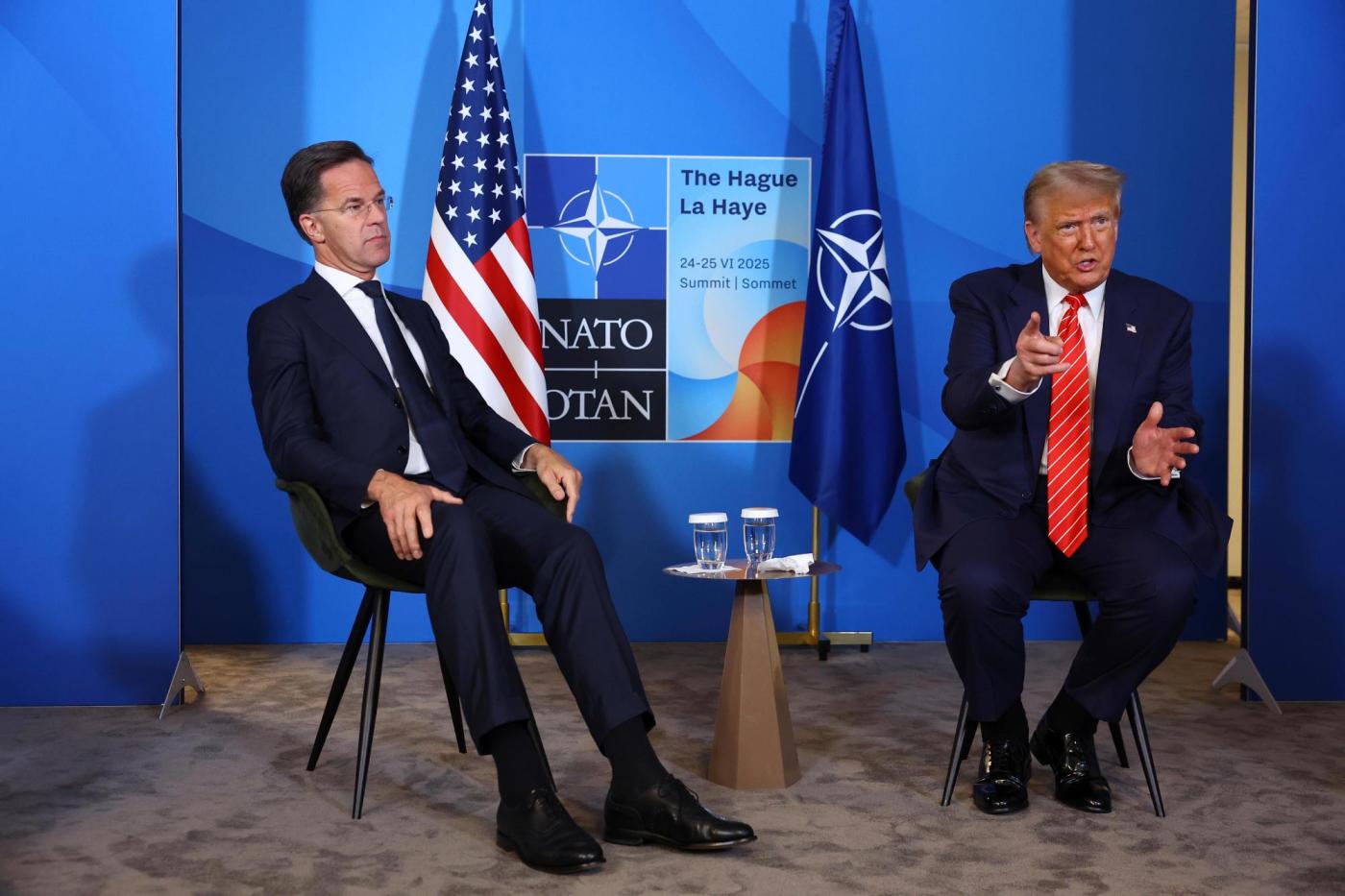
THE HAGUE, Netherlands (AP) — NATO leaders agreed on Wednesday on a massive hike in defense spending after pressure from U.S. President Donald Trump, and expressed their “ironclad commitment” to come to each other’s aid if attacked.
Related Articles
Today in History: June 25, former White House counsel begins testifying on Watergate scandal
Royal upgrade: Trump will stay at the Dutch king’s palace during his NATO visit
Early US intelligence report suggests US strikes only set back Iran’s nuclear program by months
Trump administration authorizes $30 million for Israeli-backed group distributing food in Gaza
Trump is trying to script the perfect ending to war in Iran. Will the rest of the world go along?
The 32 leaders endorsed a final summit statement saying: “Allies commit to invest 5% of GDP annually on core defense requirements as well as defense- and security-related spending by 2035 to ensure our individual and collective obligations.”
Spain had already officially announced that it cannot meet the target, and others have voiced reservations, but the investment pledge includes a review of spending in 2029 to monitor progress and reassess the security threat posed by Russia.
The leaders also underlined their “ironclad commitment” to NATO’s collective security guarantee – “that an attack on one is an attack on all.” Ahead of the summit, Trump had again raised doubts over whether the United States would defend its allies.
The show of unity vindicated NATO Secretary-General Mark Rutte’s billing of the summit as “transformational,” even though it papered over divisions. The spending pledge sets European allies and Canada on a steep path toward significant military investment.
The spending hike requires each countries to spend billions of dollars. It comes as the United States — NATO’s biggest-spending member — shifts its attention away from Europe to focus on security priorities elsewhere, notably in the Middle East and Indo-Pacific.
But ahead of the meeting, Spain announced that it would not be able to reach the target by the new 2035 deadline, calling it “unreasonable.” Belgium signaled that it would not get there either, and Slovakia said it reserves the right to decide its own defense spending.
Many European countries face major economic challenges, and Trump’s global tariff war could make it even harder for America’s allies to reach their targets. Some countries are already squeezing welfare and foreign aid spending to channel extra funds into their military budgets.
On Tuesday, Trump complained that “there’s a problem with Spain. Spain is not agreeing, which is very unfair to the rest of them, frankly.” He has also criticized Canada “a low payer.” In 2018, a NATO summit during Trump’s first term unraveled due to a dispute over defense spending.
But Rutte conceded that “these are difficult decisions. Let’s be honest. I mean, politicians have to make choices in scarcity. And this is not easy.” But he said: “given the threat from the Russians, given the international security situation, there is no alternative.”
NATO Secretary General Mark Rutte speaks with the media as he arrives for the NATO summit in The Hague, Netherlands, Wednesday, June 25, 2025. (AP Photo/Matthias Schrader)
Spain’s Prime Minister Pedro Sanchez arrives for a formal dinner at the Paleis Huis ten Bosch ahead of the NATO summit in The Hague, Netherlands, Tuesday, June 24, 2025. (AP Photo/Markus Schreiber)
President Donald Trump poses with Netherland’s King Willem Alexander and Netherland’s Queen Maxima at the Paleis Huis den Bosch prior to attending a NATO summit in The Hague, Netherlands, Wednesday, June 25, 2025. (Frank van Beek, Pool Photo via AP)
Finland’s President Alexander Stubb speaks with the media as he arrives for the NATO summit in The Hague, Netherlands, Wednesday, June 25, 2025. (AP Photo/Matthias Schrader)
Britain’s Prime Minister Keir Starmer speaks to the media as he arrives for the NATO summit of heads of state and government in The Hague Wednesday, June 25, 2025. (Ben Stansall/Pool Photo via AP)
1 of 5
NATO Secretary General Mark Rutte speaks with the media as he arrives for the NATO summit in The Hague, Netherlands, Wednesday, June 25, 2025. (AP Photo/Matthias Schrader)
Russia’s neighbors lead the pack in boosting spending
Other countries closer to the borders of Russia and Ukraine — Poland, the three Baltic states and Nordic countries — have committed to the goal, as have NATO’s European heavyweights Britain, France, Germany and the Netherlands.
“This is a big win, I think, for both President Trump and I think it’s also a big win for Europe,” Finnish President Alexander Stubb told reporters. “We’re witnessing the birth of a new NATO, which means a more balanced NATO.”
He said it would take nations “back to the defense expenditure levels of the Cold War.” NATO countries started to cut their military budgets in safer times after the Berlin Wall collapsed in 1989.
In a fresh take on Trump’s MAGA movement, Lithuanian President Gitanas Nausėda said: “We should choose a motto, ‘make NATO great again.’”
After Russia’s full-scale invasion of Ukraine in 2022, the NATO allies agreed to make 2% of GDP the minimum spending level. Last year, 22 countries were expected to hit that target, up from just three a decade ago.
In The Hague, the allies endorsed a major revamp of their spending targets. They upped the ante for what NATO calls “core defense spending” to 3.5%, while changing how it’s counted to include providing military support to Ukraine.
To hit Trump’s 5% demand, the deal set a second target of 1.5% of GDP for a broader range of defense-related spending, such as improving roads, bridges, ports and airfields so that armies can deploy more quickly, countering cyber and hybrid attack measures, or preparing societies to deal with future conflicts.
Progress will be reviewed in 2029, after the next U.S. presidential elections.
“This declaration is historic. We are 32 allies supporting that ambition, which is huge,” said Norwegian Prime Minister Jonas Gahr Støre. “We have been struggling to get above 2% and now we said 3.5%, which is necessary in order to reach our capabilities.”
Earlier this month, NATO agreed individual purchasing targets for nations to stock up on weapons and military equipment to better defend Europe, the Arctic and the North Atlantic, as part of the U.S. push to ramp up security spending.
US decision on forces in Europe expected in coming months
Extra funds will also be needed should the Trump administration announce a draw-down of forces in Europe, where around 84,000 U.S. troops are based, leaving European allies to plug any security gaps. The Pentagon is expected to announce its intentions in coming months.
Beyond Trump’s demands, European allies and Canada have steeply ramped up defense spending out of concern about the threated posed by Russia. Several countries are concerned that Russia could carry out an attack on NATO territory by the end of the decade. Hungary is not one of them, though.
“I think Russia is not strong enough to represent a real threat to us. We are far stronger,” said Hungarian Prime Minister Viktor Orbán, fielding questions from reporters, leaning back with his hands thrust into his pockets. Orbán is considered Russian President Vladimir Putin’s closest ally in Europe.
“Tenants are the majority in New York. Zohran Mamdani understands that and he gave us something to vote for,” Cea Weaver, director of the New York State Tenant Bloc, said of the candidate and expected Democratic nominee, who ran on a campaign to freeze rents for stabilized tenants.
Zohran Mamdani at a campaign rally at Terminal 5 on June 15. (Facebook/ZohranKMamdani)
Zohran Mamdani, a Queens assemblymember who ran on a campaign that promised to freeze rents for stabilized tenants and make the city more affordable, is the expected Democratic nominee in November’s general election for mayor—what housing advocates say is a win for renters.
Though an official tally of ranked choice primary ballots isn’t expected until next week, former Gov. Andrew Cuomo conceded the race Tuesday night. Unofficial early results from the city’s Board of Elections shows Mamdani with more than 44 percent of first-round votes, and Cuomo with 36 percent.
“Tenants are the majority in New York. Zohran Mamdani understands that and he gave us something to vote for,” said Cea Weaver, director of the New York State Tenant Bloc, in a statement Tuesday night.
For months, the group has been organizing thousands of canvassers in support of Democratic candidates who support a rent freeze for roughly 2 million tenants in the city’s rent-stabilized apartments.
The Rent Guidelines Board, whose members are appointed by the mayor, votes each year on allowable rent changes for those units. The current board is expected to vote next week and is considering a hike between 3.75 to 7.75 percent on two-year leases starting Oct. 1.
Mamdani pledged to freeze the rent for all four years of his term if elected. The RGB froze the rent three times under Mayor Bill de Blasio, raising it 5 percent total over eight years; its members have raised rent 9 percent in three years under Mayor Eric Adams.
Cuomo, whose mayoral bid has received millions from real estate donors, both directly and via indirect support from Super PACs, said that the board should operate independently and vote based data and the economic conditions both tenants and building owners are facing.
Landlord and property owner groups agree. They say a rent freeze will further hurt buildings already struggling with deferred maintenance and rising operational costs. The stakes are particularly high for 100-percent rent regulated buildings, which they say will further deteriorate without more substantial rent increases.
“A premeditated rent freeze is illegal,” Kenny Burgos, head of the New York Apartment Association, which represents owners of rent-regulated buildings, said in a social media post Monday.
“The Mayor appoints members to the RGB just like he appoints members to the Campaign Finance Board and the Conflicts of Interest Board,” he wrote. “These boards are created to be independent and should remain so.”
Scenes from Rent Guidelines Board’s vote in 2023. Photo by Adi Talwar.
But housing advocates say the RGB has long voted at the behest of the mayor in office, many of whom have opted to raise rents year after year, as tenants’ wages remain stagnant. A majority of renter households across the city are rent-burdened, meaning they spend more than a third of their income on housing.
“Tonight’s results send a clear message to landlord-backed politicians like Andrew Cuomo: your time is over,” Tenant BLOC’s Weaver said in statement Tuesday evening. “We are done with the status quo. We are done with struggling to stay in the city that we keep running while landlord profits skyrocket.”
Mamdani’s message appeared to resonate with primary voters, many of whom told City Limits that housing costs are among their chief priorities for the next mayor.
“It’s rough out here for people trying to make a living. I think that anything that could stabilize rent would be great,” said Kevin Rutledge, 23, a park attendant in Manhattan who said he was voting for Mamdani.
Beyond his pledged rent freeze, Mamdani’s housing plan calls for building 200,000 “publicly-subsidized, affordable, union-built, rent-stabilized homes” over the next 10 years. He says he would expand the number of units produced through existing affordability programs for seniors and extremely low-income households (those earning less than $72,000 a year for a family of four), and would “fully fund and staff” the city’s housing agencies.
He says he would pay for his plan by raising $70 million via municipal bonds, and by pooling funds from rental assistance programs (like CityFHEPS) to finance affordable and supportive housing projects.
“I will fight for a city that works for you, that is affordable for you, that is safe for you,” the Queens lawmaker said in a speech to supporters Tuesday night.
Cuomo may still run as an independent in the general election on Nov. 4. Incumbent Mayor Eric Adams is also running as an independent, as is attorney Jim Walden. Guardian Angels founder Curtis Sliwa is running as Republican.
With reporting by Patrick Spauster and Tareq Saghie.
To reach the editor, contact Jeanmarie@citylimits.org. Want to republish this story? Find City Limits’ reprint policy here.