Trump’s budget bill could complicate 2026 tax filing season after IRS cuts, watchdog warns

posted in: All news | 0

By FATIMA HUSSEIN

WASHINGTON (AP) — The budget bill championed by President Donald Trump could complicate next year’s tax filing season after the IRS lost one-quarter of its employees through staffing cuts, an independent watchdog reported Wednesday.

The IRS workforce has fallen from 102,113 workers to 75,702 over the past year, according to the latest National Taxpayer Advocate report to Congress. The report Wednesday offered the first official numbers on the IRS job losses associated with Elon Musk’s Department of Government Efficiency.

Most of the employees took the “fork in the road” resignation offer from DOGE rather than waiting to get laid off.

Some of the findings from the report:

Taxpayers will likely see effects of staffing reductions

The Trump administration’s efforts to shrink the size of the federal bureaucracy led to a mass exodus of probationary employees who had not yet gained civil service protections and were offered buyouts through a “deferred resignation program.” More than 17,500 IRS workers took that route. The biggest cuts were in taxpayer services, the small business/self-employed office and information technology.

The report noted that the Republican administration’s proposed budget includes a 20% reduction in IRS funding next year. That’s a 37% reduction when taking into account the supplemental funding in the Biden-era Inflation Reduction Act that Republicans previously stripped away.

“A reduction of that magnitude is likely to impact taxpayers and potentially the revenue collected,” wrote Erin M. Collins, who leads the organization assigned to protect taxpayers’ rights.

The 2026 tax season could be precarious

Collins said the 2025 filing season was “one of the most successful filing seasons in recent memory,” though she warned that the 2026 season could be rocky.

“With the IRS workforce reduced by 26% and significant tax law changes on the horizon, there are risks to next year’s filing season,” Collins wrote. “It is critical that the IRS begin to take steps now to prepare.”

She said that, halfway through the year, there were concerns that the IRS had not yet undertaken key preparation steps, including hiring and training seasonal and permanent employees.

Trump’s package could add new layer of problems

The report warned about the possibility of understaffing to manage new provisions from Trump’s legislative package if it’s enacted.

“Several provisions will retroactively affect the 2025 tax year, thus impacting millions of taxpayers and requiring the IRS to quickly update tax year 2025 tax forms and programming for the 2026 filing season,” the report said.

Related Articles


Trump defends US strikes on Iran as intel assessment stirs debate


How US adults’ views on same-sex marriage have changed since the Supreme Court’s 2015 ruling


What’s in and out of Trump’s big bill as Senate races to meet Fourth of July deadline


Texas will put warning labels on some foods, but its additives list has inaccuracies


Royal upgrade: Trump will stay at the Dutch king’s palace during his NATO visit

Specifically, the House bill retroactively prohibits the IRS from allowing or making payment of Employee Retention Credit claims filed after Jan. 31, 2024.

The report also said the IRS historically receives more calls in years following significant changes in tax law, so it may need additional employees and improved digital tools to maintain its level of service.

Identity theft cases are still piling up

The IRS is dealing with delays in resolving self-reported identity theft victim assistance cases — taking up to 20 months to resolve, the report said.

As of the end of the 2025 filing season, the IRS was handling about 387,000 of these cases.

That is a slight improvement from the more than 22 months it took to resolve identity theft cases, as noted in last year’s report, which outlined roughly 500,000 unresolved cases in its inventory.

“The cycle time remains unacceptably long,” Collins said. “I continue to urge the agency to focus on dramatically shortening the time it takes” to resolved identity theft cases, “so it does not force victims, particularly those dependent on their tax refunds, to wait nearly two years to receive their money.”


Kilmar Abrego Garcia is expected to be released from jail only to be taken into immigration custody

posted in: All news | 0

By TRAVIS LOLLER

NASHVILLE, Tenn. (AP) — Kilmar Abrego Garcia is expected to be released from jail in Tennessee on Wednesday, only to be taken into immigration custody.

Related Articles


How US adults’ views on same-sex marriage have changed since the Supreme Court’s 2015 ruling


Today in History: June 25, former White House counsel begins testifying on Watergate scandal


Musk’s ‘robotaxis’ draw regulatory scrutiny after video shows one driving in an opposing lane


Cargo ship carrying new vehicles to Mexico sinks in the North Pacific weeks after catching fire


California dog trainer charged with animal cruelty, evidence destruction in deaths of 11 dogs

The Salvadoran national whose mistaken deportation became a flashpoint in the fight over President Donald Trump’s immigration policies has been in jail since he was returned to the U.S. on June 7, facing two counts of human smuggling.

On Sunday, U.S. Magistrate Judge Barbara Holmes ruled that Abrego Garcia does not have to remain in jail ahead of that trial. On Wednesday afternoon, she will set his conditions of release and allow him to go, according to her order. However, both his defense attorneys and prosecutors have said they expect him to be taken into custody by U.S. Immigration and Customs Enforcement as soon as he is released on the criminal charges.

In addition, federal prosecutors are appealing Holmes’ release order. Among other things, they expressed concern in a motion filed on Sunday that Abrego Garcia could be deported before he faces trial. Holmes has said previously that she won’t step between the Department of Justice and the Department of Homeland Security. It is up to them to decide whether they want to deport Abrego Garcia or prosecute him.

Abrego Garcia pleaded not guilty on June 13 to smuggling charges that his attorneys have characterized as an attempt to justify his mistaken deportation in March to a notorious prison in El Salvador.

Those charges stem from a 2022 traffic stop for speeding in Tennessee during which Abrego Garcia was driving a vehicle with nine passengers. At his detention hearing, Homeland Security Special Agent Peter Joseph testified that he did not begin investigating Abrego Garcia until April of this year.

Holmes said in her Sunday ruling that federal prosecutors failed to show that Abrego Garcia was a flight risk or a danger to the community. He has lived for more than a decade in Maryland, where he and his American wife are raising three children.

However, Holmes referred to her own ruling as “little more than an academic exercise,” noting that ICE plans to detain him. It is less clear what will happen after that. Although he can’t be deported to El Salvador — where an immigration judge found he faces a credible threat from gangs — he is still deportable to a third country as long as that country agrees to not send him to El Salvador.

Minnesota hospitals report slight uptick in ‘adverse health events’

posted in: All news | 0

The number of adverse health events reported in Minnesota’s hospitals has increased slightly, the smallest increase since the start of the COVID-19 pandemic, according to the Minnesota Department of Health’s 2025 report.

From Oct. 7, 2023, to Oct. 6, 2024, Minnesota’s hospitals and ambulatory surgical centers reported 624 adverse health events, or AHEs. That is up from the 610 reported in the previous year, though the report notes that the number of surgeries and procedures performed in the state also increased.

Minnesota has reported more adverse health events since the onset of the COVID-19 pandemic; in report years 2015 through 2020, the state averaged between 300 and 400 events per year.

“We are glad to see the rate of increase in the number of adverse health events beginning to slow,” said Minnesota Commissioner of Health Dr. Brooke Cunningham. “Thankfully, these types of patient harms continue to be rare when viewed against overall volume. However, we believe many, if not most, of these events are preventable and we are committed to working with providers through education and analysis to advocate for patient safety.”

In Minnesota, hospitals (federal facilities excluded) and surgical centers are required to report 29 types of “often preventable errors that could lead to serious injury or death,” per MDH. Those events include medication errors, wrong-site surgery and physical assaults against patients or staff that result in serious injury or death.

Falls and pressure ulcers, also known as bed sores, are the two most common AHEs reported in Minnesota.

In this report year, the number of wrong-site and wrong-surgery events increased, while medication errors dropped by 44% over the previous year.

In Rochester, Mayo Clinic Hospital reported 84 AHEs during the report year, a 58.5% increase from the 53 events in last year’s report. No deaths occurred due to these events, but 28 resulted in serious injury. More than half (47) of Mayo Clinic Hospital’s AHEs were stage 3, 4 or unstageable pressure ulcers.

Additionally, there were 10 falls that resulted in serious injury, and 12 surgical AHEs: six wrong procedure events and six instances of “retention of a foreign object in a patient after surgery.”

In its press release, MDH said a “portion” of the AHEs recorded in 2024 could be attributed to patients’ longer stays in the hospital.

“The high level of lengths of stay can stem from things like increased patient complexity due to delayed care, Minnesota’s aging population, systemic issues with discharge delays and limited bed availability at the next level of care due to continued workforce challenges,” MDH said.

“We are seeing higher acuity patients that need longer lengths of stay to meet their needs,” added Jennifer Schoenecker, associate vice president of quality and safety at the Minnesota Hospital Association. “We’re also seeing that it can be challenging to find the appropriate discharge placement when our patients are ready to leave our hospitals and health systems.”

More acute medical needs could also be a factor in the 8.5% increase in procedures and surgeries performed year-over-year.

“It could be some catch-up from previous COVID years where some of those procedures may have been postponed,” Schoenecker said. “And it could be due to just the overall acuity and complexity of the patients we’re serving now.”

To bring the number of AHEs down to pre-pandemic levels, Schoenecker said an emphasis on patient safety needs to continue.

“There’s a lot we learn from the events that are reported,” Schoenecker said. “We want to continue to analyze those events, learn and then spread those learnings throughout the state. … Just continuing that commitment to a culture of safety.”

Related Articles


Lilly’s experimental obesity pill holds up to scrutiny in trial


‘Problematic’ MAHA report minimizes success of lifesaving asthma medicines, doctors say


AI is influencing women’s health in new ways, from fertility to menopause


The number of abortions kept rising in 2024 because of telehealth prescriptions, report finds


Health insurers promise to improve coverage reviews that prompt delays and complaints

How US adults’ views on same-sex marriage have changed since the Supreme Court’s 2015 ruling

posted in: All news | 0

By LINLEY SANDERS

WASHINGTON (AP) — For years, it looked as though the United States was steadily climbing toward a consensus on same-sex marriage. But 10 years after the Supreme Court ruled that there is a constitutional right to same-sex marriage, the split between Republicans and Democrats on the issue is wider than it’s been in decades.

Recent polling from Gallup shows that Americans’ support for same-sex marriage is higher than it was in 2015. Gallup’s latest data, however, finds a 47-percentage-point gap on the issue between Republicans and Democrats, the largest since it first began tracking this measure 29 years ago.

The size of that chasm is partially due to a substantial dip in support among Republicans since 2023.

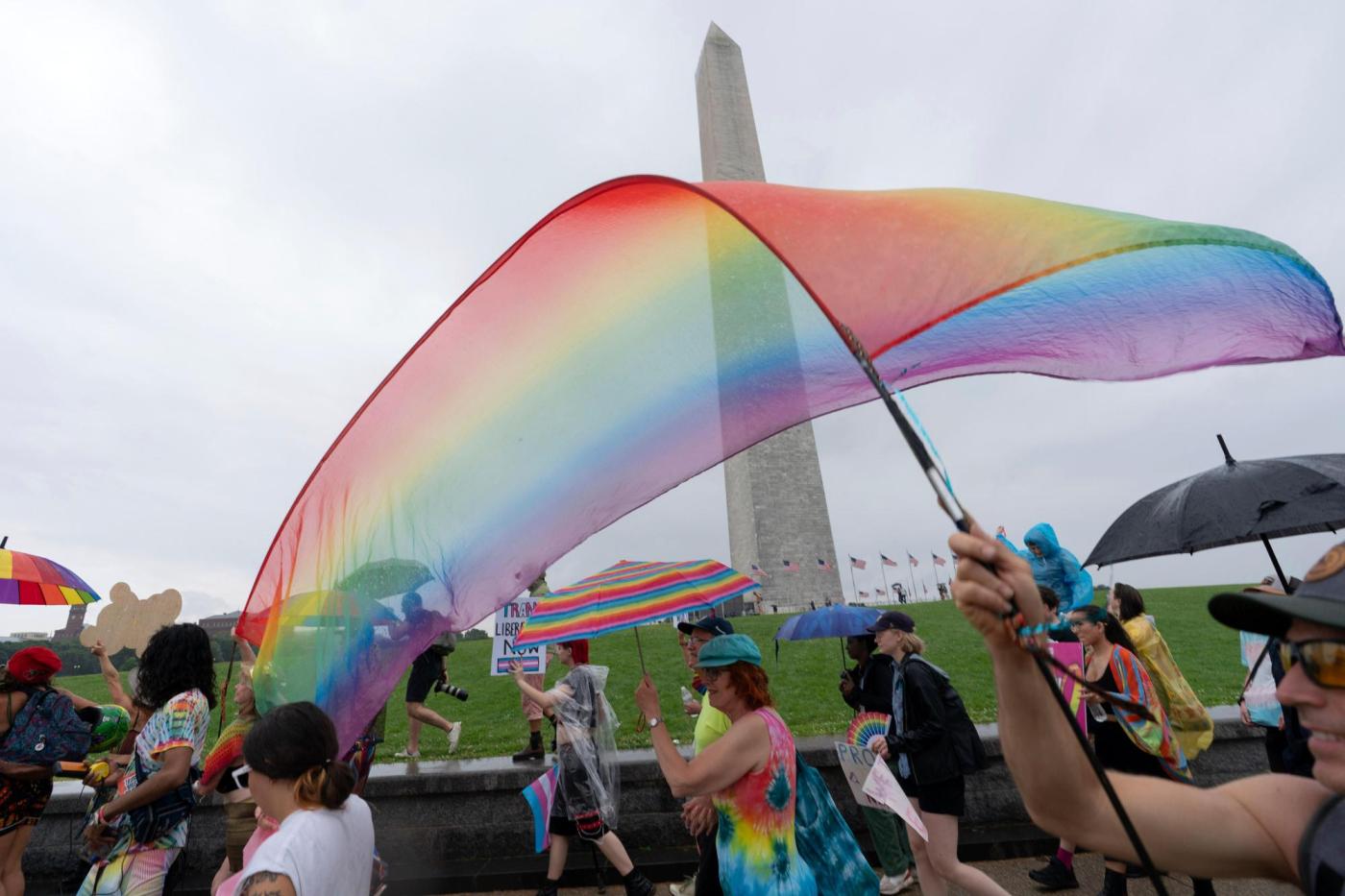
People participate in the World Pride Rally at the Lincoln Memorial, Sunday, June 8, 2025, in Washington. (AP Photo/Jose Luis Magana)

An Associated Press polling analysis shows how same-sex marriage shifted from a clear minority position to a stance with broad support — and what the future could hold for views on the issue.

Same-sex marriage was once highly unpopular

Less than 40 years ago, same-sex marriage was a deeply unpopular issue.

In 1988, The General Social Survey showed that just about 1 in 10 U.S. adults “strongly agreed” or “agreed” with a statement that gay couples should have the right to marry. At that point, roughly 7 in 10 Americans — including similar shares of Democrats and Republicans — disagreed with the statement.

But as early as the 1990s, the politics of same-sex marriage were shifting. Gallup data from 1996 — the year the Defense of Marriage Act defined marriage as between one man and one woman — showed that 27% of U.S. adults said marriages between same-sex partners “should be recognized by the law as valid.” But Democrats and Republicans weren’t in lockstep anymore: Democrats were nearly twice as likely as Republicans to support legal recognition of same-sex marriages.

Democrats’ support for same-sex marriage shifted faster

By 2004, the legalization of same-sex marriage started to unfold at the state level. That year, Massachusetts became the first state to allow same-sex couples to marry. President George W. Bush, a Republican, championed a constitutional amendment to ban same-sex marriage on the campaign trail, while Democrats vying for their party’s 2004 presidential nomination said the legalization of same-sex marriage should be left to the states.

Related Articles


Today in History: June 25, former White House counsel begins testifying on Watergate scandal


Musk’s ‘robotaxis’ draw regulatory scrutiny after video shows one driving in an opposing lane


Cargo ship carrying new vehicles to Mexico sinks in the North Pacific weeks after catching fire


California dog trainer charged with animal cruelty, evidence destruction in deaths of 11 dogs


Anthropic wins ruling on AI training in copyright lawsuit but must face trial on pirated books

At this time, Americans’ support for same-sex marriage was still somewhat limited, and the divide between Republicans and Democrats deepened. About 4 in 10 U.S. adults agreed that same-sex marriage should be permitted, according to the Gallup data. Among Democrats, that agreement was higher — about half were in favor — compared with 22% of Republicans.

Since then, Americans’ upward movement on support for same-sex marriage has been driven by Democrats and independents. Throughout Gallup’s trend, Democrats have been more supportive of same-sex marriage than Republicans have. Since 2006, at least half of Democrats have supported same-sex marriage, and independents started to see consistent majority support in 2012.

The gap between Democrats and Republicans, meanwhile, stayed wide. By 2015, the year of the Supreme Court’s ruling, about three-quarters of Democrats — but only about one-third of Republicans — supported same-sex marriage.

But Republicans did become somewhat more supportive of same-sex marriage between 2010 and 2020. While Democrats continued to lead the shift, Republican public opinion also moved during this decade — signaling a broader movement toward acceptance of same-sex marriage across party lines, even if it wasn’t always linear.

Republicans’ support for same-sex marriage dropped in recent years

About 7 in 10 Americans think marriages between same-sex partners should be recognized by the law as valid, according to Gallup data from this year, which is similar to the latest General Social Survey data showing 63% of U.S. adults agree that same-sex marriage should be considered a right.

But while the public’s support for same-sex marriage ticked up in the years following the Obergefell v. Hodges ruling — from about 60% in 2015 — it has been relatively steady since 2020.

At the same time, Republicans’ support has fallen in each of the past three years. Now, about 4 in 10 Republicans say marriages between same-sex partners should be recognized as legal, down from a record high of 55% in 2021 and 2022. This latest decline by Republicans returns their views to their 2016 measure, when 40% supported legal same-sex marriage.

Gallup Senior Editor Megan Brenan said Republicans’ recent shift in opinion on same-sex marriage is dramatic.

“This was a much steeper fall from 2022 through 2025,” she said. “And now, of course, we have the widest partisan gap that we’ve seen in the trends.”

Younger and older Republicans split on same-sex marriage

Even as overall Republican support for same-sex marriage declines, a generational split within the party suggests that opposition may not hold in the long run.

Among Republicans under age 50, about 6 in 10 say same-sex marriages should be legally recognized, the Gallup poll finds. That stands in stark contrast to just 36% of Republicans over 50 who say the same —- suggesting that views on the issue could continue to shift.

Overall, younger adults are significantly more likely to support legal recognition of same-sex marriage. About 8 in 10 adults under 35 are in favor, compared with roughly 7 in 10 between ages 35 and 54 and 6 in 10 among those 55 or older.

Brenan noted that younger Americans are more accepting of same-sex marriage than older adults are, and it’s an issue that especially appears to divide Republicans today.

“I think that’s a key to where things will be headed, presumably,” Brenan said. “Historically, people have become more conservative as they age, but this is an issue that’s so ingrained in society today and especially younger society.”