Former Ramsey County Housing Stability Director Keith Lattimore’s last day with the county was Aug. 12. Former county Deputy Director of Housing Stability Kimberly Cleminson’s last day was Aug. 20, county officials confirmed Wednesday.
A call to an attorney for Care Chexx, the company Lattimore founded which was providing recuperative care services at a hotel in Brooklyn Center, was not immediately returned Wednesday. Cleminson was listed as a partner with Care Chexx.
County officials did not say Wednesday whether Lattimore and Cleminson resigned or were let go. They also did not provide information on the current status of the investigation.
A call to Bryan Huntington, the attorney for Care Chexx and BC Seva LLC, the hotel’s owner, was not returned Tuesday.
In late June the Brooklyn Center city council revoked the hotel Suburban Studio’s license after city staff discovered the medical respite facility serving homeless individuals was operating on its the premises.
Care Chexx which began providing recuperative care services at the hotel in June under a management and operations agreement with the hotel. Cleminson is listed as a partner with Care Chexx on its website.
County officials initiated an internal investigation in July “when we learned of a potential county involvement with the business,” officials said.
The Brooklyn Center city council approved a stay of revocation of the hotel’s license during its July 14 meeting, under the condition that Care Chexx may not operate there.
An open housing stability director position was posted online by county officials on Aug. 20 and lists an annual salary of $119,516.80 to $179,275.20.
Naly Yang is serving as interim director in partnership with Economic Growth and Community Investment Deputy County Manager Kari Collins. Yang previously served as a planning manager and has been with the county for more than 18 years.
Related Articles
Alexander Ramsey High’s class of ’75 finds time capsule, memories
Class 6A football team previews: East Ridge, Forest Lake, Mounds View
New cellphone policies for many students this year. How have others worked?
Tuesday primary to pick DFL nominee for former Sen. Nicole Mitchell’s seat
The Fair is on: How to get there, what to know about Falcon Heights parking
By KATE PAYNE and MIKE SCHNEIDER, Associated Press
TALLAHASSEE, Fla. (AP) — A top Florida official says the controversial state-run immigration detention facility in the Everglades will likely be empty in a matter of days, even as Republican Gov. Ron DeSantis’ administration and the federal government fight a judge’s order to shutter the facility dubbed “Alligator Alcatraz” by late October. That’s according to an email exchange shared with The Associated Press.
In a message sent to South Florida Rabbi Mario Rojzman on Aug. 22 related to providing chaplaincy services at the facility, Florida Division of Emergency Management Executive Director Kevin Guthrie said “we are probably going to be down to 0 individuals within a few days.” Rojzman, and the executive assistant who sent the original email to Guthrie, both confirmed the veracity of the messages to the AP.
A spokesperson for Guthrie, whose agency has overseen the construction and operation of the site, did not immediately respond to a request for comment.
FILE – President Donald Trump tours “Alligator Alcatraz,” a new migrant detention facility at Dade-Collier Training and Transition facility, on July 1, 2025, in Ochopee, Fla. (AP Photo/Evan Vucci, File)
News that the last detainee at “Alligator Alcatraz” could leave the facility within days came less than a week after a federal judge in Miami ordered the detention center to wind down operations, with the last detainee needing to be out within 60 days. The state of Florida appealed the decision, and the federal government asked U.S. District Judge Kathleen Williams to put her order on hold pending the appeal, saying that the Everglades facility’s thousands of beds were badly needed since detention facilities in Florida were overcrowded.
The environmental groups and the Miccosukee Tribe, whose lawsuit led to the judge’s ruling, opposed the request. They disputed that the Everglades facility was needed, especially as Florida plans to open a second immigration detention facility in north Florida that DeSantis has dubbed “Deportation Depot.” During a tour of the South Florida facility last week, U.S. Rep. Maxwell Frost, D-Fla., said he was told that only a fraction of the detention center’s capacity was in use, between 300 to 350 detainees.
Williams had not ruled on the stay request as of Wednesday.
Related Articles
Unions seek broader foothold in the South as workers vote at an EV battery plant in Kentucky
The Colorado River is in trouble. Some groups want the government to step up
Prosecutors fail to indict sandwich thrower in Trump’s Washington public safety operation
Wall Street edges higher as the market awaits Nvidia’s quarterly report
US deportation flights hit record highs as carriers try to hide the planes, advocates say
The judge said in her order that she expected the population of the facility to decline within 60 days by transferring detainees to other facilities, and once that happened, fencing, lighting and generators should be removed. She wrote the state and federal defendants can’t bring anyone other than those who are already being detained at the facility onto the property.
Environmental groups and the Miccosukee Tribe had argued in their lawsuit that further construction and operations should be stopped until federal and state officials complied with federal environmental laws. Their lawsuit claimed the facility threatened environmentally sensitive wetlands that are home to protected plants and animals and would reverse billions of dollars spent over decades on environmental restoration.
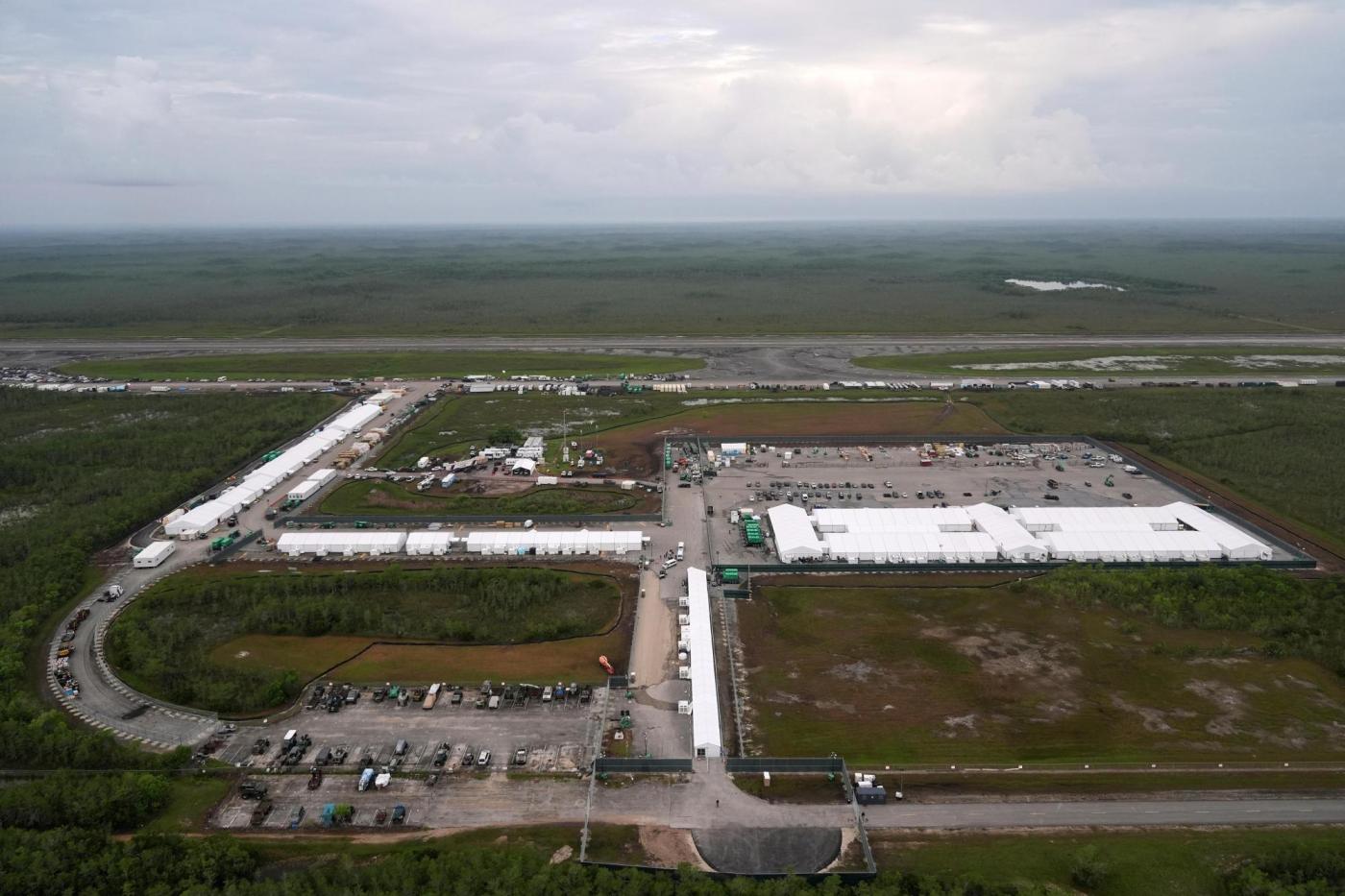
The detention center was built rapidly two months ago at a lightly used, single-runway training airport in the middle of the rugged and remote Everglades. State officials have signed more than $245 million in contracts for building and operating the facility, which officially opened July 1.
Associated Press writer Mike Schneider in Orlando contributed to this report. Kate Payne is a corps member for The Associated Press/Report for America Statehouse News Initiative. Report for America is a nonprofit national service program that places journalists in local newsrooms to report on undercovered issues.
OMAHA, Neb. (AP) — U.S. production of crucial components in electric vehicles, smartphones and fighter jets is set to expand rapidly in the coming years, as the Trump administration intensifies efforts to build up the critical mineral industry in the United States to work to break the chokehold that China has on the global supply chain.
Related Articles
Trump’s push to oust Fed’s Lisa Cook unites anti-DEI effort, bid to control independent institutions
Emboldened Democrats are starting to push back on Trump’s immigration plans
Trump extends control over Washington by taking management of Union Station away from Amtrak
Trump’s Intel stake sparks cries of ‘socialism’ from his party, but he vows more deals are coming
US to host talks on post-war Gaza as Israel calls Gaza City evacuation ‘inevitable’
The federal government is pumping hundreds of millions of dollars into American companies, has made an agreement with one firm to set a minimum price for some U.S.-produced critical minerals, and has launched an investigation into foreign-made supplies.
“This is the Manhattan Project moment for rare earths,” said Joshua Ballard, CEO of USA Rare Earth, which plans next year to start making the rare-earth magnets that appear in many products.
The White House has made it a priority to revive the domestic critical minerals industry, which is proving urgent after Beijing leveraged its near-monopoly on the products to force the U.S. to the negotiating table during a trade war.
President Donald Trump said this week that China “intelligently went and they sort of took a monopoly of the world’s magnets,” but he expressed confidence in securing supplies because the U.S. has “much bigger and better cards.”
“We’re going to have a lot of magnets in a pretty short period of time. In fact, we’ll have so many, we won’t know what to do with them,” he said as he hosted South Korean President Lee Jae Myung.
Critical minerals have been tied to national security
Industry insiders, analysts and lawmakers have warned for years that America’s dependence on China for critical minerals — a list of 50 minerals that includes 17 sought-after rare-earth elements — is a national vulnerability.
The hard-to-pronounce elements are needed in smartphones, wind turbines and robots as well as missiles, submarines and fighter jets.
“Our national and economic security are now acutely threatened by our reliance upon hostile foreign powers’ mineral production,” an executive order from Trump declared in March.
It was not until Beijing rolled out export restrictions on several rare earths in April — leading to a temporary halt of Ford’s electric vehicle production — that “the problem that for over a decade seemed far away hit close to home,” said Gracelin Baskaran, director of the Critical Minerals Security Program at the Washington-based Center for Strategic and International Studies.
Trump said Monday that he could charge 200% tariffs on Chinese goods if Beijing does not export magnets to the U.S. but noted “that’s perhaps behind us.” Instead, he said he could withhold airplane parts to ground China’s American-made Boeing jets.
When asked about the leverage, Guo Jiakun, a Chinese foreign ministry spokesman, said Tuesday that Beijing “follows the principle of mutual respect, peaceful coexistence and mutually beneficial cooperation” in dealing with the U.S.
“We hope the U.S. will work with us to jointly promote the steady, sound and sustainable development of bilateral ties,” Guo said.
The critical minerals industry welcomes support
The Pentagon is investing $400 million in rare-earth producer MP Materials. It gave the U.S. company a $150 million loan this month, has promised to ensure every magnet made at its massive new plant is bought and set a minimum price for its neodymium and praseodymium products for a decade.
“It looks like we’re going to finally do something to address that issue and make these projects a reality,” said Mark Smith, CEO of NioCorp, an American company working to raise $1.2 billion to produce niobium, titanium, scandium and rare earths in Nebraska.
Over four decades, Smith said he’s seen how the U.S. ceded the industry to China, which came to dominate the supply chain by brushing aside environmental concerns, investing in mines worldwide, developing advanced processing technology and setting low prices to squeeze out competition.
Previous efforts by U.S. companies to eke out a viable business proved futile when China flooded the market with low-priced products, chasing away potential investors.
This photo provided by NioCorp shows workers setting up a massive drilling rig in southeast Nebraska to extract core samples from hundreds of feet beneath the ground near Elk Creek where NioCorp hopes to build a rare earths mine. (NioCorp via AP)
This photo provided by NioCorp shows geologists examining core samples taken from under southeast Nebraska near Elk Creek where NioCorp hopes to build a rare earths mine one day. (NioCorp via AP)
This photo provided by NioCorp shows workers cutting core samples taken from underneath southeast Nebraska into sections this summer so NioCorp could send them to a lab to analyze their rare earths content. (NioCorp via AP)
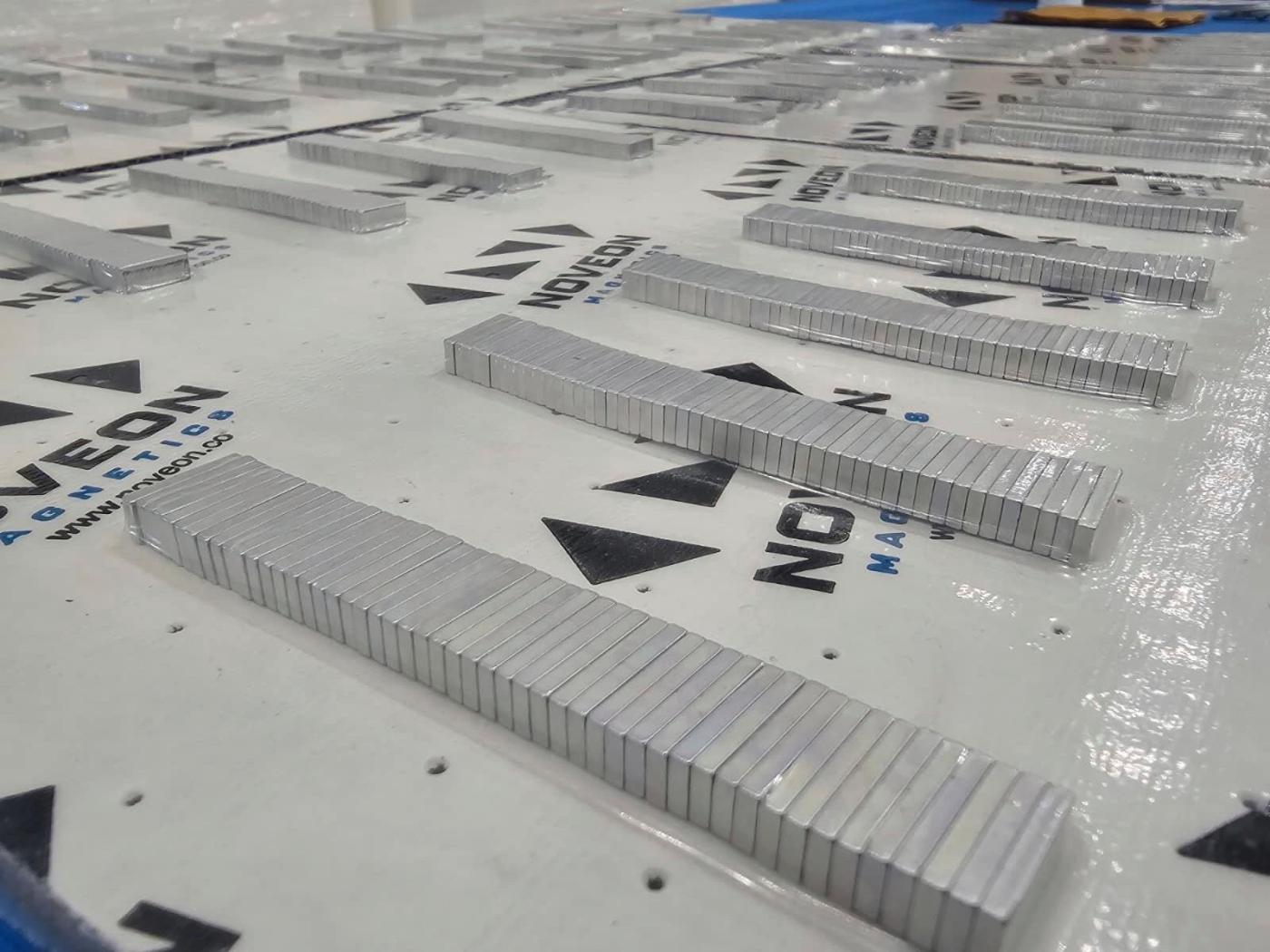
This photo provided by Noveon Magnetics, the Noveon Magnetics logo is visible inside the company’s rare earth magnets plant in San Marcos, Texas. (Noveon Magnetics via AP)
This photo provided by Noveon Magnetics, a row of specialized furnaces that are used to produce rare earth magnets sits inside the Noveon Magnetics plant in San Marcos, Texas. (Noveon Magnetics via AP)
1 of 5
This photo provided by NioCorp shows workers setting up a massive drilling rig in southeast Nebraska to extract core samples from hundreds of feet beneath the ground near Elk Creek where NioCorp hopes to build a rare earths mine. (NioCorp via AP)
NioCorp recently secured up to $10 million from the Pentagon, which helped pay for exploratory drilling this summer.
While it is unclear if the government would extend a minimum-price deal to other U.S. companies, Smith said the current support is “unbelievable” compared with the past. A price floor, he said, “just takes away the Chinese modus operandi that they’ve had for forever.”
About 220 miles away from where MP Materials is building a magnet plant in Fort Worth, Texas, Noveon Magnetics runs America’s only factory currently making rare-earth magnets. Located south of Austin, it is ramping up production to make 2,000 tons of magnets a year.
“I certainly hope and think it actually is not what may be the last of the efforts by the U.S. government,” Noveon Magnetics CEO Scott Dunn said of the Pentagon-MP Materials partnership.
Even with all the new production aiming to come online in the next few years, American companies are still nowhere near being able to satisfy North America’s demand for roughly 35,000 tons of magnets a year, analysts at Benchmark Mineral Intelligence estimate. And the demand could double in the next decade.
Ballard, whose USA Rare Earth plans to start making about 600 tons of magnets in Oklahoma next year, said the government can provide incentives to stop American buyers from falling back on cheap Chinese products once they are widely available again.
US government ramps up investments
This year’s big tax and spending cut bill includes $2 billion for the Pentagon to boost the U.S. stockpile of critical minerals and $5 billion more through 2029 to invest in those supply chains.
Between 2020 and 2024, the Pentagon said it had awarded more than $439 million to establish supply chains for domestic rare earths.
Domestic investments aside, Trump has tried to secure access to critical minerals outside of the U.S., including from Greenland and Ukraine. A peace deal the administration helped broker between the Democratic Republic of Congo and Rwanda might provide access to critical minerals, but it’s too early to tell if those efforts will succeed.
Some say a deal with Beijing still is needed
Derek Scissors, senior fellow at the American Enterprise Institute, said he’s concerned that Trump could consider it a success if China agrees to guarantee rare-earth supplies in trade talks.
“I don’t think there will be such a deal or, if there is, that it will last,” Scissors said. “But it is a threat to U.S. economic independence.”
David Abraham, a rare-metals expert who wrote the book “The Elements of Power,” said new U.S. mines are years away.
“Everyone agrees the U.S. still has to work out a deal with the Chinese because American companies need more rare earths and specialized magnets than can be produced domestically,” he said.
“Sweeps, crackdowns, and mass hospitalizations may make homelessness less visible for a moment, but they don’t solve it. They just push suffering out of view—until it resurfaces again, often worse.”
Ambulances outside Lincoln Medical Center in the Bronx. (Adi Talwar/City Limits)
I met a man I’ll call “Darrell” near Chelsea Park in Manhattan. He was sitting quietly on a bench, dressed neatly but clearly weathered by life on the street. I offered him a cup of lemonade, and soon he was telling me his story—how he went from stability to homelessness.
Darrell was diagnosed with schizophrenia in his teens. He struggled through college but found a treatment plan that worked. He held a steady job with health insurance that kept him medicated and stable—until 2020, when the pandemic cost him his job, his insurance, and eventually, his grip on reality. Without meds, the voices came back. He stopped looking for work and knew he needed government-subsidized healthcare before things spiraled further. But once he finally received benefits, the earliest psychiatric appointment he could get was eight weeks out.
Darrell’s story isn’t unique. In my 15 years working with people experiencing homelessness in New York and New Jersey, I’ve met hundreds like him. Contrary to popular belief, most aren’t refusing help—they’re caught in systems that are underfunded, understaffed, and overwhelmed. We often call people “service resistant,” but in reality, it’s the services themselves that resist people.
That’s why the recent show of force in Washington, D.C., in response to President Donald Trump’s order that “the homeless have to move out IMMEDIATELY,” is so troubling. Not to be outdone, Mayor Eric Adams has floated his own plan to involuntarily hospitalize people with untreated mental illness or drug use in New York City.
Both Trump and Adams are trying to frame coercion as compassion. But removing people from sight—whether to a hospital ward, a jail cell, or a distant encampment—without addressing the root causes only deepens the crisis and ignores research showing that forced treatment rarely works.
In practice, forced hospitalization often means hours—sometimes days—waiting in an ER hallway because no psychiatric beds are available. New York alone has lost nearly 1,000 psychiatric beds in recent years. Even when a bed is found, discharge usually comes before real stabilization, with no follow-up plan and nowhere to go. The result? More trauma, more mistrust, and more costly cycles of hospitalization, incarceration, and street homelessness.
Even if such measures provide temporary stability, the bigger question is: what next? Most cities don’t have nearly enough supportive housing—affordable apartments with built-in services to help people stay well. Waitlists stretch for months, even years. Without housing, people return to the street, and the cycle repeats.
We’ve seen this movie before. Sweeps, crackdowns, and mass hospitalizations may make homelessness less visible for a moment, but they don’t solve it. They just push suffering out of view—until it resurfaces again, often worse.
There is a better way, and we already know what it looks like. People need timely access to care, not police escorts. They need mobile mental health teams that meet them where they are. They need respite care after hospitalizations, and case managers who stick with them beyond a single crisis. And most of all, they need housing—because treatment without stability rarely lasts.
The impulse behind these high-profile crackdowns may be to respond to suffering. But homelessness and mental illness aren’t solved through control. They’re addressed through care, compassion, and infrastructure. The opposite of homelessness isn’t hospitalization—it’s housing. It’s healthcare. It’s dignity.
And it’s a system that helps people before they fall—so they don’t end up on a park bench, waiting for care that may never come. Or worse: locked in an ambulance, only to be discharged back to the same street, three days later, more broken than before.
Josiah Haken is the CEO of City Relief, a non-profit dedicated to connecting the unhoused community to hope and resources.