The U.S. women’s curling team went down to the wire in their attempt to advance to the Olympics medal round for the first time, taking a three-point lead into the 10th end and beyond.
In the end, the destination was reached.
United States’ Tabitha Peterson in action during the women’s curling round robin session against Switzerland, at the 2026 Winter Olympics, in Cortina d’Ampezzo, Italy, Thursday, Feb. 19, 2026. (AP Photo/Misper Apawu)
Switzerland used a four-point swing in the 10th end to send the match into an extra frame, but U.S. skip Tabitha Peterson used the hammer to curl a shot around three Swiss stones and rest it closest to the button to end the U.S. into the Olympic semifinals for the first time with a 7-6 victory.
The U.S. (6-3) and Switzerland (6-3) will meet again Friday for a chance to play for gold. The loser will move on to Friday’s bronze medal match.
It was a difficult task for the Americans, perhaps more difficult than it appeared it would be after their 4-1 start in round-robin play. But a surprise loss to previously winless Italy changed the trajectory.
A dominant win over Denmark gave Team Peterson — which also includes Tara Peterson, Cory Thiesse and Taylor Anderson-Heide — a chance to clinch a medal round spot with a victory in their last two pool play matches.
They had Great Britain on the ropes, up one in the 10th before skip Rebecca Morrison pulled off a two-point bank shot off a blocking stone for a 9-8, and were up by three on the Swiss before fourth Alina Paetz tied the game with a three-point hammer throw.
But Tabitha Peterson, as she has throughout round-robin play, came through in the end with a difficult winning shot, edging a pair of Swiss stones by inches to send the Americans into their first semifinal.
Because Great Britain beat Italy on Thursday, the U.S. had to beat Switzerland or be thrown into a tiebreaker situation to advance.
Related Articles
Hockey star Laila Edwards’ family cheers at Olympic debut, thanks to Kelce brothers and a GoFundMe
US hockey star Haley Winn’s three older brothers are her biggest fans online and at the rink
Olympic men’s hockey: Wild’s Hughes is OT hero as U.S. beats Sweden
Olympic women’s hockey: Dream final ahead between U.S., Canada
Women’s curling: U.S. stunned by Great Britain. Here are two paths left to medal round
WASHINGTON (AP) — Tariffs paid by midsized U.S. businesses tripled over the course of last year, new research tied to one of America’s leading banks showed on Thursday — more evidence that President Donald Trump ‘s push to charge higher taxes on imports is causing economic disruption.
The additional taxes have meant that companies that employ a combined 48 million people in the U.S. — the kinds of businesses that Trump had promised to revive — have had to find ways to absorb the new expense, by passing it along to customers in the form of higher prices, employing fewer workers or accepting lower profits.
Related Articles
Millions of eligible filers didn’t use Free File
US applications for jobless aid fall to 206,000 last week as layoffs remain low
US trade deficit declined in 2025, but gap for goods hits a record despite Trump tariffs
US stocks drift as oil prices rise on worries about a potential US-Iran conflict
Walmart delivers another quarter of impressive sales but offers a muted outlook
“That’s a big change in their cost of doing business,” said Chi Mac, business research director of the JPMorganChase Institute, which published the analysis on Thursday. “We also see some indications that they may be shifting away from transacting with China and maybe toward some other regions in Asia.”
The research doesn’t say how the additional costs are flowing through the economy, but it indicates that tariffs are being paid by U.S. firms. It’s part of a growing body of economic analyses that counter the administration’s claims that foreigners pay the tariffs.
The JPMorganChase Institute report used payments data to look at businesses that might lack the pricing power of large multinational companies to offset tariffs, but may be small enough to quickly change supply chains to minimize exposure to the tax increases. The companies tended to have revenues between $10 million and $1 billion with fewer than 500 employees, a category known as “middle market.”
The analysis suggests that the Trump administration’s goal of becoming less directly reliant on Chinese manufacturers has been occurring. Payments to China by these companies were 20% below their October 2024 levels, but it’s unclear whether that means China is simply routing its goods through other countries or if supply chains have moved.
The authors of the analysis emphasized in an interview that companies are still adjusting to the tariffs and said they plan to continue studying the issue.
The White House did not immediately respond to questions about the analysis, which showed that U.S. companies are paying tariffs that the president had previously claimed would be paid by foreign entities.
Trump imposed a series of tariffs last year for the ostensible goal of reducing the U.S. trade imbalance with other countries, so that America was not longer importing more than it exports. But trade data published Thursday by the Census Bureau showed that the trade deficit climbed last year by $25.5 billion to $1.24 trillion. The president on Wednesday posted on social media that he expected there would be a trade surplus “during this year.”
The Trump administration has been adamant that the tariffs are a boon for the economy, businesses and workers. Kevin Hassett, director of the White House National Economic Council, lashed out on Wednesday at research by the New York Federal Reserve showing that nearly 90% of the burden for Trump’s tariffs fell on U.S. companies and consumers.
“The paper is an embarrassment,” Hassett told CNBC. “It’s, I think, the worst paper I’ve ever seen in the history of the Federal Reserve system. The people associated with this paper should presumably be disciplined.”
Trump increased the average tariff rate to 13% from 2.6% last year, according to the New York Fed researchers. He declared that tariffs on some items like steel, kitchen cabinets and bathroom vanities were in the national security interest of the country — and declared an economic emergency to bypass Congress and impose a baseline tax on goods from much of the world last April at an event he called “Liberation Day.”
The high rates provoked a financial market panic, prompting Trump to walk back his rates and then engage in talks with multiple countries that led to a set of new trade frameworks. The Supreme Court is expected to rule soon on whether Trump surpassed his legal authority by declaring an economic emergency.
Trump was elected in 2024 on his promise to tame inflation, but his tariffs have contributed to voter frustration over affordability. While inflation has not spiked during Trump’s term thus far, hiring slowed sharply and a team of academic economists estimate that consumer prices were roughly 0.8 percentage points higher than they would otherwise be.
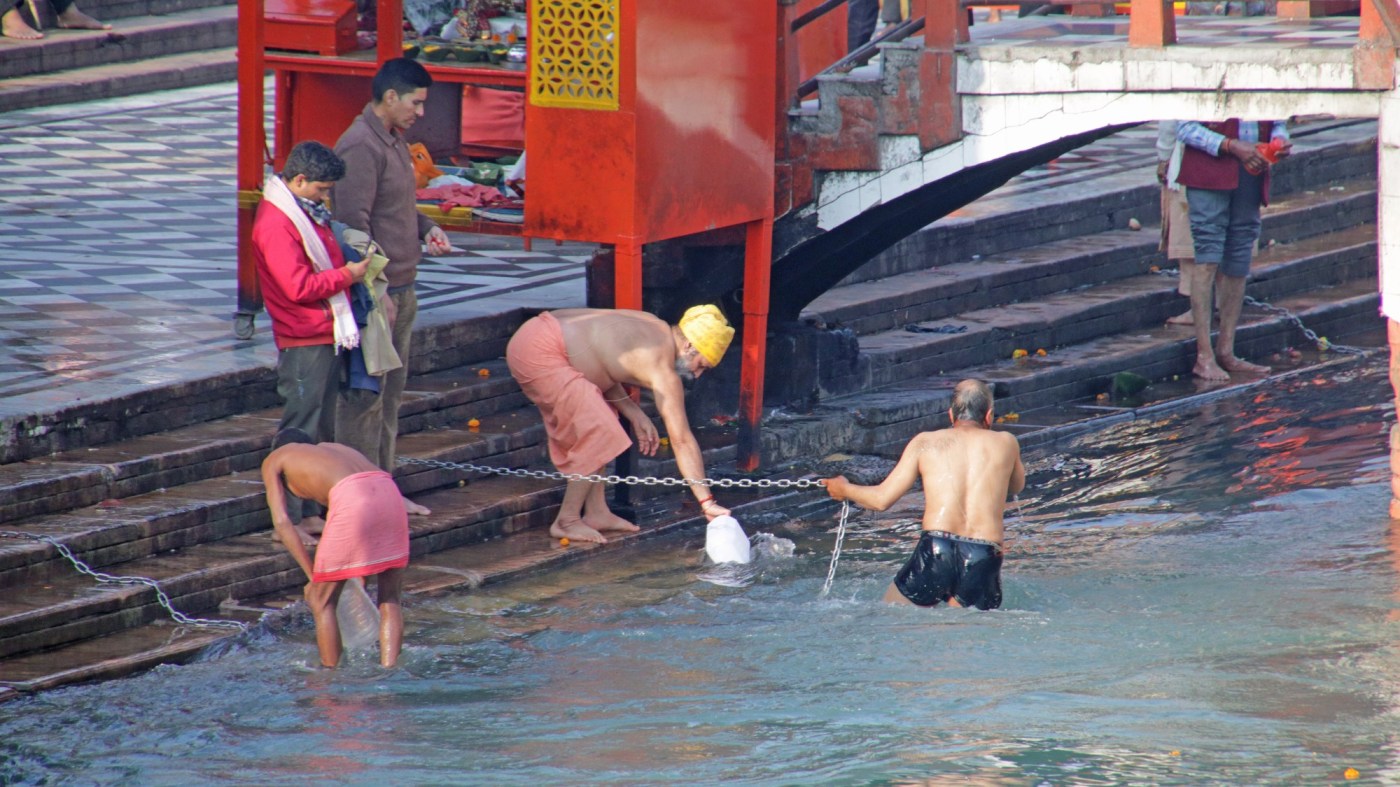
Hindu devotees fed long grasses to ribbon-adorned sacred cows as thousands of pilgrims bathed in India’s ultra-holy Ganges River to wash away their sins and cure ailments. Some soaking adherents tightly gripped iron chains secured to concrete stairs so the fast-rushing flow from the Himalayas wouldn’t fatally sweep them downstream. A young man with no legs determinedly rolled himself on a wheeled board to recite a mantra at the river’s edge. Frail elderly women, swathed in headscarves and saris, worshipped while sitting on puddled pavement near corroded metal changing lockers plastered with ads for Glow & Lovely skin cream. Men’s wet underwear briefs hung drying, an odd sight in this modest society.
Along the marigold-flecked river banks, white-cloaked Hindu priests conducted rites for families’ ancestors, whose ashes were sprinkled into the Ganges. Numerous vendors sold empty orange and clear plastic jugs that followers filled to take revered water home. Barbers, equipped with shearing scissors and razors, squatted atop mats waiting to give children their first haircut, a hallowed ceremony that eliminates bad karma of past lives and ends with the kids’ shorn locks tossed into the Ganges. Pilgrims also threw in coins as offerings, some later retrieved by impoverished people to survive.
The holy ghat Har Ki Pauri is a popular spot along the Ganges in the Hindu pilgrimage city of Haridwar. (Photo by Norma Meyer)
Understandably, I had whiplash trying to absorb vibrant, bustling Haridwar, a prime Hindu religious mecca lined with ghats, which are steps leading to the Ganges River (known as Ganga in India).
“It is not just a river, it is a goddess in the form of a river,” explained my local guide, Subhash Dobhal. In Hinduism, the deity Ganga is an eminent mother figure who purifies, pardons, and provides moksha, the ultimate eternal bliss.
The Ram Tirath Temple, near Amritsar in the Punjab state, has deep Hindu mythological roots and is linked to a medieval epic. (Photo by Norma Meyer)
Sacred cows are sometimes given as gifts to priests who perform rituals along the Ganges. These cattle are in the pilgrimage city of Haridwar. (Photo by Norma Meyer)
A monk lights prayer lamps in a room at the Dalai Lama’s temple in Dharamshala, India. (Photo by Norma Meyer)
In Haridwar, India, a merchant peddles fruit to shopping pilgrims. (Photo by Norma Meyer)
Empty plastic bottles of all sizes are sold along the Ganges River in Haridwar so pilgrims can take home the holy water. (Photo by Norma Meyer)
Food-seeking langur monkeys often wait dangerously close to trains briefly stopping in Shimla. (Photo by Norma Meyer)
1 of 6
The Ram Tirath Temple, near Amritsar in the Punjab state, has deep Hindu mythological roots and is linked to a medieval epic. (Photo by Norma Meyer)
This marked the soulful start of an intoxicating 13-day Exodus Adventure Travels odyssey through northern India; admittedly I became enamored with the country on my initial visit 12 years ago. During this “Foothills of the Himalaya” itinerary, we’d be immersed in the Beatles’ zen, the Dalai Lama, contemplative Buddhist, Hindu and Sikh temples, captivating customs, buzzing bazaars and remote mountain hamlets. There were just four other travelers — an American and three Brits — on my small-group Exodus tour that journeyed by three trains (once a strapping macaque monkey jumped on a carriage’s open window but was scared off by screaming passengers), hired cars, motorized tuk-tuks, and our feet (periodically shoeless to show respect).
Pilgrims and others gather on the waterfront facing the Ganges River in sacred city Haridwar, India. (Photo by Norma Meyer)
Mostly, especially for winding daylong road trips, our usual driver ferried us in a comfy Indian-built Force Traveller van, deftly navigating endless cardiac-arresting hairpin cliffside turns, head-on trucks and buses, and cattle, dogs and furry primates in zig-zagging horn-blaring mayhem. Fortunately, our van’s windshield sported a decal of cobra-draped, trident-wielding Lord Shiva, a Hindu god esteemed for his protective power. (Prices for the “Foothills” tour from $2,100, all-inclusive except for some meals; exodustravels.com).
One note about the spicy vegetarian food — it warmed the belly and heart. En route to the city of Shimla, we slurped lentil dal at the rural She Haat cafe run by 20 now self-reliant village women who cooked regional Himachali fare in a wood-fired mud oven and crafted earrings and baskets out of fallen pine tree needles to support themselves. Another occasion, in the spiritual hub of Amritsar, we witnessed a humble volunteer-manned kitchen at a Sikh shrine feeding up to 100,000 people a day 24/7 for free. The sheer goodness of it all brought tears to my eyes.
Enraptured in Rishikesh
Murals by street artists now fill the onetime lecture hall of the Indian ashram where the Beatles once stayed. (Photo by Norma Meyer)
After climbing a steep path, we entered grounds of the decaying, abandoned ashram where the Beatles famously stayed for a brief stint in 1968 and prolifically penned many of their “White Album” songs. The Fab Four came to the 18-acre forested retreat, known as the Chaurasi Kutiya Ashram, to reset and study the popular Transcendental Meditation with its charismatic celebrity guru, the Maharishi Mahesh Yogi.
The Maharishi closed his ashram in the 1970s — it’s currently on the fringes of a tiger reserve — but ghosts eerily infiltrate decrepit lecture halls and other buildings spread over a jungly hilltop perched above the Ganges in the city of Rishikesh. Except for the ashram’s graffiti and striking graphic murals depicting or related to the Beatles — and painted by street artists and trespassers decades later — you’d never know the iconic band repeatedly uttered “Namaste” on the premises. Or that they created a remarkable slew of hits there including “Back in the U.S.S.R,” “Blackbird,” and “Ob-La-Di, Ob-La-Da.”
The house where the Beatles slept and wrote during their short but famous stay at a yogi’s ashram near Rishikesh, India. (Photo by Norma Meyer)
These days, the multi-room private compound where the Beatles worked and slept still stands but it’s a wreck — paint has peeled, plaster crumbled, walls are mildewed, glass windows are missing, bathtubs are in broken pieces, and the carpeting and furniture are gone. Yet, there’s something strangely cool about letting it be; in America this might be renovated into some garish, overpriced, commercial Beatle Om Land featuring Nehru jacket-garbed lookalikes.
The Gyuto Tantric Monastery is designed in Tibetan-style architecture.The Dalai Lama, who lives nearby in Dharamshala, has taught at the Buddhist monastery. (Photo by Norma Meyer)
The picturesque city of Shimla, in the Himalayan foothills, was once the summer capital for British India during colonial rule. (Photo by Norma Meyer)
In Shimla, red ribbons are left by prosperity-wishing devotees at the hilltop Tara Devi Temple, with a view of the Himalayas. (Photo by Norma Meyer)
Intriguing graffiti art covers abandoned buildings, such as this one, at the Indian ashram where the Beatles studied with Maharishi Mahesh Yogi. (Photo by Norma Meyer)
The chair used by the Dalai Lama when he delivers sermons at his temple complex in Dharamshala. (Photo by Norma Meyer)
1 of 5
The Gyuto Tantric Monastery is designed in Tibetan-style architecture.The Dalai Lama, who lives nearby in Dharamshala, has taught at the Buddhist monastery. (Photo by Norma Meyer)
Paul McCartney’s then-girlfriend Jane Asher and the other Beatles’ wives were also at the ashram, along with Mia Farrow and her sister Prudence. John Lennon wrote “Dear Prudence” because the younger Farrow was so fixated on meditating she barely left her hut. When allegations swirled that the Maharishi made unwanted advances toward Mia Farrow, the disgusted, disillusioned Lennon composed “Sexy Sadie,” a veiled condemnation of the guru.
Sacred cows also like to sunbathe at a beach along the Ganges River in Rishikesh, India. (Photo by Norma Meyer)
A couple miles away, I next strolled narrow lanes in “yoga capital of the world” Rishikesh; I didn’t see anyone doing the downward dog pose but I did dodge meandering bovines and speeding motorbikes by storefronts peddling sandalwood incense, wire scalp massagers, pajama-ish kurtas, mala prayer beads, and bronze statues of elephant god Ganesha. I also never spotted a Beatle souvenir although a sign on a dump site plugged The Beatles Cafe at another location serving chickpea sattu drinks; in Hindi the ad also confirmed “fodder for cows is available.”
Hindu priests perform an aarti ceremony along the Ganges River in the city of Rishikesh. (Photo by Norma Meyer)
That evening, on the crowded but calm banks of the Ganges, five Hindu priests mesmerizingly performed the daily sunset aarti, a beautiful ancient tradition honoring the river and expressing gratitude. Accompanied by ringing bells, ethereal music and chanting hymns, the priests gracefully moved their arms in unison, holding up various flaming brass lamps during the 45-minute serene and powerful ritual. “This is like your Thanksgiving. Only it’s done every night,” our guide Dobhal said.
Awed in Amritsar
In the city of Amritsar, the Golden Temple complex includes the main Sikh shrine, religious halls and an enormous community kitchen. (Photo by Norma Meyer)
Close to Pakistan’s border, in the village of Khur Manian, we laughingly bounced to loud, raucous Punjabi music while riding in the back of a tractor past goats and wheat and garlic fields. The farm vehicle belonged to our turbaned Sikh host, Jagroop Singh, and his family; joyful relatives joined us onboard, including Singh’s gleeful children and 5-year-old pigtailed niece. All this happened before, with the aid of a boombox, Singh and the little girls taught me to crazily dance Punjabi-style in their welcoming home occupied by three generations.
When we first arrived, Singh’s wife and a neighbor fried up yummy crispy onion and potato pakoras, presented with steaming masala chai tea. We learned about the Sikh religion which believes in one God and follows teachings of 10 deceased human gurus with an emphasis on equality and defending the oppressed. Singh, who would be our local guide, always wore the five traits of a pious Sikh man — uncut hair (symbolizing strength and holiness and topped by the identifying turban), a steel bracelet, wooden comb, sheathed dagger and a baggy undergarment dating back to the Sikhs’ warrior days on horses.
“I have turbans in 20 colors,” Singh revealed with a big smile. “Although I always buy a new one for weddings.”
Volunteers help feed people at “the world’s largest community kitchen” in Amritsar, providing free meals to up to 100,000 people daily. (Photo by Norma Meyer)
The following day, in the teeming spiritual city of Amritsar, we sauntered by a McDonalds — surprisingly 100% totally vegetarian and promoting meatless Maharaja Macs. Then barefoot and heads covered, we explored the radiant Golden Temple’s sprawling compound, packed with pilgrims since it’s the most venerated religious center in Sikhism.
Scores of volunteers prepare vegetables at the Golden Temple’s massive community kitchen in Amritsar. (Photo by Norma Meyer)
My heart swelled inside the temple’s “world’s largest community kitchen,” daily round-the-clock serving free communal meals to perhaps 100,000 people; in shifts they quietly sat cross-legged in rows, awaiting ladles of food dispensed from metal buckets. Hundreds of volunteers staffed different areas: aged women with arthritic fingers shelled peas and chopped garlic, older turbaned men with flowing gray beards cooked rice pudding in massive vats, and helpers washed countless stainless dishes and pots in a cavernous room echoing with nonstop clanging. In the bakery, as flatbread glided down a conveyer belt, a proud worker told me, “We make 6,000 chapatis an hour.”
The Golden Temple in the Punjab city of Amritsar is the most important religious site for Sikhs and draws as many as 150,000 worshippers each day. (Photo by Norma Meyer)
Returning after dark, the illuminated GoldenTemple dazzlingly reflected on the adjacent sacred pool. We stood jammed tight with a claustrophobic crush of pilgrims snail-like inching into the breathtaking temple, where Sikh priests melodiously prayed under gilded inlaid ceilings and disciples pressed their foreheads to the marble floor.
At the Golden Temple, followers prepare a bed in a gold palanquin; the Sikh religion’s holiest book is nightly put to rest in it. (Photo by Norma Meyer)
Soon in an adjoining promenade, we observed how the Sikh’s most sanctified book, the Guru Granth Sahib, is nightly “put to bed.” Mystical men laid white sheets and a bright pink blanket and pillows inside a gold palanquin and strung it with marigolds and white jasmine flowers. “Sikhs consider the holy book to be a living person,” Singh had said. The bound, heavy scriptures were placed on the cot and carried off in a procession to its sleeping quarters. In the pre-dawn morning, another similar ceremony would commence to “wake it up.”
Divine Dharamshala
The streets leading to the Dalai Lama’s temple in Dharamshala hum with activity. (Photo by Norma Meyer)
A crucial landmark beckoned at the end of a hectic street brimming with shops hawking singing bowls, lucky vermillion string bracelets and Tibetan momo dumplings.
But the history was heavy. To escape being captured or killed, the preeminent spiritual Buddhist leader, the Dalai Lama, fled to India in 1959 after Communist China violently took over his homeland Tibet. A year later, he settled in Dharamshala at the mustard-yellow Dalai Lama Temple complex (called Tsuglagkhang), which also houses the Tibetan government-in-exile.
Daily offerings of water-filled bowls at the Dalai Lama’s Temple complex have spiritual meanings, such as cultivating generosity. (Photo by Norma Meyer)
The Dalai Lama’s residence is off-limits to tourists (he wasn’t in town when we were there) but in bare feet you can visit separate temple rooms where His Holiness preaches about peace and compassion from a saffron-clothed throne surrounded by intricate mandalas and giant statues of Buddha and patron saints. Devotees had left offerings — rupees, bananas, and sweets such as Choco-Pie, Oat Krunch cookies and digestive biscuits. The vibe felt so harmonious; although outside, near my surrendered Asics tennies, a sign warned, “Make Sure That Your Shoes Are Not Stolen By Someone.”
Monks at the Gyuto Tantric Monastery near Dharamshala are known for their Tibetan “tantric” vibrational chanting. (Photo by Norma Meyer)
Elsewhere in Dharamshala, a life-sized photo of the seated Dalai Lama affably peered at more than 30 maroon-robed monks listening to two colleagues philosophically debate at the Buddhist Gyuto Tantric Monastery. The 90-year-old Dalai Lama occasionally teaches there; the monastery, practicing centuries-old traditions, was built after His Holiness received the 1989 Nobel Peace Prize for advocating nonviolent solutions to the Tibet-China conflict.
A woman carries branches to feed cows and goats in Rakh, a tiny pastoral village in the Indian state of Himachal Pradesh. (Photo by Norma Meyer)
Throughout this 13-day trip, there were so many touching everlasting moments: Against the backdrop of Himalayan peaks, the sight of hundreds of good-fortune red scarves fluttering from fences at Tara Devi Temple near Shimla; in the simple mountain village of Rakh, a middle-aged woman shepherd warmly grinning at us while weighted down by a colossal load of tree branches carried on her back to feed cows; and the solitude of Naddi village at 6,600-foot altitude where inhabitants spoke their Gaddi tribal language, tended to crops and amusedly eyed a few strange-looking — but very enlightened — Westerners hiking through their tranquil countryside.
Sunrise over the Kangra valley near Rakh, an unspoiled village in India’s Dharamshala region. (Photo by Norma Meyer)
Related Articles
Apostle Island ice caves likely closed for season after storm
Whether it’s a mini-sabbatical or an adult gap year, more people are taking extended work breaks
Here’s why the Apostle Islands ice caves closed a day after opening
‘Adopt a Statue’ program for Milan’s iconic Duomo restores centuries-old marbles
A day after opening, Apostle Islands ice caves close (for now) for incoming storm
If you keep up with chain bookstore displays, bestseller lists, and celebrity book clubs, you might notice that you start to see the same books and authors over and over again.
There’s nothing wrong with that — there’s no shortage of great books backed by huge publicity campaigns and big-budget publishers — but it’s well worth seeking out books you might not have heard of as well.
Some of the most exciting releases coming to shelves this winter are from independent presses: ones that might not have the money as their Big Five publishing counterparts, but still make it their mission to bring diverse and exciting voices to readers who prefer to go off the beaten path.
Here are 27 new or forthcoming books from some of the best indie presses operating today.
“What Boys Learn”
Author: Andromeda Romano-Lax
What It’s About: This thriller from the New York press Soho follows Abby Rosso, a high school counselor who starts to suspect that her son is responsible for the slaying of two of her students.
Publication Date: out now
—
“Oromay”
Author: Baalu Girma, translated by David DeGusta and Mesfin Felleke Yirgu
What It’s About: This magnum opus from Ethiopian author Girma is getting its first full-length English translation ever. The novel, about a journalist caught up in a government propaganda campaign, was banned in Ethiopia a day after its release, because it was seen as critical of the government. Girma disappeared not long after, likely the victim of an assassination.
Publication Date: out now
—
“Hyper”
Author: Agri Ismaïl
What It’s About: The debut novel from Kurdish author Ismaïl follows the three children of Kurdish communist leader Rafiq Hardi Kermanj: Mohammad, a London financier; Siver, a sales associate in Dubai; and Laika, a hacker in New York. The book is published by Minnesota indie press Coffee House.
Publication Date: out now
—
“Mega Milk: Essays on Family, Fluidity, Whiteness, and Cows”
Author: Megan Milks
What It’s About: New York’s Feminist Press has been putting out quality books for more than 50 years. One of its latest offerings is this offbeat essay collection from Milks, inspired by their surname, that covers topics ranging from human lactation to transmasculinity.
Publication Date: out now
—
“As if by Magic”
Author: Edgard Telles Ribeiro, translated by Kim M. Hastings and Margaret A. Neves
What It’s About: The latest book from the Brazilian author (“His Own Man” and “The Impostor”) to be translated into English, this volume features a novella and three stories, all featuring intricate, labyrinthine plots. It comes from Bellevue Literary Press, which publishes fiction and nonfiction with a scientific bent.
Publication Date: out now
—
“When the Museum Is Closed”
Author: Emi Yagi, translated by Yuki Tejima
What It’s About: Indie press Soft Skull has gained a reputation for publishing quality, sometimes offbeat literature from around the world. They’re bringing Japanese author Yagi’s novel about a museum worker who falls in love with a statue of Venus to U.S. readers.
Publication Date: Jan. 27
—
“Salvation”
Author: C. William Langsfeld
What It’s About: From the always reliable Counterpoint Press comes this debut novel that follows the residents of a small, rural Colorado town thrown into disarray after a man murders his best friend.
Publication Date: Feb. 3
—
“The Roof Beneath Their Feet”
Author: Geetanjali Shree, translated by Rahul Soni
What It’s About: The British press And Other Stories, with its distinctive book covers and eclectic lineup, is an essential one. One of their latest books is this novel about two friends who connect over their roofs; Indian author Shree’s novel “Tomb of Sand,” translated by Daisy Rockwell, won the International Booker Prize in 2022.
Publication Date: Feb. 3
—
“A History of the African-American People (Proposed) by Strom Thurmond, as Told to Percival Everett & James Kincaid”
What It’s About: This 2004 political and publishing satire by the acclaimed Los Angeles-based author Everett (“Erasure,” “James”) and English professor Kincaid takes on the late South Carolina senator, an ardent opponent of civil rights and one of the longest-serving senators in our history. The novel, one of the funniest of the century, is being reissued by the punkish indie press Akashic.
Publication Date: Feb. 3
—
“Clutch”
Author: Emily Nemens
What It’s About: From the acclaimed Portland, Oregon, indie publisher Tin House, this novel by the author of “The Cactus League” follows a group of five college friends who meet up again for a reunion in Palm Springs.
Publication Date: Feb. 3
—
“The Company of Owls”
Author: Polly Atkin
What It’s About: English poet Atkin’s memoir is part love letter to the owls that live near her Lake District home and part reflection on illness, community, and the natural world in an age dominated by the internet. It comes from Minneapolis-based Milkweed Editions, which publishes literary fiction, nonfiction and poetry.
Publication Date: Feb. 3
—
“they”
Author: Helle Helle
What It’s About: New Directions has been publishing high-quality literature for 90 years now. One of their latest releases is this novel about a mother and daughter in 1980s Denmark living in an apartment above a hair salon; the mother is struggling with illness, and the daughter with teenage loneliness and angst.
Publication Date: Feb. 10
—
“White Nights”
Author: Urszula Honek, translated by Kate Webster
What It’s About: Coming with praise from John Darnielle and an introduction by translator and novelist Jennifer Croft, these interlinked stories by Polish poet and author Honek weave together the lives of the inhabitants of a small town through good times and, often, bad.
Publication Date: Feb. 10
—
“With the Heart of a Ghost”
Author: Lim Sunwoo, translated by Chi-Young Kim
What It’s About: Lim’s short story collection, with eight otherworldly stories featuring ghosts, jellyfish, and one vengeful cat, was published to acclaim in South Korea in 2022. This translation comes from L.A.’s ownUnnamed Press, which has been publishing books since 2014.
Publication Date: Feb. 10
—
“Lean Cat, Savage Cat”
Author: Lauren J. Joseph
What It’s About: Catapult Books is one of the most reliable indie presses in the country. This flashy novel follows Charli, a woman working on a research project about the Dutch musical icon Romy Haag, and who falls for an enigmatic, David Bowie-like singer.
Publication Date: Feb. 17
—
“Ashland”
Author: Dan Simon
What It’s About: Europa Editions is known for publishing gorgeous editions of books from around the world, but they’re sticking closer to home with this novel by an American author, about a young woman in a declining New Hampshire town. Simon is the founder and editor-in-chief of another indie publisher, Seven Stories Press.
What It’s About: Coming from Soho Press is the third installment of Pasadena author Hirahara’s Japantown series of crime novels. In this one, set in 1903, two Japanese American roommates go in search of a painting stolen from an art studio.
Publication Date: Feb. 24
—
“Daughter of Mother-of-Pearl”
Author: Mandy-Suzanne Wong
What It’s About: The latest from novelist and essayist Wong is a collection of her writing about small invertebrates, including starfish, snails, jellyfish, and squids. It will be published by Minneapolis-based Graywolf Press, one of the country’s most famous indies.
Publication Date: Feb. 17
—
“The Invisible Years”
Author: Rodrigo Hasbún, translated by Lily Meyer
What It’s About: Dallas indie press Deep Vellum — the name is a play on the city’s historic Deep Ellum neighborhood — has been putting out English-language translations of high-quality literature since 2013. Among its recent offerings is this novel by Bolivian author Hasbún, about two friends torn apart by a high-school scandal who reunite in Houston 21 years later.
Publication Date: Feb. 24
—
“The Disappointment”
Author: Scott Broker
What It’s About: Catapult is publishing this debut novel from L.A. author Broker, which follows married couple Jack and Randy on what is meant to be a romantic trip to the Oregon coast. The trip turns surreal, though, with odd landscapes and people they encounter along the way, and it threatens to end their marriage.
Publication Date: March 3
—
“The Valley of Vengeful Ghosts”
Author: Kim Fu
What It’s About: Fu’s debut book, the short story collection “Lesser Known Monsters of the 21st Century,” was one of the weirdest — and best — books of 2022. Her first novel, published by Tin House, follows a therapist who uses her inheritance from her mother to buy a house, but when it starts leaking during a downpour and ghosts begin to appear, she loses her grip on reality.
Publication Date: March 3
—
“City Like Water”
Author: Dorothy Tse, translated by Natascha Bruce
What It’s About: Tse’s debut novel, “Owlish,” earned rave reviews when it was published in English translation in the U.S. in 2023. Her new novel, which comes from Graywolf Press, follows a person in a city that has disappeared and where nothing is really what it seems
Publication Date: March 3
—
“Medium Rare”
Author: A. Natasha Joukovsky
In this tragicomic novel published by 24-year-old New York indie Melville House, a lobbyist named Phil realizes that he has a chance to accomplish that rarest of feats: a perfect NCAA basketball tournament bracket. (You think you could do the same? The odds are 1 in 9.2 quintillion, unfortunately.)
Publication Date: March 3
—
“Partially Devoured: How Night of the Living Dead Saved My Life and Changed the World”
Author: Daniel Kraus
What It’s About: “They’re coming to get you, Barbara!” From Counterpoint comes this nonfiction/memoir hybrid about George A. Romero’s classic horror movie, in which Kraus writes about his childhood obsession with the film and its influence on culture.
Publication Date: March 10
—
“Black Bag”
Author: Luke Kennard
What It’s About: Indie press Zando has only been publishing books for five years, but they’ve already made their mark on the literary landscape. One of its 2026 books is this novel by English author Kennard, about an actor who takes a job that involves him being zipped into a large bag and seated at a lecture hall during university classes.
Publication Date: March 17
—
“The Dog Meows, The Cat Barks”
Author: Eka Kurniawan, translated by Annie Tucker
What It’s About: New Directions continues its commitment to worldwide literature with this novel by Indonesian author Kurniawan, about a boy who chafes against his religious father’s attempts to make him devout.
Publication Date: March 24
—
“Yellow”
Author: Amy Pence
What It’s About: Pasadena press Red Hen was established in 1994, and has published over 550 books since then. One of this year’s releases is this novel, set in 1973 Louisiana, about a 12-year-old girl who forms an odd connection with a slime mold growing in her backyard.