By MATT HUDSON, Montana Free Press
In 2020, a northcentral Montana hemp crop was harvested, beginning a trial run by two Montana companies to produce clothing without the material ever leaving the United States.
Scientists change how El Niño is labeled to keep up with spike in temperature
Trump administration eliminates reservations at Yosemite National Park this summer
Organizers of the Winter Games made clean energy a priority. Here’s how they did it
Trump administration eases limits on coal plants for emitting mercury, other toxins
You can give old batteries a new life by safely recycling them
When the shirt finally went to market last year, it was proof of a concept that had long since moved overseas.
Hemp is often held up as a versatile crop with all sorts of applications: fabrics, home insulation, even edible seed oils, to name a few. But it was illegal to grow or distribute hemp in the U.S. for nearly a century until 2018 when Congress lifted federal restrictions on the marijuana-adjacent plant. So, when a Fort Benton hemp processor and a Great Falls-based apparel company sought to make a line of U.S.-made hemp shirts, they had to scrap together a supply chain to make it happen.
“Honestly, it was just: Can we do it? Because it hadn’t happened in, arguably, 100 years,” Morgan Tweet, co-founder and CEO of IND Hemp, told Montana Free Press. “No one had grown (hemp) fiber and been able to process it to a quality that they were able to spin with in the U.S.”
IND Hemp was formed in 2018 and started producing hemp seed oils from regionally grown crops for various food applications. But hemp-based textiles, known for their sturdiness, were on the company’s radar, and after two years of planning, IND started up its fiber production line in 2022.
It was around that time that Great Falls-based apparel company Smith and Rogue approached IND with a proposal. The brand is an offshoot of the North 40 Outfitters chain of farm and outdoors supply stores, which is also based in Great Falls and has 12 stores across the northwestern United States.
Smith and Rogue already had hemp-based clothing lines, but those were produced internationally. Brandon Kishpaugh, apparel merchandiser at Smith and Rogue, was interested in the possibility of a clothing line that didn’t leave American borders.
“We saw there was a demand for a more durable, more sustainable, higher quality fiber,” Kishpaugh said. “And now it’s how do we get it sourced in the U.S.?”
It was a stroke of luck that a hemp fiber processor opened up less than an hour away in Fort Benton. But that was just one early step in a long manufacturing chain.
FROM PROHIBITION TO PRODUCTION
Despite being illegal for much of the 20th century, hemp is intertwined with American history. Grown by founding fathers like Thomas Jefferson, it was seen not only as a reliable crop but also a source of domestic pride amid boycotts of British goods during the American Revolution.
Hemp fiber ready to be shipped to the Carolinas where it will be made into fabric is seen in the at the warehouse Friday, Jan. 23, 2026, in Fort Benton, Mont. (Lauren Miller/Montana Free Press via AP)
Hemp is a sibling of marijuana, although modern hemp has tiny levels of the psychoactive chemical that’s sought in the recreational drug. But the two were the same in the eyes of Congress, which passed a prohibitive tax in 1937 that outlawed both plants. Aside from a brief U.S. government push for hemp-based rope, parachutes and water hoses during World War II, industrial hemp production shuttered in America for the rest of the century.
The Montana Legislature legalized the cultivation of industrial hemp in 2001, but it didn’t spark a green rush. It wasn’t until 2009 that the state issued its first industrial hemp license to a Bozeman medical marijuana business.
Like medical marijuana, hemp remained federally prohibited and languished in jurisdictional purgatory. Montana’s hemp licenses included language that warned about the plant being federally illegal, and the DEA declined at first to recognize Montana’s industrial hemp law. Another licensed hemp farmer near Helena saw her crops die in 2017 because she couldn’t get access to federally controlled water.
Congress relaxed its stance in 2018 and lifted the restrictions on industrial hemp through that year’s farm bill, and Montana farmers harvested 2,400 acres of hemp in 2024, according to the U.S. Department of Agriculture. That makes Montana a middling state for hemp production, beaten out by larger producers such as South Dakota, Texas and California.
The prohibition is gone ( at least for now ), but over the preceding decades, the institutional knowledge around hemp production largely disappeared in the United States. In addition, American textile manufacturing of all kinds witnessed precipitous declines around the turn of the century.
Sofi Thanhauser, author of the book “Worn: A People’s History of Clothing,” told MTFP that prolonged prohibition made it difficult for hemp to return to American clothing manufacturing. What was left of the industry centered mostly on cotton. Hemp was more like a niche material, sometimes more difficult to process, and U.S. companies weren’t equipped to handle it.
“Over time, that infrastructure has disappeared,” Thanhauser said. “And so it’s really hard for companies who want to do supply chains in the U.S., because a lot of the time the equipment and expertise is not here.”
IND’s main fiber-processing equipment was manufactured in France, where a stable European hemp industry has existed. The Fort Benton plant is dedicated to a process called decortication, which separates the outer fiber material, called bast, from the hemp straw’s woody core, called hurd. The machines are massive and can process five tons per hour.
After hemp cultivation became federally legal in 2018, Tweet said lots of people started growing the plant. Few were getting into fiber processing.
“We are still always optimizing our line,” Tweet said. “But there’s not a playbook. You can’t really call up a company and say, ‘We want to make hemp fiber for T-shirts’ and they say, ‘I’ve got you covered.’”
THE SHIRT
Smith and Rogue’s test run for an American-manufactured line of clothing was limited — initially, 239 men’s work shirts. Kishpaugh said he focused on a shirt for this experimental run because it was something his New York sewing contractors could work with.
“I wanted to go with something very heritage, very workwear,” he said. “I knew our factory could execute.”
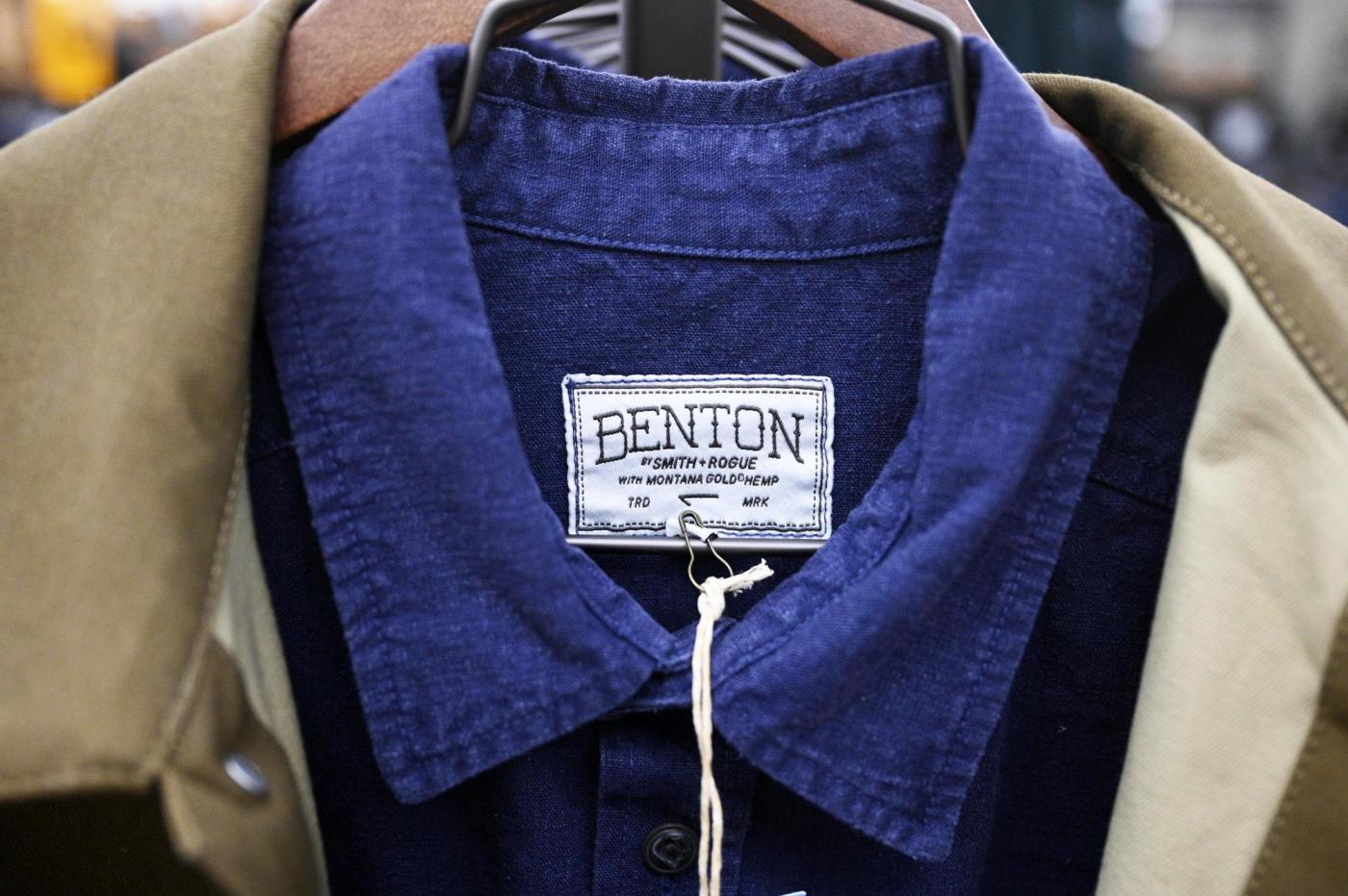
The result was the Benton work shirt, a $150 piece of clothing made from a blend of IND’s Montana-grown hemp fibers and cotton grown in Arizona. The raw fibers traveled from Fort Benton and Arizona to North Carolina to be refined and blended. The material was then sent to another North Carolina company for spinning before heading to South Carolina for weaving. The fabric was finished in Georgia before being trucked to New York City for cutting and sewing.
The difficult part wasn’t finding the companies to work with, because there are few players in American textiles. The challenge was convincing some of the companies to fit a small run of hemp-based material into their schedules.
“We were able to piece this thing together, which made it very costly,” Tweet said. “The fiber moved probably 10 more times than it had to, and freight is your biggest enemy in all these things.”
More than 97% of clothing sold in the United States is made overseas. The efficiencies of overseas production lie in scale, labor costs and experience in making modern clothing. But there are many examples of exploitative or dangerous conditions for the workers who meet the demands of a quick-turn, affordable fashion industry.
While smaller operations are coming online in the United States, some parts of the process require highly specialized equipment that startups may not be able to afford.
“It’s things like the spinning mill that turns the fiber into thread that is hugely capital-intensive and involves huge, complicated machines,” author Thanhauser said. “And also the weaving, the spinning mills. You can’t, as a small business, just buy a couple of those.”
For the Benton shirt, nearly every step required a different company. That affected the cost of the final product, but it also cost time. When Kishpaugh received a prototype in the fall of 2024 that didn’t fit right, fixing the issue meant going back through multiple hands to refine the shirt.
The Benton shirt may have debuted early in 2025, but a shipment of finished fabric went missing en route to New York City. The roll of textiles — one of the first domestic hemp fabric runs since prohibition that was painstakingly coordinated across multiple states — vanished and hasn’t been found.
“So there’s 600 yards of this historic fabric that’s warehoused somewhere,” Tweet said.
The process was once again delayed, but thankfully, there was enough additional fabric to resume production.
Smith and Rogue debuted the shirt in December, both online and in its affiliated retail stores, along with a marketing plan to showcase the effort put into it.
“You can’t just put it on the rack,” Kishpaugh said. “If you don’t know what it is, it’s just going to look like another button-up shirt. And then you look at the price tag.”
The $150 price reflects the costs of the USA manufacturing chain, Kishpaugh said, adding that Smith and Rogue’s margin isn’t as strong on this shirt as some of the company’s other clothing made overseas. He said there is a segment of consumers who respond to marketing about a USA-made shirt, even at that price.
“That is hard for some people to come to grips with,” he said. “This is $150, and this is why. We have to pay for all those other touch points.”
LINKS IN THE SUPPLY CHAIN
Stacks of hemp age in the IND Hemp warehouse Friday, Jan. 23, 2026, in Fort Benton, Mont. (Lauren Miller/Montana Free Press via AP)
The hemp for the Benton shirt run was grown in 2020 at a Meissner family farm north of Fort Benton. The fiber material was part of a crop primarily meant for other products IND was producing at the time.
“What we probably didn’t appreciate then that we most certainly do now is how much agronomic impacts and the variables that happen in the field affect the finished quality,” Tweet said.
Those factors are numerous. The variety of hemp chosen, planting density, harvest timing, soil microbes and annual precipitation all influence the crop’s suitability for textile production. There are some quality factors that Tweet can control at the Fort Benton processing plant. But if a bad crop comes in, that’s what they have to work with.
It took years to refine that process to routinely receive higher-quality hemp fibers, Tweet said. The ability to use those early 2020 crops for a shirt that was released in late 2025 was a proof of concept. Today, IND has more consistent quality fibers for use in textiles.
“No one has at scale been able to decorticate and get fibers to a point that they can be spun,” Tweet said. “Maybe it’s a reach to make that claim, but I am hard pressed to find something else.”
Plans for the second-generation Benton shirt are underway, Kishpaugh said. He hopes to scale up the process to produce larger quantities and a wider range of clothing, including outerwear and pants. He said the experience gained from producing the Benton shirt could help bring costs down a bit, but Kishpaugh and Tweet said a hybrid model is also a good avenue for Montana hemp.
“We have good factories overseas that we work with,” Kishpaugh said. “And if we can get the hemp to them, they’re set up to do the bibs, jackets. Now we’re just using American-sourced hemp versus overseas hemp.”
The constraints of cost and scale still limit growth in domestic manufacturing.
“Will there always be these opportunities to promote a full domestic supply chain? Absolutely,” Tweet said. “But they’re never going to be able to serve the larger demand to get it into everyone’s closet.”
This story was originally published by Montana Free Press and distributed through a partnership with The Associated Press.