What are set to be the final days of Robert Roberson’s life will be busy. He has lots of people to see before his October 16 execution date.
He’ll meet with his pro bono lawyer Gretchen Sween and others on his defense team; facing a ticking clock, his lawyers will be scrambling to save his life, as they have for nearly a decade. His wife Manuela Doris Roberson, whom he married in 2022, will come to the Polunsky Unit in Livingston, where men’s death row is located, for special four-hour visits. He’ll sit down for multiple interviews with reporters, as news of his innocence case draws international attention. His mother, brother, friends, and spiritual advisors will stop by. Then, at noon on Thursday, October 16, prison staff will come to take him to the unit that houses Texas’ execution chamber in nearby Huntsville.
“I was hoping and praying to be gone by now, you know? Gone home,” Roberson told the Texas Observer in an interview at Polunsky last week, referring to his hope that the courts would have recognized his longstanding innocence claim.
Roberson has an idea of how the rest of his execution day will go—because he’s lived it before. It will be exactly 365 days since his last execution was halted by Texas lawmakers. On that day, courts in Austin argued over whether the killing should proceed, while Roberson and his supporters gathered in Huntsville, expecting him to become the first person in the United States to be executed based on the controversial “shaken baby syndrome” diagnosis. (The diagnosis has been renamed “abusive head trauma,” but it is still commonly referred to as “shaken baby” or “SBS/AHT.”)
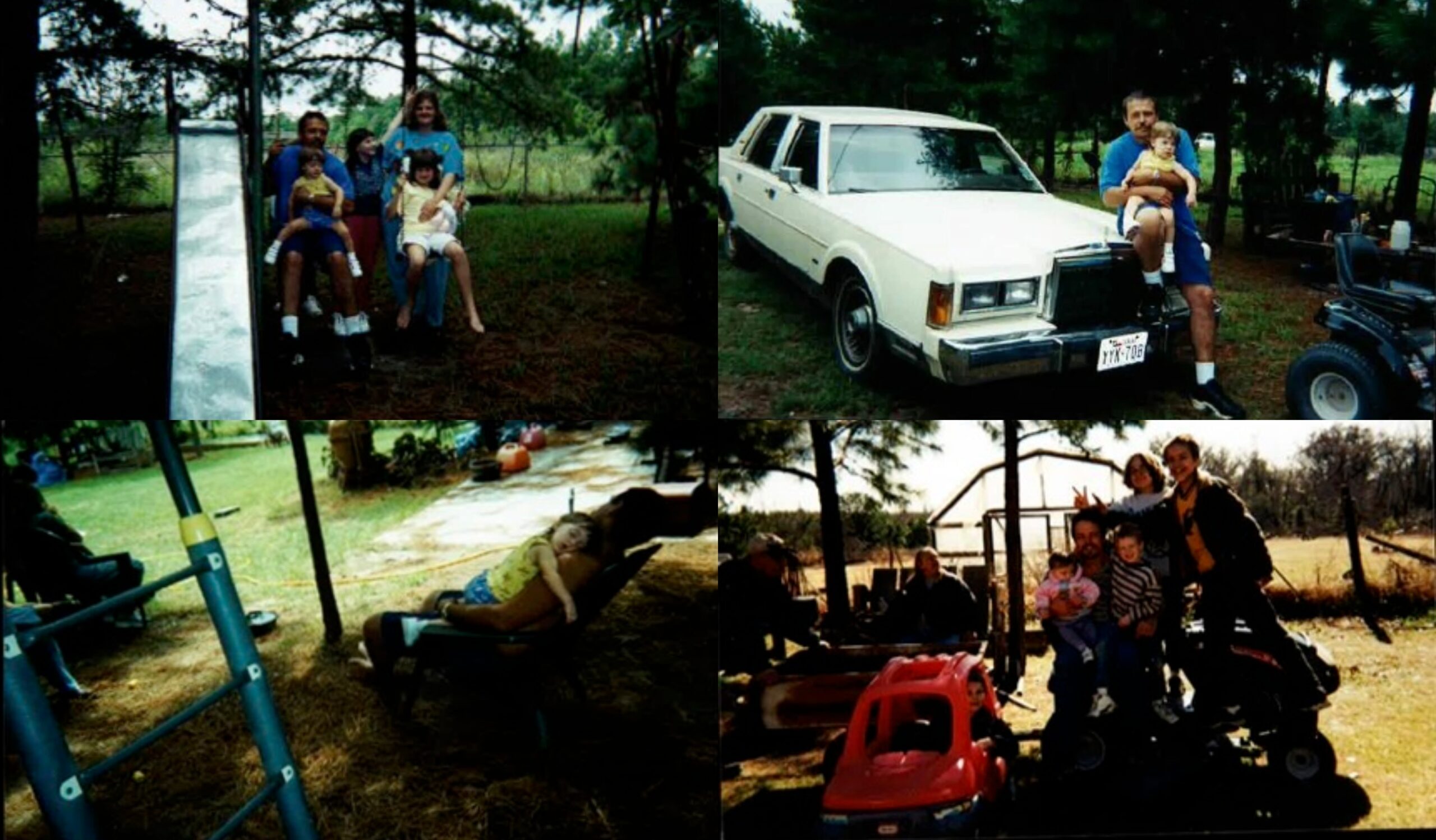
Robert Roberson in family pictures including his daughter (Courtesy/Roberson Family, Innocence Project, Gretchen Sween)
The last year has been plagued by uncertainty. In June, Anderson County District Attorney Allyson Mitchell unexpectedly handed Roberson’s case over to the Attorney General’s office, which quickly requested a new execution date. Roberson’s team continued, and continues, waiting to hear from state and federal courts about pending legal maneuvers. The Texas Court of Criminal Appeals (CCA) has yet to decide whether to reconsider Roberson’s case, eight months after his lawyers filed the request. Last week, his lawyers filed a new request in the federal Fifth Circuit Court of Appeals. His defense team has opted not to formally ask the governor for clemency—which wouldn’t address his underlying innocence claim, they reason—instead focusing on getting him a new trial.
“I think the main thing is not knowing, but continuing, continually, remaining faithful and hopeful and stuff,” said Roberson, who speaks in a thick East Texas drawl, displays vocal tics and repeats phrasing, and often avoids eye contact. In 2018, he was diagnosed with autism—an unrecognized impediment to his legal defense two decades ago, his supporters argue. “Because I’ve got a pretty good defense team, you know, attorneys and stuff and support stuff, you know. And I know they’re not going to give up on me, you know. And I got a lot of people believing in me.”
Roberson was convicted in 2003 of causing the death of his two-year-old daughter Nikki in what his own former lawyers referred to at trial as a “shaken baby case.” Roberson had rushed Nikki to the Palestine Regional Medical Center hospital when he found her unconscious and not breathing the morning of January 31, 2002. She had been ill most of her short life, being rushed to the hospital on several occasions for suddenly ceasing to breathe, according to court records. Roberson had recently won custody of Nikki, whom he described to the Observer as “a sweet little angel” who didn’t “see no strangers in nobody.”
She was transferred to Children’s Medical Center in Dallas, where a child abuse specialist noted three symptoms then believed to be indicative of shaking injury: bleeding between the brain and the skull, retinal hemorrhages, and brain swelling. She posited Nikki had been violently shaken. On February 1, 2002, based on the false belief that Nikki’s maternal grandparents had custodial rights, hospital staff took Nikki off of life support without Roberson’s consent. Police arrested him that night on capital murder charges.
Today, medical professionals no longer presume abuse when they see the three symptoms, once believed to be “virtually unique” to shaking or other extreme circumstances. Now, experts acknowledge illnesses, congenital abnormalities, and even short falls can cause the symptoms.
“That’s a dramatic shift,” said Keith Findley, co-editor of the 2023 book Shaken Baby Syndrome: Investigating the Abusive Head Trauma Controversy. “From going from a presumption of abuse and a belief that nothing causes it except violent shaking … to now saying a lot of things can cause it, including accidents and diseases and whatnot. You can’t diagnose it on the basis of any particular findings. You have to rule out all plausible alternatives.”
Based on the analysis of several independent medical professionals, Roberson’s current defense believes Nikki died of pneumonia after struggling with chronic illnesses, including apnea and a bleeding disorder, and being improperly prescribed medication that made it more difficult for her to breathe.
“The overwhelming evidence demonstrating that no crime occurred and that Robert’s daughter died, tragically, from a pneumonia that her doctors missed, has taken years of fighting to amass,” Sween wrote in an October 1 press release. “We can prove that Robert is innocent, and no reasonable jury would find otherwise if presented with all relevant medical evidence.”
SBS diagnoses and prosecutions were common when Roberson was sentenced to death. In the decades since, they’ve proven to be extremely problematic: According to the National Registry of Exonerations, 39 people have been exonerated after being convicted on faulty SBS evidence since 1989, including two in Texas.
Just last year, the CCA overturned a North Texas man’s SBS-based conviction. Andrew Roark had been sent to prison in 2000 based on the testimony of the same child abuse specialist from Roberson’s case, Dr. Janet Squires. Squires didn’t believe the 13-month-old Roark was caring for, who eventually recovered, had developed injuries from multiple minor falls, as Roark said. He was sentenced to 35 years in prison.
Dallas-based attorney Gary Udashen was Roark’s appeals attorney for more than two decades, ultimately securing his exoneration last November, when Dallas County dismissed the case. Udashen said it’s significant that issues with SBS-based cases have been “popping up all over the country from appellate courts” and that judges are recognizing the new science.
“A lot of what they said, they could not necessarily have said 10 years ago,” Udashen told the Observer, referring to the CCA’s opinion in Roark’s case. “A lot of what they relied upon was even more recent new science and even more recent new law from other courts.”
Roberson’s attorneys believe that the CCA should make the same determination in Roberson’s case, which is remarkably similar. In an additional complicating factor, Roberson’s case was colored by perceptions of his undiagnosed autism disorder, leading police and jurors to see his lack of seemingly appropriate emotional response as further evidence of guilt.
Brian Wharton, a former Palestine Police Department sergeant, supervised the early-aughts investigation into Nikki’s death. He remembers being suspicious of Roberson’s behavior at the hospital.
“We’re there because medical professionals have already said somebody has hurt this child, you know. And so, that’s the focus. Who hurt this child?” Wharton told the Observer in an interview at his church in Onalaska, not far from the Polunsky Unit, where he is now a pastor.
Wharton testified for the state at Roberson’s 2003 trial, but in recent years he’s completely reversed his stance. Now, he believes Roberson is innocent and the investigation was marred by confirmation bias. He said medical professionals believed Roberson had shaken Nikki, and, since no one hinted that there may have been other possibilities, the investigation focused on supporting that theory. “All along, nobody was looking for anything else,” he said.
He said if SBS is taken off the table, “The whole thing falls apart. It’s a house of cards.”
Brian Wharton at his church office on October 1 (Michelle Pitcher)
Exonerees have joined the public rallying behind Roberson, with some gathering for a rally held at the Capitol on October 4. Josh Burns, whose 2015 conviction for child abuse was officially vacated last year after courts reviewed the SBS evidence used against him, addressed the crowd. He had also testified last year in front of the Texas House Committee on Criminal Jurisprudence, the group behind the subpoena that halted Roberson’s 2024 execution.
“This can happen to anyone,” Burns told the Observer. “You can be going about your normal life and be accused by your government of something so horrific that has complete medical explanations and find yourself in a battle like this. That’s a battle for your life, for your family. In Robert’s case, this is a life and death situation.”
Popular author John Grisham is also publicly supporting Roberson’s innocence claim, with a book coming next year. “Innocence cases, like Robert’s, are harrowing tales with common threads,” he wrote the Observer in an email. “Bad trial lawyers. Overreaching prosecutors. Junk science. State officials who value finality over truth and justice. But not all wrongful conviction death penalty cases have to have a bad ending.”
Representative John Bucy attends the October 4 Capitol rally. (Michelle Pitcher)
Roberson’s wife, who lives in Germany, has known him since 2018, and she was with him the day of his last scheduled execution. She remembers learning that he had received a stay. “My legs broke down,” she told the Observer. “I sat on the floor. It’s one year ago now, and I still feel it.”
She said she never thought he would get a new execution date, given the pending appeals and all of the experts who came forward to support the idea that Nikki had died of a slew of medical issues, not abuse. “I hope he gets a stay,” she said. “That’s on my heart now and my mind. But there are possibilities we have to talk about if [the execution] happens. It’s hard to talk about.”
Back at Polunsky, Roberson struggled in his interview with the Observer to think of a message to leave people with. He ultimately said that he hopes his story, however it ends, will mean something.
“I would want them to keep on fighting, you know, no matter what happens October 16, you know, and to be able to make a change in the system.”
The post ‘I Got a Lot of People Believing in Me’: Robert Roberson Stares Down Death, Again appeared first on The Texas Observer.