By Kevin Hardy, Stateline.org
NORTH CONWAY, N.H. — The conversations in French having given them away, the group of motorcyclists immediately stood out as foreigners over a Saturday breakfast in the White Mountains of New Hampshire.
In the restaurant, the server was pleased, thanking them for coming. Because these days, tariffs and White House rhetoric have left Canadians a rare breed of visitors in New England, usually a hotspot vacation destination from the nearby province of Quebec.
“There’s a lot of people staying in Canada because of that,” said Dave Gingras, a 35-year-old biker from Saguenay, about two hours north of Quebec City.
While other Canadians are avoiding buying American products or traveling to the States, the group of 11 decided to leave politics behind on their road trip through New England.
“We are just keeping it neutral and trying to enjoy,” Gingras told Stateline.
After breakfast, they donned helmets and mounted an assortment of dusty Yamaha, BMW and Triumph bikes.
“We drive and when we’re tired, we stop and raise up a tent and relax with a beer,” Gingras said before pulling into a line of crawling traffic on the White Mountain Highway, the scenic byway dotted with quaint inns, old-timey stores and Colonial and Victorian homes.
Canadian Dave Gingras prepares to mount his Yamaha adventure bike on Aug. 2 in North Conway, New Hampshire. (Kevin Hardy/Stateline/TNS)
Across Northeastern states, business owners and state officials have labored to maintain key economic connections with Canada despite the rhetoric coming out of the White House. President Donald Trump’s trade war, aggressive immigration enforcement and talk of making their country the 51st state has offended many Canadians. While concerns are acute in New England, tourism hubs from Hawaii to New York are reeling from a decrease in Canadian visitors.
To quell tensions, Maine leaders erected signs in French to welcome Canadian visitors and New Hampshire’s governor just returned from a Canadian trip she took to strengthen trade and tourism.
But hospitality businesses this summer reported a sharp decline in visitors from the North — Canadian travel to New Hampshire is down about 30% this year, according to state officials. Border crossings into Vermont hit their lowest levels since 2021, according to federal data, as the Canadian government reported a 34% drop in the number of August car visits into the U.S. compared with the same month last year.
New England businesses remain concerned as the region turns the page on the summer vacation season to its vibrant autumn, known for luring leaf-peeping travelers from across the globe.
Tourism is vital for White Mountain Valley communities like North Conway. While it’s home to only about 2,300 people, the village is a historic travel hotspot known for outdoor activities, tax-free shopping and family-friendly theme parks.
While many people think of the area as a winter ski destination, summers are actually the largest travel draw, said Chris Proulx, executive director of the Mt. Washington Valley Chamber of Commerce.
Parents fear losing disability protections as Trump slashes civil rights office
US once again vetoes Security Council resolution demanding immediate Gaza ceasefire, hostage release
DC leaders defend crime fighting efforts to Congress as federal law enforcement surge continues
‘It hurts all of us’: Mass deportations ensnare immigrant service members, veterans and families
‘Inhumane’: Trump’s mass deportations ensnare noncriminal immigrants from all walks of life
The drop in Canadian tourism has been especially evident during less popular travel times for Americans. For example, Canada’s Victoria Day, a late May holiday celebrating that queen’s birthday, has traditionally brought big crowds to the Northeast.
“Our retail outlets are a very, very popular destination for them during that time,” Proulx said. “And our retail outlets have reported that it was basically nonexistent this year.”
Proulx said local businesses have tried to lure travelers from close-by regions like the Boston area to help make up for the loss of Canadian tourists, “so it’s not an unrecoverable loss.” But the absence of visitors from parts North is hard to ignore.
“It almost feels like a birder might feel if they find a rare species,” he said. “If you see someone with a Canadian license plate, you notice it right away. It gives you a little bit of a smile.”
Aside from the economic loss, Proulx said he worries about longstanding relationships.
This scenic valley is nostalgic for many visitors from the U.S. and Canada alike. He said many people return again and again, sharing fond memories of their first camping trip along the Saco River, childhood trips to the Santa’s Village amusement park and picturesque rides on the Conway Scenic Railroad.
“So we just don’t want anybody thinking that they’re not welcomed here. That’s our biggest thing,” he said. “We want everybody to be able to call this their second home, to be able to visit and reconnect and feel welcomed.”
‘Towns are quieter’
In the heart of North Conway, tourists picnic on the grass in Schouler Park, look into the 1874-era train station and meander into shops selling hokey souvenirs and homemade fudge. Framing the village is the imposing Mount Washington, which at 6,288 feet boasts the tallest peak in the Northeast.
At one of the town’s busiest intersections, the crowds come in waves to the North Conway 5&10 Store. But even as families line up, employee Polly Howe said she hadn’t seen many Canadians this summer.
“It’s a shame,” she said, bouncing between the cash register, the candy counter and stocking staples like toys and hats.
In a building listed on the National Register of Historic Places, the souvenir shop has been around for 86 years and features a false-front facade, the kind made famous in boomtowns of the Old West. Manager Terri Johnson said she had encountered a good number of Canadians inside the shop, but said she didn’t blame any who felt put off by the political climate.
“I’m thankful they still come after all that,” she said.
It’s not just international relations that have changed tourism here.
A rainy start to the summer season didn’t help, and business owners say anxiety over the domestic economy and inflation have pinched travel budgets.
Mark Lahood says family travel has dipped at the three hotels he operates in the area.
“Towns are quieter,” he said this summer. “They’re not quiet, but they’re much quieter than years’ past.”
Some summer weekends, which traditionally sell out entirely, the three hotels had 30% vacancies, he said. And travelers are more keen for weekend trips than their weeklong road trips of previous seasons.
“With a seven-day trip, by the time they were all in, it’s a lot of driving, it’s a lot of gas money, it’s a lot of meals, it’s a lot of hotels,” he said. “And I think it’s just too much.”
To help with rising costs, he ran a free breakfast promotion for kids earlier in the summer. And he increased an existing international discount for Canadian guests.
“Did it help anything? Probably not. But you know, when you view it from a Canadian traveler, at least you made an effort.”
The decline in Canadian visitors has allowed for more local, spontaneous travel, said Genn Anzaldi, who owns J-Town Deli & Country Store in Jackson, New Hampshire.
“More day trippers for sure,” she said. “So maybe not as many people spending the night or as many nights.”
Shoppers walk outside the North Conway 5& 10 Store on Aug. 2 in North Conway, New Hampshire. (Kevin Hardy/Stateline/TNS)
The scent of sizzling bacon and toasting panini fills her shop, which offers hot meals along with handmade gifts and convenience store staples.
Anzaldi, who also runs a cooperative marketing effort for a group of independent restaurants, said the local restaurant business was down, but not significantly.
The reason?
“Canadians,” she said. “I wouldn’t say it’s the economy. That seems to be going well.”
About nine miles away from North Conway, things are a bit quieter in Jackson, home to a famed one-lane covered bridge. With its spas and boutique hotels, Anzaldi said the community is more known as a destination for weddings, romantic stays and outdoor getaways.
While Anzaldi said she hopes Canadian tensions settle soon, she noted that the matter lies in the political domain and there’s little business owners can do but carry on.
“We have to run, right?” she said. “We’re not personally going to go up and advertise.”
States try to ease federal tension
To maintain tourism and trade, Democratic and Republican politicians in the Northeast have made overtures to their counterparts in Canada.
Since Trump’s inauguration, Maine Democratic Gov. Janet Mills has met with Maine businesses near the border, embarked on a diplomatic Canadian tour and even installed “Bienvenue Canadiens” welcome signs near border crossings. But on her trip this summer, she was reminded that it’s not just tariffs that have irked Canadians — many are also worried about the Trump administration’s aggressive immigration enforcement.
“Lots of people don’t feel safe in the U.S. right now and for good reason,” Susan Holt, the premier of the New Brunswick province, told Mills, according to local news accounts. Holt has encouraged her constituents to avoid traveling to the United States.
Last year, the state said some 800,000 Canadians visited Maine. On her June trip, Mills asked Canadians to remember those who rely on the tourism industry.
“To the extent people feel angst about coming to Maine, just remember that if they aren’t coming to Maine, the ones that they’re hurting are the small mom and pop businesses,” the governor told News Center Maine while in Halifax.
Mills’ office did not respond to Stateline’s requests for comment.
Similarly, New Hampshire Republican Gov. Kelly Ayotte said ahead of a trade mission that she aimed to welcome Canadians to the Granite State, the New Hampshire Bulletin reported.
“That’s one of the things I’m going to just continue to promote on behalf of New Hampshire,” Ayotte said last month. “Not only that they’re welcome here — the Canadians — but we have open arms to them.”
Polly Howe stocks the shelves with merchandise on Aug. 1, at the North Conway 5& 10 Store in North Conway, New Hampshire. (Kevin Hardy/Stateline/TNS)
Ayotte’s office did not respond to Stateline’s requests for comment about her trip.
René Sylvestre, the Quebec province’s delegate to New England, said those gestures are appreciated. He spends much of his time meeting with state and business leaders. Last month, he met numerous state lawmakers at the annual meeting of the National Conference of State Legislatures in Boston, where he is posted.
But he said calming federal tensions will be key to seeing a rebound in tourism.
“What we can see right now is people in Quebec are really sad with the whole situation,” he told Stateline. “But they’re saying, ‘Maybe we should stay and spend more time in Canada these days.’ So this is really the impact that we’ve seen, and we think that it’s going to take a while before it’s back to normal.”
A decline in international travel has hit border communities across the country — from New York state to Washington state. North Dakota estimated that Canadian visitors spent about $14.4 million less in the first half of the year compared with last year, as the number of personal vehicles crossing the border from Canada declined by 30%. Other hubs for international visitors, including Las Vegas and Hawaii, are also seeing significant declines.
“Right now, it’s hard to turn back federal policy,” Hawaii state Sen. Ron Kouchi told Stateline in August.
Kouchi, a Democrat and president of the state Senate, said Canada has traditionally been among Hawaii’s top five travel markets. The state has sent tourism officials to trade shows and is trying to show Canadians, like all visitors, the Aloha State’s iconic hospitality. But he said that message hasn’t been persuasive, even coming from leaders of the solidly liberal state.
“While we argue about Republicans or Democrats, in other nations they simply look at Americans and they don’t see it as an R or a D thing,” he said. “It’s an American thing.”
A stormy beach season
Old Orchard Beach in Maine is a favorite of New Englanders and Canadians alike.
Part of the Portland metropolitan area, the vacation town sports a seaside amusement park and seven miles of sandy beaches. But some Canadians started to cancel their summer reservations to the area early on in Trump’s term.
Sean Nickless, who co-owns the 30-room Crest Motel with his family, said Canadians began calling off trips in January and February,
Those cancellations and poor weather foretold a slower summer. “It’s not as steady,” Nickless said, noting business had been inconsistent with shorter stays.
Like many of the other beachfront properties here, the retro Crest Motel relies heavily on repeat customers, filled out by the occasional road tripper who ducks in from the angled carport to ask about an available room.
“The best you can do is let Canadians know they’re still welcome here,” he said from the motel’s small lobby scented with the aroma of a drip coffeemaker and a bright popcorn machine.
At the height of summer, rain ushered in what should have been a booming weekend along the Atlantic’s Saco Bay. Crest Motel guests swam, but only under the cover of the pool’s rolling roof.
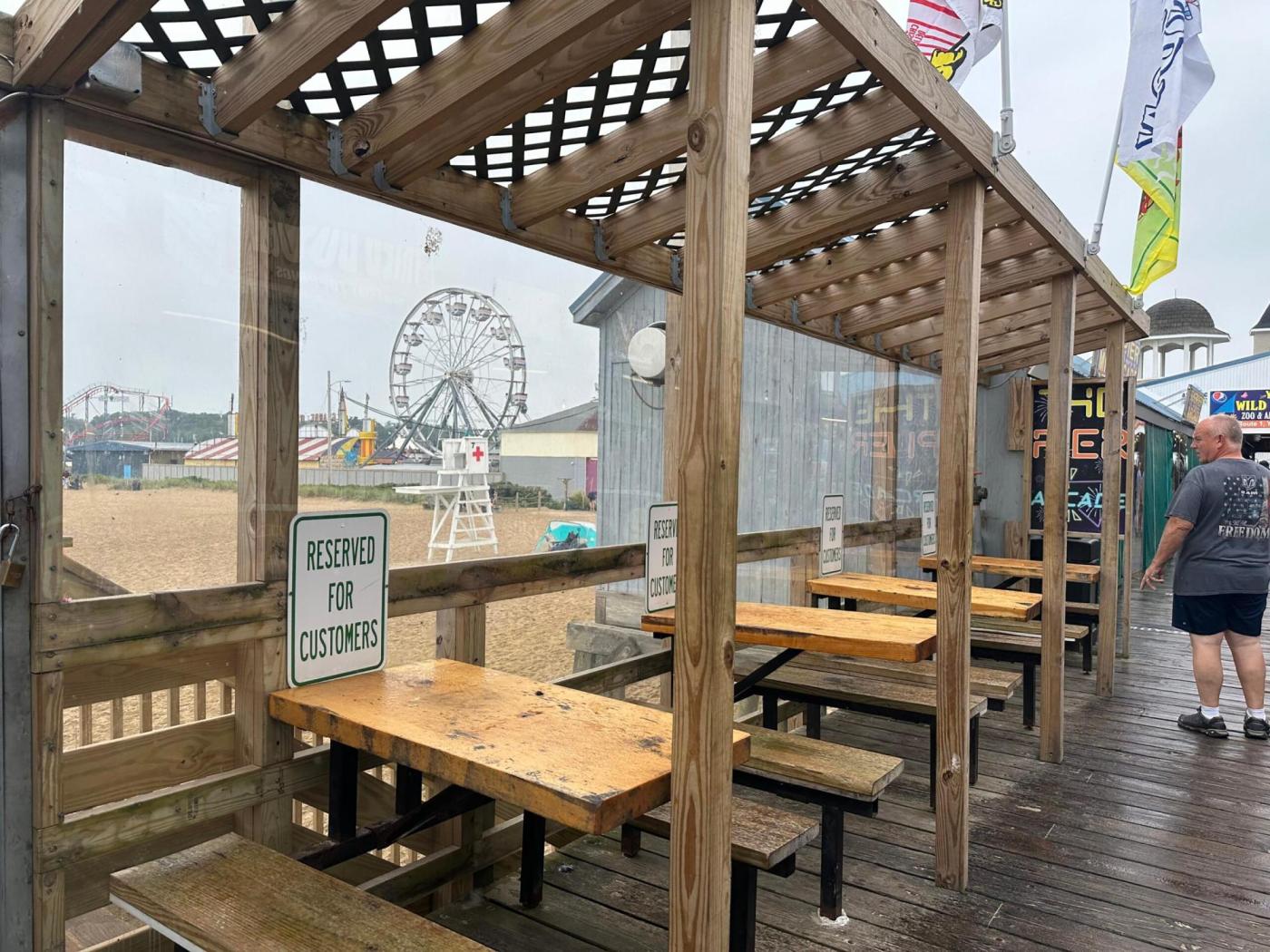
Down the way, five teenagers stood listlessly inside a walkup Dairy Queen with no customers to serve. On the pier, arcade games, $1-per-visit restrooms and barstools sat idle. Few took up heavily advertised offers for pizza by the slice, $15 lobster rolls or fried clam cakes.
“I’ve never driven around Old Orchard Beach in the summer and seen ‘vacancy signs.’ I have this year,” said state Sen. Donna Bailey, who represents the community. “I mean, you just never see that in the middle of July — all you see is ‘no vacancy’ signs.” A Democrat, Bailey emphasized that Canada isn’t some far-off destination for Mainers. People routinely cross the border for health care and work. They have friends and family on both sides.
“I mean, there’s some places up in northern Maine that the nearest hospital is in Canada, as opposed to in the United States. You know, some people have their babies over in Canada.”
But aside from emphasizing existing bonds, Bailey said Maine residents and officials were largely at the mercy of the federal government’s actions.
“I think it’s helpful to remind the Canadians of our personal relationship and that we are Maine and we’re Mainers, and so we’re not necessarily the same as the federal government,” she said. “But, yeah, it does only go so far.”
Stateline reporter Kevin Hardy can be reached at khardy@stateline.org.
©2025 States Newsroom. Visit at stateline.org. Distributed by Tribune Content Agency, LLC.