Interest in women’s sports is growing. Here’s how some women-owned companies are responding

posted in: All news | 0

By ANNE M. PETERSON

Laura Youngson didn’t expect to focus so much on soccer cleats when she organized a group of women to climb Mount Kilimanjaro and play a high-altitude match.

Related Articles


Government shutdown threatens to stall the recovery in the IPO market


Starbucks’ sweeping store closures aren’t a surprise. Here’s why


Wall Street drifts around its records as gold tops $4,000 per ounce


Toyota recalls nearly 400,000 Tundras and Sequoias due to malfunctioning rearview camera


Gold futures rise above $4,000 per ounce for the first time

The point of the 2017 game was to highlight inequality in sports for women and girls. On that front, Youngson achieved her goal with the match becoming the subject of a documentary and landing the group in the Guinness Book of World Records.

Still, something bothered Youngson as the match unfolded. Glancing at the athletes’ feet, she was struck that all the women were wearing men’s or boy’s soccer cleats instead of gear that was designed specifically for them. The realization led her to launch IDA Sports, which makes soccer cleats for the unique athletic needs of women.

“There was this real commercial gap for performance footwear for women,” said Youngson, whose IDA cleats are worn by players including Washington Spirit midfielder Courtney Brown. “As the game is growing, we’re in this moment when everything’s professionalizing, but the footwear wasn’t really keeping pace, so I wanted to go and change that.”

IDA is among a growing number of companies founded in recent years to prioritize women in sports.

Laura Youngson, CEO of IDA Sports, poses for a photograph at a store in Regent Street, in London, Thursday, Sept. 18, 2025.(AP Photo/Alberto Pezzali)

These aren’t just lifestyle or athleisure brands. Moolah Kicks, for instance, makes women’s basketball shoes designed specifically for women’s feet and counts Courtney Williams of the WNBA’s Minnesota Lynx as one of its partners. Lindsay Housman founded Hettas, a performance running shoe company. Saysh, Olympic gold medalist Allyson Felix’s running shoe company, allows buyers to make free exchanges when their size changes during pregnancy.

Beyond shoes, Liv Cycling makes performance bicycles for women and there’s even Indiana Fever partner Sequel tampons, which have spiraled grooves that help prevent leaks during strenuous activities.

The companies are entering the market at a time when interest in women’s sports is intensifying.

The WNBA has shattered attendance records recently, lifted by the star power of players like Caitlin Clark and Angel Reese. National Women’s Soccer League teams are worth 29% more this year than they were a year ago, with both Angel City and the Kansas City Current now valued at over $250 million. Several new pro sports leagues have formed in recent years, including the Professional Women’s Hockey League and the 3-on-3 Unrivaled basketball league. The Women’s Professional Baseball League is set to launch next year.

Minnesota Lynx guard Courtney Williams (10), front, is fouled by Indiana Fever guard Kelsey Mitchell (0), middle, during the first half of a WNBA basketball game Sunday, Aug. 24, 2025, in Minneapolis. (AP Photo/Abbie Parr)

Overall, women’s sports generated global revenue of $1.88 billion in 2024 and is projected to rake in $2.35 billion this year, according to consulting firm Deloitte. Commercial revenue, including s ponsorships and merchandising sales, surpassed $1 billion globally for the first time last year.

No more ‘shrink it and pink it’

All that growth means more opportunities for women-owned brands — and a chance to reject the “shrink it and pink it” mentality in which companies were criticized for taking men’s products and selling them to women by making them pretty rather than functional.

“Marketing is all about understanding the needs of consumers,” said Dae Hee Kwak of the Center for Sport Marketing Research at the University of Michigan School of Kinesiology. “So thinking of the needs of the women’s sports fan and athlete, who understands them better than women, right?”

Washington Spirit midfielder Courtney Brown warms up with cleats that read “IDA” before a NWSL soccer match against Bay FC on Saturday, Aug. 23, 2025, in San Francisco. (AP Photo/Benjamin Fanjoy)

Leela Srinivasan, CEO of the sports marketing and sponsorship platform Parity, said men’s products simply weren’t built for women’s bodies.

“Women in motor sports will tell you that even the way the seat belts are designed, they don’t fit right, they don’t fall in the right places,” Srinivasan said. “You talk to Lynn Saint James, the motor sports legend, about how she couldn’t reach the pedals. Nothing has been designed with women’s bodies in mind.”

Bonnie Tu, who founded Liv Cycling, experienced that problem with bicycles.

“Whenever I’d go for vacation, I would take a bike from the hotel,” Tu said. “Most of the time, I would get myself hurt because the bike doesn’t suit me well. Because most of the bikes are meant for men, no matter if it’s a mountain bike or it’s road bike, it was all for men.”

Youngson similarly looked at biomechanical needs when designing cleats for IDA, resulting in a product that features a wider toe box, narrower heel and shorter studs than men’s boots.

Washington Spirit midfielder Courtney Brown warms up before a NWSL soccer match against Bay FC on Saturday, Aug. 23, 2025, in San Francisco. (AP Photo/Benjamin Fanjoy)

For those who have spent decades in and around women’s sports, these shifts represent a profound change. Natalie White, who founded Moolah Kicks after playing basketball in college and working on the business side of several WNBA teams, recalled always playing the sport in boy’s and men’s shoes.

“It wasn’t until I was a senior in college and I saw an advertisement that had more top WNBA players holding out men’s shoes that it really hit me, ‘Oh, my God, this is crazy.’ When you begin your career, through pro, you’re not only going to be playing in equipment that isn’t fit for you, but you’re going to be promoting it?” White said. “Oh my gosh, crazy.”

The bigger shoemakers, including Adidas and Nike, have developed women’s soccer and basketball shoes in recognition of the growing market and the needs of the female athlete. Sabrina Ionescu has a signature shoe with Nike and, this past summer, Adidas released its first player edition of Adidas’ F50 Sparkfusion cleat with NWSL star Trinity Rodman.

Women want products without pandering

Kwak said that in addition to products made specifically for them, women also value authenticity as consumers. And that means working with women’s leagues, athletes and sometimes causes involving equity and social justice.

IDA, for example, has partnered with the players’ unions for both the NWSL and the Gainbridge Super League, a top-tier domestic professional women’s soccer league that launched last year.

Laura Youngson, CEO of IDA Sports, poses for photographs at a store in Regent Street, in London, Thursday, Sept. 18, 2025. (AP Photo/Alberto Pezzali)

Coalition Snow, a women-led ski and snowboard company based in Reno, Nevada, not only makes sure of safe and fair working conditions throughout its supply chain, it also uses recycled material for packaging and partners with a nonprofit to plant trees in rural Kenya for every board or pair of skis sold.

Liv Cycling sponsors women’s racing teams and competitions, like the Tour de France Femmes, in addition to community clubs. Athlete involvement in the creation of products helps, too. It’s really what personalizes these companies compared to the sporting goods giants.

But it’s all about taking that first leap, Youngson said.

“As the game grows and professionalizes, it should be attractive to brands,” Youngson said. “So then you’re going, ‘Why aren’t you doing it?’ Because the money’s there, the game’s there. Why can’t we have all of this choice around us in the same way that the men’s game has?”

AP Sports Writer Alyce Brown contributed to this report.

Trump administration threatens no back pay for federal workers in shutdown

posted in: All news | 0

By LISA MASCARO, AP Congressional Correspondent

WASHINGTON (AP) — President Donald Trump’s administration is warning Tuesday of no guaranteed back pay for federal workers during a government shutdown, reversing what has been longstanding policy for some 750,000 furloughed employees, according to a memo being circulated by the White House.

Related Articles


AI will soon have a say in approving or denying Medicare treatments


Florida farmers struggle as legal foreign workers worry about immigration crackdown


Watch live: Bondi defends herself against Democratic criticism that she’s weaponized the Justice Department


At the center of shutdown fight, health care is one of the most intractable issues in Congress


Canadian PM Carney visits Trump as relations between the longtime allies sit at a low point

Trump signed legislation into law after the longest government shutdown in 2019 that ensures federal workers receive back pay during any federal funding lapse. But in the new memo, his Office of Management and Budget says back pay must be provided by Congress, if it chooses to do so, as part of any bill to fund government.

The move by the Republican administration was widely seen as a strongarm tactic — a way to pressure lawmakers to reopen government, now in the seventh day of a federal shutdown.

“There are some people that don’t deserve to be taken care of, and we’ll take care of them in a different way,” Trump said during an event at the White House.

He said back pay “depends on who we’re talking about.”

Refusing retroactive pay to the workers, some of whom must remain on the job as essential employees, would be a stark departure from norms and practices, and almost certainly would be met with legal action.

While federal workers — as well as service members of the military — have often missed paychecks during past shutdowns, they are most always reimbursed once government reopens.

“That should turn up the urgency and the necessity of the Democrats doing the right thing here,” said House Speaker Mike Johnson at a press conference at the Capitol.

Johnson, a lawyer, said he hadn’t fully read the memo but “there are some legal analysts who are saying” that it may not be necessary or appropriate to repay the federal workers.

But Democratic Sen. Patty Murray of Washington blasted the Trump administration as defying the law.

“Another baseless attempt to try and scare & intimidate workers by an administration run by crooks and cowards,” said Murray, who is the ranking lawmaker on the Senate Appropriations Committee. “The letter of the law is as plain as can be — federal workers, including furloughed workers, are entitled to their backpay following a shutdown.”

In a single-page memo from Trump’s Office of Management and Budget under Russ Vought, first reported by Axios, the office’s general counsel seeks to lay out a legal rationale for no backpay of federal workers.

The memo explains that while the Government Employee Fair Treatment Act of 2019 says workers shall be paid after federal funding is restored, it argues the action is not self-executing. Instead, the memo says, repaying the federal workers would have to be part of legislation to reopen the government.

The OMB analysis draws on language familiar to budget experts by suggesting that the 2019 bill created an authorization to pay the federal workers, but not the actual appropriation.

Congress, it says, is able to decide whether it wants to pay the workers or not.

For now, Congress remains at a standstill, with neither side — nor the White House — appearing willing to budge. Democrats are fighting for health care funds to prevent a lapse in federal subsidies that threaten to send insurance rates skyrocketing. Republicans say the issue can be dealt with later.

Associated Press writers Will Weissert, Kevin Freking, Joey Cappelletti and Mary Clare Jalonick contributed to this report.

St. Paul: 24-hour conversation about homelessness begins Thursday

posted in: All news | 0

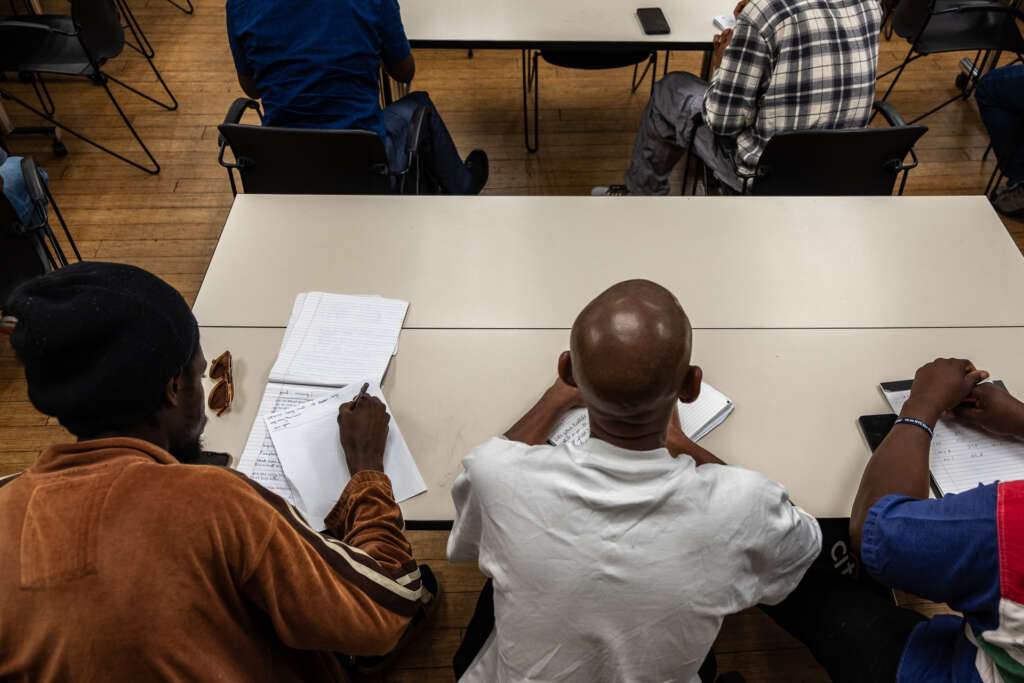
The Union Gospel Mission Twin Cities will host a 24-hour live conversation on homelessness, addiction and mental health later this week.

The event, called Conversations on a Bench, is happening at ministries nationwide and will end on World Homeless Day, observed annually on Oct. 10.

Pam Stegora Axberg, the organization’s CEO, will participate in 40 conversations from 2 p.m. Thursday to 2 p.m. Friday on a bench outside the organization’s men’s campus in St. Paul.

Participants will include Ramsey County Attorney John Choi, Ramsey County Commissioner Rena Moran and Melvin Carter, the mayor of St. Paul. Officials from the Minnesota Association for Children’s Mental Health, the Minnesota Wild and Nourish MN, a food bank in St. Paul, also are scheduled to participate.

The conversations will focus on solutions to homelessness, addressing related issues such as addiction and mental health, while highlighting the roles of public, private and nonprofit organizations in driving change.

People can watch a livestream of the conversations on the organization’s Youtube channel and Facebook page.

More than 9,000 people were homeless on a single night in January 2024, according to the Minnesota Interagency Council on Homelessness. The Point-in-Time count is an annual nationwide count of people experiencing sheltered and unsheltered homelessness on a single night in January.

For more information go to ugmtc.org.

Related Articles


Charges: St. Paul bar customer dies after security guard’s punch


St. Paul nightclub security guard charged with punching customer


St. Paul man sentenced for role in North St. Paul deadly gun heist


Cole Hanson: Weak enforcement, scattered resources can put recourse out of reach for St. Paul renters


St. Paul police investigate reports of racist fliers found in Merriam Park

What will the Wild’s lines look like to open the season?

posted in: All news | 0

On the eve of the regular season, one constant of a John Hynes‘ training camp remains true in the coach’s second season at the helm: It’s hard.

To a man, Wild players note on-ice sessions are serious, focused and strenuous. The same goes for the off-ice work. It is not for those unwilling or unable to put in a full 60-minute effort every time their skates touch the ice.

A year ago, the results of that relentless prep were seen in October and November, as Minnesota blasted to one of the best starts in franchise history, at one point tallying 19 wins to just four regulation losses.

It didn’t last, as injuries piled up. By April, the Wild needed a last-minute rally in their final game to make the playoffs. Still, Minnesota showed what it could do at full strength.

On Monday, with his his full 23-man roster on the ice at TRIA Rink for the first time, Hynes reflected on the final roster cuts made to prep for the regular season opener.

“There was some tough decisions of who we would send down and who we would keep,” Hynes said, noting that several of the players who will start with the Iowa Wild had flashes in training camp practices and preseason games to state their case for NHL roster spots.

“We feel like this is the group we’ll start with and see where they go,” he said.

In the final tuneup practices before the regular season opens in St. Louis on Thursday, the forward lines have looked like this:

Top line: Marco Rossi centering with Kirill Kaprizov and Matt Boldy on wings.

Second line: Joel Eriksson Ek centering with Marcus Foligno and Vladimir Tarasenko on the wings.

Third line: Ryan Hartman centering with Yakov Trenin and Marcus Johansson on wings.

Fourth line: Nico Strum centering with some combination of Danila Yurov, Liam Ohgren and Vinnie Hinostroza on the wings.

Mats Zuccarello is injured to start the season. On Tuesday, the team placed Zuccarello and Nico Sturm on injured reserve and designated forwards Cameron Butler and Michael Milne and defenseman Stevie Leskovar as injured, non-roster players.

Hinostroza, who the Wild claimed off waivers from Nashville last February, will likely be the veteran wing on the fourth line, with either Yurov or Ohgren on the other side.

“I think Vinnie’s had a strong camp,” Hynes said. “He didn’t get as much action later in the games, but he does have experience, we know what he can do. With Ohgren and Yurov, we’re still working those guys in, and now that camp’s over, see what they look like in different positions.”

Defensively, the pairings have been:

-Jake Middleton with Brock Faber

-Zeev Buium with Jared Spurgeon

-Zach Bogosian with David Jiricek

Newly re-acquired Daemon Hunt and veteran Jonas Brodin – who is still making his way back from off-season surgery – will be the reserve defenseman at the season’s start. Hynes said they initially did not expect to have Brodin much in October, but he’s made good progress in practice.

“I’m sure they’re going to have to test his strength, meet with the doctor, and then maybe put him in a little bit more heavier contact,” Hynes said. “The fact that he’s doing what he’s doing is really encouraging.”

The goalie tandem of Filip Gustavsson and Jesper Wallstedt is set, with veteran Cal Petersen heading to his home state to tend the Iowa net. Like most Wild fans, Hynes smiled at the contract extension given to Gustavsson over the weekend, and the stability it means in the Minnesota crease.

“It’s nice that he’s got that confidence, and I think he’s earned it. He’s the guy for us,” Hynes said. “You can’t win without good goaltending, and the way that he played last year and the way that he looks now is going to be really important for us.”

Among those waiting in the wings in Iowa are defensemen Carson Lambos and Matt Kiersted and forwards Tyler Pitlick and Hunter Haight, all of whom had strong showings in training camp and were among the final cuts.

Veteran forward Brett Leason and veteran defenseman Jack Johnson both attended Wild camp on professional tryouts, but neither was offered a contract.

Similar to October 2024, the Wild will learn much about themselves while getting to know one another away from home.

After the opener in St. Louis, they play home games versus Columbus on Saturday and versus Los Angeles on Monday, Oct. 13. Then the Wild head out on a five-game road trip, during which they’ll visit the Stars, Capitals, Flyers, Rangers and Devils.

Briefly

The Wild’s “Skate It Forward” program — which was announced last season as an effort to promote growth in youth hockey participation in Minnesota, western Wisconsin and the Dakotas — announced its initial grant recipients for the 2025-26 season this week.

The 11 community hockey programs included are Anoka, Bloomington Jefferson, Delano, Langford Park (St. Paul), Minnesota Sled Hockey, Mounds View Irondale, Osseo-Maple Grove, St. Paul Capitals, Waseca, Willmar and Winona. For every first-year player under the age of eight that registers for hockey in those associations, the Skate It Forward program will provide a $250 grant to help encourage more young players to take up the game.

Related Articles


Extension in hand, Gustavsson enjoying goalie mentor role


Wild reassign Hunter Haight to Iowa, reduced roster to 27


Five-year extension keeps goalie Filip Gustavsson with Wild


For mind and body, Wild defenseman Zach Bogosian likes it hot


Wild: Rising cap makes Kirill Kaprizov’s NHL-record deal a reasonable risk