“The findings provide some clues as to why a plurality of Latino voters supported Zohran Mamdani in the primary, and why they remain supportive as he heads into this last stretch of the campaign.”
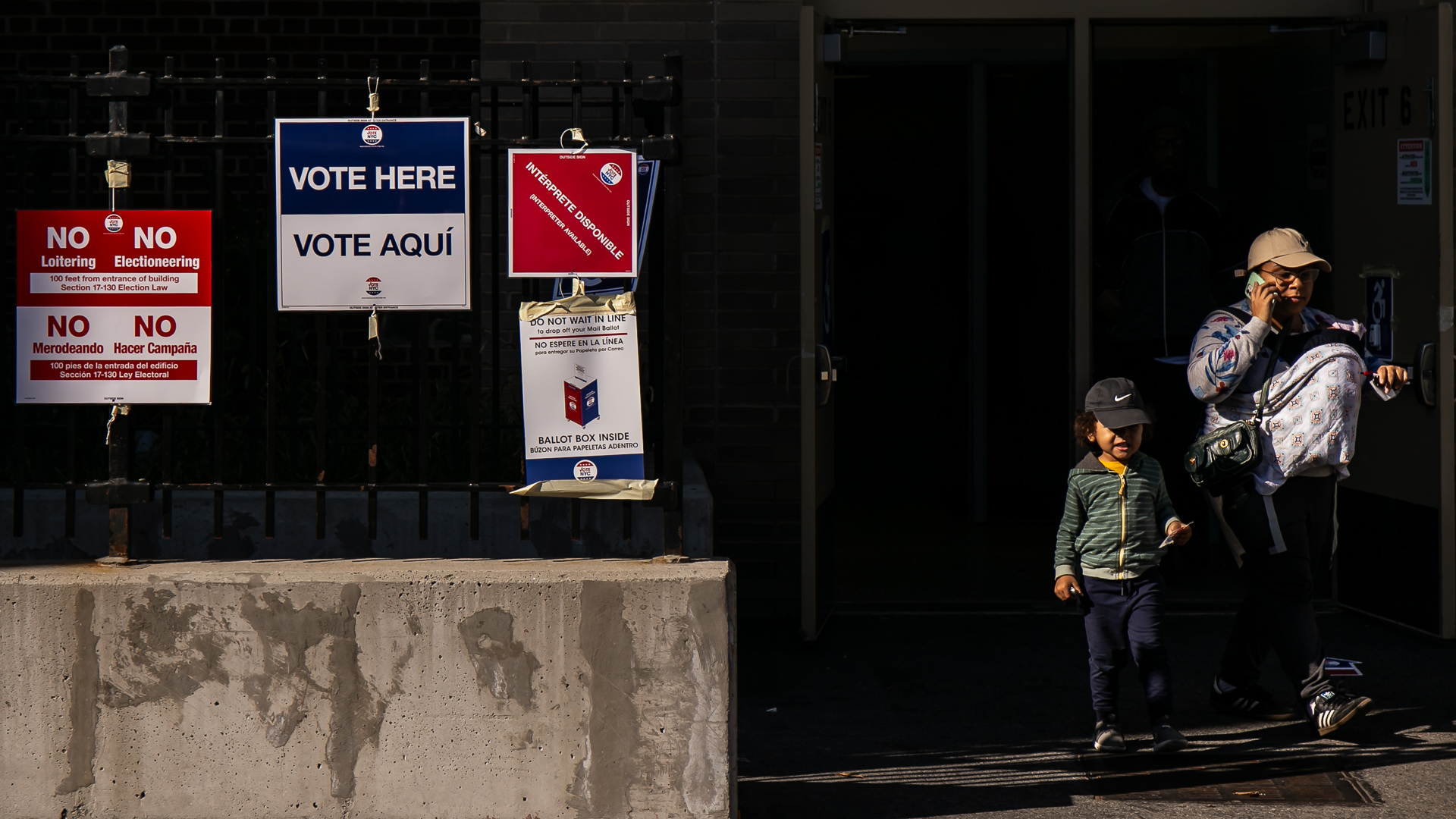
A poll site in The Bronx last year. (Adi Talwar/City Limits)
A new poll in the New York City mayoral race just landed. This is the first poll focused exclusively on New York City Latino voters in this electoral cycle, and will likely be the only one: few polls are ever taken to take the pulse of the issues important to Latino voters and the candidates they prefer. The Hispanic Federation, which commissioned this poll, must be commended for this admirable and needed work.
The findings provide some clues as to why a plurality of Latino voters supported Zohran Mamdani in the primary, and why they remain supportive as he heads into this last stretch of the campaign. My analysis of the mayoral primary in June showed that Mamdani won a plurality of support in majority-Latino election districts.
However, the nuances in voting patterns across boroughs and neighborhoods that I describe in that column point to the fact that, “Latinos are not homogeneous. We do not fit any once-size-fits-all formulations. Latinos are quite diverse in cultural variety, countries of origin, language nuances, and political philosophies.” Thus we find that this variety manifests itself in particular voting patterns: for example, Queens and Manhattan Latino voters supported Mamdani in higher numbers than Latinos in the Bronx.
The Hispanic Federation (HF)-commissioned poll in many ways reflects this very dynamic, and thus mirrors what we saw in the June primary. Another excellent poll undertaken in August by Adam Carlson and Amit Singh Bagga, two of the brightest minds in politics today, found patterns identical to the HF poll and its findings about the primary results. Carlson and Singh Bagga, interviewing 200 Latinos within a wider poll to New York City voters, were able, like the HF poll, to poll Latinos by countries of origin—specifically Puerto Rican and Dominicans voters and Central and South Americans.
On the horserace question, the Carlson and Singh Bagga poll had Latino likely voters supporting Mamdani over Cuomo at 54 percent to 24 percent. I must also note that based on the dynamics at that time, the poll was a five-person race. Since then, attorney Jim Walden and Mayor Eric Adams dropped out. The HF poll includes the three-person contest—Mamdani, Andrew Cuomo and Curtis Sliwa—the race has become.
The results of the horserace question in the HF poll show Mamdani besting Cuomo 48-24, with Sliwa at a distant 14 percent. Mamdani’s strong support among Latinos can be explained by a number of elements to which the poll points. The first and most important correlation seems connected to the issues most important to Latinos: cost of living, inflation, and housing costs.
Which leads me to believe that Fiorello LaGuardia’s adage about municipal governing, “There is no Democratic or Republican way of cleaning the streets,” may now be applied to matters relating to affordability. It is clear that there is no partisan way to speak about an affordability crisis that many Latinos are experiencing firsthand.
I say this because some quarters have sought to peg Mamdani as a radical socialist and thus as someone New York City voters should be frightened of. According to the HF poll, Mamdani is the only one in the poll who surpassed the 50 percent favorability mark. In fact, his favorability rating is at 56 percent of Latino voters polled.
Several other findings present fascinating insights. One in particular is the nuance that exists in Latino voting preference according to age and educational attainment. Mamdani’s vote share with Latinos is higher among 18- to 40-year-old voters than among voters 50 and over. Differences also exist between Latinos with college degrees and those without. While 53 percent of Latinos with college degrees give Mamdani their vote, 45 percent of non-college graduates support the Democratic nominee.
Interestingly, Adam Carlson has noted a pattern, one that connects Latinos and the rest of the electorate: “The major fault lines of this general election are not race, but rather age and educational attainment. Across racial groups, young voters and voters with a four-year college degree are way more likely to support Mamdani.”
There is one last element evident from this poll (and Carlson’s and Singh Bagga’s) that coincides with my analysis in June’s mayoral primary election. I observe some voting preference differences according to boroughs and neighborhoods, and according to Latino countries of origin.
Mamdani’s strongest support among Latinos comes from voters from South American and Mexican backgrounds, followed by voters of Dominican and Puerto Rican origins. (I must note that within the voting population, Puerto Rican and Dominican voters vastly outnumber other Latino groups in the city and state. This largely coincides with the reality of the overall Latino population in the city, where Dominicans are now the largest Latino group, followed closely by Puerto Ricans, who historically were the largest Latino group in Gotham. Puerto Rican voters still remain the largest Latino voting group in the city and state.)
This explains in some ways, though not entirely, why Mamdani’s support is greater in Queens, where the bulk of South American-born voters live and vote, than, say, the Bronx, where the overwhelming number of Latino voters are Puerto Rican and Dominican.
Some may be wondering: Why the difference between Puerto Rican/Dominican voters (for the purposes of this column and brevity’s sake, I will refer to these voters as “Caribbean voters”), and South/Central American voters, and the difference in support among Latinos by borough?
I must acknowledge that my postulations here are, in essence, working hypotheses informed by data analysis and the historical experience of Latinos in New York. This is just one theory. I also confess humility with any speculations dealing with a broad and diverse group that has so often been captured by a singular term, whether that term is Latino, Latinx, Hispanic, or Latiné. Clearly, much more analysis needs to be undertaken to understand the nuances and variety that exists among Latinos in their voting preference and participation (or lack thereof, as we see in the Bronx).
Again, I note that there is a certain correlation between Caribbean and non-Carribean Latino voters and candidate support by borough. While there are South and Central American voters in all parts of the city (just as there are other Latino groups that are more spread out than in past decades), there is a larger concentration in Queens, hence the larger share of Mamdani support there.
Furthermore, Latino voters in Queens are not as unfamiliar with progressive candidates as voters in other boroughs. Let us not forget that Alexandria Ocasio-Cortez, who like Mamdani, is a Democratic Socialist, represents chunks of Latino-majority sections of Queens, and that Queens is also the place where progressives like Catalina Cruz, Jessica Gonzalez-Rojas, and Jessica Ramos have been elected.
I realize that some may not categorize Ramos as a progressive in light of her endorsement of Andrew Cuomo; yet I believe her voting record would certainly make the case for her affinity with progressive values. Though she is Latina, I did not include State Sen. Kristen Gonzalez, another Queens Latina elected official, since she does not represent a Latino-plurality district, at least when it comes to the voting population. Gonzalez is also a Democratic Socialist.
Another theory of mine is that although Queens Latinos, particularly in East Elmhurst, Corona, and Jackson Heights, now have about a 25-year solid voting presence. Historically speaking, they can still be considered fairly new voters and less influenced by machine-backed political maneuverings, at least compared to Latino voters in Manhattan and the Bronx—mostly Caribbean voters—who have been voting for well over half a century.
And it is only within the last decade and a half or so that there have been enough Latino voters to change political representation within their respective neighborhoods from non-Latino to Latino. Interestingly, the first Latino to win elected office in the history of Queens was Hiram Monserrate in 2001.
I must note that these advancements in representation were made by sheer determination, and often against the wishes of the Queens Democratic machinery. This is a very important detail that must be included in any analysis of the Latino political reality in Queens. Compared to the Bronx, there is no real history of Latino voter engagement from the Queens Democratic County organization, and no real effort to increase Latino political representation in a borough that continues to see an increase in the Latino general and voting population.
In this sense, one can say that although there are a number of Latino elected officials in Queens, none can technically be considered “machine” or “establishment” candidates, perhaps with the exception of term-limited Councilman Francisco Moya.
The Bronx political reality presents a stark contrast to Queens. After many years of truly revolutionary movements by a number of Puerto Rican leaders, Latinos battled their way to the top of the Bronx Democratic apparatus. Nothing was handed to these Latinos, who simply sought a voice in the political process. They fought for and earned proper political representation.
After decades of struggle, Latinos began to win elected office, eventually becoming the heads of the Bronx Democratic organization, and earning the Bronx borough presidencies. (At this moment, Latinos no longer have any boroughwide representation, nor do they hold the chair of the Bronx Democratic organization, though the Bronx is the only Latino-majority borough.)
After some time, Latinos in the Bronx no longer were the reformers (as they once were called), and in many ways lost the revolutionary edge that earned them representation. Many Latinos became, and continue to be, part of the establishment. In turn, many of the voting patterns among Latino voters in the borough tilted in that direction.
This continues to be the case, and in my view, partly explains why Cuomo beat Mamdani in the Bronx in the primary, and why Mamdani is receiving less support from Latinos there compared to other boroughs. There seems to be a long-held affinity to machine-backed candidates, though there are some rare exceptions.
The differences may also be influenced by age. Based on my own analysis of several voting data sources, I observe that Puerto Rican voters, for instance, tend to be older than other Latino groups, like Ecuadorian and Colombian voters. Cuomo seems to have received his largest share of support from Puerto Rican seniors than from any other Latino subgroup (though again, Mamdani still wins a plurality of this vote). Part of this reality may also be explained by Cuomo’s strong name recognition among older voters, particularly those who also have memories of Mario Cuomo, the former governor and Andrew Cuomo’s father.
The HF poll, coupled with the most recent election results, has given us much to explore, analyze, and ruminate on with respect to the complicated “Latino vote.” The forthcoming general election will certainly shed more light.
Eli Valentin is a former Gotham Gazette contributor, founder of the Institute for Latino Politics and executive director of a new Latino studies program at Virginia Union University. He lives in New York with his family.
The post Opinion: What We Can Learn From the First Poll of Latino Voters in NYC’s Mayoral Race appeared first on City Limits.