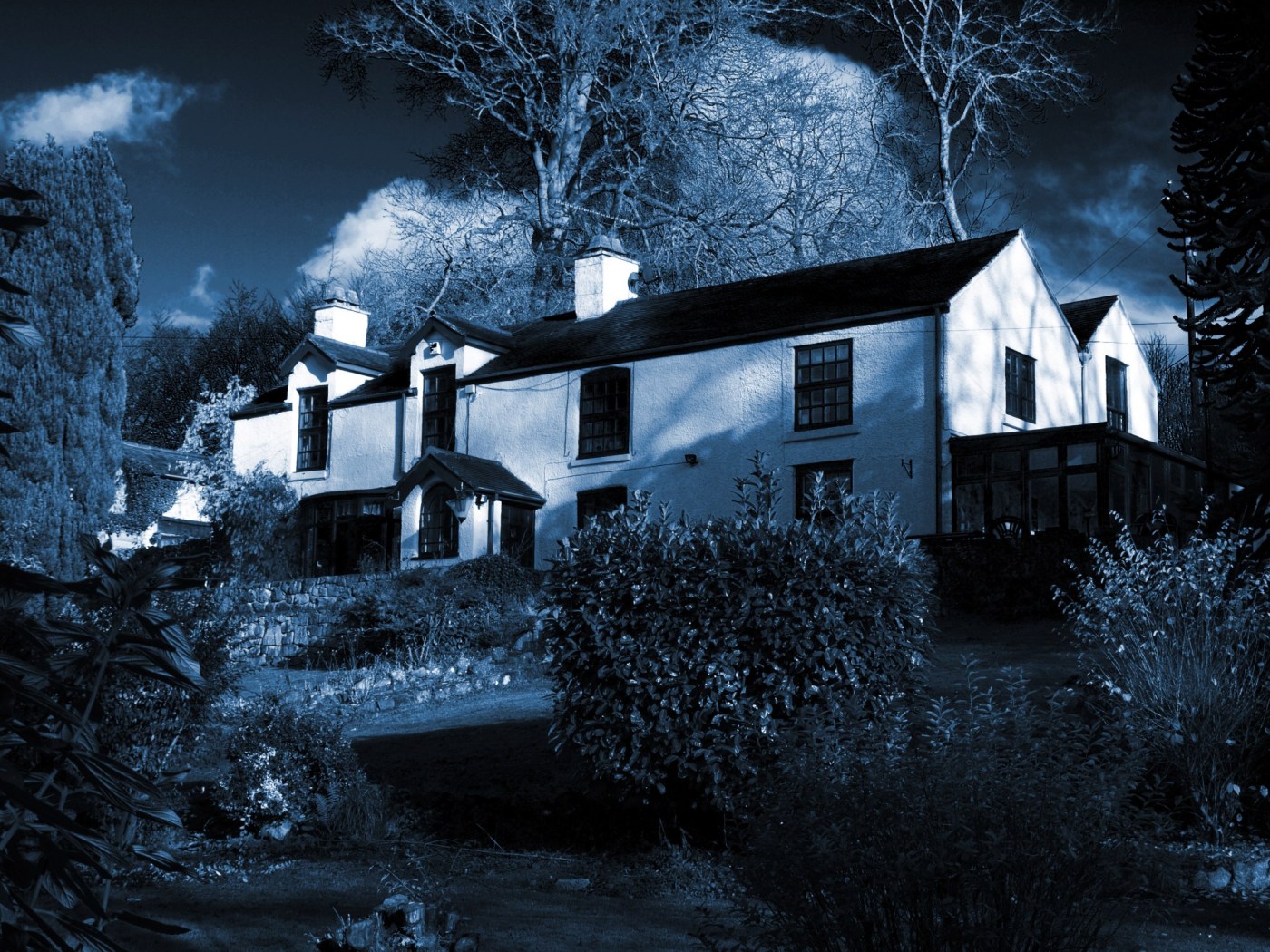
Surreal estate: How hauntings affect home sales

posted in: All news | 0

You visit an open house for a stately old Victorian on a quiet street. It has a wraparound front porch and all kinds of vintage charm … but you can’t help but wonder if that sudden cold draft is the result of poor insulation, or a past occupant dropping by. And the lights on that stunning chandelier are flickering in a way that might foretell an expensive visit from an electrician — or an exorcist.

Related Articles


Working Strategies: Job search best practices require discipline


Como Park Zoo & Conservatory issues last call for Mold-A-Rama magic


JPMorgan Chase wants out of paying $115M legal tab for convicted fraudsters


New Samsung retail store at the MOA acts a lot like Apple


Developer asks St. Paul for $3.5 million loan for housing, retail at Grand and Victoria

You want to ask the listing agent if they’ve heard about any paranormal activity on the property. But do they actually have to tell you?

That depends on where you’re house hunting. In most states, the seller doesn’t have to disclose anything. For example, according to Massachusetts state law, whether the home “has been the site of an alleged parapsychological or supernatural phenomenon” is not a material fact that has to be mentioned in a real estate transaction. However, the seller or agent are also not allowed to lie about it.

Minnesota has a similar code, which says that sellers don’t have a duty to disclose whether the home “was the site of a suicide, accidental death, natural death, or perceived paranormal activity.”

Still, a disturbing history like murder can affect the value of a home, said Ryan Dossey, co-founder of the house-buying service SoldFast in San Diego, in an online exchange. He points to search services like DiedInHouse as an example of how prospective borrowers can research a home’s past, uncovering details that a seller might have chosen not to divulge.

A gruesome case of buyer’s remorse

One such incident led to the 1983 court case Reed v. King. Dorris Reed purchased her California house from Robert King, who did not disclose that a woman and her four children were murdered in the home ten years prior. King had even requested that a neighbor not tell Reed about the killings. Reed’s attorneys claimed that while she had paid $76,000 for the home, it was really worth $65,000 because its history seriously damaged its value and desirability.

The courts ruled in Reed’s favor, finding that the home’s reputation affected its property value. Such homes are sometimes called “stigmatized properties.”

For some, a colorful history is a selling point

Not every buyer feels as Reed did. While an oversized skeleton decoration in the front yard is about as creepy as some home buyers are willing to get, others are drawn to the novelty and mystique of certain listings.

“A lot of buyers I’ve worked with love when there’s a deep or haunting history,” said Joe Luciano in an online exchange. Luciano is a Massachusetts Realtor who has shown historic homes in Salem.

For instance, one couple bought a house next to a funeral home. “They pretty much always wore all black, and the first thing they did when they moved in was paint the inside a deep purple color. This home was also right near the Salem Witch House, which, truthfully, was a selling point.”

So you bought a “haunted” house. Now what?

Let’s say you’re not afraid of things that go bump in the night and bought a stigmatized property. Even if you’re not worried about poltergeists, you still may have to contend with human reactions.

“Unbeknownst to me, I bought a ‘murder’ house back in 2021 as a flip that was the site of a homicide inside the property,” Ryan Dossey said.

“We encountered issues with the contractors,” he said, after neighbors mentioned the home’s history. From that point on, the contractors refused to be alone at the property. “It took considerable effort to persuade them to complete the renovation.”

Believer or skeptic, home buyer or seller, it’s important to know your rights when it comes to marketing a stigmatized home, as well as your legal responsibilities. Talk with your real estate agent, be honest with all parties involved, and check your state’s law if it’s relevant.

It’s perfectly reasonable to worry about the effect that such a history could have on your home’s value, but don’t be too discouraged. While some would never dream of buying a home that has a creepy past (real or imagined), you never know when Gomez Addams is prowling the market.

Taylor Getler writes for NerdWallet. Email: tgetler@nerdwallet.com.

Gophers football: John Nestor trending toward return vs. Iowa

posted in: All news | 0

IOWA CITY, Iowa — Gophers cornerback John Nestor has been trending toward a return to play against Iowa at Kinnick Stadium on Saturday afternoon, the Pioneer Press has learned.

If Nestor is able to suit up and play, it would boost a Minnesota secondary that has dealt with more injuries than any other position group this season. Nestor was listed as questionable with an unknown issue last Friday versus No. 25 Nebraska and narrowly missed the 24-6 win over the Cornhuskers.

Nestor’s official availability won’t be known until 12:30 p.m., two hours before the Gophers kickoff the Floyd of Rosedale rivalry game with the Hawkeyes.

The rivalry game has extra meaning for Nestor. The junior from Chicago played two years at Iowa before entering the transfer portal last spring. He played 20 total games for the Hawkeyes, making 16 total tackles and winning a Team Hustle Award in 2024 and ’23.

For the Gophers, Nestor has a team-high three interceptions and is sixth with 21 total tackles across the opening six games.

Related Articles


Annunciation ties unite Gophers, community in grief and hope


Gophers football at Iowa: Keys to game, how to watch, who has edge


Gophers football: Which players are drawing NFL interest?


Gophers football: P.J. Fleck corrects Iowa fans over fair catch kerfuffle


Was Gophers’ victory over No. 25 Nebraska worth storming the field?

Joe Soucheray: Trump lacks grace — and permission — in his destruction of East Wing

posted in: All news | 0

President Donald Trump’s bulldozing of the East Wing of the White House reveals him to have the aesthetic taste of a mildly successful professional con artist. The Oval Office already lacks only the requirement that all who enter the sanctum must wear grills and large jewel-encrusted chains around their neck with perhaps a clock hanging from it, or a crucifix.

Never has there been a more important man in the world with less class.

A 90,000-square-foot ballroom will be built in place of the demolished East Wing, a ballroom. Did we need a ballroom? It is certain to be grotesque, out of character, out of place, out of this world. Early betting favors the opening-night performance of either Kid Rock or maybe a full card of greased wrestling.

The Rose Garden is gone, replaced by a concrete slab and a forest of flag poles. The new Air Force One will struggle to get off the ground with the burden of all that extra weight in gold bathroom fixtures.

You can tell a lot about a guy by his place. You often see Trump-like conversions happen in Minnesota’s lake country. Somebody buys a traditional old cabin with a screened porch and those heavy canvas awnings and a winding old moss-grown footpath down to the dock, and the next thing you know, there sits a mansion loaded with framed centaurs done in purple velvet, life-size Elvis statues and probably a pontoon boat out front with a radar dish and three 200-horsepower outboards hanging off the stern. That misses the point of a pontoon boat, not to mention living on a nice piece of lakeshore. There is no accounting for taste and to each his own, but you look stupid, pal, like you got lucky with a hedge fund and you didn’t have a clue what to do with the money.

There’s a difference, though. We don’t own that guy’s lakeshore. But we do own the White House. And everything Trump does to it he does without permission or consultation and without a note of grace. He apparently knew a guy with a bulldozer and here we go.

Well, yes, but FDR built a swimming pool, to which it might be countered that pools make good palliative care for polio sufferers.

OK, but Richard Nixon built a bowling alley. Wouldn’t you rather have had Nixon go down to the basement and roll a few frames and not be seen by the public walking around talking to portraits? Jacqueline Kennedy installed art and artifacts of history, saying that it would be a sacrilege to merely redecorate. She said there must be a purpose served by the White House.

For Donald, the purpose of the White House is him.

It shouldn’t be a surprise that Trump got elected. He was the antidote to the insane ideology of progressives who are systematically ruining cities and universities. Here came a fellow who didn’t buy the DEI nonsense, didn’t believe men should compete against women in sports, wasn’t falling for the ridiculous affectation of multiple pronouns, liked the police and didn’t believe cities should burn at the hands of rioters, and he didn’t hold the military in contempt.

Related Articles


Letters: A papal exhibit? What about the sisters?


Real World Economics: ‘Creative destruction’ and Argentina’s debt crisis


Wes Burdine: Why this St. Paul business owner is voting ‘yes’ to amend the city charter


Skywatch: The great flying horse of the sky


Working Strategies: Customize cover letters, but there are shortcuts

Trump’s problem is that he takes great liberties with his possession of the antidote. He over-corrects everything. If Trump were to insist, for example, that the Christopher Columbus statue be reinstalled on the Minnesota Capitol grounds, he would also insist that the Capitol should be called the Columbus Building. If he deemed a DEI hire not suitable for a particular job, he would find the same person not suitable for any job. Other presidents have managed to deport illegal immigrants without a display of military strength.

Donald is The Great Over Corrector, even with ballrooms.

They could have knocked down a wall or two in the White House and created a quaint new banquet hall, but The Great Over Corrector doesn’t do quaint. He knew a guy with a bulldozer and there goes the entire East Wing.

Joe Soucheray can be reached at jsoucheray@pioneerpress.com. Soucheray’s “Garage Logic” podcast can be heard at garagelogic.com.

David Brooks: The death of democracy is happening within us

posted in: All news | 0

In 2020, Democrats won a convincing election victory. They proceeded to do what all victorious parties do. They passed legislation in accord with their priorities, including raising health insurance subsidies to families making up to 400% of the poverty line. They wrote the law so that the subsidies would expire in 2025.

In 2024, the Republicans won a convincing election victory. They proceeded to do what all victorious parties do. They passed legislation in accord with their priorities, including letting the Democrats’ insurance subsidies expire as planned.

If the Democrats were a normal party that believed in democratic principles, they would have planned to go to the voters in the next elections and said: These Republican policies are terrible! You should vote for us!

But of course that’s not what the Democrats decided to do. Instead, they shut down the government. Why did they do that? Because we don’t live in a healthy democracy. We live in a country in which the norms, beliefs and practices that hold up a democracy are dying even in the minds of many of the people who profess to oppose Donald Trump.

Daniel Patrick Moynihan once wrote an essay called “Defining Deviancy Down.” His core point was that when the amount of deviant behavior rises, people begin to redefine deviant behavior as normal. This is a column about that.

In a functioning democracy, a politician’s first instinct is to go to the voters and let the voters decide. In a diseased democracy a politician’s first instinct is to amass power by any means necessary. In a healthy democracy politicians abide by a series of formal and informal restraints because those restraints are good for the nation as a whole. In a diseased democracy like ours all the decent rules and arrangements are destroyed. Anything goes.

Trump is destroying democratic norms. Democrats have decided to follow him into the basement. When both parties cooperate to degrade public morality, then nobody even notices as it’s happening.

Government shutdowns became a thing during the Carter administration. The first few shutdowns during the Reagan administration lasted a day or two. Leaders in both parties did not want to face the wrath of voters who would be offended by this level of gridlock and incompetence. Now we’re in our 20th shutdown (depending on how you count them) and nobody cares. Neither political party is paying much of a price because the public has been rendered utterly cynical about government. Nothing is shocking anymore because there are no moral norms left standing.

Let me try to illustrate how deeply this cynicism has penetrated the American mind. When Democrats did decide to shut down the government they could have done it to protest Trump’s historically unprecedented assault on democracy. But instead the Democrats decided to organize their messaging around the expiring health insurance subsidies. Why did they do that? Because they calculated that the American public doesn’t care about democracy’s degradation. It’s been going on so long voters are simply inured to it. So better to talk about Obamacare.

And in fact there are good reasons to think that Americans simply don’t care about their democratic rights. For example, several states are redrawing congressional district maps to come as close as possible to eliminating competitive races. If you live in Texas or California, then you probably will not have to vote in November 2026. The district maps will have been redrawn in a way that makes House elections largely predetermined. By then you will probably have been effectively disenfranchised.

You might think that proud Texans and Californians would be outraged, or that the ruling parties in those states would be destroyed for doing this. Didn’t our ancestors at Valley Forge and on the beaches of Normandy die to preserve our democracy? But do you hear an outcry? No. It’s just crickets. People are used to the idea that the game is already rigged. So what is there left to get upset about so long as your party is ruthless enough to do the rigging?

I don’t think I appreciated how much a democracy depends upon regular people standing up to defend their rights and their powers against the elites who try to usurp them. These days people are happy to give up their rights and power if they can find some strongman or strongwoman willing to take it. This is a much larger part of human nature than I thought.

For example, when I first started covering Congress, in the 1990s, backbench members could pass legislation if they had a good idea and some entrepreneurial mojo. Back then, congressional committees and their chairs were still powerful. Power was dispersed, in true democratic fashion.

But for at least 30 years members of Congress have been content to give away their power. First, they gave the power to leadership, so that today four people basically run the legislative branch. Then they gave power to executive branch agencies, letting more and more key decisions get made by the unelected civil service.

Today, if you are a Republican you have basically given away all your power to Trump. You are a duly elected representative of your constituents, yet you’ve turned yourself into a Trump bobblehead figure who gets to go on Fox News from time to time.

The blunt truth is that a lot of Americans don’t find our founding ideals sacred, so they don’t get upset when the Constitution is trampled, so long as it is their side doing the trampling.

Let me try to describe something that may seem trivial but which I believe is at the core of our rot. It is politicians’ tendency to use the word “fight” in their campaign rhetoric. I noticed this trope when Hillary Clinton ran for president. She was continually promising to “fight” for middle-class Americans. It didn’t bother me then. She was a woman running for an office that had been held entirely by men, so she had to prove she was tough.

But now the “fighting” rhetoric is ubiquitous. MAGA Republicans claim that the old Bush-era Republicans were squishes who didn’t really know how to fight. Democrats are upset with their party leaders because they don’t fight hard enough. Political analysts casually use phrases like “he brought a knife to a gunfight.” I hear “fighting” references constantly in political discourse and every time I do alarm bells go off.

This is no longer just a metaphor. It’s a mindset. We now have a lot of people in this country who do not believe that democracy is about trying to persuade people, it’s about fighting, crushing and destroying people. I don’t agree with philosopher Michel Foucault on much, but he had a point when he observed that a lot of life is about trying to repress the little fascist in each one of us. When people start describing politics as a fight, they are unleashing their inner fascist. Fighting is for fascists.

Democracy is about persuasion. Our Constitution is a vast machine that is supposed to increase the amount of deliberation, conversation and persuasion in society. Our elections are supposed to be raw, rollicking persuasion contests.

Trump’s idiotic rhetoric is not about persuasion. The Democrats’ mind-numbingly repetitive talking points are not about persuasion. The people who want their leaders to “fight” harder just want them to shout their side’s orthodoxies at higher and higher volume. They just want their leaders to ramp up the bellicosity of their rhetoric so that the extremists on their side feel good.

What defines extremists these days? It’s not that they hold ideological extreme positions. It is that they treat politics as if it were war. They use the language, mental habits and practices of warfare. They are letting their inner Mussolini out for a romp.

Related Articles


Lionel Laurent: Louvre robbery gang used a brazen new criminal blueprint


Denise Lorence: My daughter is the face of Operation Midway Blitz. I am reclaiming her legacy


John M. Crisp: How do you know when you’ve become an autocracy?


Allison Schrager: The era of the illiquid millionaire is here


Nafees Alam: The post-Trump GOP — potentially the party of the sensible center

Let me give you one quick example of how widely this corruption has pervaded our society. Universities were once about persuasion, truth-seeking and the life of the mind. But over the past half century an ideology has spread through them that holds that persuasion is naive. Ideas are about power. Thus many professors decided their job was indoctrination, not truth-seeking. To impose power so that students think just like they do.

Jon A. Shields, Yuval Avnur and Stephanie Muravchik recently published a study in the magazine Persuasion looking at college syllabuses. As you’d expect, professors assign a lot of left-wing books like Michelle Alexander’s “The New Jim Crow,” about the criminal justice system and race, that align with the official orthodoxy of academia. But there are a lot of other books that dispute the historical claims of books like “The New Jim Crow.” You might think that some professors would assign books on both sides of the issue so students would learn how to weigh evidence and be persuaded. But the researchers estimated that “less than 10% of professors assigning Alexander’s book actually teach the controversy surrounding it.”

Students are completely aware that they are not being educated; they are simply players in a cynical indoctrination game. At Northwestern and the University of Michigan, 88% of students told researchers that they pretend to be more progressive than they are because they think it will help them succeed academically or socially. I saw exactly this kind of performative dishonesty while covering the Soviet Union years ago.

Yes, Trump is launching an assault on democracy. But what worries me more is what has happened over the last few decades to the rest of us. There has been a slow moral, emotional and intellectual degradation — the loss of the convictions, norms and habits of mind that undergird democracy. What worries me most is the rot creeping into your mind, and into my own.

David Brooks writes a column for the New York Times.