By DAVID A. LIEB, MICHAEL CASEY and SCOTT BAUER, Associated Press
BOSTON (AP) — President Donald Trump’s administration asked a federal appeals court Friday to block a judge’s order that it distribute November’s full monthly SNAP benefits amid a U.S. government shutdown, even as at least some states said they were moving quickly to get the money to people.
U.S. District Judge John J. McConnell Jr. had given Trump’s administration until Friday to make the payments through the Supplemental Nutrition Assistance Program. But Trump’s administration asked the appeals court to suspend any court orders requiring it to spend more money than is available in a contingency fund.
The court filing came even as Wisconsin Gov. Tony Evers’ spokesperson Britt Cudaback said on Friday that some SNAP recipients in the state already had received their full November payments overnight on Thursday.
“We’ve received confirmation that payments went through, including members reporting they can now see their balances,” she said.
The court wrangling prolonged weeks of uncertainty for the food program that serves about 1 in 8 Americans, mostly with lower incomes.
Thursday’s federal court order came in a lawsuit from cities and nonprofits challenging the Trump administration’s decision to cover only 65% of the maximum monthly benefit, a decision that could have left some recipients getting nothing for this month. McConnell was one of two judges who ruled last week that the administration could not skip November’s benefits entirely because of the federal shutdown.
The judges in both cases ordered the government to use one emergency reserve fund containing more than $4.6 billion to pay for SNAP for November but gave it leeway to tap other money to make the full payments, which cost between $8.5 billion and $9 billion each month.
On Monday, the administration said it would not use additional money, saying it was up to Congress to appropriate the funds for the program and that the other money was needed to shore up other child hunger programs.
In its court filing Friday, Trump’s administration contended that Thursday’s directive to fund full SNAP benefits runs afoul of the U.S. Constitution.
“This unprecedented injunction makes a mockery of the separation of powers. Courts hold neither the power to appropriate nor the power to spend,” the U.S. Department of Justice wrote in its request to the court.
Some states said they stood ready to distribute the money as quickly as possible.
The Michigan Department of Health and Human Services said it directed a vendor servicing its SNAP electronic benefit cards to issue full SNAP benefits soon after the federal funding is received. Benefits are provided to individuals on different days of the months. Those who normally receive benefits on the third, fifth or seventh of the month should receive their full SNAP allotment within 48 hours of funds becoming available, the department said, and others should receive their full benefits on their regularly scheduled dates.
___
Lieb reported from Jefferson City, Missouri, and Bauer from Madison, Wisconsin.
A record number of Americans are predicted to get on board in 2026 for a cruise vacation, according to a report from AAA, with Florida’s big three ports forecast to be the top embarkation points.
The travel company projects 21.7 million Americans will book a cruise next year, a 4.5% increase from the 20.7 million travelers from the U.S. in 2025.
“Cruising is surging, with travelers booking more voyages and exploring new destinations in record numbers,” said Debbie Haas, vice president of travel for AAA in a press release.
The projection would mark the fourth record year in a row, following a dip from 2020 to 2022 because of fallout from the COVID pandemic.
PortMiami is projected to lead the way again, with 10.2% of all American cruise embarkations and debarkations.
Port Canaveral, which held the title of world’s busiest cruise port for one year after the pandemic reopening based on 2022 traffic, has since fallen back to No. 2. Canaveral is projected to grab 8.8% of the traffic, while No. 3 Port Everglades would get 5.6%.
Port Canaveral could once again challenge Miami’s numbers, however, as the Orlando-area port also gets daily passenger movements from ships that call on the port as a destination when they sail from embarkation points such as New York. Daily passenger movements are counted when people get on as well as off.
Port rankings for the full calendar year are usually released by late February by the Florida Ports Council.
Port Canaveral’s fiscal 2026 budget, which is for October 2025 to September 2026, is projecting more than 9 million passenger movements, building on fiscal 2025’s record of more than 8.6 million from 1,038 cruise calls.
The demand amid the industry’s pandemic rebound has meant cruise lines have had welcome takers for their new ships, with Florida getting the lion’s share of debuts.
Royal Caribbean has brought to the state the three largest cruise ships in the world with Icon of the Seas, Star of the Seas and Utopia of the Seas as well as the last of its Quantum Plus class, Odyssey of the Seas.
Disney Cruise Line has debuted from Port Canaveral two of its new Wish class ships, Wish and Treasure, with a third, Disney Destiny, set to arrive next month at Port Everglades.
Carnival has brought two of its three Excel class ships to the state, with Mardi Gras’ debut from Port Canaveral in 2021 followed by Carnival Celebration from Miami in 2022. Norwegian has debuted two Prima class ships (Prima and Viva) and one Prima-plus class ship (Aqua) with Norwegian Luna coming in 2026. And MSC Cruises had brought its largest ship MSC World America to Miami along with other new ships MSC Seashore and Seascape.
Celebrity is set to debut its sixth Edge-class ship, Celebrity Xcel, from Port Everglades next month, with four of the five others having also arrived to the Fort Lauderdale port since 2021. Princess Cruises also headed to Port Everglades, having sailed out its last two Royal-class ships, and is about to bring its second Sphere class ship next month with the arrival of Star Princess following sister ship Sun Princess’ debut in 2024.
Virgin Voyages rolled out three of its fleet of four ships since 2021, including the new Brilliant Lady this month, and Holland America had the last of its Pinnacle class debut with the ms Rotterdam. New ships have also made their way to the state from Oceania Cruises, Regent Seven Seas, Explora Journeys, Silversea Cruises, Seabourn and others.
Older adults remain the majority of those who cruise, according to AAA, with 65% of passengers aged 55 and older, 27% from 35-54 and 7% between 18-34.
More than half travel as couples, with 20% also bringing children. Only 7% travel solo.
The Caribbean remains the most popular destination with 72% of U.S. cruise passengers. Alaska comes in next with 7% and 5% head to the Mediterranean.
AAA travel agents state that nine out of 10 of their customers who have cruised rate the experience as either good or very good, and 91% have cruised more than once.
The projections from AAA are based on scheduled cruise itineraries paired with a database from Tourism Economics focused on the cruise industry as well as economic forecasts from Oxford Economics.
NEW YORK (AP) — Salman Rushdie’s new book, his 23rd, is also a resetting of his career.
Related Articles
In ‘Queen Esther,’ John Irving travels back to ‘The Cider House Rules’
Bruce Lee biographer Jeff Chang is fighting a ban on one of his own books
Readers and writers: Prose, poetry, murder, memoir, history
Literary pick: Twin Cities Book Festival comes to Union Depot
Literary calendar for week of Nov. 2
“The Eleventh Hour,” which includes two short stories and three novellas, is his first work of fiction since he was brutally stabbed on a New York lecture stage in 2022. His recovery has been physical, psychological — and creative. Just finding the words for what happened was a painful struggle that culminated with his memoir “Knife,” published in 2024. Fiction, the ability to imagine, was the last and crucial step, like the awakening of nerves once feared damaged beyond repair.
“While I was writing ‘Knife,’ I couldn’t even think about fiction. I had no space in my head for that,” Rushdie told The Associated Press last week. “But almost immediately after I finished the book, before it came out, it’s like this door swung open in my head and I was allowed to enter the room of fiction again.”
Two of the pieces in his book out Tuesday, “In the South” and “The Old Man in the Piazza,” were completed before the attack. But all five share a preoccupation with age, mortality and memory, understandable for an author who will turn 79 next year and survived his attack so narrowly that doctors who rushed to help him initially could not find a pulse.
This cover image released by Random House shows “The Eleventh Hour” by Salman Rushdie. (Random House via AP)
“The Eleventh Hour” draws from Rushdie’s past, such as his years as a student in Cambridge, and from sources surprising and mysterious. The title character of “The Old Man in the Piazza,” an elderly man treated as a sage, originates from a scene in the original “Pink Panther” movie, when an aging pedestrian looks on calmly as a wild car chase encircles him. The novella “Oklahoma” was inspired by an exhibit of Franz Kafka’s papers that included the manuscript of “Amerika,” an unfinished novel about a European immigrant’s journeys in the U.S., which Kafka never visited.
For “Late,” Rushdie had expected a straightforward narrative about a student’s bond with a Cambridge don, an eminence inspired by author E.M. Forster and World War II code-breaker Alan Turing. But a morbid sentence, which Rushdie cannot remember writing, steered “Late” to the supernatural.
“I had initially thought that I would have this friendship, this improbable friendship between the young student and this grand old man,” Rushdie explained. “And then I sat down to write it, and the sentence I found on my laptop was, ‘When he woke up that morning, he was dead.’ And I thought, ‘What’s that?’ And I literally didn’t know where it came from. I just left it sitting on my laptop for 24 hours. I went back and looked at it, and then I thought, ‘You know, OK, as it happens, I’ve never written a ghost story.’”
Rushdie will always carry scars from his attack, notably the blinding of his right eye, but he has otherwise reemerged in public life, with planned appearances everywhere from Manhattan to San Francisco. A native of Mumbai, he moved to England in his teens and is now a longtime New Yorker who lives there with his wife, the poet Rachel Eliza Griffiths.
His most celebrated novel is “Midnight’s Children,” his magical narrative of the birth of modern India that won the Booker Prize in 1981. His most famous, and infamous, work, is “The Satanic Verses,” in which a dream sequence about the Prophet Muhammad led to allegations of blasphemy, rioting and a 1989 fatwa from Iran’s Ayatollah Ruhollah Khomeini that called for Rushdie’s death and drove him into hiding. Although Iran announced in the late 1990s that it would no longer enforce the decree, Rushdie’s notoriety continued: The author’s assailant, Hadi Matar, was not even born when “Satanic Verses” was published. Matar, found guilty of manslaughter and attempted murder in a state trial, was sentenced in May to 25 years in prison. A federal trial is still pending.
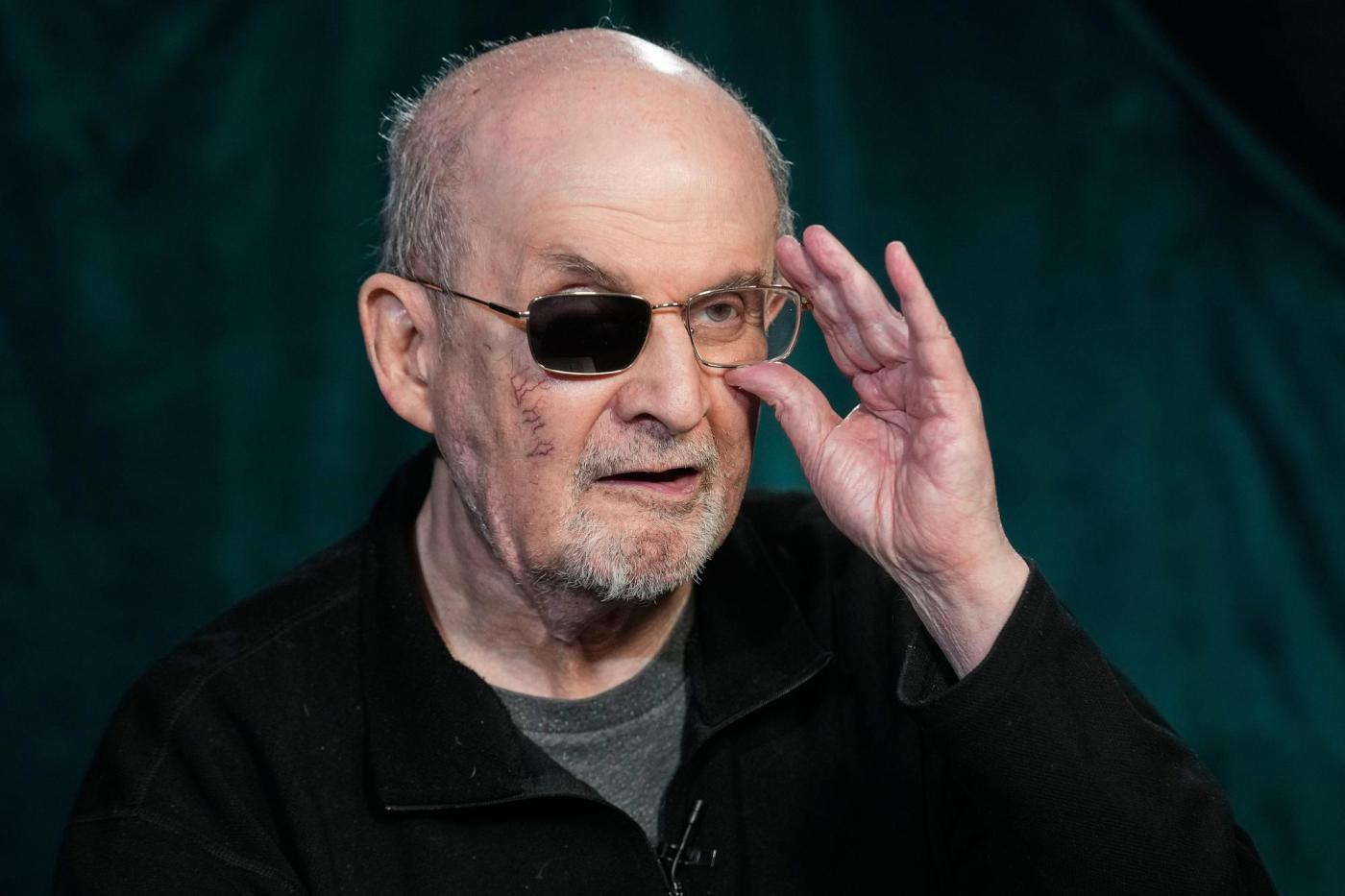
Author Salman Rushdie appears during an interview in New York on Wednesday, Oct. 29, 2025. (AP Photo/Richard Drew)
Author Salman Rushdie appears during an interview in New York on Wednesday, Oct. 29, 2025. (AP Photo/Richard Drew)
1 of 2
Author Salman Rushdie appears during an interview in New York on Wednesday, Oct. 29, 2025. (AP Photo/Richard Drew)
Rushdie also spoke with the AP about his legacy, his love of cities and how his near-death experience did not make him any more spiritual. This interview has been edited for clarity and brevity.
AP: Age is obviously a theme throughout this book, and something you had been thinking about it before the attack, the idea of “Will I be valued at the end?” “Does it matter that whatever knowledge I have accumulated?” These are things that you think about?
RUSHDIE: I think about what maybe all of us think about. What do we amount to in the end? What did our life add up to? Was it worth it or was it trivial and forgettable? And if you’re an artist, you have the added question of will your work survive? Not just will you survive, but will the things you make endure? Because certainly, if you’re my kind of writer, that’s what you hope for. And, it would be very disappointing to feel that they would just vanish.
But I really love the fact that “Midnight’s Children,” which came out in 1981, is still finding young readers, and that is very pleasing to me. That feels like a prize in itself.
AP: Something else that struck me about the book was how much it was a book of stories about stories. The conscious art of storytelling.
RUSHDIE: Yes, and much more than in the others. I think particularly the story called “Oklahoma” is very much a story about storytelling and about truth and lies.
According to (Kafka’s friend and literary executor) Max Brod, Kafka had this idea that when his character arrived in Oklahoma, he would find some kind of happiness. He would find some kind of resolution, some kind of fulfillment there. And I often thought the idea of a Kafka book with a happy ending is kind of hard to imagine, so maybe it’s just as well he didn’t write the last chapter. The Oklahoma in the story is entirely fictitious. I mean, he never went anywhere. He never came to America, Kafka. But it becomes like a metaphor of hope and of fulfillment.
AP: Was America like that for you?
RUSHDIE: It’s why I came to live here, because I was excited by a lot about America. New York City was a place that excited me enormously when I first came here in my 20s, when I was still working in advertising. But I just thought, “I just want to come and put myself here and see what happens.” I just had an instinct that it would be good for me. And then, you know, life intervened and I didn’t do it for a long time. And then around the turn of the century, I told myself, “Well, if you’re ever going to do it, you better do it, because otherwise, when are you going to do it?”
AP: I remember after the fatwa that people would refer to you as reclusive. But that is clearly not true.
RUSHDIE: I like being in the world. You know, one of the things that I have often said to students when they’re following the kind of “write what you know” mantra, I said, “Yeah, write what you know, but only if what you know is really interesting. And otherwise go find something out, write about that.” I always use the example of Charles Dickens, because one of the things that impresses me about Dickens is how broad the spectrum of his characters is, that he can write about all walks of life. He could write about pickpockets and archbishops with equal credibility, and that must mean that he went to find things out.
AP: Is there a part of you that likes the idea of being that old man in the piazza that people come to?
RUSHDIE: I don’t want to be a kind of guru or oracle. I don’t have answers. I have, I hope, interesting questions.
AP: Does writing fiction feel different to you than it did before what happened three years ago.
RUSHDIE: No, it just feels like I’m so glad to have it back. I hope that people reading the book feel a certain kind of joy in it because I certainly felt joyful writing it.
AP: Did any of that make you more spiritual?
RUSHDIE: I’m afraid it hasn’t. It has not performed that service.
AP: You are still in agreement with your friend Christopher Hitchens (the late author of “God Is Not Great”)?
RUSHDIE: Hitch and myself are still united in that zone of disbelief, aggressive disbelief.
In a final message, Jane Goodall urged us not to lose hope, even “as we destroy one ecosystem after another, as we create worse climate change and worse loss of biodiversity.” She believed our actions still mattered on this beautiful Earth. Above all, she said, in a statement released soon after her October 1 death: “I want you to understand that we are part of the natural world.”
For some years now, I have been studying the art of wildlife tracking—specifically the identification of tracks and signs—as a way of deepening that understanding. I want to slow down, bend down, look, and really see. Humans have been doing this for millenia: matching shapes on the ground to meaning and story. In my own life, this new competence in the natural world has connected me more deeply to that world, with a greater desire to preserve its beauty and health.
My intention is not to trail wild animals. I have no desire to startle or interfere in their secret lives, which are often short and already difficult. I received training from expert tracker Jonah Evans, a supervisor in the Texas Parks and Wildlife Department, and I follow his creed: Do no harm. Instead, I find pleasure in seeing a track in the dirt and knowing that a striped skunk or bobcat or blue heron recently stood here. Perhaps an hour ago. Perhaps a day or week. As I bend down to look, I am profoundly, thankfully, aware that I’m not alone but surrounded by the nonhuman.
In particular, I love skunks. Whenever I see a skunk, I think: fashion show. Something from Chanel. A bit of art deco. That black and white aesthetic.
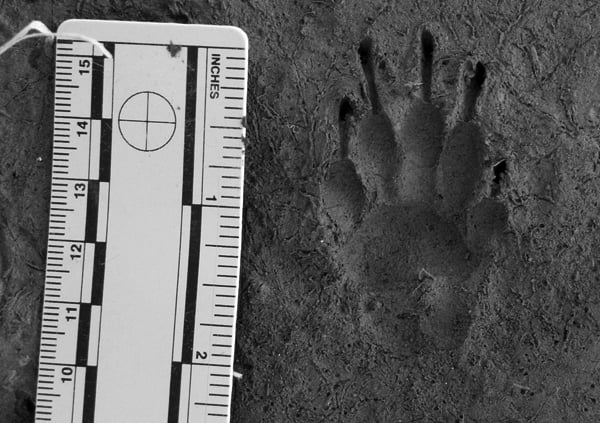
Striped skunk track (Kim A. Cabrera)
Texas is lucky to have four skunk species. The striped skunk seeks cities and suburbs partly for denning opportunities under porches and in garden and tool sheds. The hefty hog-nosed skunk can weigh up to ten pounds, and uses its long claws for digging and its powerful upper body and elongated snout to explore rocky areas; the back of a hog-nosed skunk tends to be luminously white, from the top of the head to its tail. The smallest and most carnivorous, Western and Eastern spotted skunks, both have coats of partial stripes or spots.
All skunks, when threatened, might raise their tails and use a defensive spray. This concentrated sulfurous fluid can be deployed with accuracy at targets six feet away and with less accuracy up to 15 feet. Spotted skunks further intimidate by doing a handstand on their front feet, performing a split with their back legs, and walking forward in imitation of a flying carpet. Stop and imagine that for a moment, or watch it on YouTube. But skunks don’t want to use up their musk and might instead eject a warning smell or hiss and stamp their feet.
If these strategies fail, a striped skunk will twist into a U shape so that its eyes and rump both face the threat. Its spray can burn skin and cause temporary blindness. The odor alone—a mix of rotten eggs, rotting cabbage, burnt garlic, burning tires, and something undecipherable —makes some people gag. Everyone, instinctively, backs away.
Still, I rarely worry about a skunk targeting me. (Mostly because I don’t bring along a barking dog.) I keep a good distance from any wild animal, and healthy skunks are not usually aggressive. The result of their strong defense system is that skunks can often seem relatively docile and carefree. Adult striped skunks, weighing only a few pounds, have been videotaped eating from a carcass while a fox or mountain lion waits nearby. In 2017, Ohio State University biologist Stan Gehrt looked on while three coyotes circled a skunk atop a dead deer. The coyotes approached, retreated, split up, whined, fussed, nipped forward, nipped back. “It was hilarious watching this little animal standing on top of a dead buck, holding a pack of coyotes at bay,” Gehrt said, according to an account in the National Wildlife Federation journal. “The skunk never even sprayed.”
Like other animals who have learned to adapt and live among humans (think coyote and white-tailed deer) the decorative striped skunk remains relatively common, though populations of the hog-nosed skunk and Western and Eastern spotted skunks have dropped. Globally, the Eastern spotted skunk has been listed as Vulnerable by the International Union for Conservation of Nature, which tracks endangered species worldwide. In the Lone Star State, this species is particularly threatened by habitat loss due to agriculture, use of pesticides, and urban sprawl.
This is part of a larger alarming trend. In Texas, more than 1,300 animals and plants have been identified by experts as Species of Greatest Conservation Need, either rare or declining. Among the most endangered are charismatic creatures like ocelots and black bears. Rising sea levels and increased water temperatures particularly threaten the Kemp’s Ridley sea turtles and whooping cranes. (Whooping cranes can also be seen as a success story. Extensive conservation efforts have helped them rebound in Texas from near-extinction to a migratory population of about 400.)
Climate change and disappearing or degraded habitat are causing similar losses worldwide. The populations of more than five thousand species of fish, reptiles, amphibians, birds, and mammals have dropped by 73 percent since 1970, according to the World Wildlife Fund. Humans and domesticated livestock now account for 96 percent of the weight of mammals worldwide. Wild mammals add up to only 4 percent. The scientific term is defaunation. At first, that word feels awkward, stilted, like marbles in my mouth. Defaunation. Then it becomes exactly right.
These losses are deeply felt by me and many other people. But loss is only part of the story and not where I like to focus my attention. I prefer the pleasures of identifying track and sign. A perfect skunk track is artwork on the ground. About 1 1⁄2 to 2 inches long, with five toes, the prints look winsomely like small human hands. On both front and back feet, the three middle toes are partially fused to facilitate digging. Two outer toes are only slightly splayed to the side. Front and hind tracks usually show handsome claw marks, with the digging claws of the front feet longer than the rear. In the hind track of a striped skunk, the single large heel pad is separated from the palm pad by a distinct seam, a distinguishing mark. That distinct seam always gives me a ping of satisfaction. Pattern recognition is its own reward.
Skunks—and coyotes—are often considered “pests,” something to dismiss or even scorn. But these animals belong to the wild world that remains on Earth, that ribbon of life winding secretly through our lives, slipping around our house at night, just ahead of us on the trail. They are precious reminders of what we have not yet destroyed or diminished.
In identifying the track and sign of wildlife, I want to celebrate and name them, “Striped skunk!” “Tree squirrel!” “Bobcat!” or “Gray fox!” This is a democratic thrill, something almost anyone can have almost anywhere, something you can do at almost any age or in any physical condition. So I bend down to look, using my imagination, my mirror neurons, and, yes, my reading glasses.
Jane Goodall spent her life observing animals. At 91, she was still exploring; on a trip this fall, she visited an animal park in the Texas Hill Country. Her connection to the natural world was profound. Each of us now can—and perhaps must—find our own connection, one that will lead to a greater commitment to shun pesticides, plant natives, protect habitat, and treat wildlife with respect. Change can begin in our backyards or on a walk. Wildlife is still threaded through our lives. We only have to pay attention.