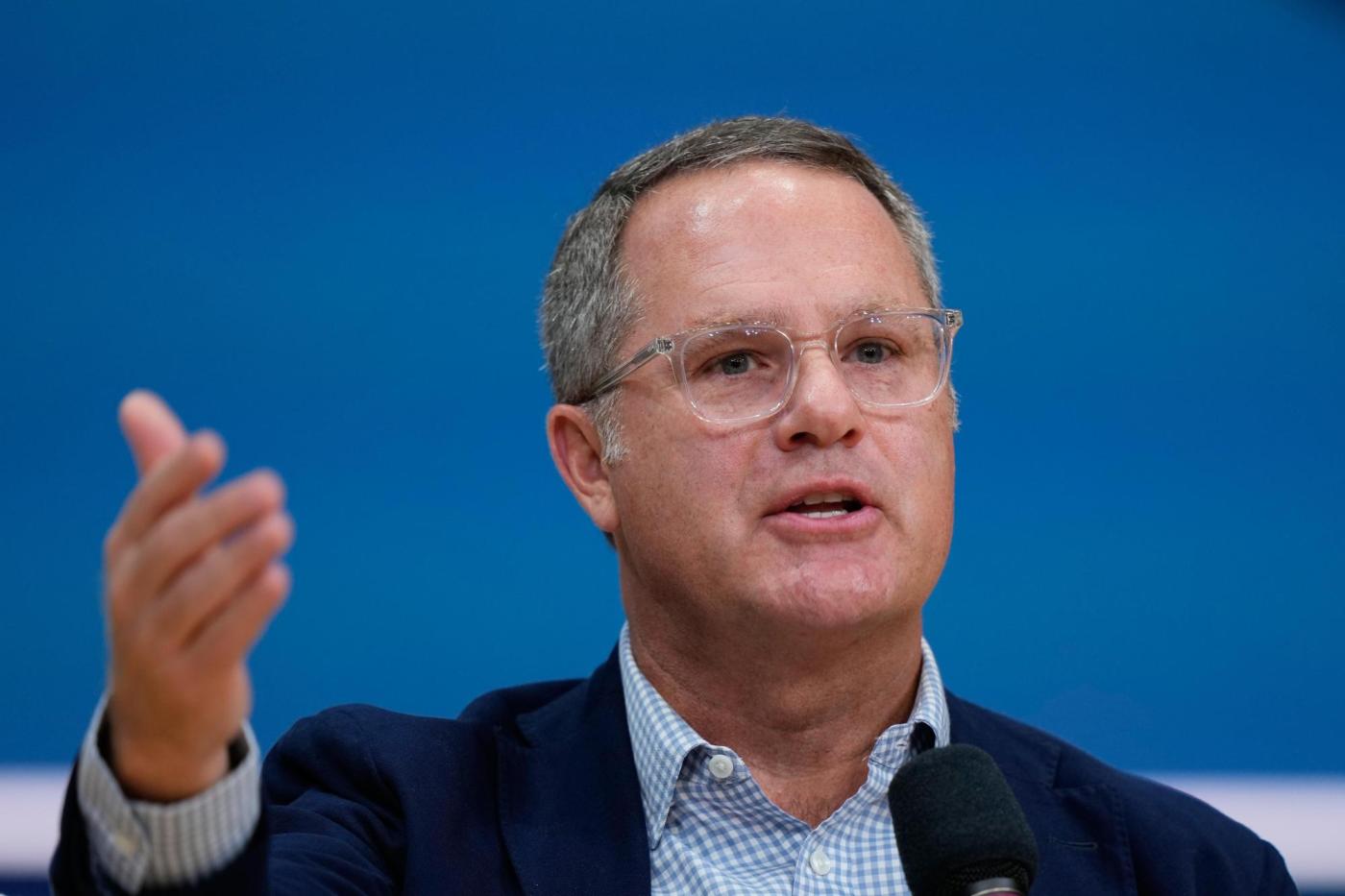
Small grocers and convenience stores feel an impact as customers go without SNAP benefits

posted in: All news | 0

By DEE-ANN DURBIN, Associated Press Business Writer

A little more than a year ago, Ryan Sprankle welcomed President Donald Trump to one of the three grocery stores his family owns near Pittsburgh. Trump was on the campaign trail; they talked about high grocery prices, and the Republican nominee picked up a bag of popcorn.

But these days, Sprankle would have a different message if Trump or any lawmakers visited his store. He wants them to know that delayed SNAP benefits during the government shutdown hurt his customers and his small, independent chain.

People leave Sprankle’s Neighborhood Market, Monday, Nov. 10, 2025, in Kittanning, Pa. (AP Photo/Jessie Wardarski)

“You can’t take away from the most needy people in the country. It’s inhumane,” Sprankle said. “It’s a lack of empathy and it’s on all their hands.

The Trump administration froze funding for the Supplemental Nutrition Assistance Program at the end of October, impacting food access for some 42 million Americans. On Monday, the U.S. Senate passed legislation that would reopen the federal government and replenish SNAP funds, but the U.S. House of Representatives still must consider the bill. It’s unclear when SNAP payments might resume if the government reopens.

In 2024, SNAP recipients redeemed a little more than $96 billion in benefits, according to the U.S. Department of Agriculture, which administers the program. The majority – 74% — was spent at superstores and supermarkets, a category that includes big chains like Walmart and Kroger but also some independent stores like Sprankle’s.

Around 14% was spent at smaller grocery and convenience stores, businesses often tucked into neighborhoods and more easily accessible to SNAP beneficiaries.

A stalled economic engine

Etharin Cousin, a former director of the United Nations World Food Program and founder of the nonprofit Food Systems for the Future, said the cutoff of SNAP benefits had immediate impacts on grocers and convenience stores of all sizes, most of which operate on slim profit margins of 1% to 2%.

“SNAP isn’t just a social safety net for families. It’s also a local economic engine,” Cousin said. “SNAP benefits flow directly into neighborhoods, stores, regional distributors and community jobs.”

Walmart declined to comment on the impact of the SNAP funding lapse but noted that it has been lowering prices and donating to local food banks. Kroger also declined to comment.

Shoppers not receiving their food benefits affects all retailers but becomes “a big problem more quickly” at small chains, Sprankle said. His Kittanning, Pennsylvania, store gets 25% of its revenue from SNAP, but customers who don’t get government assistance also are worried about the shutdown, according to Sprankle. They’re spending less, trading down to cheaper goods or heading to food banks, he said.

Ryan Sprankle, left, owner of Sprankle’s Neighborhood Market, speaks with Timothy A. Mohney at the market Monday, Nov. 10, 2025, in Kittanning, Pa. (AP Photo/Jessie Wardarski)

Sprankle said lower sales cut into the overtime he can offer to the chain’s 140 employees. Many are worried about losing their jobs, he said.

“They have families to feed, they have kids for buy gifts for,” he said. “If I have to sell my truck, we’re going to give Christmas bonuses.”

Liz Abunaw, the owner and operator of Forty Acres Fresh Market in Chicago, recently saw a customer putting back a full cart of groceries because she couldn’t afford them without SNAP.

Abunaw opened the supermarket in September after years spent selling produce at pop-up markets and in delivery boxes. Only about 12% of Abunaw’s revenue comes from SNAP benefits right now, she said. But without it — or if SNAP recipients spend less money in her store — it will slow Forty Acres’ growth and make it harder to pay the workers, suppliers and farmers who depend on her, she said.

“SNAP is currency. I get money I then use in this economy. It’s not a food box,” Abunaw said. “The economic impact of SNAP is larger than the dollars spent.”

From neighborhood shops to food pantries

The suspended food aid also had an immediate impact on Kanbe’s Markets, a nonprofit that stocks produce in coolers at 110 convenience stores around Kansas City, Missouri. Kanbe’s distributes a mixture of donated food and food purchased from wholesalers to keep prices low, founder and CEO Maxfield Kaniger said.

Related Articles


Today in History: November 12, Ellis Island closes its doors


A happy circumstance: Bob Ross paintings sell for more than $600K to help public TV stations


What to know about Trump’s plan to give Americans a $2,000 tariff dividend


Cleto Escobedo III, Jimmy Kimmel’s bandleader and childhood friend, dies at 59


Federal Border Patrol chief Gregory Bovino and agents said to be leaving Chicago, sources say

Kanbe’s also distributes free food to 50 food pantries and soup kitchens around the city.

Kaniger said some of the convenience stores he works with saw their sales drop 10% in the days after Nov. 1, when SNAP benefits weren’t paid. At the same time, the food pantries he supplies asked for double or triple their usual orders.

Because it’s giving away more food than usual, Kanbe’s has to spend more buying produce for the coolers it stocks. It’s frustrating for Kaniger, who must make decisions quickly before food spoils.

“It should be enough that people are going without food. Period, end of sentence. People going without food is wrong,” he said.

Babir Sultan sells berries, lemons, potatoes, bananas and other produce from Kanbe’s at his four FavTrip convenience stores in the Kansas City area. His stores are in food deserts, far from other groceries or big retailers, he said, so it’s important to him to stock fresh produce for those neighborhoods.

Sultan said foot traffic at his stores fell 8% to 10% in early November after SNAP funding ceased. He decided to offer $10 of free produce to SNAP beneficiaries but said he’s also happy to help out other customers who might be struggling right now.

“If you’re in need, just ask, we’ll take care of you,” Sultan said. “Everybody is affected whenever the customer is feeling the pinch.”

Durbin reported from Detroit. Associated Press data journalist Kasturi Pananjady in Philadelphia contributed to this report.

Mega Millions jackpot grows to $965 million for Friday’s drawing

posted in: All news | 0

The Mega Millions jackpot has grown to $965 million for Friday’s drawing, after no ticket matched all six numbers, according to lottery officials.

Related Articles


Today in History: November 12, Ellis Island closes its doors


A happy circumstance: Bob Ross paintings sell for more than $600K to help public TV stations


What to know about Trump’s plan to give Americans a $2,000 tariff dividend


Cleto Escobedo III, Jimmy Kimmel’s bandleader and childhood friend, dies at 59


Federal Border Patrol chief Gregory Bovino and agents said to be leaving Chicago, sources say

The numbers selected Tuesday night were: 10, 13, 40, 42 and 46, with the gold Mega Ball 1.

There were four Mega Millions jackpot wins earlier this year, but Friday’s drawing will be the 40th since the last win on June 27, a game record.

In September, two Powerball players in Missouri and Texas won a nearly $1.8 billion jackpot, one of the largest in the U.S. The current Mega Millions jackpot isn’t among the top 10 U.S. lottery jackpots ever, but would be the eighth-largest for Mega Millions since the game began in 2002.

Tickets are $5 each and are sold in 45 states, Washington, D.C., and the U.S. Virgin Islands. The odds of winning the jackpot are 1 in 290,472,336, but the odds of winning any Mega Millions prize are 1 in 23.

Judge to hear arguments on law cutting Planned Parenthood Medicaid funds

posted in: All news | 0

By SAFIYAH RIDDLE, Associated Press/Report for America

A federal judge will hear arguments Wednesday about whether a spending law passed in July that ended Medicaid reimbursements for Planned Parenthood can remain in effect while legal challenges continue.

Related Articles


A historic shutdown is nearly over. It leaves no winners and much frustration


What to know about Trump’s plan to give Americans a $2,000 tariff dividend


Lawsuit challenges TSA’s ban on transgender officers conducting pat-downs


Trump pardons the husband of Republican supporter Rep. Diana Harshbarger of Tennessee


White House’s 50-year mortgage proposal has one notable benefit but a number of drawbacks

President Donald Trump’s tax and spending cut bill targets organizations that both provide abortions and receive more than $800,000 a year in Medicaid reimbursements. Planned Parenthood has argued the law violates the Constitution, while anti-abortion activists applauded the legislation.

An appeals court ruled that the law could go into affect in September while a lower court considered Planned Parenthood’s claims.

In a report released Wednesday morning ahead of the hearing, Planned Parenthood said the legislation cost $45 million in September alone as clinics across the country paid for treatment for Medicaid patients out of pocket — a rate that the organization says is unsustainable.

Nearly half of Planned Parenthood’s patients rely on Medicaid for health care aside from abortions, which was already not covered by the federal insurance program that serves millions of low-income and disabled Americans.

Legal fight

Planned Parenthood Federation of America and its member organizations in Massachusetts and Utah, as well as a major medical provider in Maine, filed lawsuits against Health and Human Services Secretary Robert F. Kennedy Jr. in July. The Maine provider has been forced to stop it’s primary care services while its lawsuit works its way through the courts.

In the meantime, seven states — California, Colorado, Massachusetts, New Jersey, New Mexico, New York and Washington — have directed state funds to compensate for lost federal Medicaid reimbursements.

That has covered roughly $200 million of the $700 million that the organization spends annually on Medicaid patients, according to Planned Parenthood.

In light of the shortfall, some clinics will force Medicaid patients to pay out of pocket while others will close altogether, adding to the 20 Planned Parenthood affiliated clinics that have closed since July and the 50 total that have closed since the start of Trump’s second term.

“The consequence is for patients who are going to be forced to make impossible choices between essential services,” Planned Parenthood President and CEO Alexis McGill Johnson said in an interview with The Associated Press.

Abortion at the heart of the debate

Carol Tobias, president of the National Right to Life Committee, said Trump’s legislation is a step in the right direction. Even though federal tax dollars aren’t used for abortions directly, she said taxpayers are contributing to abortion services even if they are morally or religiously opposed since Medicaid reimbursements help organizations that provide them stay afloat.

“To be forced to pay for that is just very objectionable,” Tobias said.

FILE – Grand Rapids anti-abortion activist Jim Albright, center, leads fellow activists Robert “Doc” Kovaly, left, and Miguel Jomarron Fernandez, right, to pray the Rosary at Planned Parenthood, April 2, 2025, in Grand Rapids, Mich. (Arthur H. Trickett-Wile/MLive.com/The Grand Rapids Press via AP, File)

She suggested Planned Parenthood could stop offering abortions if it wanted to keep providing medical care to vulnerable populations.

Planned Parenthood’s president has doubled down on the organization’s commitment to providing abortions.

“The government should not play a role in determining any pregnancy outcomes,” Johnson said.

A range of services hit

Planned Parenthood is the country’s largest abortion provider, but abortions only constituted 4% of all medical services in 2024, according to the organization’s annual report. Testing for sexually transmitted infections and contraception services make up about 80%. The remaining 15% of services are cancer screenings, primary care services and behavioral health services.

Jenna Tosh, CEO of Planned Parenthood California Central Coast, said in an interview that the Medicaid cuts threaten abortion and non-abortion medical care in equal measure. Roughly 70% of patients who use Planned Parenthood California Central Coast rely on Medicaid, she said.

“Many of our patients, we are their primary provider of health care,” Tosh said. “You really start pulling at the thread of the entire health care safety net for the most vulnerable people.”

A historic shutdown is nearly over. It leaves no winners and much frustration

posted in: All news | 0

By KEVIN FREKING, Associated Press

WASHINGTON — The longest government shutdown in history could conclude as soon as Wednesday, Day 43, with almost no one happy with the final result.

Democrats didn’t get the heath insurance provisions they demanded added to the spending deal. And Republicans, who control the levers of power in Washington, didn’t escape blame, according to polls and some state and local elections that went poorly for them.

The fallout of the shutdown landed on millions of Americans, including federal workers who went without paychecks and airline passengers who had their trips delayed or canceled. An interruption in nutrition assistance programs contributed to long lines at food banks and added emotional distress going into the holiday season.

People wait in security lines at O’Hare International Airport, Monday, Nov. 10, 2025, in Chicago. (AP Photo/Erin Hooley)

The agreement includes bipartisan bills worked out by the Senate Appropriations Committee to fund parts of government — food aid, veterans programs and the legislative branch, among other things. All other funding would be extended until the end of January, giving lawmakers more than two months to finish additional spending bills.

Here’s a look at how the shutdown started and is likely to end:

What led to the shutdown

Democrats made several demands to win their support for a short-term funding bill, but the central one was an extension of an enhanced tax credit that lowers the cost of health coverage obtained through Affordable Care Act marketplaces.

The tax credit was boosted during the COVID-19 pandemic response, again through President Joe Biden’s big energy and health care bill, and it’s set to expire at the end of December. Without it, premiums on average will more than double for millions of Americans. More than 2 million people would lose health insurance coverage altogether next year, the Congressional Budget Office projected.

“Never have American families faced a situation where their health care costs are set to double — double in the blink of an eye,” said Senate Democratic leader Chuck Schumer, D-N.Y.

While Democrats called for negotiations on the matter, Republicans said a funding bill would need to be passed first.

“Republicans are ready to sit down with Democrats just as soon as they stop holding the government hostage to their partisan demands,” Senate Majority Leader John Thune, R-S.D., said.

Senate Majority Leader John Thune, R-S.D., speaks to reporters as he arrives at his office following a weekend vote to move forward with a stopgap funding bill to reopen the government through Jan. 30, at the Capitol in Washington, Monday, Nov. 10, 2025. (AP Photo/J. Scott Applewhite)

Thune eventually promised Democrats a December vote on the tax credit extension to help resolve the standoff, but many Democrats demanded a guaranteed fix, not just a vote that is likely to fail.

Thune’s position was much the same as the one Schumer took back in October 2013, when Republicans unsuccessfully sought to roll back parts of the Affordable Care Act in exchange for funding the government. “Open up all of the government, and then we can have a fruitful discussion,” Schumer said then.

Democratic leaders under pressure

The first year of President Donald Trump’s second term has seen more than 200,000 federal workers leave their job through firings, forced relocations or the Republican administration’s deferred resignation program, according to the Partnership for Public Service. Whole agencies that don’t align with the administration’s priorities have been dismantled. And billions of dollars previously approved by Congress have been frozen or canceled.

Democrats have had to rely on the courts to block some of Trump’s efforts, but they have been unable to do it through legislation. They were also powerless to stop Trump’s big tax cut and immigration crackdown bill that Republicans helped pay for by cutting future spending on safety net programs such as Medicaid and SNAP, formerly known as food stamps.

The Democrats’ struggles to blunt the Trump administration’s priorities has prompted calls for the party’s congressional leadership to take a more forceful response.

Schumer experienced that firsthand after announcing in March that he would support moving ahead with a funding bill for the 2025 budget year. There was a protest at his office, calls from progressives that he be primaried in 2028 and suggestions that the Democratic Party would soon be looking for new leaders.

Sen. Minority Leader Chuck Schumer of N.Y., speaks with reporters at the Capitol Subway on day 36th of the government shutdown, Wednesday, Nov. 5, 2025, in Washington. (AP Photo/Mariam Zuhaib)

This time around, Schumer demanded that Republicans negotiate with Democrats to get their votes on a spending bill. The Senate rules, he noted, requires bipartisan support to meet the 60-vote threshold necessary to advance a spending bill.

But those negotiations did not occur, at least not with Schumer. Republicans instead worked with a small group of eight Democrats to tee up a short-term bill to fund the government generally at current levels and accused Schumer of catering to the party’s left flank when he refused to go along.

“The Senate Democrats are afraid that the radicals in their party will say that they caved,” House Speaker Mike Johnson, R-La., said at one of his many daily press conferences.

The blame game

The political stakes in the shutdown are huge, which is why leaders in both parties have held nearly daily press briefings to shape public opinion.

Related Articles


What to know about Trump’s plan to give Americans a $2,000 tariff dividend


Trump pardons the husband of Republican supporter Rep. Diana Harshbarger of Tennessee


White House’s 50-year mortgage proposal has one notable benefit but a number of drawbacks


Judge adopts Utah congressional map creating a Democratic-leaning district for 2026


Speaker Johnson faces an unruly House as lawmakers return for shutdown vote

Roughly 6 in 10 Americans say Trump and Republicans in Congress have “a great deal” or “quite a bit” of responsibility for the shutdown, while 54% say the same about Democrats in Congress, according to the poll from The Associated Press-NORC Center for Public Affairs Research.

At least three-quarters of Americans believe each deserves at least a “moderate” share of blame, underscoring that no one was successfully evading responsibility.

Both parties looked to the Nov. 4 elections in Virginia, New Jersey and elsewhere for signs of how the shutdown was influencing public opinion. Democrats took comfort in their overwhelming successes. Trump called it a “big factor, negative” for Republicans. But it did not change the GOP’s stance on negotiating. Instead, Trump ramped up calls for Republicans to end the filibuster in the Senate, which would pretty much eliminate the need for the majority party to ever negotiate with the minority.

Damage of the shutdown

The Congressional Budget Office says that the negative impact on the economy will be mostly recovered once the shutdown ends, but not entirely. It estimated the permanent economic loss at about $11 billion for a six-week shutdown.

Beyond the numbers, though, the shutdown created a cascade of troubles for many Americans. Federal workers missed paychecks, causing financial and emotional stress. Travelers had their flights delayed and at times canceled. People who rely on safety net programs such as the Supplemental Nutrition Assistance Program saw their benefits stopped, and Americans throughout the country lined up for meals at food banks.

“This dysfunction is damaging enough to our constituents and economy here at home, but it also sends a dangerous message to the watching world,” said Sen. Jerry Moran, R-Kan. “It demonstrates to our allies that we are an unreliable partner, and it signals to our adversaries that we can’t work together to meet even the most fundamental responsibilities of Congress.”