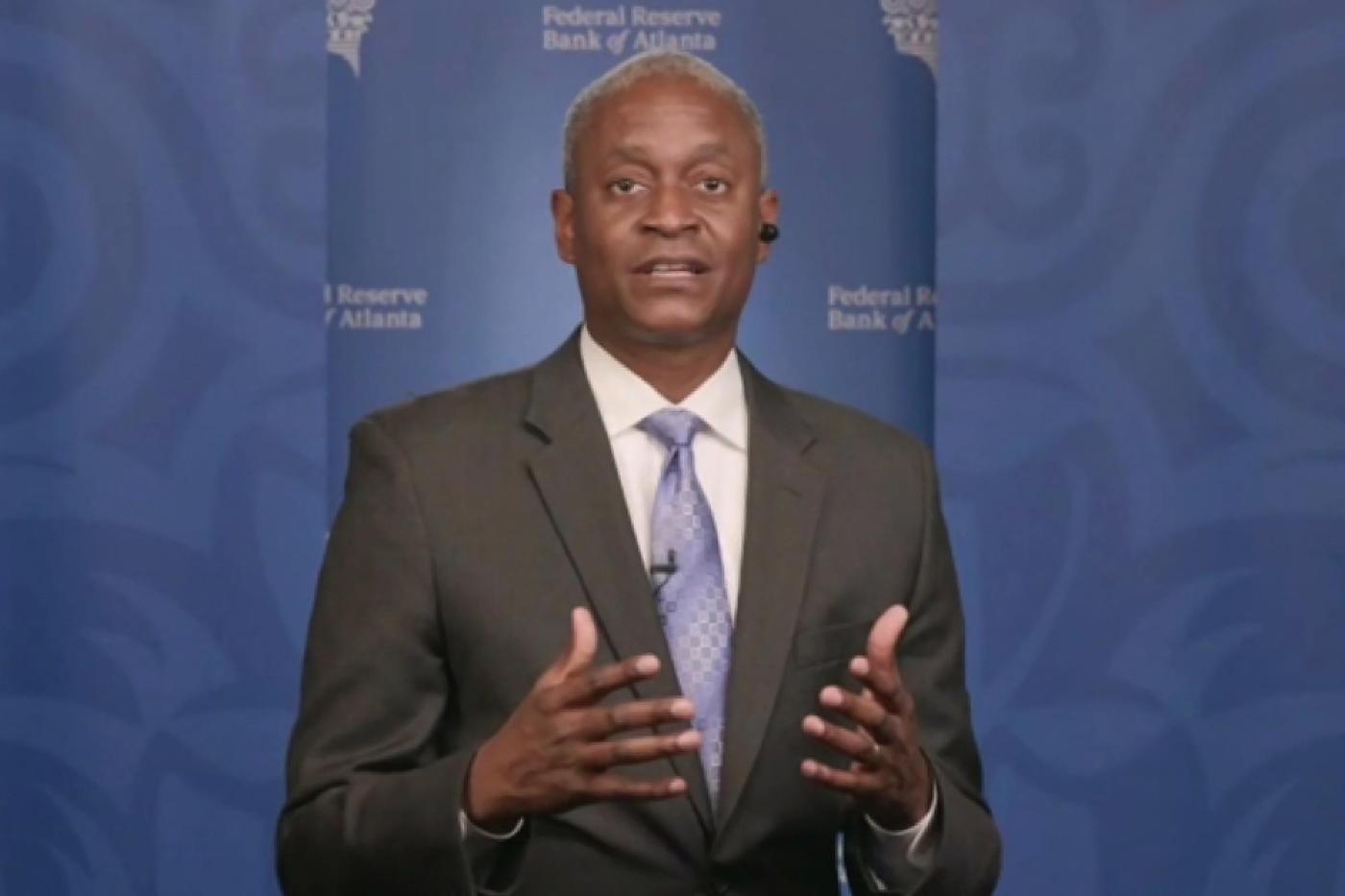
Atlanta Fed president Bostic to retire in February, opening seat on key committee

posted in: All news | 0

By CHRISTOPHER RUGABER, Associated Press Economics Writer

WASHINGTON (AP) — Raphael Bostic, president of the Federal Reserve Bank of Atlanta, will retire at the end of his current term in February, opening up a new seat on the Fed’s interest-rate setting committee at a time that President Donald Trump is seeking to exert more control over the central bank.

Related Articles


Trump urges Israel to pardon Netanyahu, sparking concerns over US influence


Grijalva will be sworn in as the House’s newest member, paving the way for an Epstein files vote


House returns for vote to end the government shutdown after nearly 2 months away


Top diplomats will talk with Ukraine’s foreign minister at the G7 meeting in Canada


Appeals court to hear arguments on law cutting Planned Parenthood Medicaid funds

As president of one of the Fed’s 12 regional banks, Bostic, 59, serves on the 19-member committee that meets eight times a year to decide whether to change a key short-term interest rate that influences borrowing costs throughout the economy. Only 12 of the 19 participants vote on rates at each meeting. The regional Fed presidents rotate as voters, and the Atlanta Fed’s president will next vote in 2027.

Bostic’s replacement will be selected by the Atlanta Fed’s board of directors, which are made up of local business and community leaders, not the Trump administration. The terms of all the regional Fed presidents end in 2026.

Bostic is the first Black and openly gay president of a regional Fed bank in the Fed’s 112-year history. He has recently expressed concerns that inflation is still too high for the Fed to cut its key rate, and in recent months suggested he supported just one rate cut this year, while the Fed has cut twice.

The Fed’s Washington, D.C.-based board of governors will vote on whether to approve Bostic’s replacement. Trump has sought to gain more control over the Fed’s board, which would potentially give the administration more sway over the approval of the regional Fed presidents. Three of the current seven members of the board were appointed by Trump.

Trump has also sought to fire Fed governor Lisa Cook, which would have given him a fourth seat on the board. But Cook has sued to keep her seat and the Supreme Court has allowed her to stay in the job while the issue is fought out in court.

The regional Fed banks were set up specifically to ensure that voices outside Washington and New York would have a say in the central bank’s decisions.

Trump has repeatedly attacked the Fed this year for not cutting interest rates as quickly as he would prefer. The Fed reduced its key rate by a quarter-point at its September and October meetings, but Chair Jerome Powell said at a news conference last month that another cut in December is not a “foregone conclusion.”

House returns for vote to end the government shutdown after nearly 2 months away

posted in: All news | 0

By KEVIN FREKING, JOEY CAPPELLETTI and MATT BROWN, Associated Press

WASHINGTON (AP) — House lawmakers will make a long-awaited return to the nation’s capital on Wednesday after nearly eight weeks away to potentially put an end to the longest federal government shutdown in U.S. history.

Related Articles


Top diplomats will talk with Ukraine’s foreign minister at the G7 meeting in Canada


Appeals court to hear arguments on law cutting Planned Parenthood Medicaid funds


A historic shutdown is nearly over. It leaves no winners and much frustration


What to know about Trump’s plan to give Americans a $2,000 tariff dividend


Lawsuit challenges TSA’s ban on transgender officers conducting pat-downs

The House is scheduled to take up a bill to reopen the government that the Senate passed on Monday night. President Donald Trump called the measure a “very big victory,” and it’s expected to pass the Republican-led chamber. But the prospect of travel delays due to the shutdown could complicate the vote. Speaker Mike Johnson may need nearly perfect attendance from fellow Republicans to get the measure over the finish line.

The House has not been in legislative session since Sept. 19. That’s when it passed a short-term funding patch to keep the government open when the new budget year began in October. Johnson sent lawmakers home after that vote and put the onus on the Senate to act, saying House Republicans did their job.

Democrats seized on the opportunity to cast Republicans as going on vacation while the federal workforce went without paychecks, travelers experienced airport delays and food assistance benefits expired. Johnson, R-La., said members were doing important work in their districts.

The vast majority of Democratic lawmakers are expected to vote against the measure because it does not include an extension of Affordable Care Act tax credits that expire at the end of this year and make coverage more affordable.

“Our strong expectation is that Democrats will be strongly opposed,” Democratic leader Hakeem Jeffries of New York said Tuesday night in previewing the vote.

But Johnson said of the pending legislation that “our long national nightmare is finally coming to an end, and we’re grateful for that.”

“After 40 days of wandering in the wilderness and making the American people suffer needlessly, some Senate Democrats finally have stepped forward to end the pain,” Johnson said.

The compromise to end the shutdown

The measure that passed the Senate included buy-in from eight senators who broke ranks with the Democrats after reaching the conclusion that Republicans would not bend on using the measure to continue the expiring health care tax credits. Meanwhile, the shutdown’s toll was growing by the day. Wednesday marks Day 43 of the shutdown.

The compromise measure funds three bipartisan annual spending bills and extends the rest of government funding through Jan. 30. Republicans also promised to hold a vote to extend the health care subsidies by mid-December, but there is no guarantee of success.

The U.S. Capitol is seen on a sunset a day before the House prepares to vote on a bill to reopen the government at the Capitol in Washington, Tuesday, Nov. 11, 2025. (AP Photo/Jose Luis Magana)

“We had reached a point where I think a number of us believed that the shutdown had been very effective in raising the concern about health care,” said Democratic Sen. Jeanne Shaheen of New Hampshire. The promise for a future vote “gives us an opportunity to continue to address that going forward,” she said.

The legislation includes a reversal of the firing of federal workers by the Trump administration since the shutdown began. It also protects federal workers against further layoffs through January and guarantees they are paid once the shutdown is over. The full-year funding in the bill for the Agriculture Department means people who rely on key food assistance programs will see those benefits funded without threat of interruption through the rest of the budget year.

The package includes $203.5 million to boost security for lawmakers and an additional $28 million for the security of Supreme Court justices.

Democrats are also seizing on language that would give senators the opportunity to sue when a federal agency or employee searches their electronic records without notifying them. The language seems aimed at helping Republican lawmakers pursue damages if their phone records were analyzed by the FBI as part of an investigation into Trump’s efforts to overturn his 2020 election loss to Democrat Joe Biden.

“We’re going to tattoo that provision, just like we’re going to tattoo the Republican health care crisis, on the foreheads of every single House Republican who dares vote for this bill,” Jeffries said.

House Minority Leader Hakeem Jeffries, D-N.Y., talks to reporters a day before the House prepares to vote on a bill to reopen the government at the Capitol in Washington, Tuesday, Nov. 11, 2025. (AP Photo/Jose Luis Magana)

Many Democrats are calling the passage of the bill a mistake. Senate Democratic leader Chuck Schumer of New York, who received blowback from his party in March when he voted to keep the government open, said he could not “in good faith” support it after meeting with his caucus for more than two hours on Sunday.

Independent Sen. Bernie Sanders of Vermont, who caucuses with the Democrats, said giving up the fight was a “horrific mistake.” Sen. Chris Murphy, D-Conn., agreed, saying that voters who overwhelmingly supported Democrats in last week’s elections were urging them to “hold firm.”

Health care debate ahead

It’s unclear whether the two parties will find any common ground on the health care subsidies before the December vote in the Senate. Johnson has said he will not commit to bringing it up in his chamber.

Some Republicans have said they are open to extending the COVID-19 pandemic-era tax credits as premiums could skyrocket for millions of people, but they also want new limits on who can receive the subsidies. Some argue that the tax dollars for the plans should be routed through individuals.

Senate Appropriations Committee Chairwoman Susan Collins, R-Maine, said Monday that she’s supportive of extending the tax credits with changes, such as new income caps. Some Democrats have signaled they could be open to that idea.

“We do need to act by the end of the year, and that is exactly what the majority leader has promised,” Collins said.

Other Republicans, including Trump, have used the debate to renew their yearslong criticism of the law and called for it to be scrapped or overhauled.

In a possible preview, the Senate voted 47-53 along party lines Monday not to extend the subsidies for a year. Republicans allowed the vote as part of a separate deal with Democrats to speed up a final vote.

Associated Press writer Mary Clare Jalonick contributed to this report.

PODCAST: ¿Por qué los inmigrantes detenidos están pasando más tiempo en salas de procesamiento de ICE?

posted in: All news | 0

En la ciudad de Nueva York, en la dirección 26 Federal Plaza en Manhattan hay un edificio federal y en el décimo piso, la duración media de la detención en las salas ha aumentado casi un 600 por ciento, según el periódico inglés The Guardian.

Visitantes entran en el 26 Federal Plaza, el edificio donde se celebran muchas audiencias de inmigración. (Adi Talwar)

Cuando el Servicio de Inmigración y Control de Aduanas (o ICE como se le conoce normalmente) arresta a inmigrantes, los lleva a salas de espera o procesamiento (holding rooms) que están dentro de edificios de oficinas federales, oficinas locales, aeropuertos y juzgados por todo el país.

Estas salas son habitaciones pequeñas, sin ventanas, sin camas y sin luz solar.

Estos espacios deberían albergar a los inmigrantes durante unas pocas horas, el tiempo suficiente para que los funcionarios de inmigración tramiten la detención, para luego trasladar a la persona a un centro de detención.

Antes de finales de junio, las propias políticas internas de ICE prohibían detener a inmigrantes por más de 12 horas en estas salas, pero en un memorándum de finales de junio, la agencia anunciaba que las personas recientemente detenidas podían permanecer hasta por tres días, 72 horas.

Sin embargo, un nuevo reportaje de The Guardian ha revelado que, cada vez más, las personas permanecen en estas salas durante días o incluso semanas.

En la ciudad de Nueva York, en la dirección 26 Federal Plaza en Manhattan hay un edificio federal y en el décimo piso, la duración media de la detención en las salas ha aumentado casi un 600 por ciento, según el periódico inglés. 

En agosto, un juez ordenó al Departamento de Seguridad Nacional (DHS por sus siglas en inglés) que mejorara las condiciones en estas salas de procesamiento para que las personas dispongan de llamadas telefónicas, más espacio y colchonetas para dormir, entre otras cosas.

ICE ha utilizado al menos 170 salas de procesamiento en todo el país, incluidas 25 oficinas locales de ICE.

Según el reporte, tras la toma de posesión del presidente Donald Trump, el tiempo medio que las personas pasan detenidas aumentó en 127 salas de procesamiento en todo el país.

Estas salas de procesamiento no son centros de detención, por lo que no están sujetas al mismo tipo de escrutinio que otras instalaciones de ICE. 

Así que para hablar sobre estas áreas y lo que implica largos procesamientos, invitamos a uno de los autores del reportaje, José Olivares, quien cubre inmigración para el periódico inglés.

Más detalles en nuestra conversación a continuación.

Ciudad Sin Límites, el proyecto en español de City Limits, y El Diario de Nueva York se han unido para crear el pódcast “El Diario Sin Límites” para hablar sobre latinos y política. Para no perderse ningún episodio de nuestro pódcast “El Diario Sin Límites” síguenos en Spotify, Soundcloud, Apple Pódcast y Stitcher. Todos los episodios están allí. ¡Suscríbete!

The post PODCAST: ¿Por qué los inmigrantes detenidos están pasando más tiempo en salas de procesamiento de ICE? appeared first on City Limits.

Top diplomats will talk with Ukraine’s foreign minister at the G7 meeting in Canada

posted in: All news | 0

By ROB GILLIES and MATTHEW LEE, Associated Press

NIAGARA-ON-THE-LAKE, Ontario (AP) — Top diplomats from the Group of Seven industrialized democracies are meeting Ukraine’s foreign minister on Wednesday as Ukraine tries to fend off relentless Russian aerial attacks that have brought rolling blackouts across the country ahead of winter.

Related Articles


Appeals court to hear arguments on law cutting Planned Parenthood Medicaid funds


A historic shutdown is nearly over. It leaves no winners and much frustration


What to know about Trump’s plan to give Americans a $2,000 tariff dividend


Lawsuit challenges TSA’s ban on transgender officers conducting pat-downs


Trump pardons the husband of Republican supporter Rep. Diana Harshbarger of Tennessee

U.S. Secretary of State Marco Rubio will participate in a G7 session on Ukraine and defense cooperation.

Canadian Foreign Minister Anita Anand is hosting the meeting in southern Ontario as tensions rise between the U.S. and traditional allies like Canada over defense spending, trade and uncertainty over President Donald Trump’s ceasefire plan in Gaza and efforts to end the Russia-Ukraine war.

Ukrainian President Volodymyr Zelenskyy has said he wants to order 25 Patriot air defense systems from the United States. Combined missile and drone strikes on the power grid have coincided with Ukraine’s frantic efforts to hold back a Russian battlefield push aimed at capturing the eastern stronghold of Pokrovsk.

Canada announced additional sanctions on 13 people and 11 entities, including several involved in the development and deployment of Russia’s drone program.

Britain says it will send $17 million to help patch up Ukraine’s energy infrastructure as winter approaches and Russian attacks intensify. The money will go toward repairs to power, heating and water supplies and humanitarian support for Ukrainians.

U.K. Foreign Secretary Yvette Cooper, who made the announcement before the meeting, said Russian President Vladimir Putin “is trying to plunge Ukraine into darkness and the cold as winter approaches” but the British support will help keep the lights and heating on.

Canada recently made a similar announcement.

The two-day meeting in Niagara-on-the-Lake, near the U.S. border, comes after Trump ended trade talks with Canada because the Ontario provincial government ran an anti-tariff advertisement in the U.S. that upset him. That followed a spring of acrimony, since abated, over the Republican president’s insistence that Canada should become the 51st U.S. state.

Anand will have a meeting with Rubio, but she noted that a different minister leads the U.S. trade file. The U.S. president has placed greater priority on addressing his grievances with other nations’ trade policies than on collaboration with G7 allies.

The G7 comprises Canada, the United States, Britain, France, Germany, Italy and Japan. Anand also invited the foreign ministers of Australia, Brazil, India, Saudi Arabia, Mexico, South Korea, South Africa and Ukraine to the meeting, which began Tuesday.

Putin has tried to justify Russia’s attack on Ukraine by saying it was needed to protect civilians in eastern Ukraine — a false claim the U.S. had predicted he would make as a pretext for his invasion.