Editor’s Note: This story is a collaboration between the Texas Observer and Inside Climate News.
For 15 years, Debrah Linn and her children have raised chickens, miniature donkeys, pet geese, and, more recently, longhorn cattle on what she’d considered an idyllic and peaceful farmette near the village of Elysian Fields.
Her kids ride horses on their shady lane, a 4.3-mile-long country road that undulates through woods filled with standing water that feeds Sacogee Creek and, in summer, waving blossoms of Black-eyed Susans.
A few doors down, Bonnie and Robert Arbuckle, a couple from Shreveport, Louisiana, have kept busy over the last year roughing out their own do-it-yourself retirement dream house on pastureland with a pond stocked with catfish and bass. Waskom-Elysian Fields Road in Harrison County, deep in Northeast Texas, is so quiet that it’s long been used for training by cross-country runners from the high school near its point of origin.
So it attracted curiosity—and concern—when what initially seemed like an oversize pond grew into an enormous wall of dirt on a patch of wetlands across from the Arbuckles’ place. Unbeknownst to them and other locals, the Texas Railroad Commission had already issued a permit to allow the largest oil and gas waste disposal site in the region to be erected on their country road.
Soon, the Arbuckles could see mounds rising and hear the roars of a fleet of dump trucks, cranes, and other heavy construction equipment on that previously undeveloped acreage. And when Bonnie, a U.S. Army vet who knows a thing or two about excavation, introduced herself to the acting site supervisor, she got no answers. “He was friendly and came over,” she recalled. “But then when we started asking questions about what the operation was, it was just closed lips.”
The developer of this massive oilfield waste disposal site sent notices only to adjacent landowners—mostly unoccupied land with absentee owners, including the Texas General Land Office. A legal ad in a nearby small newspaper offered no details and didn’t mention Elysian Fields. These were the only notices required by the Railroad Commission, the state agency that regulates Texas’ oil and gas activities, including its toxic waste disposal.
Linn and others learned of the project only after the fact when Harrison County Judge Chad Sims, an Elysian Fields native, gathered locals at the village’s volunteer fire department in January.
Records show that a company called M2T, LLC., with a mailing address in faraway Montana, had initially applied for a Railroad Commission permit in January 2022 to handle what is described as “nonhazardous” oil and gas wastes on the 187-acre site. It had been approved in 2023 with no hearing and no local comments.
But Sims told residents who gathered inside the village fire department that he had recently learned that the out-of-state developer was tied to a Longview, Texas, company called McBride Operating LLC, which had already drawn scrutiny and complaints over its existing waste-handling operations in the nearby town of Waskom. Residents were shocked to learn from Sims that the Railroad Commission had, before anyone knew enough to formally protest, already approved this large new waste site on the same Waskom-Elysian Fields road where Sims’ daughter and other high school cross-country runners regularly practiced.
In 2019, McBride Operating had obtained a five-year permit from the Railroad Commission to operate the waste-handling center in Waskom, on an industrial site on the frontage road along Interstate 20, about 5 miles north of the Elysian Fields construction site. McBride Operating’s permit for Waskom expired in mid-2024. The commission staff then declined to renew it this February—a rare action by the pro-business agency. The denial came, records show, after the company had ignored instructions by agency employees and committed dozens of violations of state rules, including unauthorized construction and expansion, unauthorized waste disposal, and evidence of ongoing groundwater contamination.
McBride Operating never stopped running the Waskom site, even after the commission pulled its permit in February. It was able to do so because the company appealed.
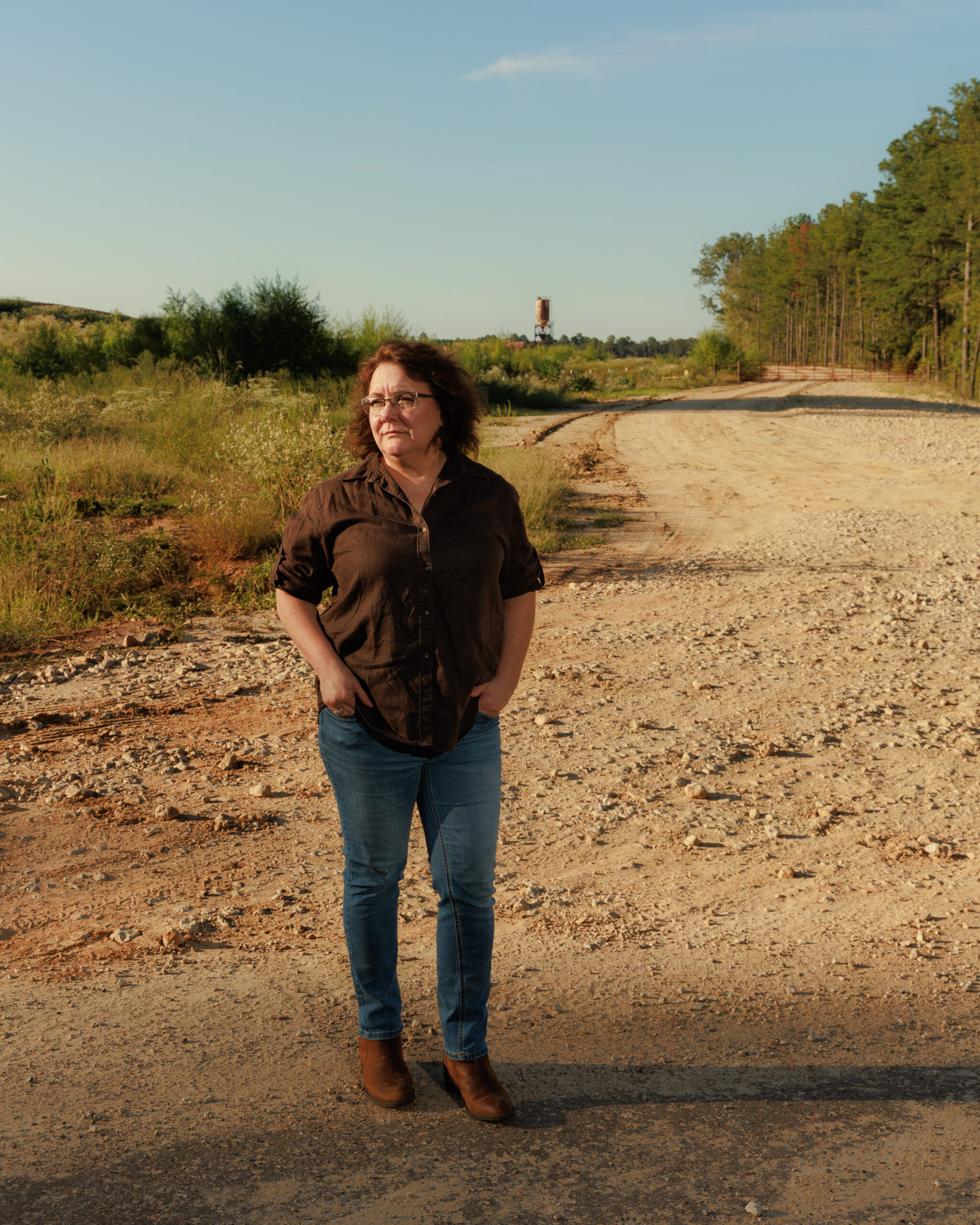
Debrah Linn stands near the construction site of a new McBride facility for oil and gas waste disposal in Elysian Fields. (Shelby Tauber/Texas Observer)
Earlier this year, Linn began regularly driving her trusty Suburban SUV by the existing McBride waste site in Waskom to survey what might be coming to Elysian Fields. She worried even more about the excavation on her road after hearing Waskom residents complain that they could smell the operation from as far as 2 miles away. “Now the people that live closer, they have been complaining of headaches, nausea, things like that,” she said during one recent visit. “So that’s what my big worry is because my daughter has asthma and she struggles a lot with that. And I don’t want to be run out of my home by someone who doesn’t … play by the rules.”
Some complained about the odors to the Railroad Commission. McBride’s operations manager, Carrie Dowden, admitted as part of a deposition in a lawsuit filed by an employee who was overcome by chemical fumes that the company “can’t control the smell.” In a response to this report, a company spokesperson noted that McBride has never been fined for odors and that other businesses contribute to smells in the town.
Even as McBride Operating negotiated to stay open in Waskom, and pursued its options in Elysian Fields, the company had been simultaneously fighting other local opponents to secure a permit for another oilfield waste landfill 50 miles south near the town of Paxton, on a proposed site near wells that supply public drinking water.
But the massive Elysian Fields project would be McBride’s largest yet.
Linn soon found herself joining a growing and eclectic group of East Texans—including folks who consider themselves pro-oil and gas—who banded together to fight McBride’s expansions in Elysian Fields and Paxton and its efforts to continue in Waskom. Her allies included local teachers, a pastor who doubles as a rural water official, and a pair of ranchers.
Cattleman Terry Allen was fighting a court battle to halt McBride’s plans for Paxton. In Waskom, an octogenarian rancher named Jerry Cargill was pursuing all legal avenues to get McBride shut down. Both men traveled back and forth to Austin to appeal to the Railroad Commission, state legislators, and anyone who might listen.
Linn, tied down by family obligations and the need to tend farm animals, got on her computer and used her considerable research skills to dig—discovering quickly that McBride had racked up many more violations than other active oil and gas waste pit operators in East Texas. She wondered why there were so many waste pits in her area, right along the Louisiana state line.
Everyone worried that the litany of violations at Waskom, a site that had previously been an industrial area, would be repeated on pristine flood-prone acreage in Paxton and Elysian Fields. But their concerns gained little traction with decision-makers in Austin, and some were shocked when the only elected Railroad Commissioner from East Texas, Wayne Christian, who’d initially seemed friendly to their arguments, began advocating for McBride.
Christian defended McBride, stating that more waste disposal capacity was urgently needed in Northeast Texas, part of the Haynesville-Bossier Shale, which runs into northwest Louisiana. It follows the Marcellus Shale in Pennsylvania and the Permian Basin in West Texas as the third-most-productive natural gas basin in the country.
But Linn and others swear they spotted many trucks with Louisiana plates unloading fracking waste at McBride’s facility—and fear their rural communities were becoming dumping grounds for the neighboring state. Linn figured it was no coincidence that two new proposed pits in Paxton and Elysian Fields were only minutes from the state line. “If we didn’t have the Louisiana business, would these [facilities] even be here?” Linn said. “I don’t think they would.”
Oil and gas wells produce prodigious amounts of waste. One horizontal well generates upwards of 8,000 barrels—or 336,000 gallons—of waste during the drilling and completion process, according to the Texas company Milestone Environmental. As oil and gas production soared to record highs in Texas, the industry needed more capacity to dispose of all the waste. Disposal wells and landfills opened and expanded from the Permian Basin to the Haynesville Shale.
As of August 2025, there were 86 commercial surface waste disposal facilities permitted by the Railroad Commission. Six of those are in the agency’s East Texas District 6, headquartered in Henderson. Some facilities, like the one in Waskom, separate solid and liquid waste. Much of the liquid waste is injected underground in disposal wells. The solid waste, which includes drill cuttings and muds, is permanently buried in pits or commercial landfills.
Jerry Cargill attends a Railroad Commission hearing in July. (Brenda Bazán/Texas Observer)
That waste can contain benzene, toluene, ethylbenzene, xylene, and other harmful constituents. But industry lobbyists succeeded in classifying this waste as nonhazardous under the federal Resource Conservation and Recovery Act.
McBride’s Waskom facility currently separates and sends solid waste to an industrial landfill in Mount Pleasant. The liquid waste is injected into a disposal well on-site. The McBride landfills planned for Paxton and Elysian Fields could accept the waste that is currently sent to Mount Pleasant.
By the time Linn and others first learned about the company’s permitted plans for Elysian Fields in early 2025, Cargill had already been fighting McBride’s Waskom facility in the Railroad Commission’s administrative law courts for years.
Cargill, 82, grew up 20 miles away in Marshall, the county seat, while making frequent visits to the ranch his grandparents owned outside Waskom. In the 1980s, he bought out his relatives to become the sole owner of the 600-plus-acre property. After retiring from a long career in beverage sales, Cargill now lives on the ranch. He took notice of McBride soon after the site in Waskom opened, in 2020.
Cargill watched with concern as heavy trucks barreled down the highway to McBride, where they loaded and unloaded wastewater and solids. Cargill had flown drones over the site and observed how heavy rainfall would wash runoff from the waste stored on-site toward his property. He worried that two nearby creeks—Big Sis and Little Sis—could become conduits for pollution to reach his land. Cargill declined to be interviewed for this story but made his sentiments clear in statements to the commission and in documents filed by his attorneys.
For years, McBride accumulated violations during Railroad Commission inspections. Regulators issued 68 violations during the company’s first five years of operations in Waskom (2020 through 2024). Many violations were for disposal of solid oil and gas waste in pits that McBride built but were not authorized in its permit, and failure to comply with the permit. The facility was also added to the commission’s Operator Cleanup Program, which manages complex environmental remediation cases, after groundwater contamination was found on-site. Inspection reports found leaking tanks of produced water and waste piled on the ground outside the pits.
Despite dozens of violations, the Railroad Commission fined McBride only once in this five-year period: a $668 penalty issued in November 2024 for a spill that occurred in 2023. Inspectors found that the spill of extremely salty produced water had traveled more than 300 feet in the direction of a creek.
Company spokesperson Charlie Rose said that many of these violations of “unpermitted” disposal fell under a “catchall” category in the Railroad Commission rules that “includes any violation of a permit provision under which a commercial waste management facility operates.
“Of the referenced violations, all but one were resolved immediately upon reinspection. The single exception occurred during our first year of operation and involved a spill incident that required follow-up,” Rose said. “In every case, we responded promptly and effectively.”
Railroad Commission spokesperson Bryce Dubee said that McBride, like other operators, is given an opportunity to address violations before it is referred to legal enforcement.
Meanwhile, other government regulators were uncovering problems at McBride.
On the night of February 6, 2024, Pedro Julian Garcia died in a workplace accident at McBride’s Waskom site. Garcia, a 26-year-old father of two, was fixing a leaking pump when the valve blew off, fatally striking him in the chest. McBride had no written procedures for repairing hazardous electrical equipment, like the pump, and its employees had no training to perform such tasks, according to an Occupational Safety and Health Administration (OSHA) investigation.
OSHA, the federal agency that enforces workplace safety laws, had never previously inspected the McBride site. It ultimately fined the company $32,264 for 12 violations. McBride later settled a lawsuit with Garcia’s family.
A lawsuit filed by Jaire Jackson, a worker injured in 2021 while cleaning one of McBride’s tanks, uncovered other issues at the site. In a 2022 deposition, Dowden, the operations manager, said that she’d previously worked as a bartender and had no prior oilfield experience when she was hired as a supervisor. She described her office as a “mess,” said workers were not provided with protective gear, and claimed she did not know if there was any operating manual for the site.
Rose said that the company’s safety program has been expanded in recent years and that every employee undergoes extensive training.
Trucks drop off waste at the McBride oil and gas disposal facility in Waskom in late September. (Shelby Tauber/Texas Observer)
Cargill formally protested McBride’s permit renewal when the application was filed in 2024. Evidence to support the protest would come later. First, the Railroad Commission would have to determine whether Cargill had legal standing to protest the permit. If he was found to have standing, a full hearing would be scheduled before a Railroad Commission administrative law judge.
In February 2025, Cargill filed a separate complaint with the Railroad Commission, asking for a hearing in which McBride would have to show why its permit should be renewed and not canceled. The complaint filing contended that McBride had consistently violated statewide rules for oil and gas waste, that groundwater had been contaminated at the site, and that contamination had not been remediated.
“Mr. Cargill’s claims are part of a seemingly coordinated effort that has now expanded to the media,” Rose said when asked about those complaints.
Cargill was not the only party to protest renewal when McBride’s first five-year permit was set to expire, on July 30, 2024. Other local landowners and the City of Waskom filed their own protests too. In February 2025, it seemed as though they’d won a victory: A letter from the commission’s technical permitting division laid out numerous ways McBride had violated the terms of its first permit, denied the permit renewal, and ordered the facility to shut down.
“Commission staff has attempted to work with the operator to address these concerns,” Railroad Commission engineer Alisa Patterson wrote. “However, after several meetings and a series of request[s] for additional data (RAD) letters, staff concludes that the amendment and renewal permit application cannot be approved.”
Cargill, still building his case against McBride, thought his concerns were finally being heard.
But McBride’s attorney, John Hicks, appealed the permit rejection, which, under commission rules, allowed McBride to continue its operations while the appeals process proceeded. During a June visit, its truckers’ lounge and loading docks were bustling with activity, as rumbling trucks came and went from the stretch of Interstate 20 that leads to Louisiana, only a few minutes east of the site.
Both sides prepared for a July 31 prehearing before a Railroad Commission administrative law judge to hear the merits of Cargill’s permit protest and complaint. Cargill’s lawyers would argue why he should be granted standing to protest the permit renewal. Hicks would argue why the facility should stay open and why Cargill was undeserving of standing in the administrative court.
Then, less than 24 hours before the prehearing was set to begin, a Railroad Commission lawyer notified the legal teams that the agency had settled with McBride. The two-paragraph notice retracted the denial and gave McBride 90 days to submit engineering plans to resolve the outstanding problems and continue operating.
Nonetheless, the legal teams arrived at the Railroad Commission hearing room in Austin the next morning. Attorneys George Neale and Charles Zhang, representing Cargill, argued that McBride had already been given more than enough time to resolve the numerous rule violations. They pointed out that after the site was added to the Railroad Commission’s cleanup program in 2021, it took McBride four years to submit a cleanup plan.
“[McBride] is one of, if not the worst, operators in the state of Texas,” Zhang said. “They’ve had four years of second chances.”
But Hicks argued that Cargill’s complaints were “entirely inappropriate” and circumvented the Railroad Commission’s existing protocols.
Cargill watched the proceedings with anxious attentiveness, nervously clicking a pen. He took the stand after lunch and implored the Railroad Commission to rein in McBride, saying he felt a duty to report the violations he had observed. He told the judge that he thought Joseph McBride, the Longview entrepreneur who formed McBride Operating in 2013, was “stalling because he wants to open his next landfill,” echoing a theory posited by other East Texans.
“This isn’t the way to run a business. … They’re playing games with our environment,” Cargill said. “If someone does something wrong, why would you give him five years to fix that?”
Given that the Railroad Commission had reached a settlement the day before, Cargill knew the agency would reconsider the permit application and the progress he had achieved could slip away. He had driven five hours from his ranch to Austin. On the way home, he would stop at a Dallas doctor’s office for a heart checkup.
His lawyers withdrew the complaint asking for a “show cause” hearing in September. At that time, the administrative law judge had not yet ruled on whether Cargill would be given standing to protest the permit renewal.
In September, Rose said the company had already submitted “preliminary proposals” as part of the settlement and is “working through finalizing the detailed engineering documents.” He said the company cannot disclose the specifics but is “committed to full transparency and compliance.”
In an email, Dubee, the Railroad Commission spokesperson, said that if agency staff is not “satisfied these remedies will be implemented,” the matter can be denied and the permit sent back again for another hearing.
Cargill and Linn both fretted that McBride was simply using lawyers to buy time until the Elysian Fields facility could open. The Railroad Commission staff had already found McBride’s stormwater plans in Waskom to be insufficient to protect ground and surface water. In the low-lying Elysian Fields construction site, Linn foresaw worse problems. The construction site, part of the headwaters of Sacogee Creek, was full of standing water when a local television crew went out to film in January. Residents worry that once the pits are filled with heaping piles of chemical-laden waste, runoff or flooding could contaminate local waterways.
George Neale, an attorney representing Cargill, points to a map showing the site of a McBride waste pit. (Brenda Bazán/Texas Observer)
In responses for this story, Rose said the company has designed a stormwater system for the site’s specific terrain that includes elevated containment and retention features that would prevent water from the site from reaching nearby estuaries.
Environmental advocates point to how pollution from oilfield waste landfills in areas like Western Pennsylvania have fouled local creeks and raised health concerns among residents. “When you dispose of drill cuttings in a landfill and it rains, it’s going to take all of the contaminants and soak through the whole landfill like a tea,” said Matt Kelso, of the nonprofit organization FracTracker Alliance, based in Pennsylvania.
The Paxton, Elysian Fields, and Waskom sites are all in low-lying areas minutes from the Louisiana state line. Though East Texas produces plenty of its own oil and gas waste, records show that many of the pits in the region have been profiting by accepting chemicals, mud, and other byproducts from Louisiana oil and gas operators.
Louisiana does not have any solid oilfield waste disposal facilities in the Haynesville-Bossier Shale, according to the state’s Department of Natural Resources. Louisiana also has stronger regulations for injection wells that accept liquid waste from oil and gas fields. Louisiana requires that the waste be tested and logs recorded for injection well sites. In Texas, oilfield waste sites must certify only that they do not accept waste containing naturally occurring radioactive material, which can be present in some fracking waste. (Additional testing is required only for substances not exempted from federal hazardous waste rules.)
The Texas Railroad Commission itself does not track what proportion of waste comes from out of state. For this story, Inside Climate News analyzed quarterly reports made to the Railroad Commission by five waste facilities in East Texas between 2022 and 2024. Three reported accepting waste from Louisiana. Charles Holston, Inc., in Center, Texas, reported that three-quarters of the waste it accepted came from Louisiana. More than half the waste processed at the Top Cat Truck Wash in Panola County came from Louisiana. Across the state, in the Permian Basin, waste sites are known to accept drilling waste from neighboring New Mexico.
McBride’s quarterly reports from that period indicate waste arriving at the Waskom facility came from Texas. But Rose noted that those reports do not include liquid waste directly injected into two wells there. He said that both the Waskom and Elysian Fields facilities can accept waste from any operator that meets Texas regulations, including Louisiana sites.
“New Mexico and Louisiana have recognized the danger of this waste,” said Terry Allen, the cattleman who’s fighting another McBride project in the town of Paxton. “They’re making Texas the dumping ground.”
For more than four years, McBride’s proposal to build yet another waste pit 50 miles south of Waskom near the village of Paxton was blocked—temporarily at least—by the Railroad Commission. Two different administrative law judges ruled that the application should be denied in part because of evidence provided by Allen and by a rural water company that the site could compromise wells only 1,200 feet away that provide a significant amount of the county’s water supply.
“This is our aquifer. This is where we get our drinking water from,” said Eric Garrett, who runs Paxton Water. For him, the risks of even a tiny bit of poison seeping into those wells was too high.
But ultimately, the final decision would go to a vote by the three railroad commissioners, who are all elected Republicans. Paxton community members hoped that Christian, a former state representative from Center, would listen to the concerns of his Shelby County neighbors and oppose the permit.
When the vote came in January 2025, Commissioner Jim Wright, who owns oilfield waste companies, and Commissioner Christian voted to issue the permit. They overruled Commissioner Christi Craddick, the sole vote in opposition. All three commissioners have accepted campaign contributions. From 2020 to 2025, McBride and McBride Operating contributed more than $90,000 to the three commissioners, including recent contributions to Craddick’s campaign for state comptroller. At the same time, the company plowed between $336,000 and $778,000 into lobbying, records show.
In an emailed statement, Wright said that feedback received through the hearings resulted in additional safeguards to address local residents’ concerns. He also said there is a “significant lack” of permitted oilfield waste disposal in East Texas.
In a statement for this story, Christian said the project would bring “real paychecks, tax revenue for our schools and roads, and a chance to bring life back to communities that have been left behind.
“Rural Texas has been losing jobs and families for decades, and we can’t afford to turn away investment,” he added.
Christian previously wrote a letter to the Light and Champion newspaper in Center to explain his vote. “The idea that this project could have simply been blocked because it is in my local county is a misunderstanding of the law,” he wrote. “If a company meets the legal requirements, we cannot arbitrarily deny a permit.”
He also claimed that opposition to the permit was pushed by outside groups with “radical, anti-energy policies.” Much of the opposition “around this permit hasn’t come from landowners—it’s been manufactured by professional activist groups from outside our region,” he wrote.
Garrett, of Paxton Water, had a different view. “What is totally baffling to me is that despite the recommendations of their own people, Commissioner Wright and Commissioner Christian felt like they knew better than their own staff,” he told the Observer. “How do you explain that?”
Linn wrote her own letter to the paper. She argued that the only outside interests involved were the Louisiana oil and gas companies that would get to dump their waste in Texas. “The protection of our water is non-negotiable and not a partisan issue,” she wrote. “Why are Texas taxpayers liable for other states’ toxic waste?”
Allen is relieved that, for now, McBride has not started construction in his town, but he has continued to fight the company on other fronts.
It’s possible that all that waste will now arrive in Elysian Fields, where some local residents and the village’s high school and elementary school depend on groundwater wells within a few miles of the landfill, according to the county judge and other local residents.
McBride’s spokesperson said that construction at Elysian Fields is “nearing completion” and that the site will begin accepting waste “once every safety and environmental measure is fully in place.”
By September, Linn said she’d already seen more trucks making deliveries to the site, where plastic pieces of what look like a liner have been lying out in the sun for months. In an email, Rose confirmed that a liner had been delivered but said operations have not yet begun. He said there’s no estimated construction date for Paxton.
The Socagee Creek flows near the Elysian Fields waste disposal site. (Shelby Tauber/Texas Observer)
Allen’s experience challenging the permit has motivated him, along with Linn and others, to advocate for changes to Texas laws governing oilfield waste. Allen traveled to the state Capitol in April to testify before the House Energy Resources Committee on two bills that would, respectively, require companies to notify landowners before burying oil and gas waste and demonstrate the necessity of a commercial oil and gas landfill when applying for a permit. He urged lawmakers to consider the compliance history of operators that are applying for new permits.
State Representative Jay Dean, whose district includes Waskom and Longview, responded to Allen’s comments and said that McBride has a way of “eluding” regulators. “If you’re going to be in that business—the rules, regulations, processes—you need to follow them, and nobody should get an exception,” he said.
Linn and Allen are working to found an organization called Texas Legacy Defense to assist communities, so far with members from Shelby, Panola, Harrison counties. “Because no one is listening,” Linn said. They like to say the group began when a “retired banker, a pastor, an editor, and a nurse walked into a room. It might sound like the setup to a joke, but that’s actually how Texas Legacy Defense began—in the fellowship room of a little country church.”
Allen bristles at the suggestion that outside interest groups are backing the movement against McBride. “I can tell you unequivocally that there have been no outside funds from any outside interests,” he said. “It’s all from people who are concerned that our groundwater, our land, and our air will be contaminated from this rogue operator.”
To drive home the point, Allen paid to hang banners in Shelby County calling Christian and Wright “Proven Liars.” In an email, Wright’s spokesperson disagreed: “Chairman Wright may be a lot of things, but a liar isn’t one of them.”
The East Texas waste dumps remain flash points for the growing number of Texans voicing their discontent with the Railroad Commission. Commissioner Wright is up for reelection in 2026. One of the first contenders to announce a campaign was Hawkins “Hawk” Dunlap, himself a native of East Texas and a longtime oilfield firefighter.
One of Dunlap’s first campaign stops was in Waskom.
Peter Aldhous contributed data analysis for this story.
The post Pitted Against Waste appeared first on The Texas Observer.