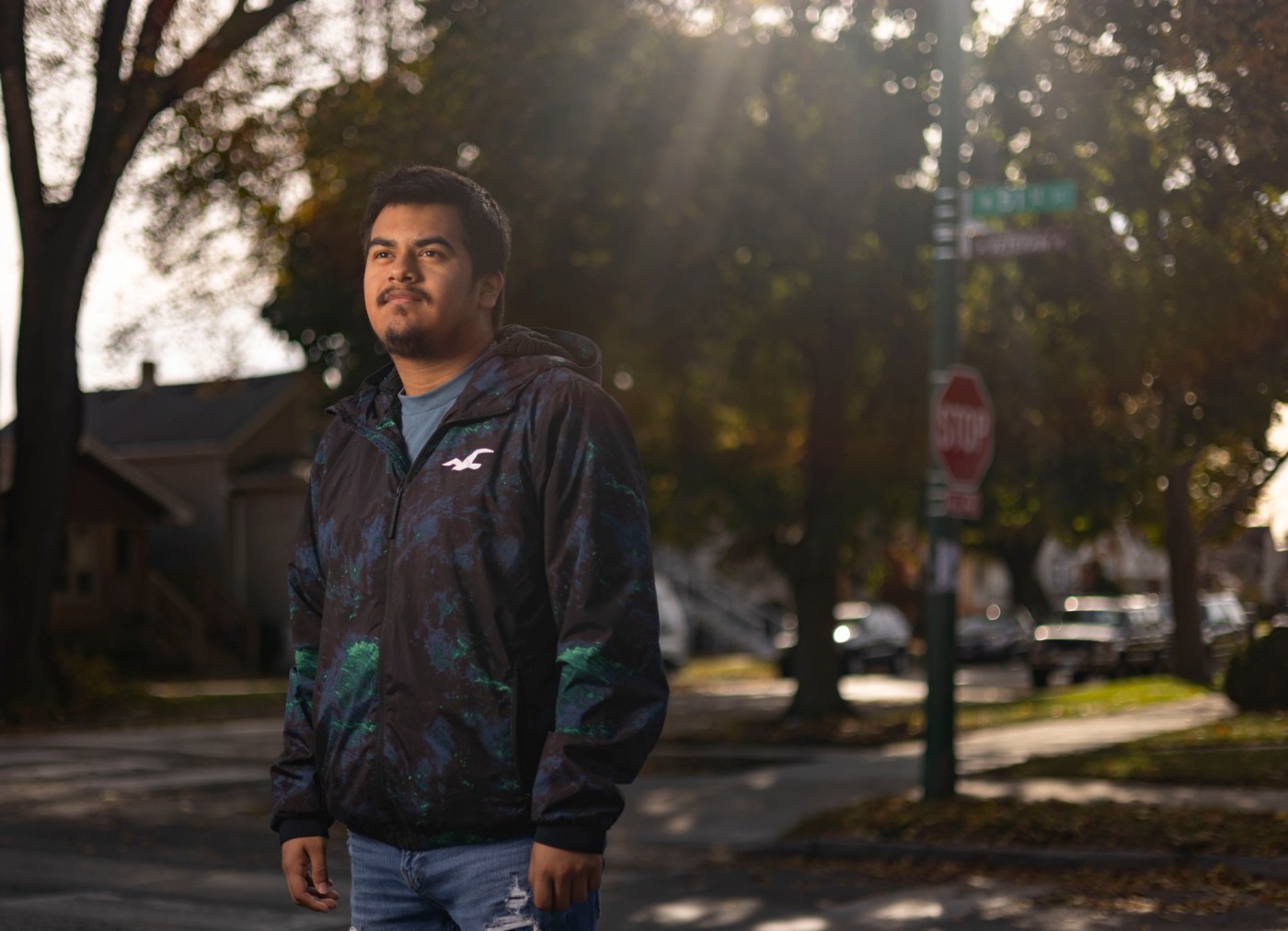
When a masked man grabbed Ernesto Diaz’s left shoulder and slammed him against a vehicle, he thought he was being robbed.
Diaz, 23, had been walking down Archer Avenue on the Southwest Side in late September, heading toward the CTA Orange Line for a trip downtown. Earbuds in, he was listening to music and said he barely registered the vehicle that pulled up near him. That was until he felt the pain in his shoulder.
Diaz felt confused and disoriented. He couldn’t hear because “Higher Power” by Coldplay was still playing in his ears. But when he craned his neck, and saw more than half a dozen federal agents surrounding him, he understood what was happening.
“I’m Hispanic and I’m dark (skinned), so that’s why they picked me up,” Diaz, a U.S. citizen, said. “It feels scary because I’m wearing a target — you know, pick me up because I’m this color. It shouldn’t be like that.”
Diaz is one of the five U.S. citizens and green card holders the Tribune spoke to who has either been questioned or detained by federal immigration agents during Trump’s Operation Midway Blitz for seemingly no other reason than being Latino, an experience they said was equal parts terrifying and frustrating.
It’s impossible to say just how many Chicagoans have experienced what experts say constitutes racial profiling since the immigration crackdown began. The Department of Homeland Security has repeatedly denied that it targets people based on race and said it’s going after the “worst of the worst.” But dozens of reports and videos have circulated in the past couple months — many affecting those working at manual labor jobs.
Border Patrol agents detain worker Krzysztof Klim while verifying his identification, Oct. 31, 2025, outside a home in Chicago’s Edison Park neighborhood. Klim, originally from Poland and now a U.S. citizen, was briefly detained and then released. (Brian Cassella/Chicago Tribune)
Among them, a landscaper in Evanston was handcuffed until he proved he’s an American citizen. House painters and laborers in the northwest suburbs were asked to show proof of citizenship. A woman finishing her shift at a downtown bar zip-tied and questioned for an hour because she “doesn’t look like” her last name.
Under Border Patrol Cmdr. Gregory Bovino, agents’ focus has largely been on Latinos, but the government has also stereotyped working people from other backgrounds without papers, including Polish and Ukrainian handymen in ethnic areas along the city’s bungalow belt and an Illinois Department of Transportation employee, who is Indian, questioned if he’s aware of New York City Mayor-elect Zohran Mamdani at a resurfacing project in Park Ridge.
Those confrontations don’t include scores of arrests of U.S. citizens who were protesting federal officials.
Even when the mass deportation campaign winds down, which sources say could be soon, experts said the effects of discriminatory practices leave a permanent stain: potential lawsuits, diminished trust in the federal government and lasting trauma for the city’s large immigrant and Latino populations.
“From a societal perspective, it fundamentally creates a world where citizens and people with documented status are treated differently because of the way that they look, because of their race, their ethnicity, or where they work and the communities they work in,” said Michelle Teresa Garcia, deputy legal director of the ACLU of Illinois.
That, she said, “is fundamentally unconstitutional under the Fourth Amendment, under the equal protection clause, and it is a blight on our societal sense of fairness and community.”
Officials with the Department of Homeland Security did not respond to multiple requests for comment, which included a detailed list of each encounter detailed in this report. Last month, DHS said in a statement that allegations that their officers engage in racial profiling are “disgusting, reckless and categorically FALSE.”
“What makes someone a target for immigration enforcement is if they are illegally in the U.S. — NOT their skin color, race, or ethnicity,” the statement said. “Under the Fourth Amendment of the U.S. Constitution, DHS law enforcement uses ‘reasonable suspicion’ to make arrests. There are no ‘indiscriminate stops’ being made. The Supreme Court recently vindicated us on this question. DHS enforces federal immigration law without fear, favor, or prejudice.”
‘They’re not even treating me like a human being’
While he was up against the vehicle, Diaz said one of the agents ripped out his earbuds and handcuffed him. He said the masked agents didn’t tell him their names or badge numbers. He worried that they may not even be real agents.
They asked him a series of questions — is he a citizen, does he have a green card, is he here illegally, where was he born, Diaz recalled. He told agents they could check his ID and Social Security card that he’s carried in his wallet since hearing about immigration raids in Los Angeles earlier this year.
While an agent inspected the card, Diaz said he tried to move his sore right arm that was pinned behind his back.
“And one of the agents says, ‘Don’t move. Don’t try to run.’ And I told him, ‘I’m not trying to run. I’m just getting comfortable,’” Diaz said. “He’s like, if you move again, I’m gonna tase you. And he takes out his taser, and points it at my ribs.”
“I felt like a piece of trash. They’re not even treating me like a human being,” sayidErnesto Diaz, who was detained in Archer Heights by federal agents in September despite being a U.S. citizen. (Brian Cassella/Chicago Tribune)
After about five minutes, he said an agent put the cards back in his wallet and threw it on the ground. They then walked to their vehicle and drove away, he said.
“I felt like a piece of trash,” Diaz said. “They’re not even treating me like a human being. They’re treating me like I’m some piece of plastic.”
MAHA idealism meets political reality as RFK Jr. attempts to wrangle a growing movement
Trump and Mamdani meet Friday in the Oval Office. They’ve cast each other as adversaries for months
Schools fear disruptions as the White House begins dismantling the Education Department
Supreme Court meets to weigh Trump’s birthright citizenship restrictions, blocked by lower courts
Leaders arrive for a first African G20 summit overshadowed by a rift between the host and the US
Another man, a Little Village resident in his early 20s, also said he was stopped last month by federal agents while walking with his father to the neighborhood’s La Chiquita grocery store. They wanted to buy carne asada and beans for lunch with their family.
The son is a U.S. citizen. The father is not. But federal agents arrested both men and took them to the ICE facility in west suburban Broadview.
The son was released later but said he remembers trying to reason with agents that his younger brother has epilepsy and needs their father. He requested anonymity for fear that his father would be retaliated against in ICE detention, where he is currently being held out of state.
“I told them I’m a U.S. citizen, I know my rights,” he said. “All they said was, I don’t (expletive) care.”
Racial profiling is unconstitutional
Garcia, of the ACLU, said the number of citizens reportedly detained throughout Operation Midway Blitz demonstrates that the government isn’t simply making targeted arrests, as it often claims.
“The fact they are sweeping up U.S. citizens and people with documented status is further proof the agenda is not about addressing crime and violence, but rather, it is about creating a society where people of color are living in fear,” Garcia said.
In September, the conservative majority on the Supreme Court lifted a restraining order from a judge who found that roving patrols were conducting indiscriminate stops in and around Los Angeles. The order had barred immigration agents from stopping people solely based on their race, language, job or location, The Associated Press reported.
The majority did not explain its reasoning, as is typical on the court’s emergency docket. But Justice Brett Kavanaugh said the lower court judge had gone too far in restricting how federal immigration agents can carry out brief stops for questioning, the AP said.
Jasmine Gonzales Rose, a professor at Boston University School of Law who teaches courses on Latinos and the law, said that racial profiling remains unconstitutional because it violates the Fourth Amendment’s protection against unlawful seizures and the 14th Amendment’s equal protection guarantee. It also, she said, “really diminishes the freedom of all people.”
“It’s absolutely heartbreaking that families are being torn apart and U.S. citizens and noncitizens alike are being told that they’re not safe to go about their daily business without government intrusion into their lives,” she said.
She also said the government targeting Latinos and treating them as “others” — or that they aren’t truly a part of the country — is ironic because there’s a long history of Latinos living in the Americas before Europeans arrived. Traits of a so-called Mexican appearance are features often associated with indigeneity to the Americas, she said.
“It’s very painful for people to be questioned whether they’re a full citizen based upon their appearance, their language,” Rose said.
Gov. JB Pritzker said in a statement that he’s “appalled” citizens are being harassed and detained.
“These practices are fundamentally un-American and do nothing to make our community safer,” he said. “Our neighbors shouldn’t live in fear of being stopped and questioned based on the color of their skin.”
The governor also sharply criticized a reported stop in Park Ridge on Nov. 7. His office said three masked agents questioned the immigration status of an IDOT employee, who is Indian and a U.S. citizen, working at the Busse Highway resurfacing project. The agents allegedly asked the employee whether he had traveled to New York and if he was aware of New York City Mayor-elect Zohran Mamdani, who is also Indian, his office said.
“Our state employees should be able to go to work and do their jobs without masked agents targeting them for no legitimate reason,” the governor said.
Green card holder detained for five hours
Lawful permanent residents, or noncitizens who are authorized to live in the country, have also been caught up in the arrests.
Antonio Enriquez, 53, said he was walking to a Melrose Park store last month when federal agents got out of unmarked vehicles and demanded to see his documents. He told the agents they were a few blocks away at his home, pleading “Vamos a mi casa. Let’s go to my house.”
But the agents ignored him, Enriquez said. A video taken at the scene shows at least three agents pushing Enriquez to the ground and handcuffing him after he tries to pull his arm out of an agent’s grasp. An officer tells a bystander recording that “we’re not trying to hurt anybody, but if you resist, that’s what happens.”
They took Enriquez to the ICE facility. His daughter, Alexis Gomez, said he was held for six hours until she brought a copy of his green card and Social Security card. She feared that ICE wouldn’t let him go even though he’s in the country legally.
When he was finally able to leave, he smiled and rushed out of the gated facility to hug his daughters.
Agents also last month arrested Omar Huerta Cisneros, a green card holder who has lived in the U.S. since he was a child, while he was on his way to a grocery store in the Chicago Lawn neighborhood. A witness said they zip-tied his hands and drove away in a red minivan.
It marked the start of a desperate 10-day search by Huerta’s family. The 54-year-old has schizophrenia, a mental illness that often leaves him disoriented and unable to independently care for himself when he isn’t medicated.
Huerta’s family only learned that he had been arrested Oct. 15 because of a video Edgar Manzo, who was shopping with his wife at the time, posted to Facebook.
“He seemed a little confused but just followed orders,” Manzo said. “He didn’t resist at all.”
Huerta’s sister-in-law, Aracely Favela, said the family called and emailed every office within DHS that they could think of, conveying that Huerta urgently needs his medication. But most of the calls went unanswered, she said. And if someone did pick up, they told her they didn’t know where he was.
In the meantime, the family combed WhatsApp groups, Facebook posts and drove around the neighborhood looking for Huerta. He doesn’t own a cellphone and they feared he wouldn’t know how to ask for help.
“He had disappeared,” Favela said. “They disappeared him despite him being here legally.”
It took 10 days for the family to find Huerta wandering the streets of Franklin Park, disoriented, dirty and hungry. Based on what Huerta could recall, the family believes agents released him without a phone call or transportation home.
Huerta’s family asked that he not be interviewed for the story because of his condition.
“His story, thankfully, had a happy ending, but I can’t imagine how many don’t,” Favela said. “This could have been really bad for Omar and our family.”
Taking a psychological toll
Aside from legal consequences, the administration’s strategies are also exacting a psychological toll on communities that already have frayed relationships with the government from “great trauma and harm,” NAMI Chicago CEO Matt Davison said.
“They have a very real and understandable reason to be distrustful already,” Davison said. “(It) has taken decades to kind of build up that trust, and it’s being absolutely destroyed by, I can only characterize it as haphazard nonsense fear tactics.”
Maria Greeley said she has felt the need to “lay low” after she was grabbed by three federal agents who zip-tied her hands behind her back in October. She had just finished a double shift at the Beach Bar on Ohio Street.
Maria Greeley was detained by federal agents in October after leaving work at a downtown bar despite being a U.S. citizen. (Brian Cassella/Chicago Tribune)
The agents questioned her for an hour and told her she “doesn’t look like” a Greeley before letting her go, she previously relayed to the Tribune.
Weeks later, Greeley has channeled some of her energy into packing whistles with volunteers and advocating for political change in coming elections.
“I’m glad that they wasted that hour on me and it gave an opportunity for somebody else to get home safe,” she said.
However, she said the encounter has been very stressful for her and her family. She gets anxious “seeing tinted windows, SUVs that have Florida license plates or different out of state license plates.”
“I do second guess,” Greeley said. “I try not to be on the streets since it happened.”
Diaz, the man detained in Archer Heights, also finds himself looking over his shoulder. Sometimes, he said, he runs through worst-case scenarios in his mind. Like what happens if he’s taken to the Broadview facility or what if he gets deported.
He said he understands agents have a job to do, but he wants them to treat people with more respect.
“It shouldn’t be OK for us to live in fear,” he said. “No matter your color or your race you shouldn’t have to live in fear.”