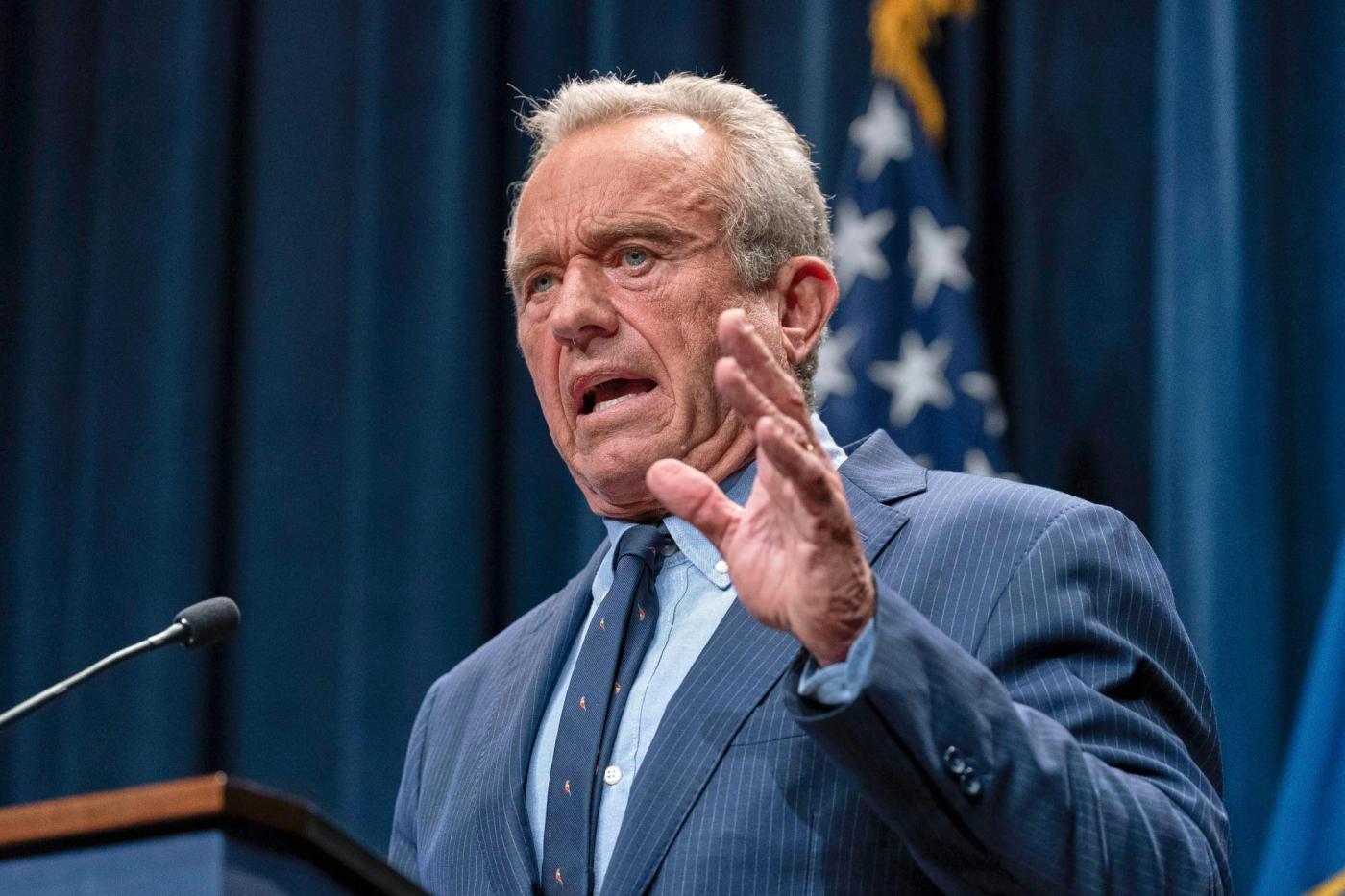
David M. Drucker: Trump is not as unpopular as his opponents think

posted in: All news | 0

President Donald Trump is not as popular as he claims. But neither is he as unpopular as his opponents might like to think.

That’s the simple explanation. Dig under the hood, however, and things get complicated.

I’m constantly asked to assess Trump’s political standing; it’s among the more consistent questions posed to professional political analysts. And — in case you hadn’t noticed — there is a ton of polling out there. But these surveys, many of them credible and worth considering, often spit out different data, allowing interested readers to draw different, sometimes contradictory, conclusions.

Veteran polling analyst Nate Silver, writing Sunday with colleague Eli McKown-Dawson in his newsletter, Silver Bulletin, explained: “Inevitably, there’s a lot of disagreement from survey to survey, not just because of statistical variation but because pollsters have long had trouble pegging down Trump’s popularity — and often underestimated it.”

Even respected polling averages — which you should absolutely heed more than individual polls — aren’t saying quite the same thing. The Silver Bulletin’s most recent average clocks the president’s job approval rating at 44.2%; the RealClearPolitics average is 45.9% and the Cook Political Report’s average is 42.9%. Yes, the numbers are similar. But mentally, 46% and 43% can feel much different — after all, elections have been decided by slimmer margins.

Either way, Trump’s “topline” job approval rating — the overall share of voters who approve of how he’s doing — is short of 50%, a vital sign that suggests poor political health for the president personally. And yet, to extend the analogy further, Trump is not flat-lining. This November’s key off-year contests and the 2026 midterm elections may not go well for the Republican Party; historically, the president’s party loses ground in both. But it’s not necessarily a shellacking, or a thumping, in the making.

“I’d keep my eye on the toplines, which are bad enough that they might well cost the GOP the House, but not (yet) nuclear,” RealClearPolitics senior elections analyst Sean Trende told me via email.

To wit, Democratic candidates are favored in this fall’s gubernatorial campaigns in New Jersey and Virginia. And with Republicans defending a threadbare majority in the House of Representatives, Trump’s numbers don’t have to drop too far under 50% for Democrats to recapture the speaker’s gavel in 2026. (GOP mid-decade redistricting efforts underway in various red states could change that equation.) Total collapse is probably what would have to happen for Democrats to win control of the U.S. Senate, where Republicans aim to grow their three-seat advantage.

But as I wrote at the outset: Assessing Trump’s political standing via these polls is complicated.

Although the president’s topline numbers remain relatively stable, crucial independent voters seem to be abandoning the president, with a YouGov poll for The Economist showing the president’s approval among them at a miserable 33%. On the other hand, a Fox News poll showed Trump with a decent 48% rating among Hispanic voters and a positive 55% approval among men ages 45 and younger. On the other other hand, the president is underwater on his handling of the economy.

“His base is solid as a rock,” CNN polling expert Harry Enten told me. Among Republicans, Trump’s ratings are sky high, in the high 80s to low 90s. That support is helping to keep Trump’s overall numbers afloat. In fact, he’s more popular — or perhaps we should say “less unpopular” — than he was in his first term.

“There is zero doubt that Trump is in a better position now than he was at this point in his first presidency,” Enten said. That might have something to do with Trump’s second term unfolding more like a first term. But when Trump’s second “first term” is compared to his predecessors in their actual first terms, Enten finds, “Compared to every other elected presidency, he is in worse shape now than those other presidents were.”

However, Enten went on to explain that ultimately, it’s most accurate to compare Trump’s political standing so far in his second presidency to how his predecessors were performing in the polls at the same point in their second term. On that front, Trump is in better shape than those who came immediately before him. “Maybe the right baseline is comparing him to other second-term presidents,” he said. “In that way, he’s in a better position than George W. Bush and, arguably, Barack Obama.”

And if there’s any real improvement in Trump’s topline numbers, Enten said, he’d put his party in a decent position for the midterms.

Such an outcome might seem improbable, given historical trends and the political headwinds buffeting the White House. But it was no less improbable in 2022, when Democrats managed to increase their Senate majority and come close to hanging onto the House amid President Joe Biden’s lousy 40% job approval rating and voters’ dissatisfaction with skyrocketing inflation, rising crime and the disastrous pullout of United States military forces from Afghanistan.

It’s why what I fear most in politics is certainty.

David M. Drucker is columnist covering politics and policy. He is also a senior writer for The Dispatch and the author of “In Trump’s Shadow: The Battle for 2024 and the Future of the GOP.”

Related Articles


Lynn Schmidt: Presidential incapacity and the limits of the 25th Amendment


Bret Stephens: Our vanishing culture of argument


Stephen L. Carter: Presidents can’t sue their way out of criticism


Mary Ellen Klas: Don’t let a generation lose faith in free speech


Pegah Banihashemi: Three years after ‘Woman, Life, Freedom’ protests, Iran remains in a deadlock

Lynn Schmidt: Presidential incapacity and the limits of the 25th Amendment

posted in: All news | 0

The authors of the 25th Amendment to the Constitution established and explained the complete order of presidential succession, as well as a series of contingency plans to fill any executive vacancies. It was written as a response to the weaknesses found in Article II after the assassination of President John F. Kennedy and what was learned about the inadequacies related to presidential illnesses and hospitalizations.

It feels like the time is not only right but needed for another updated response.

On June 27, 2024, Americans joined the rest of the world in watching the infamous presidential debate between then President Joe Biden and then former President Donald Trump. Yet, despite watching with our own eyes a president of the United States unable to complete a coherent thought, Biden remained in the presidency for 207 days afterwards.

The attention immediately went to the presidential race, and very few focused on whether or not Biden could complete his term in office. So as America grapples with an aging political class, the question of reforming the 25th Amendment must become part of the country’s discourse.

The 25th Amendment to the Constitution, ratified in 1967, was designed to address presidential succession and disability in an era of nuclear weapons and global superpower responsibilities. Yet nearly six decades later, this constitutional provision has proven inadequate for the realities of modern governance, revealing dangerous gaps that leave America vulnerable during presidential health crises.

Our most recent history reveals critical flaws with the current version that demand constitutional reform. The amendment’s ambiguous language, cumbersome procedures, and insufficient safeguards create dangerous vulnerabilities in our democratic system that must be addressed.

The amendment’s most glaring weakness lies in Section 4, which addresses presidential incapacity when the president cannot or will not acknowledge their disability.

The process requires the vice president and a majority of cabinet members to declare the president unable to perform their duties — a standard that is both too vague and too political. What constitutes “inability to discharge the powers and duties” remains undefined, leaving interpretation to officials who serve at the president’s pleasure and may face retaliation.

Cabinet members, appointed by and loyal to the president, are unlikely to vote against their benefactor except in the most extreme circumstances. The amendment essentially asks political appointees to commit political career suicide while navigating a constitutional crisis — a recipe for paralysis and politicization when decisive action is needed most.

A reformed 25th Amendment should establish clearer standards and more independent mechanisms for determining presidential incapacity.

The amendment should define specific criteria for incapacity, including mental illness, cognitive decline, substance abuse, or any condition that substantially impairs judgment or decision-making capacity. While some flexibility must remain for unforeseen circumstances, basic parameters would provide essential guidance.

The determination process of a president’s capacity should be removed from purely political actors. Instead of relying solely on cabinet members, a reformed amendment could replace the current system’s reliance on political intuition with medical expertise.

An update to the amendment must also account for technological and national security realities unknown to the 1960s drafters. The president’s role in nuclear command and control requires special consideration. The procedures for transferring such responsibilities cannot wait for lengthy political deliberations. The amendment should establish protocols for immediate temporary transfer of critical national security authorities while broader capacity questions are resolved.

The reformed amendment should also address transparency and attempt to restore public trust and confidence. While medical privacy deserves protection, the American people have a right to know about their president’s fitness for office. Balanced disclosure requirements could provide necessary public information without unnecessarily violating personal privacy.

Additionally, the amendment should address succession beyond the vice president more comprehensively. The current system assumes the vice president will be available and capable, but simultaneous incapacity of both officials remains possible. Clear protocols should extend further down the line of succession while maintaining constitutional principles.

With our current hyperpolarized society, changes are not likely to be enacted, especially because the amendment process is arduous and is intentionally difficult, requiring a broad consensus that reflects the gravity of changing our fundamental law.

Reform advocates should emphasize that a stronger 25th Amendment protects the presidency itself by ensuring smooth transitions and public confidence in executive leadership and that the proposed reforms serve the national interest rather than partisan advantage. A clear, fair, and efficient system for addressing presidential incapacity strengthens rather than weakens our constitutional order.

The 25th Amendment was a crucial step forward in 1967, but constitutional evolution must continue. By addressing its shortcomings now, we can ensure that future generations inherit a more perfect system for preserving democratic governance in times of crisis.

Lynn Schmidt is a columnist and Editorial Board member with the St. Louis Post-Dispatch. She holds a master’s of science in political science as well as a bachelor’s of science in nursing.

Related Articles


David M. Drucker: Trump is not as unpopular as his opponents think


Bret Stephens: Our vanishing culture of argument


Stephen L. Carter: Presidents can’t sue their way out of criticism


Mary Ellen Klas: Don’t let a generation lose faith in free speech


Pegah Banihashemi: Three years after ‘Woman, Life, Freedom’ protests, Iran remains in a deadlock

The growth spurt that turned Carson Wentz into an NFL prospect

posted in: All news | 0

The gravity of the situation wasn’t lost on veteran quarterback Carson Wentz this week.

Though he’s been focused on leading the Vikings to a win over the Cincinnati Bengals on Sunday afternoon at U.S. Bank Stadium, Wentz took a moment to appreciate how his journey through the NFL has led him to this point.

“I grew up rooting for this team,” Wentz said. “I think running out of the tunnel this weekend will probably hit me a little bit different.”

Undated courtesy photo, circa Aug. 2007, of Minnesota Vikings quarterback Carson Wentz during his freshman year at Century High School in Bismarck, N.D. After a massive growth spurt as a teenager, Wentz saw his recruitment process pick up. (Courtesy of Century High School)

The full circle moment wouldn’t have been possible without a growth spurt Wentz experienced as a scrawny teenager at Century High School in Bismarck, N.D. He stood 5-foot-8 as a freshman and might have weighed 125 pounds, depending on what he ate for breakfast.

Not exactly the makeup of an NFL franchise quarterback.

“I just remember praying,” Wentz said. “I’d be like, ‘God, if we get me to 6 feet, that would be terrific.’”

Those prayers were answered in a big way. Not only did Wentz sprout to 6-foot-5 as a senior, he filled out and weighed just north of 200 pounds by the time he enrolled at North Dakota State.

“It was a wild time,” Wentz said. “Those growing pains were real.”

Asked for his perspective on the growth spurt, older brother Zach Wentz recalled how they grew up competing against each other at pretty much everything, adding he knew his younger brother had a chance to be a really good athlete if his body cooperated.

“It was always a matter of, ‘Is he going to grow? Is he going to be big enough? Is he going to be blessed with that part of it?’” Zach said. “It was fun to see it all come together for him.”

The progression for Wentz saw him grow to 5-foot-10 as a sophomore, to 6-3 as a junior, to 6-5 as a senior. As he rapidly grew into his frame, Wentz caught the attention of longtime Century football coach Ron Wingenbach.

Undated courtesy photo, circa Aug. 2010, of Minnesota Vikings quarterback Carson Wentz during his senior year at Century High School in Bismarck, N.D. After a massive growth spurt as a teenager, Wentz saw his recruitment process pick up. (Courtesy of Century High School)

“It was unbelievable,” Wingenbach said. “It seemed like he got taller and taller every time I saw him.”

His stature allowed for an easy transition when Wentz stepped in at quarterback as a senior. He led Century on a playoff run, which ended with a heartbreaking loss to Fargo South in the state semifinal.

“There were a lot of factors that came into play with him that allowed us to do some stuff that maybe we couldn’t do before that,” Wingenbach said. “We already knew he had the ability to throw the ball. We were also able to incorporate his ability to run the ball. We knew he could handle all of it.”

After he came up short of a state championship on the gridiron, Wentz was working out in the weight room when longtime Century basketball coach Darin Mattern convinced him to take his talents to the hardwood.

Never mind that Wentz had never played the sport at the varsity level. As far as Mattern was concerned, Wentz’s combination of size and strength would more than make up for his of experience.

“I knew we could use him,” Mattern said. “I told him to visit with his parents and talk about it. He got back to me and told me he was going to try it. He ended up being incredible for us.”

The physical presence Wentz brought to the table was palpable. He was an incredible rebounder who cleaned the glass. He was also an elite defender usually tasked with taking away the best player on the other end of the court.

That was on display as Century went on a playoff run, which culminated with a close win over Bismarck in the state final. In the game, Wentz was tasked with guarding Dexter Werner — the North Dakota Gatorade Player of the Year who went on to start games for North Dakota State — and held the star forward to just 14 points.

“Honestly, he might’ve been the only kid in the state of North Dakota that was going to attempt to guard him,” Mattern said. “He had that mindset where he wouldn’t back down from any challenge.”

That’s something Wentz has carried with him ever since.

After starring himself at North Dakota State, Wentz was selected by the Philadelphia Eagles with the No. 2 pick in the 2016 NFL Draft. He’s also taken snaps for the Indianapolis Colts, Washington Commanders, Los Angeles Rams, and Kansas City Chiefs before ending up with the Vikings.

“He was kind of a late bloomer,” Wingenbach said. “He was a very very good high school football player. Would I have projected him to be in the NFL? No, probably not.”

As he reflected on his time working with Wentz nearly 15 years ago, Wingenbach referenced the growth spurt once again. He cited a conversation with then North Dakota State quarterbacks coach Brent Vigen.

“He made the comment, ‘The young Wentz kid could have some NFL potential if he continues to work,’” Wingenbach said. “He was certainly correct about that, knowing everything we know now.”

[related_articles location=”left” show_article_date=”false” article_type=”automatic-primary-section”

Other voices: That’s more Karl Marx than Ronald Reagan

posted in: All news | 0

President Donald Trump has apparently lost his taste for traditional American capitalism. His policies are creating what Chinese government officials might describe as a “socialist market economy with American characteristics.”

That is not a compliment.

Our country’s economic dynamism is rooted in a few hallowed principles. One is that the free market, meaning supply and demand, not government fiat, should set prices and production levels. We also require a light touch with regulation and taxes. Last, we have an independent central bank that sets interest rates based on objective economic indicators, not political goals. Investors here and abroad trust our Federal Reserve system because its decisions reflect reality.

American capitalism disdains centralized, state-directed economic planning and state-owned enterprises. The government should not try to directly mandate prices, production targets or interest rates. It shouldn’t take an ownership stake in private enterprises except in extreme situations.

Trump has done all those things. Some of his threats are silly, such as his vow to lower prescription drug costs by 1,500%. No one took that seriously. We hope.

More chilling are Trump’s ongoing attempts to drive out Federal Reserve Board Chairman Jerome Powell, whom Trump elevated to that role. So far, Powell and his colleagues have resisted personal attacks and intense pressure to manipulate interest rates. We admire their professionalism and commitment.

In late August, Trump accused Lisa Cook, a member of the Federal Reserve’s board of governors, of mortgage fraud and tried to fire her. She denied the allegation and has sued to keep her post. Trump’s action is an obvious attempt to intimidate Cook. (If he were concerned about public officials and alleged mortgage fraud, surely he would have asked Texas Attorney General Ken Paxton to resign.)

Equally indefensible is Trump’s meddling in individual businesses.

TikTok was the first example. In January, Trump essentially suspended a law, passed with bipartisan support and upheld by the courts, that banned the Chinese-owned app unless it was sold to a U.S. owner. Lawmakers had legitimate concerns that the app posed risks to users’ privacy and to national security.

Trump said he could make a sale happen. He hadn’t, so he kept extending his original executive order, which allows the company to keep operating.

That was just the start of the president’s interference. Trump threatened Apple with additional tariffs on devices made overseas unless it brought more manufacturing to the United States. The U.S. Treasury wants a 15% cut of the revenue Nvidia and AMD earn from selling certain microchips to China that had previously faced export bans. The arrangement may not be legal.

The president urged the CEO of faltering chipmaker Intel to resign and strong-armed it into giving the U.S. a 10% ownership stake. According to news reports, the administration also may invest in major defense contractors.

We’re not convinced that the U.S. government should own more and more of the means of production. That’s more Karl Marx than Ronald Reagan. It’s creeping socialism.

— The Dallas Morning News

Related Articles


US attorney whose office is investigating Letitia James is told he’s being removed, AP source says


Federal judge tosses Trump’s $15B defamation lawsuit against New York Times


Trump’s moves against the media mirror approaches by authoritarian leaders to silence dissent


Trump asks Supreme Court to halt order letting transgender people choose passport sex markers


House passes a bill to avoid a partial government shutdown, but prospects in the Senate look dim