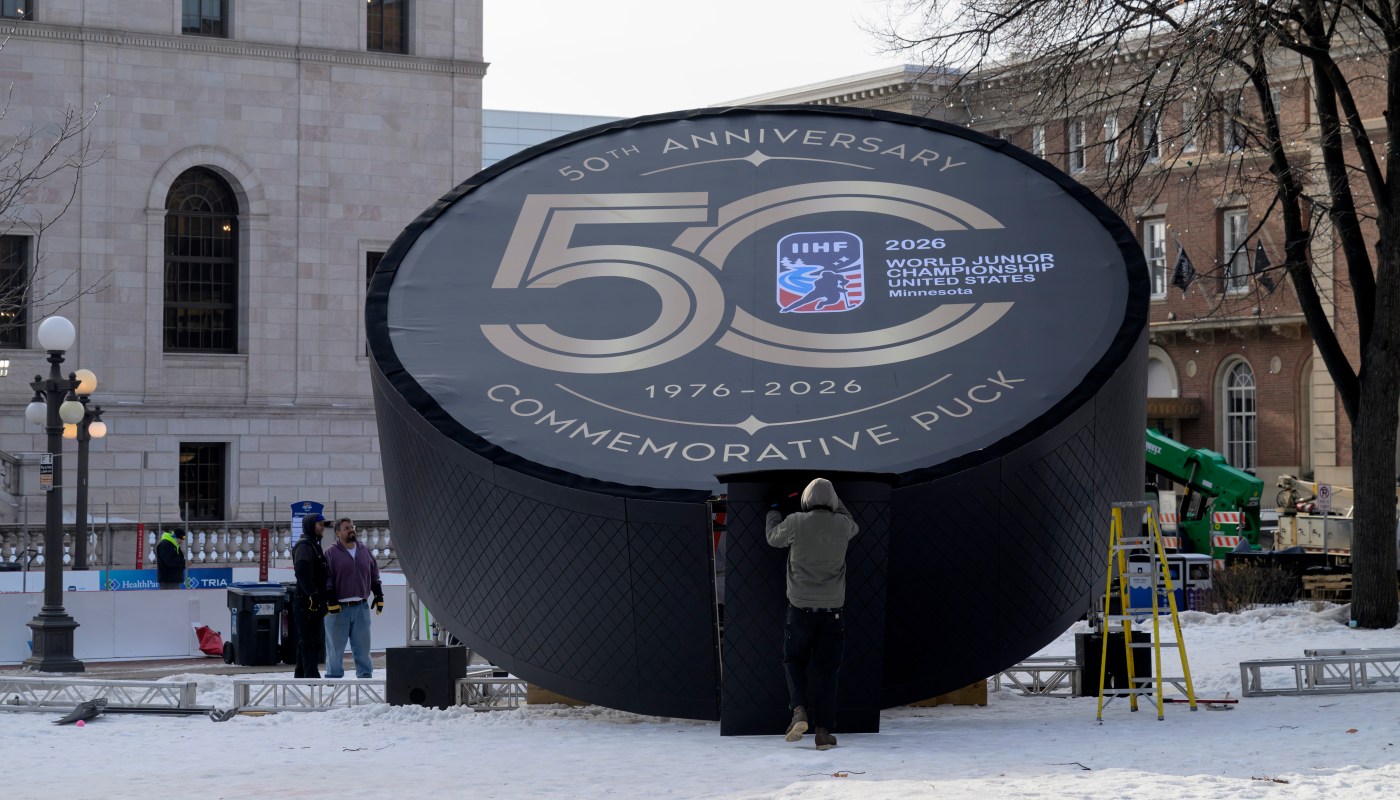
The puck dropped on the 2026 International Ice Hockey Federation World U20 Junior Championship on Friday when Sweden met Slovakia and the U.S. faced off against Germany at Grand Casino Arena. It’s the first time in more than 40 years that the event has been held in the Twin Cities.
The 10-team field is divided into two groups of five. Every team plays every other team in its group once in round-robin play. The top four teams from each group advance to single-elimination bracket play. The gold medal game is scheduled for 7:30 p.m. on Monday, Jan. 5, at Grand Casino Arena.
GROUP A
United States
About the team: The U.S. has won back-to-back golds, and three of the past five (2021, 2024, 2025), but is projected by some international hockey experts to miss the medals altogether this year.
Player to Watch: Defenseman Cole Hutson has been sensational in international play; a year ago, he had three goals and eight assists in seven games. This season, he has seven goals and 20 points in 18 games this year for Boston University. The blue line also will lean on Ottawa draft pick Logan Hensler, New York Rangers pick E.J. Emery and Buffalo pick Adam Kleber. … Up front, James Hagens (Boston College, Bruins pick); Max Plante (Minnesota Duluth, Detroit pick); Ryker Lee (Notre Dame, Nashville); Cole Eiserman (Boston U., Islanders), Brodie Ziemer (Minnesota, Buffalo) and Will Horcoff (Michigan, Pittsburgh) are among a deep group of forwards. At goaltender, Notre Dame’s Nick Kempf is expected to get that nod ahead of Caleb Heil (of the USHL’s Madison Capitols) and Brady Knowling, a 17-year-old who plays for the U.S. National Team Development Program and is among the top goalie prospects for the 2026 Draft.
Germany
About the team: This is the seventh consecutive year the Germans will play in the WJC, and avoiding relegation is again a primary goal. It finished ninth last year, avoiding relegation by coming from behind to beat Kazakhstan.
Players to Watch: Forward Maxim Schafer. The 2025 third-round pick of the Washington Capitals is a good skater with deceptive speed for his size (6-4, 190). Schafer can score, too, with 12 goals and 23 points so far this season in the Quebec Maritimes Junior Hockey League. … Goalie Linus He has five years of international experience for Team Germany and currently plays for the Spokane Chiefs in the WHL, where he is 9-6-0, with a 3.15 GAA and .890 save percentage. … The Germans have two drafted forwards playing major juniors in Canada this year. Schaefer and David Lewandowski (Edmonton Oilers). Lewandowski is one of Germany’s top playmakers; he has 24 assists and 32 points in 28 games for the Saskatoon Blades this winter. Max Penkin, a rare 16-year-old playing in the WJC, has already played more than a dozen games in Germany’s top pro league. He’s a prospect for the 2027 NHL Draft.
Slovakia
About the team: Slovakia reached the quarterfinals last year, and put up a fight, but it ran into a tough Finland team right off the bat and fell 5-3.
Players to Watch: Goalie Michal Pradel was selected by Detroit in the third round, 75th overall, of last summer’s NHL Draft. The only Slovakian goalie chosen earlier in a draft was in 2023, when the. Chicago Blackhawks took current Minnesota Duluth goalie Adam Gajan with the No. 35 overall selection. … Defenseman Luka Radivojevic, a freshman at Boston College, was born in Edina when his father, Branko, played for the Wild. Luka is a right-shot with nine points in 16 games at B.C. … Patrik Rusznyak (6-4, 200) adds size to the defensive corps, as does WJC rookie Adam Goljer (6-3, 195), who is projected by some outlets as an early- or mid-round pick in next summer’s NHL Draft. … Los Angeles Kings draft pick Jan Chovan and Detroit Red Wings pick Michal Svrcek are Slovakia’s only drafted forwards.
Sweden
About the team: It’s been 14 years since the Swedes have won gold at the WJC and they’re tired of hearing about it. “I think we had (winning gold) in our minds before we went to Canada” for pre-tournament games, captain Jack Berglund said after a 7-3 win over Switzerland in Rochester on Dec. 23. Berglund is a “glue” guy on a team with 17 NHL Draft picks.
Players to Watch: Forward Ivar Stenberg is widely projected to be a top-three pick in the 2026 NHL Draft. At 18, he’s already a point-per-game player in Sweden’s top professional league with 24 points in 25 games for Frolunda HC. … Viggo Bjorck is also expected to be a first-round pick, joining teammates Victor Eklund (No. 16 overall, 2025, N.Y. Islanders) and Anton Frondell (No. 3, 2025, Chicago). Frondell could be the best forward in the tournament, though Stenberg and Canada’s Gavin McKenna will have something to say about that.
Czechia
About the team: Czechia’s U20 program has won the bronze medal the past two years, beating a strong Sweden team last year for bronze after winning silver in 2023.
Players to Watch: Defenseman Adam Jiricek has been dominant in major junior hockey, with 10 goals and 29 points in 25 games for the Brantford Bulldogs of the OHL. Drafted 16th overall by St. Louis in 2024, he is the brother of Wild defenseman David Jiricek. … Center Adam Benak was a fourth-round pick by the Wild and has 15 goals and 43 points in 26 games in the OHL. He could be Czechia’s go-to playmaker. … Buffalo Sabres first-round pick Radim Mrtka (6-6, 215) has the ability to make a big hit, shut down plays with his size and reach, and produce offense from the blue line. He has 16 points in 14 games for Seattle of the WHL this year.
GROUP B
Canada
About the team: Two consecutive quarterfinal losses haven’t sat well with Canadian hockey fans, players or executives, particularly last year’s, which occurred in Canada. The good news: This team is loaded.
Players to Watch: Porter Martone, 19, has 20 points in 20 games for third-ranked Michigan State. The 6-3, 209-pound winger was drafted sixth overall by Philadelphia … Gavin McKenna is the potential No. 1 pick in the 2026 Draft, and Michael Misa has three points in seven games with … the San Jose Sharks. Canada also has Montreal prospect Michael Hage up front. … Defenseman Keaton Verhoeff, a freshman at the University of North Dakota, also is a possible top overall pick next summer, Carson Carels could also be top-10 pick next summer. However, Zayne Parekh (Calgary) and Harrison Brunicke (Pittsburgh), will lead the blue line; they’re on loan from NHL teams Calgary and Pittsburgh, respectively. … Canada also has the best 1-2 goalie punch in the WJC: Carter George (Los Angeles) and Jack Ivankovic (Nashville). George posted a 1.76 GAA and .936 save percentage in four games in last year’s WJC.
Switzerland
About the team: Switzerland’s clear strengths are goaltending and a blue line that features three NHL picks. The Swiss held Minnesota State, Mankato, to just 15 shots on goal in a 1-1 tie in a pre-tournament game on Dec. 16, then held Denmark to just six five days later.
Players to Watch: One of a small handful of 2009-born players in the WJC this year, forward Jonah Neuenschwander. Neuenschwander (6-3, 183) is being projected as a first-round NHL Draft pick in 2027. … A pair of drafted goalies will again share the net: Christian Kirsch, San Jose’s 2024 fourth-round pick, and Elijah Neuenschwander, Anaheim’s 2025 fourth-round pick.
Denmark
About the team: The Danes haven’t been in this tournament in six years and their best hope for success in the Twin Cities is to avoid relegation. Denmark struggled in their two exhibition games, a 6-1 setback against Switzerland and 13-2 loss to Canada.
Players to Watch: Mads Kongsbak Klyvo is the Danes’ lone NHL Draft pick, The 6-2, 195-pound forward struggled to show his skills in a pair of pre-tournament games because opposing defenses were able to key on him … Markus Jakobsen is Denmark’s most offensively gifted player on the back end.
Finland
About the team: Finland won the silver medal last year, but in heartbreaking fashion. The Finns led the U.S. 3-1 halfway through the gold medal game, but the U.S. scored twice late in the second period to tie it, then won it on a Teddy Stiga goal in overtime.
Players to Watch: Goalie Petteri Rimpinen might be the best goalie in the tournament. He backstopped the Finns to the gold medal game last year, going 5-2-0 with a 2.34 GAA and .933 Save%. He is a fifth-round pick of the Los Angeles Kings. … Up front, a name that will jump out to fans in Minnesota immediately is Aatos Koivu, the nephew of former Minnesota Wild star Mikko Koivu and son of Saku Koivu can play center or wing. A 2024 third-round pick of the Montreal Canadiens, he has seven points through 30 games in Finland’s top pro league this season. … Wild draft pick Aron Kiviharju (fourth round, 2024) is expected to quarterback his team’s power play and excels at getting the puck out of the defensive zone quickly and accurately.
Latvia
About the team: The Latvians pulled off the upset of the tournament a year ago, beating Canada in a shootout. It marked the first-ever win for Latvia against Canada in U20 play.
Players to Watch: Defenseman Darels Uljanskis, the 2024 seventh-round pick of the Anaheim Ducks, could be Latvia’s MVP, could play as much as 30 minutes a game and has considerable international experience. This will be his second WJC appearance after serving as Latvia’s alternate captain in the 2024 U18 World Championship. … Harijs Cjunskis and Alberts Smits help solidify a strong Latvian blue line; Smits (6-3, 205) is expected to be a first-round pick in the 2026 NHL Draft. … With 6-6 Roberts Naudins (a 2027 NHL Draft prospect) and and 6-4 Kristors Ansons, Latvia has some size up front, as well. Naudins is committed to Harvard and plays at Shattuck St. Mary’s in Faribault, where he has 42 points in 26 games.
World Juniors: It was unofficial, but these Minnesotans were USA’s first
328 Grill to run a pop-up inside Alary’s during the World Juniors Hockey Tournament
World’s largest hockey puck is in downtown St. Paul
St. Paul: World Juniors hockey event brings Bold North festival downtown
Lino Lakes woman is named Hockey Mom of the Year