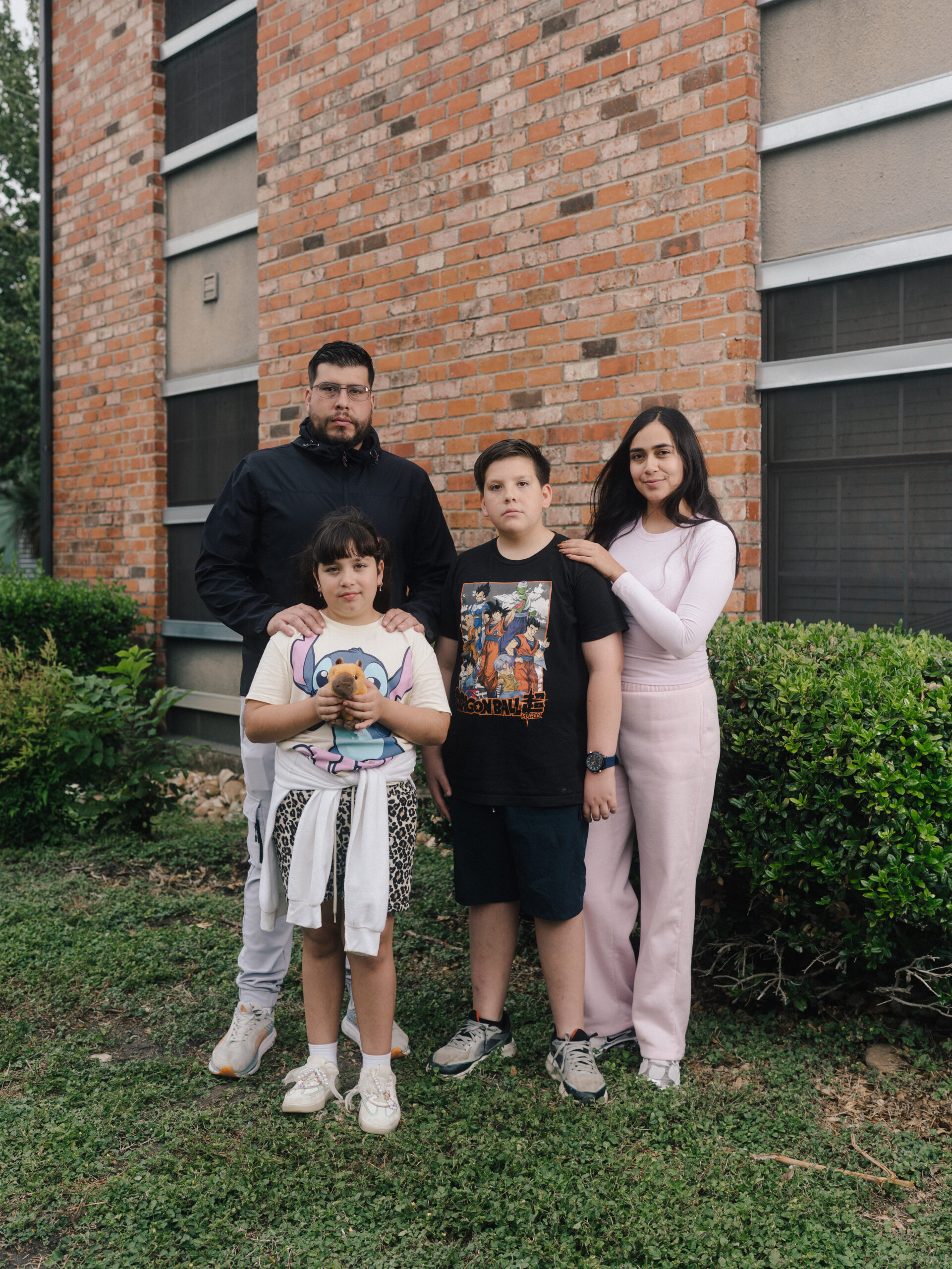
They’ve been home for two weeks now, but Monse and Victor Alexander Labrador can’t yet bring themselves to play outside. The half-siblings, ages 8 and 11, especially want to avoid the parking lot. If their dad, Victor Sr., could, he’d move his children far from the place where their immigrant detention nightmare began. But they can’t afford to break their apartment lease, so he returns with them to their San Antonio parking lot. “They start looking around, very scared, very anxious,” he says. “Nothing’s wrong,” he tells them. “Let’s keep going. We also have to face our fears.”
On April 27, as the kids crossed that parking lot with Betania Uzcategui, their mom and stepmom respectively, heading to the school bus stop, unmarked SUVs swerved around them. It was Betania’s birthday and pajama day at school. They carried blankets and pillows, expecting a day of movies and a night filled with singing and cake. Instead, masked immigration agents took the three of them to the Dilley family detention center an hour southwest of the city.
Under the Trump Administration’s mass deportation agenda, theirs was as happy an ending as many could ask for. Their story struck a nerve in San Antonio. As the bus pulled up and stopped on its way to Cambridge Elementary School, many of Monse and Victor Alexander’s classmates had seen them flanked by the Immigration and Customs Enforcement (ICE) agents. The school rallied behind the family, who’d fled Venezuela for San Antonio and had a pending asylum case. The kids sent letters and drawings to their detained friends. The parents raised money and connected Victor with Democratic Congressman Joaquin Castro, who championed their cause and helped them find hard-charging attorneys to take their case. Local press covered the story relentlessly.
Though the Trump Administration routinely detains families for 100 days or longer—flouting a still nominally in-effect 20-day legal limit—the massive community effort brought the three of them home in just over two weeks. On May 13, a federal judge granted their habeas corpus petition, ruling their detention ran afoul of the U.S. Constitution. He ordered their immediate release. Victor Alexander, a gifted-and-talented student once proud of his stellar attendance, had agonized in detention about missing his fifth-grade graduation. They made it out with a week to spare.
“From all that hardship,” says Betania of her family’s harrowing experience, “we emerged victorious.”
The Labrador Family in San Antonio on October 29
But even with the triumph of their release, they’ve struggled to put the trauma of arrest and detention behind them. And their efforts to heal keep getting interrupted. This summer, ICE arrests reached record highs—especially in Texas, where the cooperation of state and local law enforcement, from sheriffs’ offices to the highway patrol, has extended ICE’s reach. Though the family’s detention ordeal has ended, an onslaught of ICE arrests has continued to pick off their friends, neighbors, and family members.
Betania, 26, had planned to study law: She’d won a college scholarship before fleeing Venezuela with Victor and the kids in 2021. She’s proud of her family’s fight for their internationally recognized right to seek asylum. The day of their arrest, Victor narrowly avoided detention himself; he’d been walking with them to the bus but had returned home to grab his keys. ICE agents tried to lure him outside, Betania says, by having her call him to deliver the threat that Victor Alexander could be put in foster care. But Victor, a former political activist who’d faced government threats back in Venezuela, resisted “all that psychological warfare,” Betania says. He stayed in their apartment and later worked tirelessly to secure his family’s release while he sheltered in place.
From within detention, Betania also resisted what felt like a ceaseless pressure campaign, she says, waged by seemingly everyone at Dilley, from its guards to its nurses, to sign deportation papers that would have broken up their family indefinitely. Instead, with their release on May 14, they’ve been able to pursue their asylum case from home.
Yet even short periods of ICE family detention—a practice begun under the W. Bush administration, revived by Barack Obama, and briefly ended by Biden before coming back with a vengeance—can cause lasting harm to the physical and mental health of children and their families. Study after study has confirmed the long-term impacts of detention on mental health, particularly for children. These findings have also been affirmed by the federal judge overseeing the settlement agreement that imposes the now-ignored 20-day limit. “Decades of research demonstrate that toxic stress in childhood is associated with lifelong risks of mental illness, cardiovascular disease, immune dysfunction, and shortened lifespan,” reads a February letter addressed to then-Department of Homeland Security Secretary Kristi Noem and signed by roughly four thousand medical and mental health professionals.
“There are so many ways that this causes harm, and all those harms don’t stop when you get out,” said Javier Hidalgo, public affairs director for RAICES, an immigration services nonprofit. He sees parallels between family detention and earlier dark periods in American history, including Japanese internment and Native American boarding schools. The impact, he said, will be “generational.”
Given conditions reported within Dilley, it’s easy to see why. Betania remembers the South Texas camp as a kind of desert hellscape. Dust never seemed to stop blowing in the sprawling trailer complex, which at the time held some 400 people. Beneath those trailers, she often saw black snakes wriggling on the ground. A July 2026 investigation by the Senate Judiciary Committee describes “substandard medical care, inadequate food, undrinkable water, disrupted sleep, rude and dismissive guards, confusion about legal processes, and limitations on communication with family members outside of Dilley.” In sworn declarations, parents and children have gone into even more disturbing detail, recounting cloudy, foul-smelling tap water, a toddler’s flu left untreated for a week, nighttime wakeups every few hours, a male employee repeatedly walking in on young girls as they showered, and food crawling with worms. A cafeteria guard dismissed their complaints about the food, one father recalled, saying of the detainees, “If they were in their own countries, they would be eating shit.”
ICE did not respond to a request for comment for this story.
For four years in San Antonio, the family had flourished. As their asylum case worked its way through the immigration court system, Betania and Victor received work permits and became delivery drivers for Amazon Flex. At their Alamo Heights elementary school, soft-spoken Victor Alexander took up every sport he could find, and outgoing Monse grew to love reading and roller skating. “The most beautiful thing we had here,” Betania says, talking by phone in late May, “far beyond material things or anything like that, was that calm, that trust in the authorities—being at peace here without fear or anxiety.” As she looks ahead, her voice grows determined. “So that is now our challenge: Our new job is to give the children the peace of mind they once had here.”
But, in some ways, it’s like they’re all still detained. With school just let out, they leave the house only to buy food, for Sunday church, or in Victor’s case for work. Still a Flex driver, he’s switched to a night schedule, when the streets are quiet, starting his shift at 2:30 am.
“It’s very easy to miss a lot of very practical, day-to-day consequences of detention for immigrants and their families,” said Efrén Olivares, an attorney and vice president of litigation and legal strategy with the National Immigration Law Center. He’s seen detained clients fired for missing work or evicted for missing rent. With weeks or months missed of school, kids can fall behind academically. His 18-year-old mariachi-playing client, Antonio Gámez Cuéllar, was released from adult detention on a Monday and scheduled to take the SATs that Saturday, Olivares said, with limited ability to study while imprisoned. The Gámez Cuéllar family’s case also sparked public outrage. But “the vast majority of people don’t have the luxury of such a support system,” he noted. Some, when released from detention, have no one to even pick them up.
Betania can’t yet get herself to return to delivery driving, which means an income loss of about $800 a week. “I could have an accident,” she says. “What if the police arrive and don’t help me, but instead want to take me back? All those thoughts are running through my head.”
Monse
In theory, the judge’s order protects Betania and the kids from detention while their asylum case continues. So when they do go out, Victor Alexander is “very, very alert to every little thing,” Betania says. “Now he’s the one saying, ‘Don’t forget the papers! Put them in the car, make copies, take photos.’” Betania isn’t as sure the judicial order will be enough. The agents had been looking for someone else back in late April, she says, when without asking permission they held a phone to her face to scan her biometrics and quickly learned she wasn’t the person they sought. But that didn’t matter. “How can we trust that it won’t happen again if they already did it once and it was a mistake?”
Victor, 31, tries to convince his kids that it won’t, as much as he wrestles with those fears himself. This is a familiar struggle for him. He was 13, just a few years older than his own son now, when he began volunteering for a Venezuelan political opposition party. Over time, his close friends and associates were shot at and imprisoned. Then government soldiers began to camp outside Victor’s house. To avoid them, he’d leave out the back, jump over walls, and travel through his neighbors’ homes. “It was very clear he was on the chopping block,” one of Victor’s attorneys, Kate Lincoln-Goldfinch, said, noting the family “has a very good case” for asylum.
In his family’s arrest and detention, Victor sees an echo of the lives they left behind. “You can give them your documents and everything else to show that you’re doing things right, you’re not doing anything wrong, but no—just because they’re the ones with power, they’ll immediately harm you.”
For Betania as well, images of the ICE arrest overlap with Venezuela. Back home, she’d been alone at night when she was stopped and extorted by armed government soldiers; in San Antonio, she was with her daughter and stepson in broad daylight. In both countries, the agents surrounding her had worn masks. The Venezuelan masks were fashioned to look like skulls, completely covering the soldiers’ faces. Here, at least, she could see the agents’ eyes.
“We live in this country precisely because of the safety, the freedom, the respect for human rights,” she says. “So, to feel this way now is—well, it’s very sad.”
By mid-July, Victor Alexander has transformed into a kind of neighborhood watchman. He and his sister now both play outside, but, first, he scans the parking lot for suspect vehicles. He plays soccer with friends only if the coast is clear. When a strange car passes, he shouts, “Everyone inside!” and all the kids run home.
Earlier that month, Victor’s cousin-in-law—considered an uncle to the kids—was detained by ICE in Midland. Now Monse checks in often with the uncle’s young son, and Betania sometimes listens in as the little cousins compare their experiences. “Hearing them talk about those things… wow.”
Betania, meanwhile, has found work at an ice cream shop she can walk to. She makes half of what she did before and feels like an old lady among her co-workers, who are all high school students. But she gets to practice English with them, and handing sweets to the little kids is its own kind of healing.
All summer, the parents have walked a tricky line. Gone are the frequent trips to summer splash pads and their earlier plans to send Victor Alexander to baseball camp and Monse to gymnastics. It simply feels too dangerous. Still, they try to keep up with play dates, and they enroll both kids in a shorter, weeklong summer program at school. They still go to mass as a family, even after seeing two young men handcuffed by ICE just blocks away.
It helps that Cambridge Elementary has connected them to a therapist who sees them once a week. Nightmares take Monse back to detention. She dreams of the long, sleepy walks to Dilley’s cafeteria: They’re woken up early; they cross again through the rocky dirt yard, all to eat food that makes them sick. The therapist tells Monse and Victor Alexander that something bad happened, but it’s over now. They are brave kids, he says. They’ll get through this.
The therapist visits them at home, Victor explains, because his office is located in a “red zone,” meaning a known hotspot for ICE. It’s hard not to divide up the world that way with ICE still so present in their neighborhood, he explains. “A lot of people have been taken from here,” he says. “On Monday they arrested a friend, on Tuesday a cousin, and on Wednesday another acquaintance.” Between them, Victor and Betania say they know at least 20 people who’ve been detained in recent months: their barber, Betania’s friend, and many more.
Texas has been at the epicenter of Trump’s mass deportation campaign. Since 2022, roughly a quarter of ICE arrests have occurred in Texas, and the number of monthly arrests and detentions have more than tripled in the state since Trump took office last year. Like detention, the fear of ICE arrest and deportation can pose long-term mental health risks for entire communities. During periods of heightened ICE activity, a Los Angeles health clinic serving low-income Latino families documented sharp spikes in patients’ anxiety, depression, and suicidal thoughts.
Then, there are the shootings. Thinking of Lorenzo Salgado Araujo, the Houston father killed by ICE in July, Betania suddenly feels lucky to have survived her own arrest. When she reads of ICE’s contract for gloves that deliver electric shocks, “at this point, it really does resemble Venezuela,” she says.
It’s a muggy mid-August afternoon, the Sunday before school starts up. Monse is all smiles as she switches between Spanish and English, introducing their new rescue cat. When she says she’s had a good summer—she got to swim in her friend’s pool—it seems like a hard-fought victory. She joins her parents at the kitchen table and admits she’s less than thrilled about the return to homework. Her dad lectures her gently about the importance of education as she nibbles a cupcake.
Victor Alexander is absent. He’s visiting his grandfather. A few days earlier, a Department of Public Safety (DPS) trooper had pulled Victor’s father over near San Antonio and asked to see papers. He was stopped for hours, but finally the trooper let him go. This still rattled Victor Alexander, however, and he wanted to “keep his grandpa close,” Victor explains, making a hugging motion with his hands.
Betania overall feels calmer, “and yet,” she says, “I’m always afraid.” Her eyes still flash involuntarily to strange cars passing by. One morning before work, an ICE vehicle stopped again in the parking lot. “I didn’t have the courage to go out,” she recalls. She messaged her manager to say she’d be late. Victor has a group chat going with other Flex drivers to warn each other of ICE sightings on their routes.
Despite it all, both parents are hopeful they can return to normalcy. Monse’s message is also one of hope: “Being detained is horrible,” she says, “but you reach a point where you know you’re going to get out, and when you have a lot of faith, you end up okay and nothing happens to you. It’s going to hurt to be there, but it’s not forever.”
Days later, however, that hope is shattered. Dilley may be behind them, but the threat of ICE, of deportation, and of family separation remains. Victor Alexander was right to be on high alert, it turns out, and right to worry about his grandfather’s encounter with DPS. The day before school started, the kids’ grandfather was arrested by ICE at work. The family suspects DPS shared his information with immigration authorities, as has often been the case under outgoing Texas Governor Greg Abbott. (DPS did not respond to a request for comment.) They raised money for his legal fees, but the case proceeded much more quietly than theirs had. After weeks in El Paso’s Camp East Montana, the 61-year-old was deported back to Venezuela. Victor Alexander asks all the time when he’ll see him again.
“It feels like it just hasn’t stopped,” Betania says in October. They keep trying to claw back hope—that life will calm and their immigration judge will fairly consider their asylum case, which has its final hearing scheduled for next year. But immigration courts these days deny a record 94 percent of asylum cases—up from a 68 percent denial rate at the end of Biden’s term. And the family continues to be devastated by the grandfather’s deportation. “But we’re trying to be ok so the kids are ok,” Betania says.
After months in detention, the kids’ uncle has been deported now too; with his wife left alone, she and their son have moved in with Victor and Betania. The young cousins play cards together indoors. They have no friends left in the neighborhood to play with outside. “Literally all of them have moved or left Texas,” Betania explains. “There are so many kids going through this.”
The post Life After Family Detention appeared first on The Texas Observer.
Leave a Reply