During a September panel at the Texas Tribune Festival focused on building the Texas workforce, John Kelly, one of BlackRock’s head corporate honchos, pointed to a recent Brookings report indicating that investments in the U.S. data center boom could total up to $10.3 trillion between 2025 and 2032. It was, as Kelly put it, a “generational” opportunity for his company, the world’s largest investment manager with control of more than $15 trillion in assets. Around $500 billion of that is invested in publicly traded companies in Texas.
Referring to his multinational investment firm as the “largest investor” in the state, Kelly, who is BlackRock’s global head of corporate affairs, explained that his clients want the financial behemoth to invest in training programs for electricians to meet the state’s massive data center skills gap. But he went slightly off topic during his answer. “It’s our clients’ money, right? … It’s important,” he said, “and I thank you for letting me tell that story—because in Texas, we’ve not always told our story, so I have to sometimes use opportunities like this.”
That appeared to be a likely reference to the once-embattled asset giant’s almost completely successful campaign to get back in the good graces of Republican state leadership which had, until last summer, blacklisted the firm over its “Environmental, Social, and Governance” (ESG) investment practices—a now-verboten investment strategy that prioritizes shareholder proposals and investments that promote social and environmental justice principles.
The panel at the Tribune event, for which BlackRock was a “premier” sponsor, followed a May event in which BlackRock CEO Larry Fink joined Governor Greg Abbott at a technical college in Waco to announce the firm’s $30 million philanthropic gift meant to train 12,000 Texans in the electrical trades. BlackRock’s investment in the college represents one of the firm’s largest dealings with a public institution since the passage of Senate Bill 13, the state’s 2021 anti-ESG law, which banned state entities from contracting with companies that divest from fossil fuels. That law was overturned in February, but BlackRock had already worked its way off the law’s resultant blacklist in June 2025.
The Texas Comptroller’s office, which had initially listed the company in 2022, confirmed to the Texas Observer that, since BlackRock was cleared last June, the comptroller’s office—which manages investments for the state, including a new Strategic Bitcoin Reserve—made at least two purchases of a BlackRock-managed Bitcoin exchange product. The Observer also found that the Permanent school Fund paid Blackrock about $8.3 million for investment-related services in recent years, including while the firm was blacklisted.
Despite regaining Texas’ blessing, and despite rolling back its support for environmentally focused shareholder proposals, BlackRock contends it hasn’t abandoned its ESG commitments. As of 2025, it reported more than $1.3 trillion in client assets dedicated to sustainable and transition investment portfolio strategies.
BlackRock is, nevertheless, the largest investor in data centers in both Texas and across the nation. In addition to the firm’s $4.9 billion July investment in a Meta’s 1-gigawatt AI data center campus in El Paso, BlackRock is invested in, owns shares of, or is otherwise financially linked with, at least 28 corporate members of the Data Center Coalition, a national trade organization, according to research compiled by Texas Coalition Against Data Centers. The investments run counter to BlackRock’s stated ESG goals, funding an AI boom whose environmental and energy impacts as a resource-sucking blight on rural Texas communities have become so well publicized that even Governor Greg Abbott has ordered a statewide audit and temporary pause on permitting for new projects.
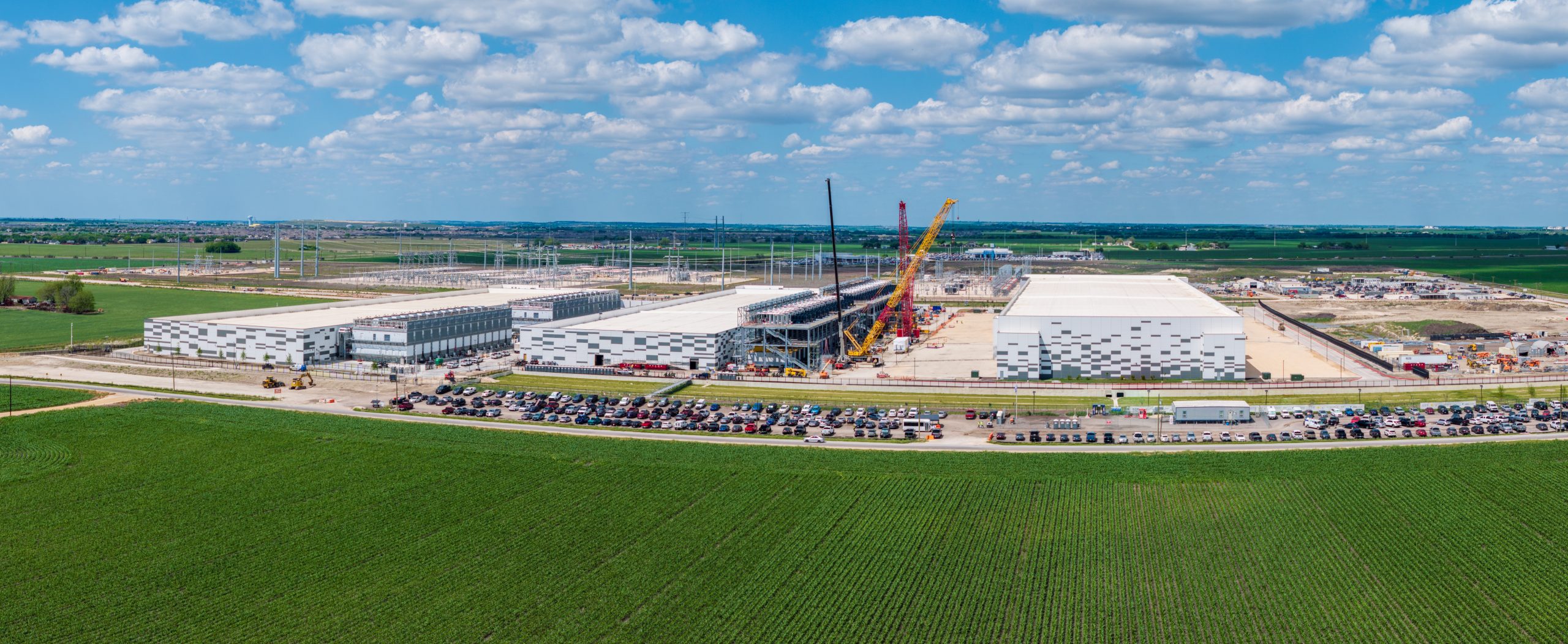
Aerial view of a data center under construction in Hutto, Texas. (Shutterstock)
When asked how the firm’s AI investments square with ESG principles, Kelly said Blackrock is the largest sustainable investor in the world and repeated his line about simply being a conduit for other people’s money. “It’s our clients’ money, and so we invest when and how they want, whether that is in oil and gas, or whether that is in solar and wind or nuclear,” Kelly told the Observer.
So how did the world’s largest asset manager go from being the Texas GOP’s ESG enemy number 1 to the state’s newly celebrated comeback kid? It’s a nearly five-year-long tale that reflects the profound impact the one-party governing apparatus of Texas can wield against powerful private entities in the name of culture wars, and, in turn, the ability of a corporate giant to rehabilitate itself. It’s a saga that also remains far from over.
“BlackRock made those [ESG] commitments in a different political climate, when that seemed to be the smart bet in this country, and there are … obviously incentives for companies based in America that are doing business abroad to have those sets of goals,” Public Citizen Texas Director Adrian Shelley told the Observer.
Shelley noted that some state anti-ESG policies still remain on the books, like a 2023 law that bars insurance companies from using ESG criteria to set insurance rates. Anti-ESG policies like these, Shelley says, have been bad for Texas. “It’s a misapplication of state resources. It drains talent away from the state, and it prevents us from solving real problems like a looming insurance crisis,” he said.
Witold Jerzy Henisz, a management professor with expertise on sustainable business practices at the University of Pennsylvania’s Wharton School of Business, says that BlackRock’s ESG reversal wasn’t merely a matter of trying to regain its lost Texas funds and the favor of its politicians, but was part of a national effort to distance itself from ESG advocacy while still maintaining climate-aware funds. That effort inherently included a Texas component, which included “greasing the way” with political donations, advertising, and marketing efforts to get off the state’s exclusion list.
“It wasn’t just like [BlackRock CEO] Larry Fink abandoned all this [ESG] stuff, and then he got back into Texas. He had to play a political game. He had to do some lobbying,” Henisz told the Observer. “He had to kind of bend at the knee a little bit and show that Texas was really important to him.”
It was Fink who helped pioneer ESG investing as we know it, declaring in a 2020 letter to corporate execs around the world that BlackRock would begin divesting from coal producers and other firms that present a sustainability risk. He even showed up to the World Economic Forum in Davos sporting a scarf design meant to represent rising planetary temperatures. It was Fink’s clarion call that motivated much of Wall Street to begin joining the same climate-focused ESG investor organizations that BlackRock had joined—groups like ClimateAction 100+ and the Net Zero Asset Managers initiative. It was part of an en vogue movement of corporate players who were, in critics’ eyes, virtue signaling amid the upheavals of 2020.
The reaction from the heart of oil and gas country in Texas was relatively swift and decidedly harsh. The GOP-controlled Texas Legislature passed SB 13 the following year.
In marked contrast to their once-rigid free market fundamentalism, Republican leaders like Abbott and Lieutenant Governor Dan Patrick were now embracing a newfangled form of petroleum protectionism. “Any Wall Street firm that says, ‘We are turning our back on the oil and gas industry in Texas, and we will not loan them money (and) we will not invest’—Texas is not going to give them any of our money,” Patrick said just before the unveiling of the bill.
Lieutenant Governor Dan Patrick presides over the Senate on May 20. (Jordan Vonderhaar for the Texas Observer)
In 2022, five months after the law was enacted, Patrick wrote a letter directing then-Comptroller Glenn Hegar to place BlackRock “at the top of the list” of investment firms under the new anti-ESG law, arguing the firm was “discriminating” against the state’s oil industry by divesting from firms that lacked net-zero emissions goals.
According to a statement from Patrick’s office, Fink began reaching out to Patrick in 2023, traveling at least twice to Texas to discuss what the firm could do as it lost at least $4 billion throughout 2023, including holdings divested bythe Teachers Retirement System of Texas.
Patrick said that his second meeting with Fink became a “catalyst” for the Texas Power Grid Investment Summit, a cattle call to gin up capital for new power plants the following year, with BlackRock inviting potential investors to Houston to back new fracked gas plant projects with $5 billion in taxpayer-funded loans approved after Winter Storm Uri to stabilize the state’s grid.
A day before the February 6, 2024 summit, then-BlackRock Vice Chairman Mark McCombe was reaching out to then-Comptroller Hegar to tout BlackRock’s $550 million investment in a carbon-capture facility in West Texas, as well as the firm’s work to convene more than $12 trillion worth of “capitol allocators” in Houston for the event, according to email communications from the comptroller’s office that were obtained via open records request. “Your focus on SB 13 and shining a light on the energy sector has been transformative,” McCombe wrote.
The following day, Patrick was praising Fink on stage during a joint appearance, telling the audience of investors that he had “hit it off” with the “king of Wall Street” during their 2023 meetings and that “BlackRock has been a big investor in the fossil fuel industry, but it wasn’t the perception.” Fink, for his part, told investors that the ESG label had become “too politicized.”
Days later, BlackRock pulled out of the Climate Action 100+, citing “legal considerations, particularly in the U.S.” McCombe reached out to Hegar again to notify him of the firm’s withdrawal, writing, “We have been and will continue to be significant investor in the energy sector, particularly in Texas where we have more than $120 billion in energy exposure,” per Comptroller email records. While Climate Action 100+ spokesperson Reginald Zimmerman told the Observer the group would not comment on the specific circumstances of the withdrawal—which was made by BlackRock, Inc., the parent company of the multinational firm—he did confirm that the firm’s international operating subsidiary, the BlackRock International Fund, remains a signatory.
But BlackRock’s backtrack wasn’t yet enough to shore up the firm’s imperiled Texas portfolio. The following month, on March 19, BlackRock’s contract to manage $8.5 billion in the Permanent School Fund, a massive endowment vehicle that funds state public education, was terminated. Texas State Board of Education Chair Aaron Kinsey, who oversees the fund, told Reuters: “That money originates from the oil and gas industry primarily. … If there’s no income, no billion dollars a year from oil and gas, that’s a problem for our fund, obviously an existential long-term risk.”
According to comptroller records, McCombe wrote a letter to Kinsey asking him to reconsider and had a calendar meeting scheduled with Hegar the day following the contract’s termination. The loss of the $8.5 billion Permanent School Fund was part of $13.3 billion in state-led divestments over its ESG policies as of April 2024, which amounted to about 2 percent of the company’s $641 billion in profits that year.
Governor Greg Abbott speaks at a news conference in Austin. (AP Photo/Eric Gay)
By June 2024, BlackRock, alongside Charles Schwab and Citadel Securities, invested millions into the Lone Star alternative to Wall Street: the Texas Stock Exchange, an endeavor that was championed by Abbott and the GOP Legislature. BlackRock had almost entirely abandoned its climate and environmental commitments by that time, backing just 4 percent of shareholder proposals focused on environmental issues, compared to 47 percent support for such proposals in 2021, according to Forbes.
Around the same time, BlackRock made its decision to invest more heavily in “telling its story” in Texas. Texas Ethics Commission reports show that BlackRock hired Daniel Hodge, formerly chief of staff to Governor Abbott, at the end of that month to lobby on the firm’s’s behalf, paying him between $107,610 and $215,229.99 that year. In August 2024, Hodge held a call with Whitney Blanton, general counsel of the Texas Treasury Safekeeping Trust Company, a comptroller entity that helps administer the ESG blacklist, telling her in a follow-up email that he really appreciated the “open dialogue,” according to comptroller records. There was no explicit mention of BlackRock in the email, but the correspondence was provided in response to the Observer’s public information request for the office’s communications with BlackRock and its lobbyists.
In another example of pairing its political lobbying with local philanthropy, in October of that year, the BlackRock Foundation made a $4 million contribution to the Commit Partnership, an influential education reform group whose CEO was appointed by Abbott to the Permanent School Fund Corporation board, to support college readiness in Dallas County.
By mid-November 2024, Hodge was brokering a meeting with Abbott’s current chief of staff Robert Black, BlackRock’s Kelly, and another BlackRock government affairs executive, per calendar records from the Texas governor’s office.
But BlackRock’s comeback tour in Texas hasn’t been entirely smooth. In late November 2024, Attorney General Ken Paxton launched an 11-state lawsuit in federal court charging BlackRock, Vanguard Group, and State Street Corp. with using their shareholdings in coal companies to extort managers to suppress coal extraction. The suit also cited the companies’ participation in ESG and climate investor groups as part of the pressure campaign. Vanguard paid $29.5 million to settle the case. BlackRock, meanwhile, filed a motion to dismiss.
Paxton talks with his defense attorney Tony Buzbee during last year’s impeachment trial. (AP Photo/Eric Gay)
Then, on January 9, 2025, Abbott held a call with both Fink and Kelly, according to the governor’s calendars. That same day, BlackRock announced its withdrawal from the Net Zero Asset Managers initiative. Alluding to Paxton’s lawsuit in its official statement, BlackRock wrote: “Our memberships in some of these organizations have caused confusion regarding BlackRock’s practices and subjected us to legal inquiries from various public officials.”
Hodge has remained as a lobbyist on retainer for BlackRock ever since he was first hired in 2024. The firm has also employed a handful of other lobbyists as well. Both Abbott and Lieutenant Governor Patrick’s offices did not respond to the Observer’s request for comment about BlackRock’s Texas revival.
Come June 2025, BlackRock’s ESG fever had apparently broken enough for Hegar to remove the firm from the state’s blacklist. Hegar specifically cited the firm’s backing of the Texas Stock Exchange, its reversal on ESG shareholder proposals, and its retreat from the Net Zero Asset Managers initiative. BlackRock “has acknowledged the real social and economic costs, both here in Texas and globally, that come from limiting investment in the oil and gas industry,” Hegar wrote.
Despite BlackRock’s official reconciliation with the comptroller, it was nevertheless dealt another blow in August 2025, when a federal district court judge denied BlackRock’s motion to dismiss Paxton’s multi-state lawsuit. The decision allowed the litigation to move forward. “Today’s victory represents a major step in holding them accountable. I will continue fighting to protect Texas and defend America’s energy independence from this unlawful conspiracy,” Paxton’s office wrote.
BlackRock has continued its strategic retreat on ESG into this year, despite the fact that a federal judge has ruled the anti-ESG Texas law violated First Amendment protections. (The Fifth Circuit Court of Appeals stayed the federal court’s motion to enjoin enforcement of the law while a Texas comptroller and Texas attorney general appeal plays out.)
Fink’s 2026 annual letter to investors underscored the new reality of Wall Street’s “energy pragmatism” when it comes to the global AI energy arms race. Fink wrote that “the old model of global capitalism is fracturing” as nations focus their spending on becoming more self-reliant in energy, defense, and technology. Fink also argued that “the reshuffling of global trade, the inequality that’s risen over the past generation, and how AI threatens to widen the gap without broader market participation” are among the most important forces shaping global finance.
In May, President Trump’s Department of Justice and Federal Trade Commission filed an amicus brief in support of Paxton’s ongoing lawsuit against BlackRock, Vanguard, and State Street. BlackRock characterized the agencies’ support as undermining “the Trump Administration’s goal of American energy independence.” In its statement, it said: “As we made clear in our earlier motion to dismiss, this case is trying to re-write antitrust law and is based on an absurd theory that coal companies conspired with their shareholders to reduce coal production.”
Henisz, the Wharton business professor, characterized the state’s anti-ESG laws, including its policy restricting insurance firms from factoring climate into their policies, as harmful. “There’s been a lot of push back in many states to these very political restrictions that are being passed, and it’s often the financial and insurance industry that is saying, ‘We need this information. This is financially relevant information,’” he said. “There was a political movement that met the hard edge of financial reality that climate is material.”
Claire O’Manique, a public finance analyst for Oil Change International, an advocacy group that has watchdogged the investment giant’s ESG actions, said that BlackRock’s reversal on its ESG commitments in recent years reveals the folly of governments looking to the private sector to finance the energy transition—and to impose ESG standards voluntarily rather than by regulation. “BlackRock is a perfect example of why that model isn’t adequate,” she told the Observer, “because we see how they are happy to roll back on these commitments and things that get in the way of making money.”
Texas Observer News & Politics Editor Justin Miller contributed reporting.
The post How BlackRock Became Texas’ Comeback Kid appeared first on The Texas Observer.
Leave a Reply