The call came at noon on a Friday from a number I did not recognize. It was my client’s brother. He had been trying to reach me for days, as I had been trying to reach my client for weeks through the jail’s messaging portal.
My client never replied.
“He is nonverbal,” is the first thing his brother told me. The brother went on to explain that my client has a severe intellectual disability, that he has been through the county’s mental health system, and that a court found him incompetent earlier this year. Because of the nature of his disability, his competency was never going to be restored. Still, he was stuck in the county jail unable to post a $10,000 bond.
The charge? A non-violent misdemeanor.
In the tired voice of someone who has told this story many times before, his brother explained that my client likes to take walks in the evening. Sometimes officers stop and question him and because he cannot answer, they mistake it for noncompliance—failure to comply, resisting, or interfering are criminal offenses in Texas—and arrest him. This was not the first time.
While this man sat in jail, a key document that could get him released sat in the county’s files. A doctor had examined him and had filed a written report finding him incompetent in February, in an earlier case, in front of the same court. Still I, the lawyer appointed to defend him, didn’t get that information. Instead, I received only a one-page mental health intake sheet from the jail that said my client had answered “no” to questions about suicide, alcohol, and drug use.
I now know that information was wrong. He is nonverbal. He cannot answer no.
I have thought about that piece of paper more than is probably healthy, and I still do not know how a government form recorded the “spoken” answers of a man without speech, and at the end of that process, a magistrate judge set bond at $10,000 for a man who could not have asked for a lawyer even if his life depended on it. Which, in a way, it did.
Most of us never consider how bail works, but we should. Almost everything that happened to my client happened because of that dysfunctional system. A bond is money you put up to guarantee that you will return to court. Post it and you go home while you fight your case; fail to post it and you sit in a cell until the case ends. A bondsman will assist for a fee of around ten percent, which on a $10,000 bond is a thousand dollars. My client is cared for full time by his brother, and he has no income and no way to earn any, so there was never a version of this story where he paid and went home.
Fortunately, the prosecutor on this case is one of the best I have worked with. I called him that Friday and told him what I’d learned, and I asked that we move to dismiss the charges given the prior evaluation. I told him I did not want my client sitting in jail through the weekend. He immediately filed to dismiss, and my client was released.
I could tell you at least a dozen stories similar to this one. They all share a common theme: In a cash bail system, justice depends on the size of your bank account. Asking a judge to lower a bond means requesting a separate hearing that can take months, especially in a small county. And if you cannot pay, the fastest way out of a cell is to plead guilty, not to win and not to be found innocent but to give up. People take the plea, and if I were in their position, I probably would too.
This kind of thing doesn’t happen much in Harris County anymore, which is the reason I am telling you this. It happened 100 miles down the road in one of the small Texas counties where I take court appointments.
In Harris County, it would not have gone the same way, and not because the people there are any better at their jobs. It is because a federal court order prevents it. Since 2019, Harris County has operated under the ODonnell consent decree, which came out of a lawsuit filed by a woman arrested for driving with an invalid license who could not afford a $2,500 bond.
That decree clearly works and saves taxpayers’ money—though it is currently being challenged in federal court. Before that decree, roughly 40 percent of everyone arrested on a misdemeanor in Harris County sat in jail for the entire time their case was pending, not because a judge found them dangerous but because they could not pay. And 84 percent of those still in jail when their cases ended pled guilty just to get out.
Under the consent decree, most people arrested on Class A and B misdemeanors are released automatically pretrial. Those reforms, researchers found, have cut misdemeanor system costs by about a third, roughly $1,191 per case. Almost 28,000 cases a year now qualify for release without anyone paying a bond.
In response to an appeal, Senior U.S. District Judge Lee Rosenthal refused to vacate the order on October 5. She reasoned that the four misdemeanor judges who filed motions challenging the consent decree, and the Texas attorney general, had all missed their deadlines to make certain arguments. But another appeal has already been filed.
Two things from that briefing stayed with me. First, Harris County, the government that actually got sued, said it would need a full year to prepare if the consent decree were to be vacated in order to hire staff and possibly build another jail facility. So Harris County is on record saying that if it returns to cash bail, it lacks room to house all the people who would be stuck in custody, unable to bond out.
The second is the attorney general’s argument that throwing out the order takes away no remedy an individual arrestee could pursue in state court.
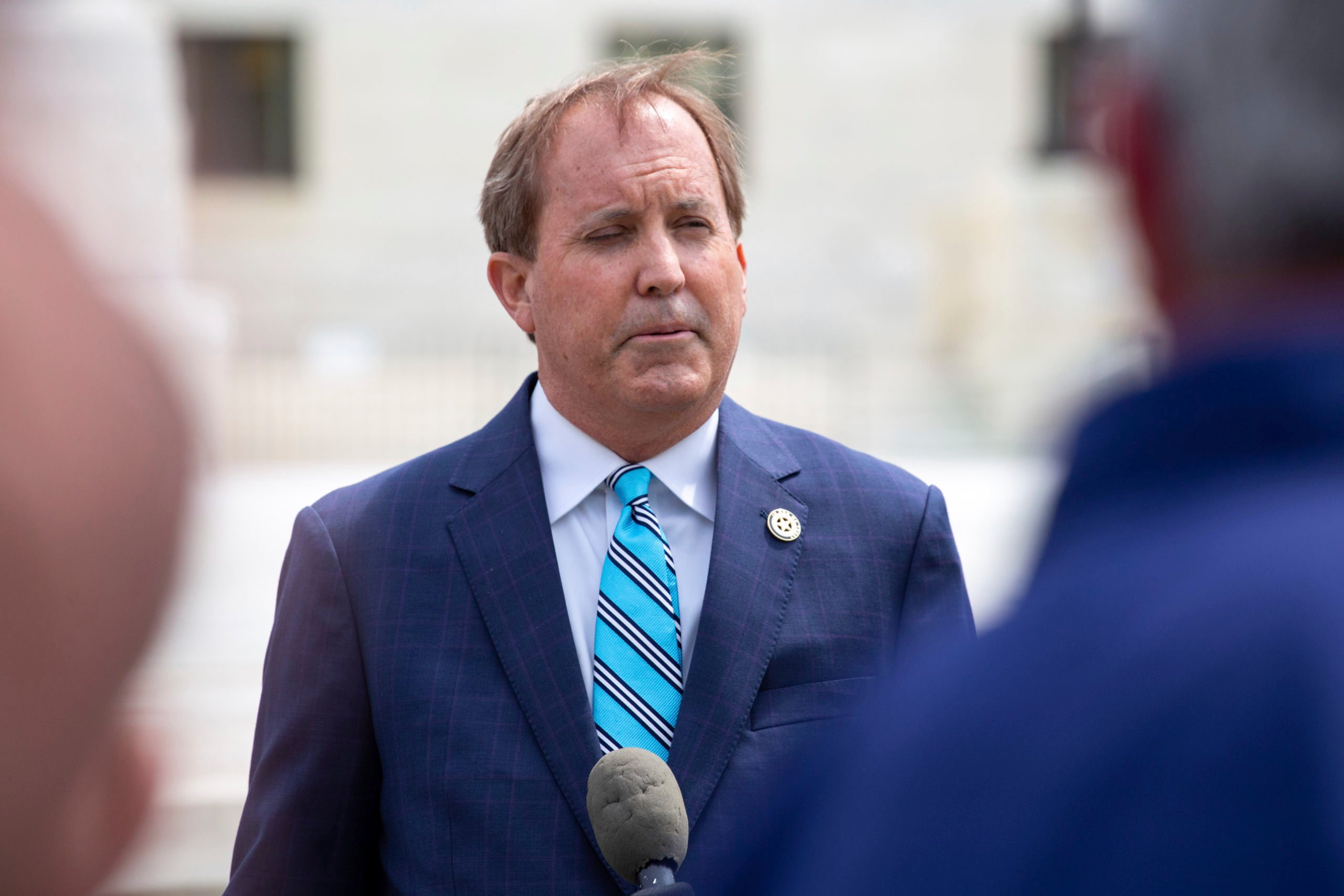
Attorney General Ken Paxton speaks outside the U.S. Supreme Court. (Bryan Olin Dozier/NurPhoto via AP)
I practice in state court, and I would love to tell you that the system works. Unfortunately, pursuing a remedy there looks like filing a written motion and waiting months for a hearing you may not get. It looks like appearing by video on the day your client, still in jail, pleads guilty just to go home to family. It looks like a man who cannot speak and was stuck in jail on a $10,000 bond because nobody sent his lawyer the document saying he had already been found incompetent.
Harris County is rare, because a multitude of people here are fighting for the rights of clients like the one I described. In fact, 12 of the 16 misdemeanor judges, the county itself, and the sheriff all fought efforts to overturn the order that helps poor people accused of minor crimes who can’t post bond—even though the order also limits county officials’ own authority. That’s not something leaders often do.
My job is mostly to point out how and when the system fails, and for that reason I think it is equally important to say so when the system gets something right, but the fight is not finished.
What should worry everyone outside Harris County is none of these reforms reach the rest of us. In the rural county I described above there is no consent decree, and no published data on how many people remain stuck in jail on minor charges because of an inability to post bond. The only reason Harris County knows that 28,000 cases a year clear the jail without anyone paying bond is that the county is required to track that data.
Pretty much everywhere else, nobody is counting. This is not about any one judge, prosecutor, or officer. Most have done right by my clients when it counted, including in the case I described. It’s about what a cash bond does to a person who has no cash.
My nonverbal client, if relief had not been granted, was never going to be able to post a $10,000 bond. For him, the bond was not a condition he could satisfy, it was a sentence. It was a wall. And in a county with no order instructing it otherwise, the only thing that removed that wall was a brother who found my phone number. My client is fortunate to have such a brother. Most do not.
The post In a Cash Bail System, Justice Depends on Your Bank Account appeared first on The Texas Observer.
Leave a Reply