Though exact counts vary, Department of Homeland Security agents have shot at about two dozen people in the United States since Donald Trump resumed the country’s highest office last year. Three of those shootings were by Immigration and Customs Enforcement (ICE) officers in Texas, most recently in North Austin, an area of the city where thousands of migrants live and, not coincidentally, that is inundated with ICE searching for people to detain and deport.
One of these ICE agents shot 28-year-old Venezuelan national Wilber Garces Perez on September 20 under an overpass near the intersection of Research Boulevard and Anderson Lane. Two agents had pulled Garces Perez over while he was making a DoorDash delivery, after running his license plate and finding an active deportation order. In an exchange that has only been shown in court, the ICE agents told Garces Perez to get out of the car before he drove away. The agents chased after him, and the ordeal ended under the overpass after one of them shot at Garces Perez’s car three times from behind. One bullet struck his back.
According to his attorney, Kate Lincoln-Goldfinch, Garces Perez had applied for asylum and has a work permit. His deportation order came from missing a court date, after his notice to appear was sent to a former address, she said.
Garces Perez was released from an Austin hospital a few hours after he was shot, then sent to Pearsall Detention Center, outside of San Antonio. A federal judge paused his deportation. Eleven days after he was shot, he had surgery to remove the bullet in his back.
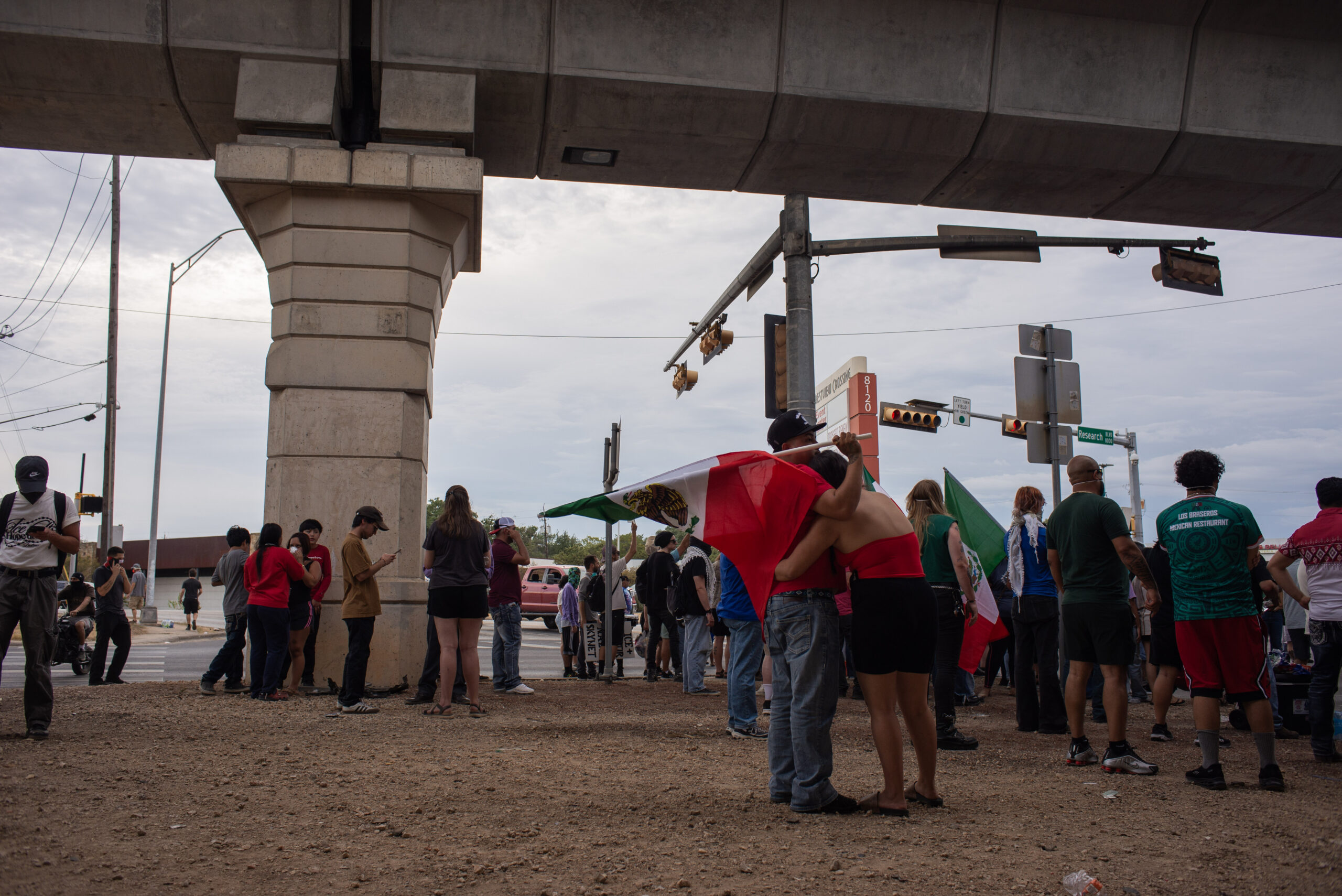
In the hours and days after the shooting, Austin-area officials—local, state and federal—quickly decried ICE’s activity in the city, coalescing around an independent investigation and calling for Garces Perez to be released from detention. Residents mobilized at the site, beneath the highway overpass and across from a bowhunting supply store, of Garces Perez’s shooting within hours, engaging in a protest that blocked off a side road and initially resulted in four arrests (in addition to arrests made days later by state police).
Protesters gather after the shooting in North Austin. (Gaige Davila)
A handful of further protests at the same intersection have happened since, with calls for ICE to get out of Austin and to be abolished. Area elected officials have said much the same, as they look for options to prevent ICE from shooting anyone else or, at the very least, to hold the one who shot Garces Perez accountable—since no city or state can entirely stop ICE or any federal agency from operating in its jurisdiction.
“We need to fight for justice and get ICE the fuck out of Austin,” Mike Siegel, Austin’s District 6 councilman, who is a Democratic Socialists of America endorsee and lives near the area Garces Perez was shot, said in a September 20 video captioned “Fuck ICE” on his Instagram.
“We will all be more safe when ICE gets the hell out of Austin, Texas,” Austin Congressman and Congressional Progressive Caucus chair Greg Casar said at a press conference a day after the shooting. Casar said his office would be issuing subpoenas for the people involved in Garces Perez’s shooting to testify before Congress. A September 28 deadline from Casar’s office to the Department of Homeland Security (DHS) for the congressman to be briefed on the shooting has come and gone, with no indication that the briefing happened.
Little information, if any, comes from the federal government after these shootings, and North Austin’s is no different. DHS has not given any information, like body camera footage or written reports, to Austin Police Department (APD) investigators, Travis County District Attorney José Garza told the Observer.
“As of now, this has been a one-way street, with information flowing from the Austin Police Department to federal officials,” Garza, a progressive prosecutor who has also run with local socialist backing, said. “We really need this to be a two-way street, and we really need cooperation from the federal government.”
As of October 2, APD and the DA’s office are still investigating the shooting and have not brought state charges against the ICE agent who shot Garces Perez, whose name remains unknown. That agent, who is referred to as “L.G.” in a federal criminal complaint filed against Garces Perez this past week for allegedly assaulting a federal officer, did not have his body camera on. The other agent, referred to as “D.F.”, turned off his body camera before the shooting occurred. The complaint includes descriptions and photos of L.G. possibly being touched by Garces Perez’s sideview mirror well before the shooting.
(Source: federal criminal complaint)
If charged with a state-level crime, such as aggravated assault or deadly misconduct, federal agents can have their case moved to a federal court, where, Garza explained, the agent can claim immunity and possibly stymie the case.
But the Travis County DA can still pursue charges, even without cooperation from DHS. Harris County’s district attorney took its own case against the ICE agent who shot Lorenzo Salgado Araujo in Houston to a grand jury, partly to try compelling the federal government to release evidence. A witness in that shooting was seen in a Houston grand jury courtroom four days before Austin’s ICE shooting. The agent who committed that shooting was identified by the Texas Tribune last week.
All three of the people ICE agents have shot in Texas were in their cars. DHS’s use-of-force policy, which applies to ICE, says agents cannot shoot at people driving moving vehicles or at the vehicles themselves to disable them. However, an agent can do so, according to the policy, if there is an “imminent” threat against their life or others.
DHS policy does not explicitly say that agents need to move out of the way of vehicles before they decide that shooting at them is necessary. The Justice Department says agents should move out of the way. In 2022, then-President Joe Biden signed an executive order that said federal law enforcement agencies needed to adopt the DOJ’s policy. ICE didn’t.
“ICE had this directive and policy not to, generally, shoot at moving vehicles. Yet we’ve seen all these instances of them shooting at moving vehicles,” Ben Jones, a professor at Penn State that researches policing ethics, told the Observer. “So, that raises questions about, well, ‘What’s the training? What’s the emphasis within the agency?’ And there definitely seems to be a gap between the two.”
Jones said ICE agents shouldn’t shoot at vehicles at all but instead get out of the way, calling attempts to stop cars with bullets futile and dangerous. He compares ending DHS’s moving vehicle shooting exceptions to the 1984 Supreme Court ruling that shooting at individuals while they’re running away was unconstitutional. Less people were killed by police after the ruling.
Ten days after Austin’s ICE shooting, the agency sent out a directive for agents to stop chasing cars and make traffic stops only after undergoing training, according to the Associated Press.
Prosecuting ICE agents who shoot people is one avenue left for local governments to test in Texas. Otherwise, the state has made local noncompliance with federal immigration enforcement generally illegal. Because of the 2017 “sanctuary cities” ban, municipal police and county sheriffs cannot cut off cooperation with ICE. Earlier this year, the governor also threatened to pull grants from cities that sought to limit cooperation.
In Austin, Police Chief Lisa Davis amended department policy in March to change how police handle so-called administrative warrants from ICE, which—thanks to a Trump policy shift—are encountered by local cops in an interagency database much more often than in the past. The new department orders clarified that APD officers do not have to contact ICE in such cases and that they need supervisor approval in order to detain someone for ICE to come pick them up on these non-judicial warrants.
This policy change came after APD called ICE when responding to a domestic violence call in January in southwest Austin. That service call would end with a mother being detained by ICE then deported along with her young daughter.
By April, Governor Greg Abbott threatened to cut millions of dollars in public safety funding in response to APD’s policy change. The department adjusted its policy again, saying officers “should” call ICE “when operationally feasible.”
Siegel, the District 6 councilman, said he wants to pursue an ordinance that would prohibit APD from cooperating with ICE on administrative warrants that have not been reviewed by a judge, suggesting that other large Texas cities do the same. That united front could help against the state.
“If ICE is going to act with criminal impunity, why should we cooperate with them at all?” Siegel told the Observer in a phone call. “But it’s not just my choice, right? It’s the choice of council. It’s the choice of the community whether this is going to be the line in the sand we draw to say ‘no more cooperation.’”
Siegel said he is having discussions with people on council about the ordinance but did not provide a timeline for its introduction.
Other officials said that the problems need to be addressed top-down.
“Ultimately, we need [federal] comprehensive immigration reform,” District 4 Austin Councilman and immigration attorney Chito Vela told the Observer. “We can try to mitigate the ICE activity. We can try to do this. We can try to do that. But ultimately, we need comprehensive immigration reform.”
Vela also pointed to the upcoming midterm elections as possible resistance.
The September shooting happened in Vela’s district, where Monsterrat Garibay, the incoming representative to replace gubernatorial candidate Gina Hinojosa in the state House, also lives. She’s seen the dark SUVs around town, heard from neighbors about their loved ones being picked up and taken to detention centers. When Garibay—a former Texas AFL-CIO officer who is formerly undocumented herself—runs in her North Austin neighborhood, she’s sure to carry her ID and calls her husband to let him know when she’s finished.
“I, myself, don’t feel that I’m safe in my own community because these ICE agents are not doing their job, and they’re not being transparent and they’re not treating people properly,” Garibay told the Observer.
She said that ICE agents should be required to wear and turn on their body cameras, trained in de-escalation, and, overall, vetted properly. ICE requires agents to turn their body cameras on when they’re “at the start of the [enforcement] activity or, if not practicable, as soon as safely possible thereafter.”
Garibay said: “We do it with teachers. We do it with professionals. We vet them properly, make sure that they don’t have history. And I’m not sure that that is happening with these ICE agents.”
A police helicopter hovers over protesters at the shooting site. (Gaige Davila)
Jones, the Penn State professor, said at the federal level the political will to pass policy against ICE currently isn’t there. It will take a change in Congress and the presidency. But public pressure, as it did in Minneapolis, could create a losing proposition for the administration.
“The law is important, and it is obviously a valuable tool in holding people accountable, but mobilization, political participation, that can be as, or more, important, when trying to push back against dubious forms of policing.”
Increasingly, progressive politicians have once again picked up the call to abolish ICE, an agency created in 2003, altogether—a call that emerged under the first Trump administration but had largely vanished until the recent string of ICE violence. Amnesty International, a global human rights organization, published a report last month that explicitly called for the agency to be abolished, saying no reform was possible.
“Between the call of communities, and the long history of abuse in the way in which they have acted in recent years, that makes rebuilding trust nearly impossible,” Amy Fischer, the Director of Refugee and Migrant Rights at Amnesty International, told the Observer. “It felt as if there was no other option than to abolish the agency and encourage the United States to rethink immigration enforcement to be in line with what immigration actually looks like in this country, and have an approach that actually encourages compliance without relying on a purely punitive approach.”
Regardless of how, if ever, ICE and the federal government are held accountable for the violence they’ve committed against people across the country, much damage has been done.
“I worry a lot of what’s going to happen and in years to come,” Garibay said. “Because we are hurting our own in a very deep way, and I don’t think people are making that connection.”
Garces Perez—a man whose life reportedly consists of “family, soccer, and work” and whose wife works in healthcare—faces up to 20 years in prison if convicted on the feds’ assault charge.
The post What Will It Take to ‘Get ICE the Fuck Out of Austin’? appeared first on The Texas Observer.
Leave a Reply