Ten years after Donald Trump was first elected President, the Republican Party has placed its chips on a region that would have made little sense at any other time in the last century: South Texas. Yet, if current polling holds, the GOP may have already overplayed its hand.
Congressional districts from San Antonio down to Brownsville, aggressively (and perhaps foolishly) redrawn at Trump’s orders, are at the crux of any Republican midterm hopes to hold the U.S. House, and state legislative races are similarly key to the party keeping its comfortable supermajority in Texas’ lower chamber. Up to the top of the ballot, where South Texas voters were key to James Talarico’s primary victory and where Brownsville-raised Gina Hinojosa sits one rung down, the region may hold the car keys. All as Republicans run without the man who seemed to break Democrats’ hold in the area on the ticket.
With weeks left to go, proclamations of another “red wave” coming to the region—after Trump flipped the majority-Latino South Texas border in 2024 and the GOP seized a state Senate seat while holding onto a congressional and state House district snagged two years before—are no more. Instead, national GOP leadership, like House Speaker Mike Johnson, is anxiously coming to stump for South Texas’ GOP candidates, working to convince voters that the stakes are high for the Republican Party this year.
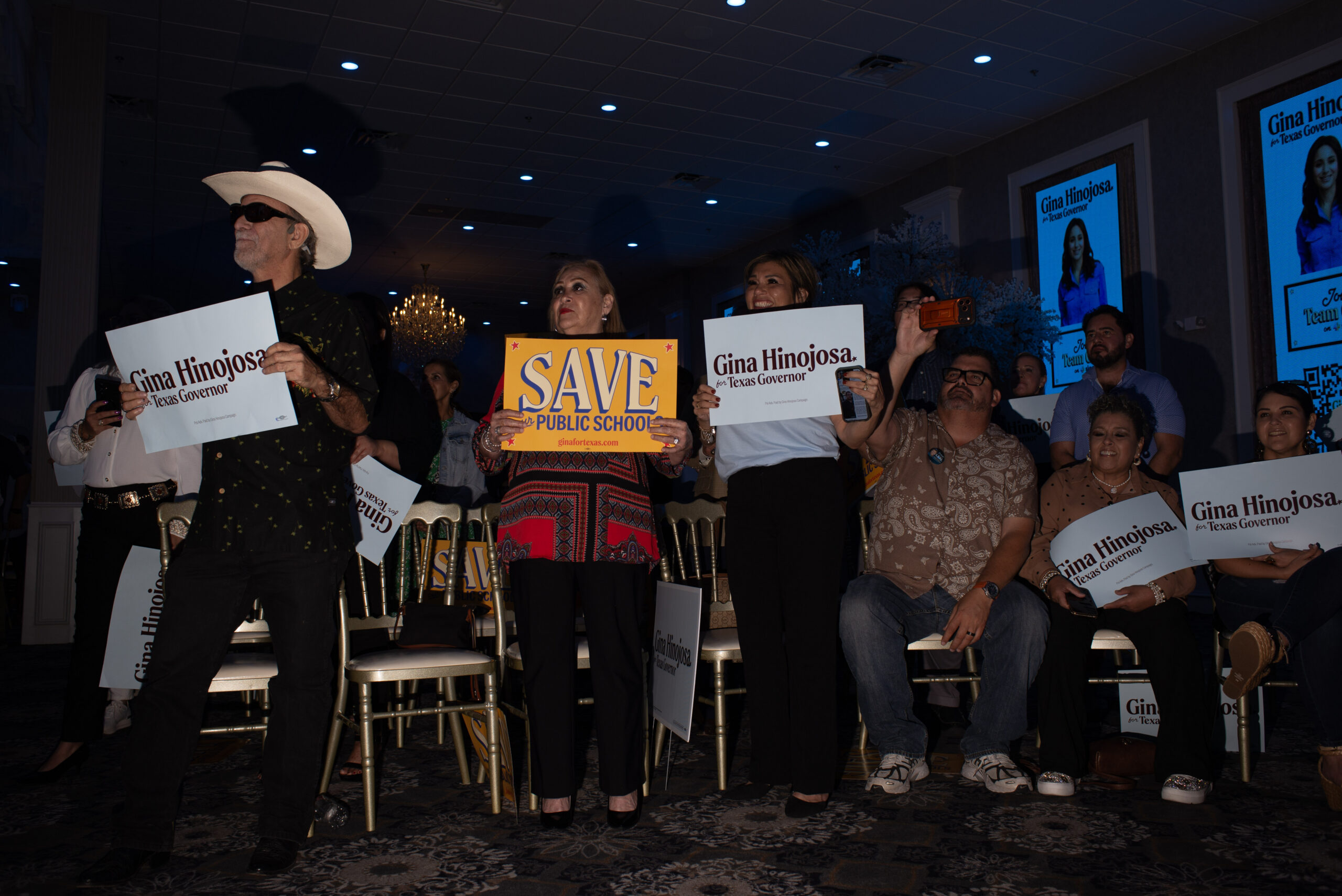
Supporters of Texas Democratic candidate for Governor Gina Hinojosa during a campaign rally in Brownsville on September 15 (Gaige Davila)
“[Democrats] want to remove the president, okay. They want one, unicameral body, the House, to run everything. You have to ask yourself why,” Johnson told a couple dozen people in Sinton in August at The Butter Churn, where he was campaigning for Monica De La Cruz, who since 2022 has represented Congressional District 15, which sprawls from near San Antonio down to the Rio Grande. “Because they have calculated that, over the next couple of cycles, they can elect enough Marxist communists to take over the whole thing.”
The national GOP has opened a “battle station” in Harlingen, near Brownsville in the Rio Grande Valley, much like they did in McAllen years prior, hoping to hold the electoral gains it made in the four-county, 1.4-million-person southern tip of the region. That hold looks increasingly tenuous as the popular Tejano singer Bobby Pulido has turned De La Cruz’s CD-15 into a toss-up, per the Cook Political Report, and incumbents Vicente Gonzalez and Henry Cuellar look increasingly likely to keep their districts, the 34th and 28th, that were re-gerrymandered for GOP pickup.
The prognosis is perhaps unsurprising in retrospect, since there were always signs the 2024 South Texas swing could have been peculiar to that specific presidential context. Downballot Democrats largely survived the Trump wave. And all that was before, of course, South Texas became ground zero for the harsh realities of Trump’s mass deportation project.
South Texas GOP candidates are appearing to now distance themselves from Trump and his policies—after ICE has arrested tens of thousands of people in the agency’s Harlingen and San Antonio sectors, where most of these races are located; after the cost of living has continued to increase in these metro areas; and after sometimes-trillionaire Elon Musk’s company town and its proliferation outside of Brownsville has drawn more ire from surrounding communities with each rocket launch. Democrats are capitalizing on the frustration, with the party’s confidence resurging.
Dems are coalescing around messaging that also seems to be resonating statewide, such as the platform of Austin state Representative Gina Hinojosa, the gubernatorial hopeful whose roots are in the Valley. This includes lowering the cost of living, holding Immigration and Customs Enforcement (ICE) accountable after repeated violence, and getting billionaires out of politics.
Red scare efforts aside, South Texas’ GOP candidates for Congress and the state Legislature are actually running on similar platforms to Democrats on some issues, vying for the same kind of support that has kept the region—up until recently—a stronghold for moderate Democrats. Republican legislator Janie Lopez, who won her San Benito-based state House seat in 2022, is campaigning on fixing roads and flood infrastructure. One of De La Cruz’s TV ads talks about lowering costs for people working in restaurants. Eric Flores, a former federal prosecutor under the Biden administration who’s challenging Gonzalez, has made water one of his campaign focuses. Nary a “mass deportations” sign in sight.
Two years prior, it seemed everyone running in South Texas races had a border security ad, even Michelle Vallejo, a progressive who was then running in a losing bid against De La Cruz.
Now, De La Cruz herself has advocated for and helped release some people from ICE detention. But it may be too late to create distance from ICE, Trump, and the cost of living, experts told the Texas Observer.
“We’ve seen a sea change, in just two years: a sea change in Latino voting from what we saw in ’24, where we saw a substantial number of Latinos vote for Trump, vote for Republicans,” Jon Taylor, the University of Texas San Antonio’s political science department chair, told the Observer. “And now, if you look at polling, consistently now you’re seeing a complete flip in the other direction toward Democrats.”
This loss of support isn’t limited to Latino voters in South Texas, but—as both the site of 2024’s perhaps most surprising pro-Trump swing and many of the president’s most harmful policies in practice—South Texas may serve as the definitive referendum on the White House occupant this November.
“I have to say, it doesn’t feel like 2018 quite for me,” Vicente Gonzalez, the incumbent Democratic congressman for CD-34, which runs from Brownsville to Corpus Christi, told the Observer in a September phone call. “I wasn’t working near as hard as I am right now in 2018, I’ll tell you that.”
Having been redrawn last summer into a district that went for Trump in 2024 by 10 points, Gonzalez says Democrats can’t take another election for granted in South Texas. But Democratic turnout during the primaries this March has Gonzalez hopeful.
That’s partly because Gonzalez has already managed to survive a decade’s worth of election cycles, in the 34th and in the neighboring 15th, which he vacated voluntarily and is now held by De La Cruz.
Back in 2022, the self-described “triple threat” of De La Cruz plus Mayra Flores and Cassy Garcia all of whom were Rio Grande Valley-based, right-wing Latinas vying for seats with districts that stretched as far as San Antonio and its suburbs, garnered much media attention. South Texas’ Latino voters were simultaneously being invested in by the Republican party and disinvested in by Democrats, or so the narrative went. But the Blue Dog Dem congressmen, Gonzalez and Henry Cuellar—whose Laredo-based 28th stretches down into the Valley—held Flores and Garcia at bay. Cuellar then rebuffed (criminal pardon-related) speculation that he might change parties late last year, setting up the two men, often derided by liberals within their own party in the past, as the resilient paragons of the South Texas Democrat style.
Vicente Gonzalez in November 2022 (Denise Cathey/The Brownsville Herald via AP)
Eric Flores, Gonzalez’s opponent, prevailed in the March GOP primary thanks to Trump’s backing and recently got a stump speech from Vice President JD Vance in Harlingen. Earlier this year, Trump visited a Corpus Christi Whataburger with Flores in tow. The president has twice posted a video on his social media channels calling for people to vote for Flores. He’s done similar for De La Cruz.
But, following the primaries, Flores’ campaign signs don’t say he’s endorsed by Trump anymore. He also recoiled when a local Democratic Party made campaign signs that looked like Flores’ older signs, saying the National Guard Army veteran was “Trump Endorsed” and supported ICE. In a statement on social media, Flores used the term “dirty tricks” to describe the signs that tied him to the president who likely secured his congressional nomination for him and to the federal agency that’s carrying out the same president’s signature policy promise.
A survey from Texas Southern University’s policy research arm says the race is now in Gonzalez’s favor. Mark P. Jones, one of the authors of the survey report and a professor of political science at Rice University, said the GOP, when they redrew districts in 2025, depended on a voting bloc to turn out that likely won’t this election: young, Latino men who voted for Trump.
“It’s not that many of them have decided to become Democrats, although some will vote Democratic,” Jones told the Observer, describing some of the survey respondents. “They are disillusioned by Trump and are not motivated to turn out to vote for anyone this year.”
Redistricting is also a factor in De La Cruz’s reelection chances. The new CD-15 map, though shifted just slightly east, removed about 60 percent of De La Cruz’s previous constituents, meaning she had to introduce herself to voters while her opponent, Bobby Pulido, is one of the most successful Tejano artists of all time. In South Texas, his name recognition is undeniable, and policy-wise he’s running in the established mold of Gonzalez and Cuellar. Which means De La Cruz, arguably, does not have the incumbent advantage, despite two terms in Congress.
“You add that with he had a profile of someone who you can’t easily portray as left, as a coastal elite, or a coastal liberal, and that he’s from the Valley,” Jones said. “But [he] also has, historically, had a set of positions and has a profile of somebody who’s a traditional South Texas centrist.”
Democrats are largely eschewing progressivism this cycle, after the failed congressional bids in recent cycles of Vallejo and Jessica Cisneros, who nearly ousted Cuellar in two Dem primaries. With one exception: the Bernie Sanders-backed Julio Salinas, who won the Democratic primary for the McAllen-based House District 41 against former city council member and moderate Democrat Seby Haddad.
“South Texas voters are, in their heart of hearts, centrist Democrats. The majority are,” Jones said of the region’s electorate going from blue to red and possibly back to blue. “That’s the dominant political organization in South Texas. … They also are not going to vote for extreme Republican candidates if they’re given a palatable Democratic alternative.”
Henry Cuellar and Tano Tijerina 2026 campaign signs posted next to each other in Laredo (Justin Miller)
As for whether the Blue Dogs are truly back in town, Gonzalez said it will take some time to know for sure. Trump is omnipresent in the GOP’s South Texas races, having endorsed all the current Republican congressional and legislative candidates and made a handful of appearances in the area, but this remains a midterm race. Time will tell if, one way or another, a 2024-like effect can be achieved in 2028.
“I think it’s going to take another couple of election cycles to really say there is a trend one way or another,” Gonzalez said. “I always said Donald Trump brings a different type of excitement to an election.”
Eric Flores’ campaign did not respond to the Observer’s request for an interview.
In mid-September, at an event center on the southwestern edge of Brownsville, Gina Hinojosa was welcomed by hundreds of people, as Selena’s “Como Me Duele” reverberated from several loudspeakers through a space that hosts many of the city’s quinceañeras.
It was as “South Texas” of a homecoming as Hinojosa could have. She’s represented central Austin in the Texas Legislature since 2017 but was raised in Brownsville, making the Rio Grande Valley a recurring campaign stop since she announced her candidacy in her hometown eleven months prior. With less than two months left before the election, Hinojosa blamed the state’s healthcare, public school, and electricity woes on Greg Abbott, his donors, and tech billionaires.
“What people have finally figured out is, as we’ve been in our partisan tribes for the last 10 years, fighting each other with the culture wars over Thanksgiving dinner, fighting with our families about culture wars, the only people winning those wars are the billionaires,” Hinojosa said. “Like, 15 billionaire tech dudes who just have massive money and massive power and all of our data, and are about to blow up this planet … if we don’t come together fast to save ourselves—that’s what this election is about. Who does Texas belong to?”
Though she didn’t mention issues particular to the Valley in her speech, she did tell the Observer afterward that ICE was not the kind of border security she supported. That morning, she had visited homes under construction with the South Texas Builders Association, a group with a president that has become particularly outspoken about ICE detaining people on job sites and about regretting his prior support of Trump. A few days before her visit to Brownsville, two ICE agents pulled a teenager out of a car at an Alamo intersection, punched his face several times, then put him in handcuffs.
“These ICE raids are not making us more safe. They’re making us less safe,” she said. “I support border security here at the border. We want secure communities, right? But that’s making us less safe, not more safe.”
Nearly everyone who came to the rally lined up to take photos with Hinojosa, as Cameron County’s senior Democratic players talked among themselves, leaning against the stage. Former classmates of Hinojosa brought yearbooks to sign, supporters their campaign signs, and one person an infant child.
Hinojosa signs the shirt of Lisa Peña’s son, Romeo, on September 15 (Gaige Davila)
Zoe Griffith, a first-time voter from Brownsville who has organized with Healthy Futures of Texas, attended the rally with her mother, Christine Ramos, a local high school teacher and Marine veteran. Griffith said that Hinojosa’s positions against data centers and egregious ICE arrests are why she’ll be voting for her.
“Having seen Greg Abbott and how he runs in Texas, I want to see better change from my generation, and especially the generations that come before me,” she told the Observer. “Having people like Gina, especially as a female role model, it brings me more hope.”
The post South Texas Is Moving On from Trump appeared first on The Texas Observer.
Leave a Reply