Like everyone else, the César Chávez revelations shocked us, maybe more so than others since we had worked with him for almost two decades.
The stunning news did not just deliver a gut-punch betrayal but also immediate anxiety about the damage that the exposé of his dark side would do to the movement, to all those who, for decades, had worked and given their time and sweat to La Causa, including the United Farm Workers (UFW) organizers killed in California and Florida—the martyrs.
We cannot ignore César’s influence, leadership, brilliant strategies, and inherent abilities to lead farmworkers. He united people across the country with the grape boycott, his position against violence, and his campaign for pesticide control.
At the same time, we cannot condone his acts of hurting girls and women. We must acknowledge and reject this abuse. We need to support the victims and condemn the behavior of others in the movement who enabled or engaged in similar conduct.
Our additional task is to help others, including ourselves, understand the movement and continue to back it. The movement is about people and what people do about justice. It is never about one person, no matter how iconic.
Two of us worked in the fields as children with our families. We know firsthand what the movement is about. We saw our parents’ sacrifices. We still feel those long days under the hot sun and how hard the work was. Bending and stooping all day harms bodies and shortens lives. All this for a pittance of the money that agribusiness and grocery stores reap from the labor.
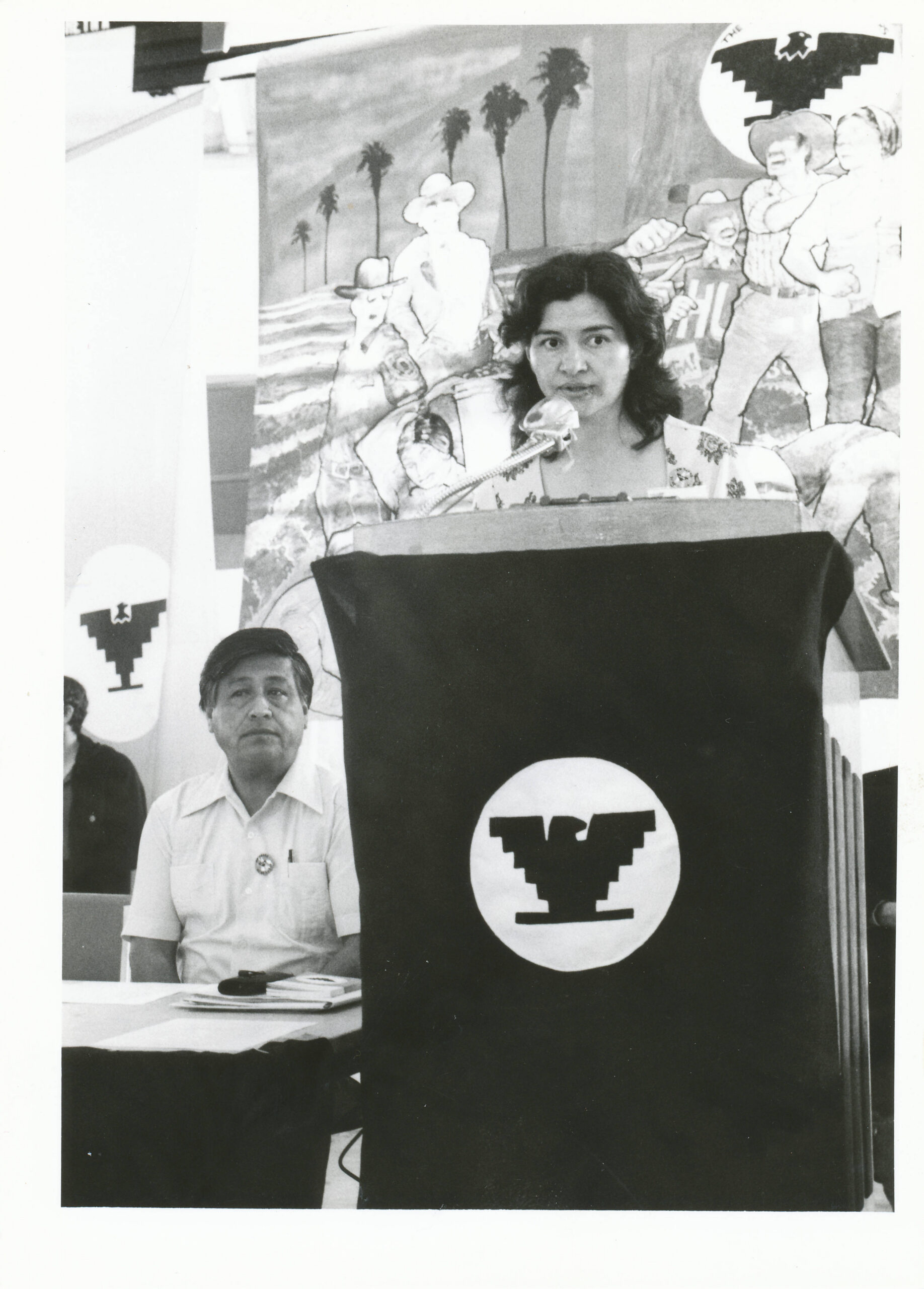
Rebecca Flores speaks at the 1979 Texas UFW convention as César Chávez listens. (The University of Texas at San Antonio Special Collections)
The great contradiction is that our society oppresses and mistreats the workers who keep us alive and put food on our tables with abysmal wages and working conditions. As civil rights leader Reverend Jim Lawson famously put it, “plantation capitalism” controls our lives. We are either the oppressed or the oppressors. There is no middle ground.
Farmworkers in Texas have a history of almost 100 years of rising up when the boot on their neck is too heavy, only to be met by the brutality of the Texas Rangers in collusion with the growers.
They crushed the 1930s wildcat strike of 1,200 onion harvesters in Webb County for higher wages, led by La Asociación de Jornaleros. They did the same in 1966 with the Starr County melon strike to such a grotesque extent that the U.S. Supreme Court rebuked the Rangers for their state-supported brutality against workers and organizers.
The 1966 Starr County workers’ 500-mile march to Austin electrified South Texas and ignited the Chicano movement in Texas. People rallied to join the farm laborers as they marched through the small towns from the Valley to Corpus Christi and then San Antonio. Supporters along the way provided food and nighttime shelter. The march culminated with thousands rallying at the Capitol and demanding a just wage.
The mid-70s saw another raft of wildcat strikes in fields across the Valley, Presidio, and areas of West Texas. However, Texas, being an anti-union state, hardens state power against the workers, and sufficient funds are not available to sustain an organizing campaign and strikes. There is a saying in the Valley that eight workers are waiting to replace someone terminated from a job. Whether the number is accurate, the reality is true, and the growers use it as a threat.
Those reality checks changed the nature of farmworker organizing in Texas and sent the movement in a different, and successful, direction. The UFW sent Fred Ross, Sr., to train organizers in the Valley. A contemporary of Saul Alinsky of Industrial Areas Foundation fame, Fred trained César and Dolores Huerta in house-meeting organizing to get the farm labor movement up and running in California.
Fred trained Texas union staff in the art of house meetings and in organizing UFW committees in the colonias. Fred’s training lasted several weeks and turned the UFW into a South Texas powerhouse. In the house meetings, the workers, both men and women, spoke out about the conditions in the fields and became leaders of the union.
Once organized, the committees began holding annual Valley-wide conventions beginning in 1979. For the workers, this was their first time participating in their own convention and having a voice in their future, rather than someone dictating their future for them. The convocations adopted legislative and organizing priorities for the coming year.
After years of organizing from the late 70s through the mid-80s, the workers were able to pass legislation, securing workers’ compensation, unemployment benefits, and the right to know about pesticide use in the fields, all crucial protections for farm laborers and from which Texas law had systematically excluded them. Pesticides were especially concerning for pregnant women workers.
Farm labor is the nation’s most dangerous occupation, alternating at times with construction, depending on the time of year. It is seasonal like construction. Nevertheless, farmworkers had none of the protections that construction employees and other laborers had. The separation point was ethnicity—racism. That was our winning argument in court when we sued as part of the organizing campaign.
The local UFW then pressured the health department to require employers to provide portable toilets in the fields, along with drinking water and handwashing facilities. The fact that this effort took place in 1983 reflects the longstanding powerlessness and oppression of farm workers and the Mexican-American community in general.
Monsignor George Higgins, labor activist and priest, with escort committee and Flores being received by delegates at 1979 convention (The University of Texas at San Antonio Special Collections)
In 1981, the legislature finally banned use of the 24-inch short-handle hoe (el cortito), a backbreaking, cruel holdover from the slave era. The purpose was to keep people bent over to make sure they kept busy weeding and thinning crops. If they stood to stretch, the assumption was they were not working hard enough. El cortito caused debilitating back problems and premature arthritis in workers who had to do stoop labor for long hours.
These efforts involved intense political organizing, creative litigation, and stalwart legislative efforts by the workers. Crucial allies, like the Texas AFL-CIO, religious leaders, Mexican-American community leaders, and friends in the Legislature, all stepped in to help.
From the late 70s on, organizing in the colonias continued. House meetings yielded a series of lightning picket actions at fields to raise wages. Committees focused on improving conditions in the colonias, where most farmworkers reside. Because of direction from César, Dolores, Fred, and union leaders in South Texas like the Baltazar Saldaña family and Pedro de la Fuente, we worked together to successfully form a long-lasting UFW organization in the Valley.
Another movement change of direction occurred as 1993 approached, when Congress passed NAFTA, which caused even more hand-harvested crops to be relocated to Mexico, where American agribusiness could pay much lower wages and avoid protective laws for workers.
Early in the movement, the idea of a community union began to come into focus. It took hold in 1989 when La Unión del Pueblo Entero (LUPE), a nonprofit community organizing effort, formally became a reality. In 2003, LUPE opened its Texas doors at the farmworkers’ center in San Juan, as successor to the UFW’s farm labor efforts and became a dynamic promoter of justice throughout the Valley.
La Causa continues because people in Texas put their hearts into the movement. Even when it redirects itself from time to time, and even when it must grapple with deep harm caused by a major leader, the movement remains about justice by the people who suffer the most and for the people who suffer the most.
The post ‘La Causa’ Continues in South Texas appeared first on The Texas Observer.
Leave a Reply