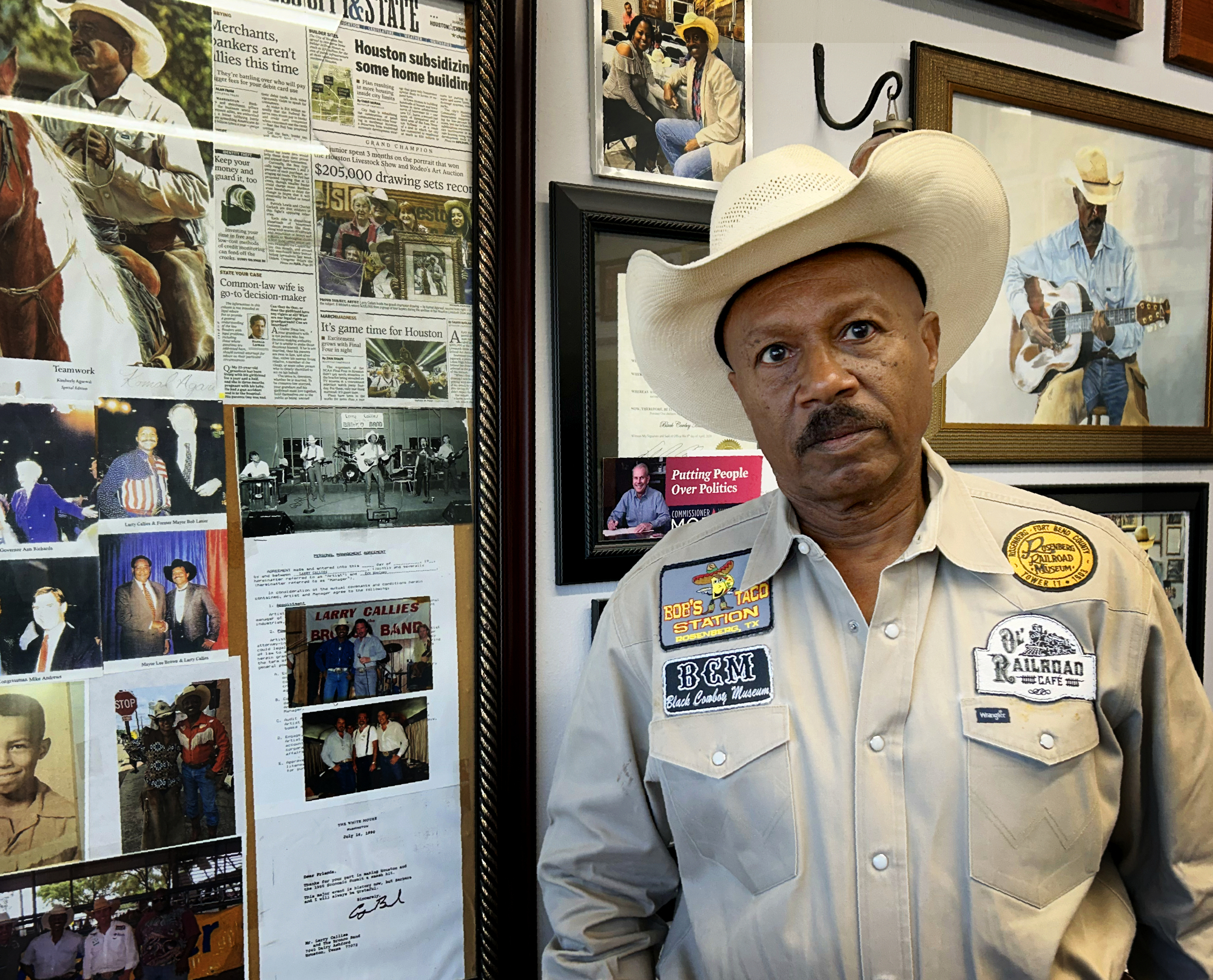
Larry Callies ambles through the Black Cowboy Museum in downtown Rosenberg, southwest of Houston, sporting his straw Stetson and a pair of worn work boots. The founder and CEO of the museum, he’s spinning stories in his compelling, though perennially strained, voice. He leads visitors young and old—from Texas and across the globe—through this 900-square-foot space, which is tucked into a commercial strip center and chock-full of badges, boots, guns, and photos of Black cowboys riding bulls, roping calves, and busting broncos.
Over the decades, Callies has worked as a cowboy, singer, and postman. Born in the sleepy railroad town of Wharton, he began early, learning to rope and helping his father break horses on a local ranch. Later, he performed country music for about two decades with his Bronco Band before losing his voice to a neurological condition called vocal dysphonia.
These days, Callies keeps busy mostly as a storyteller. “My dream is to keep telling the history of Texas,” he told the Texas Observer. One framed newspaper headline in his collection summarizes his mission: “A Black Cowboy Confronts the Whitewashed History of the West.”
In middle age, Callies began collecting cowboy memorabilia as a hobby, then he decked the walls of his Rosenberg saddle shop with it. He founded the museum in 2017, because, he says, God told him to. He’s long since run out of room for myriad items: regalia from buffalo soldiers, an antique gun collection, and a large collection of badges, one of which reads “South Carolina Slave Patrol.”
Callies (Lise Olsen)
Now Fort Bend County officials are supporting a 9,000-square-foot facility—10 times larger—by providing land and funding. The Black Cowboy Museum’s $4-million building will soon rise in Bates Allen Park, 14 miles southeast of Rosenberg, in a park that originally was a Freedmen’s town called Kendleton (near the eponymous small city). They hope to open in 2027.
Plenty of arguments have erupted in Texas recently over other historical initiatives and books that bear even a hint of diversity. But Fort Bend County Commissioner Dexter McCoy told the Observer that support for the museum here has been unanimous and steady.
“This is a very important project because it’s important to tell these stories,” said McCoy. As a Louisiana native who grew up in Fort Bend, he said: “I did not know about the consequential nature of people who look like me here.”
On one wall at the museum is an enlarged copy of a faded photo, likely taken in the 1940s, that shows five Cowboys astride horses on a Fort Bend County ranch—four are Black. To Callies, that photo illustrates why this area is the perfect place for the museum: Before Emancipation and for decades later, most cowboys on Fort Bend ranches were Black, including on the ranch in the photograph, which later became the 20,000-acre George Ranch historical park. (Callies briefly worked at the historical park as a cowboy.)
As Callies tells visitors, the term “cow boy” arose from a racial slur coined in Texas under slavery: “House boys,” he explains, worked inside plantation houses, and “cow boys” worked the cattle. Much later, after Hollywood romanticized that term, it was adopted by cowboys of all races.
Callies shares an unflinching and personal version of cowboy history: One exhibit includes a fat binder filled with genealogical information—including proof that some of his ancestors, born under slavery, were the illegitimate children of prominent Texas plantation owners. “Major James Kerr—you’ve heard of Kerrville?” he asks visitors. “It was named after him. He was a minister of the gospel; he had kids with slaves, and he wrote about it in his Bible.” And he was one of Callies’ forebears.
With the bigger museum, Callies will have more space for stories about figures like Bass Reaves, the legendary Black cowboy born in 1838 in Arkansas whose subsequent adventures as a U.S. marshal, and one of America’s first Black sheriffs, spawned the legend of the Lone Ranger.
His voice warms when he introduces young visitors to Texas Black cowboy heroes like Bill Pickett, a Travis County native and rodeo champion who invented a steer-wrestling technique called “bulldogging” that involves grabbing horns, twisting heads, and initially biting a steer’s sensitive snout or lower lip. Though Pickett died in 1932 of injuries from a rogue horse, other Black cowboys continue to ride in the 40-year-old rodeo that bears Pickett’s name.
Callies loves telling how his first cousin, Tex Williams, crossed color lines in the late 1960s to become the first Black teen to win the Texas State High School Rodeo championship. He starts the story by saying how Williams initially competed in all-Black rodeos against much older riders. “Tex was 14 in ’65,” he told visitors recently. “And Tex Williams was a champion. … Then he got the nerve to get into the all-white rodeo, and he won.”
At an annual banquet, Callies and his cohorts add cowboy heroes to the museum’s growing Hall of Fame. To qualify, honorees can’t just be rodeo stars, he said; each must have ranch ties or cowboy cred.
In 2025, the museum chose its first cowgirls: Acynthia Villery, a Bill Pickett Rodeo official and announcer who grew up riding, and Mollie Stevenson Jr., co-founder of the American Cowboy Museum on Houston’s historic Taylor-Stevenson Ranch, one of the nation’s oldest African American-owned ranches.
A few months later, Villery found herself drafted to serve on the Black Cowboy Museum board. In an interview, Villery said she can’t wait for it to grow. She felt inspired by seeing oversize displays at the National Museum of African-American History in Washington, D.C., and a traveling exhibit at the Gene Autry Museum in California.
Over a cup of coffee, Villery expressed hope that she could convince musicians and Hollywood stars with Texas ties or cowboy cred to support modernized exhibits, which will require more funding than Fort Bend County has provided. The museum has already won a $25,000 grant from the BeyGood Foundation, begun by Beyoncé.
For Villery, some of the biggest thrills she gets from touring with the Pickett rodeo come when little kids exclaim: “Y’all real!” after seeing Black cowboys in action. Such moments can be amplified at this new museum—especially with more-interactive exhibits and demos. “It’ll allow us to be able to grow,” she said.
Somehow, amid everything else, Callies wrangles room in his crowded exhibition space to show young visitors how to rope using a small wooden sawhorse (really a “sawcalf”). In November, he hurled a lasso for a small boy named Ivan, who seemed delighted to watch though reluctant to rope himself (at least before spectators).
Along with his boots and hat, Callies wore an elaborate belt buckle that day—showing that he still has the stuff of a rodeo champ. He won that latest calf-roping buckle at the Fort Bend County rodeo in 2023, he told the Observer.
Then Callies chuckled, adding a coda to the tale. Turns out, he had a bit of a competitive advantage. As founder of the Black Cowboy Museum, he could enter the rodeo’s businessmen division: “Not many people that have a big business can rope,” he said. “They get somebody to do it, you know.”
The post A Black Cowboy Museum, Rebooted appeared first on The Texas Observer.
Leave a Reply