Editor’s Note: This article originally appeared at Inside Climate News, a nonprofit, non-partisan news organization that covers climate, energy, and the environment. Sign up for their newsletter here.
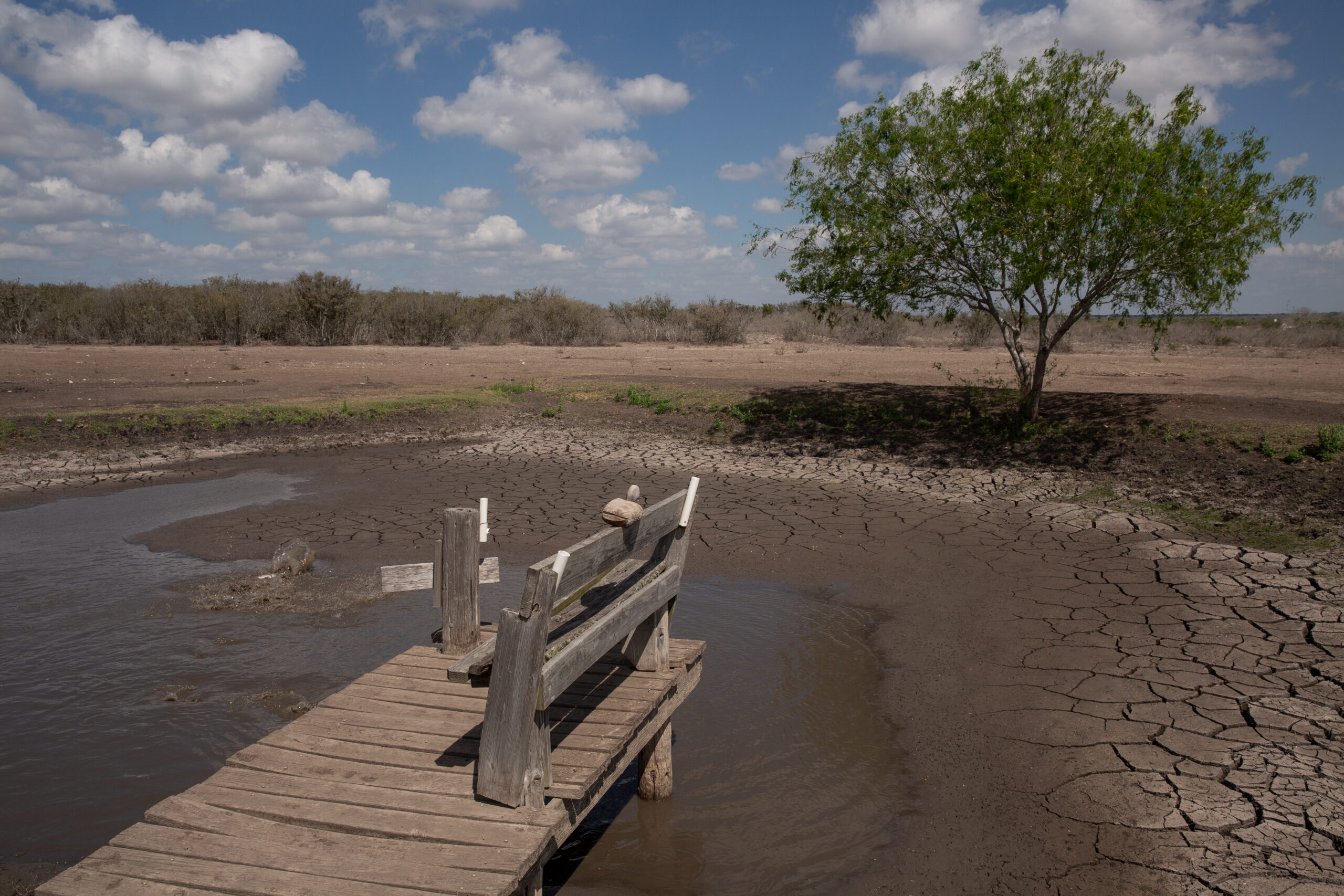
Around Jim Wells County, dwindling levels in main reservoirs have triggered a rush on local aquifers as cities, towns, chemical plants, and ranchers drill for water.
The nearby city of Corpus Christi faces a looming catastrophe from the imminent depletion of water supplies that sustain 500,000 people and one of Texas’s main industrial complexes. Recent emergency groundwater projects have pushed off the timeline to disaster by months, officials said last week. But locals fear they may threaten the water supplies of rural towns and residents who have historically relied on their own small wells.
“People like me are probably gonna be running out of water,” said Bruce Mumme, a retired chemical plant worker who lives on family land in rural Jim Wells, about 40 miles outside Corpus. “Then this property and house is useless.”
Dust covers the fields where hay for Mumme’s cattle should grow. His catfish are about to die as the last of their pond evaporates. Sand dunes have started to form. He’s roamed this land since he was a boy and he’s never seen sand dunes.
“Without water we can’t even live out here,” he said as he drove dirt roads on the land his grandfather bought. “You can’t feed cows bottled water.”
Last fall, after the city of Corpus Christi first began pumping millions of gallons per day from the Evangeline Aquifer, towns and landowners across this area saw water levels in their wells drop. Mumme lost access to water for three days while he waited for workers to come lower his pump, which he said cost thousands of dollars. After that experience, he paid $30,000 to add another well on his property, for backup.
He’s not the only one. The region’s largest industrial water users are also drilling wells, according to officials. In Nueces County, where Corpus Christi is located, newly planned pumping projects alone could add up to over 1,000 percent of what the state water plan considers a sustainable rate of withdrawal from aquifers.
In March, Corpus Christi began pumping millions more gallons per day from its wellfield on the western banks of the Nueces River, about 15 miles outside the city, after Texas Gov. Greg Abbott waived permitting processes for the project in a bid to avert a water shortage. Across the river, drill rigs are turning at the city’s eastern wellfield.
“I’ve done a lot of big projects in my career,” said Rik Allbritton, an operations manager for Weisinger Inc. with 40 years drilling experience, as a rig roared behind him at the eastern wellfield last Tuesday. “This is on the bigger side.”
These two projects, each containing clusters of several large water wells, aim to pump tens of millions of gallons per day in coming months. More than 20 miles away, in San Patricio County, piping has arrived for a third wellfield. A fourth and fifth are also in the queue along the Nueces River.
The region’s largest water user, a massive, new plastics plant operated by ExxonMobil and the Saudi state oil company, also drilled test wells recently but found water that was too salty to use, according to Corpus Christi city manager Peter Zanoni.
“They continue to look for alternative water sources,” Zanoni said in an interview. “Several of the big companies are doing that, and the choice is really just groundwater.”
A spokesperson for Exxon, Kelly Davila, said the company doesn’t comment on operational details.
“We continue to explore alternative water sources that do not draw on those currently used for public consumption,” she said.
About five miles away, the tiny town of Taft depends on Corpus Christi water and is looking at rehabilitating its own old wells, according to Mayor Elida Castillo. “Funding is always gonna be the issue,” she said.
Salty Groundwater
Salty, or brackish, groundwater in this region poses major challenges for the rush to develop its aquifers. Treating brackish groundwater requires complex hardware for reverse osmosis, which is expensive to build and operate.
Last year the city of Beeville issued a $35 million bond for an emergency brackish groundwater project, which it hopes to have running next year. Corpus Christi also has agreements with a private company, Seven Seas Water Group, for a large reverse osmosis plant to treat brackish groundwater.
The tiny town of Orange Grove might need to install reverse osmosis treatment systems for its current groundwater supply, according to city manager Todd Wright. Salinity has risen rapidly in Orange Grove’s wells since Corpus Christi began pumping last summer, Wright said, and soon could exceed safe drinking water standards.
“We’re closely approaching that threshold,” Wright said in an interview at his office last week.
Wright, like officials and residents in nearby towns, attributes the falling water levels and rising salinity in local wells to drawdowns and sediment disturbance caused by Corpus Christi’s new large-scale pumping. Officials with Corpus Christi stress that no conclusive link has been made.
A pond on Bruce Mumme’s land is drying up, leaving his catfish to die. (Dylan Baddour / Inside Climate News)
Orange Grove can’t pay for reverse osmosis systems, Wright said, but the city has hired legal counsel to explore other options. It might also be able to buy water from the neighboring town of Alice, where Seven Seas booted up a reverse osmosis treatment facility last year.
Planning for that project started more than a decade ago, according to Alice city manager Michael Esparza, then picked up speed around 2018. Esparza, the son of a local life insurance underwriter, said Alice foresaw this situation.
“You get life insurance when you don’t need it because when you need it, you can’t get it,” he said last week. “Same thing with our water.” Alice is also drilling an emergency freshwater well, he said.
Refineries and Chemical Plants Will Have to Cut
The city of Corpus Christi supplies more than 100 million gallons per day to 500,000 residents, businesses and industrial complexes across seven counties. If the city’s portfolio of groundwater projects can’t meet most of that demand within months, it will need to implement emergency reductions in water demand.
The city previously projected the emergency could come as soon as May. But following Abbott’s executive orders, that’s been pushed to October, according to officials.
On Tuesday, the city presented plans to achieve 25 percent curtailment in water consumption across all customer classes, including the 23 fuel refineries, chemical plants and other industrial facilities that collectively use about half the region’s water.
“Industry, everybody will have to cut,” Zanoni told the meeting. “Because there might not be enough to supply if we don’t.”
Councilmember Gil Hernandez, a national account sales executive at the Coca-Cola Co., which bottles drinks in Corpus Christi, said the city rules didn’t appear to require cutbacks for certain large industrial users.
“There is no penalty for them not doing curtailment,” Hernandez said. “Are you going to shut off their water? I don’t think so.”
But Corpus Christi city attorney Miles Risley pointed to a line in the city’s contract with industrial users that said: “This agreement does not prevent the city from allocating water supply in the event of an emergency.”
Risley said, “That provision specifically allows us to sit down with the large water users and directly cut them back, potentially, maybe even going so far as to cut them off.”
It remains unclear exactly how industrial curtailment would unfold, what authority the city could wield and how the surcharge exemption contracts would be regarded during an emergency, according to Michael Miller, a member of the Corpus Christi Planning Commission and a vice president at Teal Construction Co.
“There’s going to be a lot of legal opinions, possible litigation surrounding that, if and when we go into curtailment,” he said.
Without big rain soon, he said, it appears likely the city will go into emergency curtailment while its well fields gradually come online. This race to tap aquifers comes at a cost.
Today the city is paying more to acquire water rights alone than it would have cost several years ago to buy entire properties, said Miller.
“The days of inexpensive water projects are long gone,” he said. “The clock is ticking and we have to turn on water sources very quickly.”
“Ready, Shoot, Aim”
Many factors contributed to this situation. Five consecutive years of record heat and drought have dried up the region’s reservoirs, while large-scale pumping of the state’s inland aquifers has killed springs that used to feed local tributaries.
Miller attributes the predicament primarily to poor planning. In the last 15 years, this region welcomed a spate of downstream industrial projects, including massive petrochemical plants by Exxon and Occidental Chemical, as well as expansions at Valero and Flint Hills refineries.
While those and other projects came online, the city tried fruitlessly to develop designs for a seawater desalination plant, which Miller considered ill-conceived.
“We did not simultaneously add new water supply,” Miller said. “We thought everything was going to be OK. But it was not going to be OK. And we should have known better.”
By all accounts, leaders in Texas watched this crisis approach for generations. Now the plight of Corpus Christi might await other parts of the state, according to Larry Soward, a former commissioner of the Texas Commission on Environmental Quality.
Soward joined the Texas Water Quality Board as a staff attorney in 1975, became executive director of the Texas Water Commission in the 1980s and served as chief counsel on water for Agriculture Commissioner Rick Perry in the 1990s. All along, he said, everyone knew Texas was on course to outgrow its water supply.
The state hasn’t been able to build new reservoirs since the 1960s. As water demand crept upwards through the decades, no comprehensive plans to keep up emerged.
The crisis in Corpus Christi, he said, “seems like a ready-shoot-aim type thing.”
“The reasons this floundered is the same reason that a lot of water issues in Texas have floundered,” Soward said. “There’s been a lack of realistic planning.”
Thirty years ago, Corpus Christi also faced a severe drought. Projections said its Nueces River reservoirs could dry up completely within 18 to 24 months. The city responded with a swift, ambitious project that it still depends on today, running the 64-inch-wide Mary Rhodes Pipeline 101 miles to Lake Texana, then 30 miles farther to the Colorado River.
The Mary Rhodes Pipeline “was needed to save jobs and avert wrenching economic disruptions that might scar the region for decades to come,” according to a project summary from the time.
“It’s going to be an economic disaster,” said James Dodson, former director of the Corpus Christi Water department, pictured March 6, 2026, at his home in Fulton, Texas. “It’s the very worst scenario that I’ve ever seen.” (Dylan Baddour / Inside Climate News)
James Dodson, the regional director of Corpus Christi Water who oversaw the Mary Rhodes Pipeline, later went to work as a private consultant, developing a project to pump groundwater from the Evangeline Aquifer in Bee County, on the route of the Mary Rhodes Pipeline, and send it to the city. But the city abruptly canceled its contract with the company in 2008, Dodson said.
Dodson, a Corpus Christi native and the son of an oilfield worker, later discovered that the city had decided to pursue seawater desalination instead.
Emergency Groundwater Projects
Late in 2024, as outlooks began to appear dire for Corpus Christi’s water supply, Dodson booked a meeting with the city water department, accompanied by John Michael, vice president of Hanson Professional Services, an engineering firm. The duo brought in a stack of old maps from Dodson’s house showing old city wells that had been forgotten along the Nueces River.
“We educated the staff on what we had done previously,” said Michael, who drilled some of those wells in the 1980s.
The city issued an emergency authorization for the groundwater project on Dec. 31.
In the summer its wells started pumping water into the Nueces River.
“If we don’t get the rains that we need in our reservoirs, we’re going to have to continue to drill our way through this. That’s really the only source of water,” said Michael, who has spent 44 years with Hanson in Corpus Christi. “I think the city is doing everything it literally can do at this point.”
Until last July, water trickled naturally from the small, domestic well at Chris Cuellar’s house, about two miles from the city’s wellfield. Within six months it had dropped to 15 feet below ground. Luckily, he still received municipal water service from the city of Robstown.
A retired chemical plant worker who spent 10 years managing wastewater operations at one of the region’s largest industrial complexes, Cuellar began to organize the neighbors.
Chris Cuellar uses a conductivity meter to measure salinity in the Nueces River and the city of Corpus Christi’s wells that flow into it. (Dylan Baddour / Inside Climate News)
Every day he made rounds and measured the salinity of the outfall from the city’s wells and the river that received their output, seeking to hold the city accountable for limits that would restrict how much it could pump.
He didn’t think to check his municipal tap water until his mother-in-law began to experience a quick, dramatic rise in blood pressure. Cuellar said his measurement showed that the tap water, which came from the Nueces River, was significantly above safety limits.
With no well and no safe tap water, his family started drinking bottled water, while Robstown soon struck a deal to pipe in water from Corpus Christi.
By that time, Corpus Christi was also urgently pursuing plans to pump water from the Evangeline aquifer into the Mary Rhodes Pipeline. But that effort got hung up when the city of Sinton, which depends on Evangeline water, challenged Corpus Christi’s permits before the local groundwater conservation district, which regulates allowable pumping rates.
A well at Corpus Christi’s western wellfield pumps water into the Nueces River on March 31, 2026. (Dylan Baddour / Inside Climate News)
Nueces County, in contrast, has no groundwater conservation district to regulate pumping, although Cuellar and his neighbors are working to create one.
The only thing stopping Corpus Christi from running its wells full-blast is limitations on the salinity levels it can create in the Nueces River. The city would need a “bed and banks” permit to authorize such significant changes to the river, which Cuellar and his neighbors, as well as the city of Orange Grove, planned to challenge in administrative court.
But Abbott issued the permit by directive in March, waiving standard processes for public input, and the city commenced large-scale pumping the next day.
The city’s temporary permits still contain guidelines for salinity, known as total dissolved solids (TDS), in the river, which city manager Zanoni said continue to limit production from the wells.
He thanked Abbott for the directives that have bought critical time for Corpus Christi, and he called for further relaxation of the standard in order to help the city continue supplying all its customers with water.
“A little bit of TDS in the river for a short distance is not all that bad,” Zanoni said. “It’s better than having no river and we could be heading there.”
The post Corpus Christi Water Crisis Spurs Stampede on South Texas Aquifers appeared first on The Texas Observer.
Leave a Reply