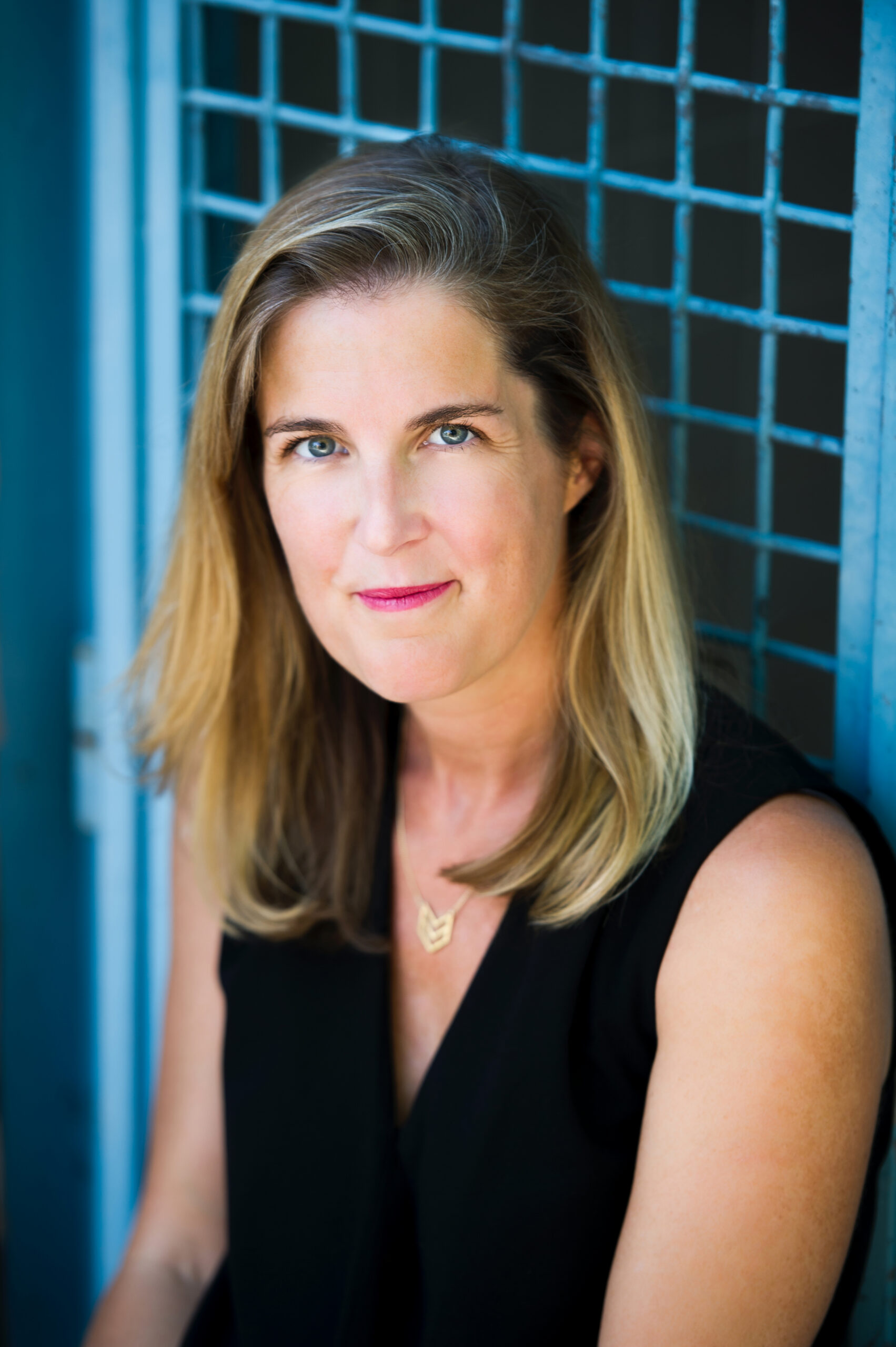
Amanda Eyre Ward is an Austin writer and author of 13 novels—three of which are set in Texas and the rest scattered all over the world. Her latest book, Arrivals and Departures, out June 16, delves deep into the dark world of international romance scammers and how they masquerade as lovers by employing deepfake videos, rom-com scripts, and high-pressure sales pitches. Some even have scammer handbooks, scam universities, and how-to rap songs.
Ward recently spoke with the Texas Observer about her book, what she learned about the scammers who live everywhere from Lagos to Austin, and about how some Texas-based fraud detectors are exposing them.
TO: I love that you dove into the world of scammers because, of course, they’re everywhere. You spent two years researching them. And along the way you visited members of the International Association of Certified Fraud Examiners in Austin, right?
So, a mom friend of mine said, “I run this thing. Do you want to come?” And my jaw dropped. I was almost done with the novel at that point. But wow! I didn’t know there were lawyers [and investigators and accountants] whose entire job is dismantling scams and finding scammers in Texas. They are fascinating people. And this is what they do every day. So they’re telling stories in this throwaway tone that are just so insane. Like the person who got billions of dollars out of a nursing home…it was a resident.
And I met scammers and I met people who were scammed. And people who are scammed, to a one, kept going when it was pretty clear that it was a scam. They just continue, and this happens in my novel.
Even when you’re positive objectively that this person is scamming you, when you wake up in the morning and someone says: “If you send me $10, my dear, and tell me about your day,” it’s like Stockholm Syndrome. It’s worth the $10 to keep pretending that there is this person who loves you and wants to hear about your day.
That’s very sad.
I know. It’s sad, but it’s all just fascinating. And this was before [artificial intelligence]—the deepfakes and psychology. The scammers know what they’re doing.
I started my research, honestly, [on] TikTok. And on TikTok and YouTube, there are “Yahoo Boys,” what they call the Nigerian scammers and a new book just came out about them. [The Yahoo Boys: Love, Deception, and the Real Lives of Nigeria’s Romance Scammers by Carlos Barragán]
But anyway, the Yahoo boys have classes. So they’re like: “Join my class, I’ll teach you how to do it.” And there’s universities.
And then I found out there were Americans doing it. Then I found there were kids in Austin doing it…
One thing you shared in a post is that so often they pretend they’re surgeons when they’re using deepfake AI videos. Why?
I found a training manual in Chinese—a “pig butchering manual.” That’s what they call the scamming, is pig butchering. And it explains what you should say about why you can’t be on screen. For example, you are to say you’re autistic and you can’t really talk to people’s faces.
(Courtesy of Amanda Eyre Ward)
Anyway, you asked about the surgeons. So one of the things that I found out through my research was that the deepfake technology can take a kid in another country or a kid in Austin and make them look like a handsome age-appropriate man or woman… However, the mouths don’t always work right. Some of the movements are a little janky, but usually the voice works, the face works, but the mouth cannot keep up; the mouth flaps with the words. So they decided to make them surgeons so that they could call from the operating room with their mouths covered. And a lot of the romance scammers are supposed surgeons for that reason.
I have noticed that there’s a lot of doctors and military fake profiles on platforms like Facebook, and they tend to have first names for both their first and last name (Brian George, etc.)
A lot of military because when you’re in the military or like on an oil rig you can sort of explain [ the anomalies]. Like if you send a gift link, and if they hit it, it’ll tell [the location]. But if you’re in the military, you can explain why you’re in Yemen, for example, or Iran when you say you’re from Brooklyn. [They say] things like, “I need money to go on leave to see you.” They’ll say, I have a week, this is the only week, and this is how much the plane ticket is…. It’s always very stressful and very specific.
Tell me about the people you found doing this in Austin?
I have kids who go to Austin High and I always talk to them about what I’m doing. And a lot of them are friends with kids from all over the city. … I said this is what I’m researching [and] they said there’s kids doing that here… and I went to their social media and contacted some of them… And they are not as much romance scamming, the kids that I met. They are pretending to be your grandson who was in a car accident.
You also delve into addiction and mental illness in this book. Your character Lee, the reality TV star, is introspective about her drinking and depression. You’ve been open about your own recovery journey. How do you infuse what you know about drinking and recovery into a character like that?
The question is, “How can I not?” … It’s my obsession, you know, I grew up with an alcoholic dad. I’ve been sober for 12 years and it always comes up. And it’s something I just find endlessly fascinating. Addiction, because you’re not in control of what you’re doing and it’s so ruinous. And why does it happen to some people and not others and how do you escape it and how do brains work?
I thought, if somebody reads this and they’re reading it [for] the romance scams, they’re reading it for the Greek beach scenes, the love, and they also understand very specifically how mania and bipolar lows happen, so maybe that they’ll recognize someone in their own life and either be more understanding, [or] be more helpful….
So that is really important to me to remove the stigmas around these issues and also about addiction.
You have several books set in Texas: The Lifeguards, set in Austin, The Same Sky, your book about the border…and Sleep Towards Heaven—that’s my first novel about a librarian from Austin and women on death row in Gatesville. So three books set in Texas.
Do you tend to choose a place for a book, or do you tend to say, “I’d really like to write about this place” and then travel there to do your research?
Texas is endlessly fascinating to me. And I could set all of my books there. But I also lived in Athens when I was younger. My next book is set in Hawaii, where I’ve spent a lot of time. My daughter goes to camp there. I think it’d be hard to write a book from a tourist point of view if you’re just in a place for a day or two. So it’s more places I know well.
It’s more, I get obsessed with ideas like romance scamming.
What other other tricks did you find that scammers were using that aren’t ones that people might expect?
Well, here’s one thing I didn’t know: In the really organized systems, the main source of income for a lot of geographical areas is scamming dumb Americans and Europeans. There are different levels of scammers. So if there’s a bunch of kids, like the lowest level, will just be sitting around a generator in a slum in Nigeria, for example, and texting hundreds and hundreds of people a day. So most people don’t answer when you get those silly texts, like, “Jane, are we meeting for lunch?”
So once they get an answer, it goes up to the loaders. So the loaders—because a lot of them don’t speak English—have purchased scripts. So if you have enough money to purchase a script to do a little back and forth, well then you can be a loader.
And then the next level, once they really get going, there’s pickers. Then there’s the AI guy. There’s the video guy. They will hire a local woman to come be the video person or they can do the deepfake. And it all depends on your level. And your level depends on if you can speak English, if you know how to do more of the technical stuff. I mean, it’s just so organized. I thought that was amazing.
That is amazing and creepy.
And so creepy. And then one of my biggest places for research is the AARP podcast called “The Perfect Scam.” And it is fascinating. It’s probably hundreds of stories of people who were scammed. And it’s everything from love to things like, you buy a dog who doesn’t exist, …and you’re paying and they’re saying: “Oh my God, I’m 10 miles fromAaustin and my truck broke down and I need a little bit of kibble for the night at the motel, can you just send me 15 dollars?”
And people just keep going—they’ve spent hundreds of dollars and they’ve seen pictures of the puppy and they’re gonna pay another $15 when it’s so obvious!
This interview has been edited for length and clarity.
The post Inside the Dark World of Romance Scammers appeared first on The Texas Observer.
Leave a Reply