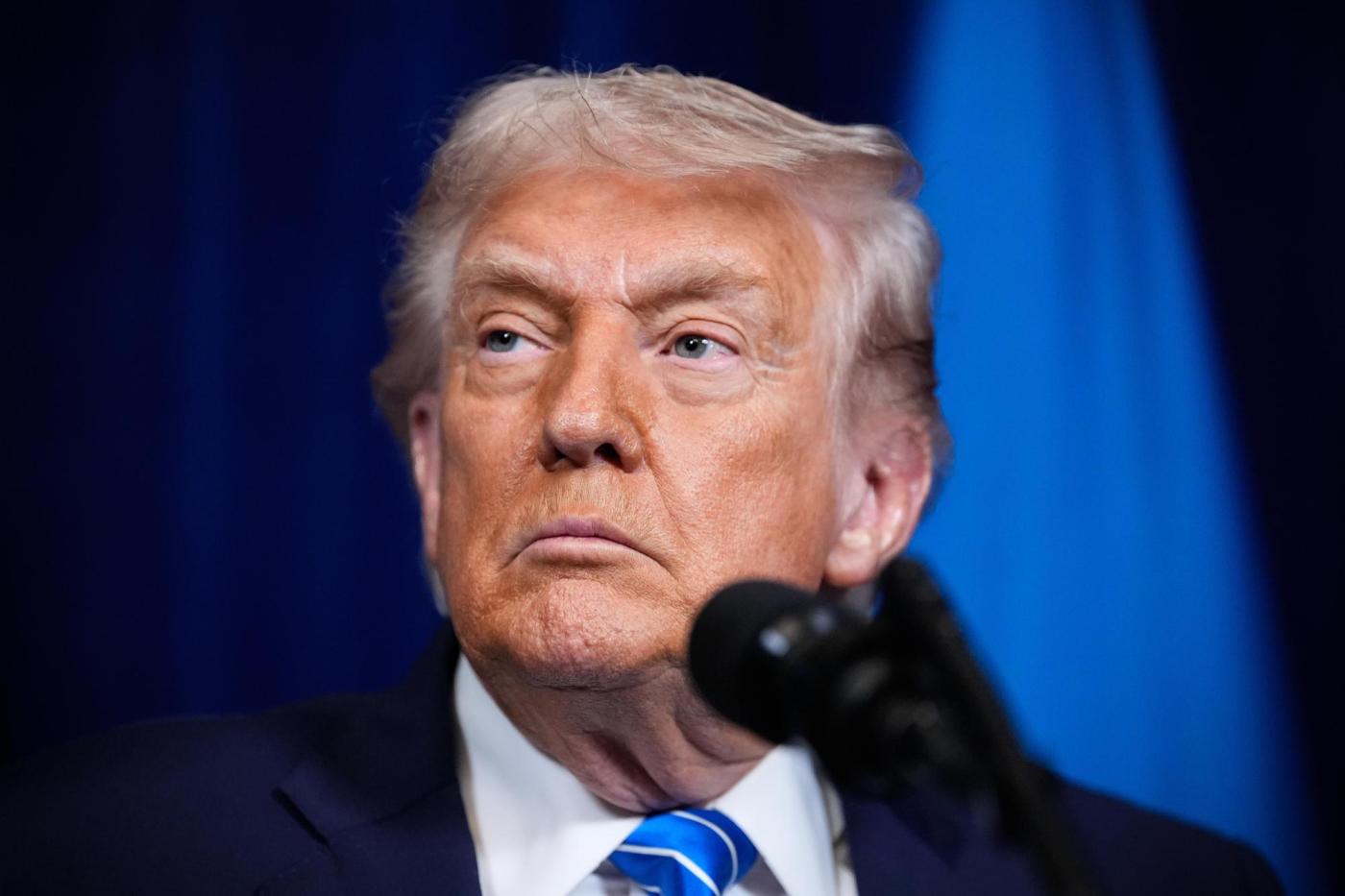
WEST PALM BEACH, Fla. (AP) — President Donald Trump marked Christmas Eve by quizzing children calling in about what presents they were excited about receiving, while promising to not let a “bad Santa” infiltrate the country and even suggesting that a stocking full of coal may not be so bad.
Vacationing at his Mar-a-Lago estate in Florida, the president and first lady Melania Trump participated in the tradition of talking to youngsters dialing into the North American Aerospace Defense Command, which playfully tracks Santa’s progress around the globe.
“We want to make sure that Santa is being good. Santa’s a very good person,” Trump said while speaking to kids ages 4 and 10 in Oklahoma. “We want to make sure that he’s not infiltrated, that we’re not infiltrating into our country a bad Santa.”
He didn’t elaborate.
President Donald Trump, speaks accompanied by first lady Melania Trump, during a NORAD, North American Aerospace Defense Command, Tracks Santa Operation call at his Mar-a-Lago club, Wednesday, Dec. 24, 2025, in Palm Beach, Fla. (AP Photo/Alex Brandon)
First lady Melania Trump speaks during a NORAD, North American Aerospace Defense Command, Tracks Santa Operation call at her Mar-a-Lago club, Wednesday, Dec. 24, 2025, in Palm Beach, Fla. (AP Photo/Alex Brandon)
1 of 3
President Donald Trump, speaks accompanied by first lady Melania Trump, during a NORAD, North American Aerospace Defense Command, Tracks Santa Operation call at his Mar-a-Lago club, Wednesday, Dec. 24, 2025, in Palm Beach, Fla. (AP Photo/Alex Brandon)
Trump has often marked Christmases past with criticisms of his political enemies, including in 2024, when he posted, “Merry Christmas to the Radical Left Lunatics.” During his first term, Trump wrote online early on Dec. 24, 2017, targeting a top FBI official he believed was biased against him, as well as the news media.
But Trump was in a jovial mood this time. He even said, I “could do this all day long,” but likely would have to get back to more pressing matters like efforts to quell the fighting in Russia’s war with Ukraine.
When an 8-year-old from North Carolina, asked if Santa would be mad if no one leaves cookies out for him, Trump said he didn’t think so, “But I think he’ll be very disappointed.”
“You know, Santa’s — he tends to be a little bit on the cherubic side. You know what cherubic means? A little on the heavy side,” Trump joked. “I think Santa would like some cookies.”
The president and first lady Melania Trump sat side-by-side and took about a dozen calls between them. At one point, while his wife was on the phone and Trump was waiting to be connected to another call, he noted how little attention she was paying to him: “She’s able to focus totally, without listening.”
Asked by an 8-year-old girl in Kansas what she’d like Santa to bring, the answer came back, “Uh, not coal.”
Related Articles
Kennedy Center Christmas Eve jazz concert canceled after Trump name added to building
Pediatrics group sues HHS for cutting funds for children’s health programs
Federal judge upholds Hawaii’s new climate change tax on cruise passengers
After missing deadline, DOJ says it may need a ‘few more weeks’ to finish releasing Epstein files
Judge blocks Trump effort to strip security clearance from attorney who represented whistleblowers
“You mean clean, beautiful coal?,” Trump replied, evoking a favored campaign slogan he’s long used when promising to revive domestic coal production.
“I had to do that, I’m sorry,” the president added, laughing and even causing the first lady, who was on a separate call, to turn toward him and grin.
“Coal is clean and beautiful. Please remember that, at all costs,” Trump said. “But you don’t want clean, beautiful coal, right?”
“No,” the caller responded, saying she’d prefer a Barbie doll, clothes and candy.
Associated Press writer Darlene Superville contributed from Washington.
In a social media post after the Tuesday hearing, defense attorney Scott Danks said grand jurors decided not to indict his client, Jacob Lee Bard, for the Dec. 9 shooting and he is out of jail. In a previous statement sent to news outlets, Bard’s attorneys have said that 20 to 30 people had gathered to attack his son and family, and that he was justified in shooting two people who were beating his son.
After the grand jury decision, Kentucky State officials said they “will cooperate with law enforcement and investigators as appropriate” and are focused on student safety and well-being.
Bard’s attorneys say the family was moving their younger son out, with two armed campus police officers present, after withdrawing both sons from school because of “multiple armed, violent” incidents against them and other students in the days leading up to Dec. 9, some captured on security cameras.
When the family and an officer reached the dormitory entrance on the move-out day, the group of people in masks and hoods rushed out and began violently assaulting the family and others, including beating the son’s head against the pavement, the attorneys said.
In October, the younger son reported a burglary in his dorm room to campus police and received threats of violence afterward, the attorneys said.
Because of continued death threats, the sons are now staying in an undisclosed location, the attorneys added.
“Jacob’s actions were absolutely justified under the law, and were the only measure that prevented his son’s death or serious injury,” the attorneys wrote.
Investigators have said the shooting was isolated, but they have not publicly shared details of the circumstances or a possible motive. The shooting killed 19-year-old De’Jon Fox of Indianapolis.
Related Articles
Call 911 or risk losing the baby? Raids force some immigrants to avoid care
Kennedy Center Christmas Eve jazz concert canceled after Trump name added to building
Two Iowa National Guard members killed in Syria return home on Christmas Eve
After missing deadline, DOJ says it may need a ‘few more weeks’ to finish releasing Epstein files
‘The best gift ever’: Baby is born after the rarest of pregnancies, defying all odds
In a message to the campus community, Kentucky State said the grand jury decision “does not lessen the pain our community continues to feel, nor does it change our priorities.”
“Our commitment remains centered on supporting our students and ensuring Kentucky State University is a safe place to learn, live, and work,” it said.
The shooting was the second in four months near the residence hall. Someone fired multiple shots from a vehicle on Aug. 17, striking two people who the university said weren’t students. Frankfort police said one victim was treated for minor injuries and the second sustained serious injuries. The dorm and at least one vehicle were damaged by gunfire.
Police have said Bard, 48, is from Evansville, Indiana, which is about 150 miles west of Frankfort. He had also been charged with first-degree assault.
Kentucky State is a public historically Black university with about 2,200 students. Lawmakers authorized the school’s creation in 1886.
One of the joys of living in flyover country is the annual state fair. It is a mix of traveling circus, amusement park, unbelievable food, live entertainment and serious competitions.
You see children (and adults) vying for prizes for raising livestock; you can watch everything from barrel racing to sheep shearing; and you can not only see the biggest watermelon but also participate in watermelon seed-spitting contests, not to mention other contests and games. And don’t forget the famous butter cow — that is, a life-size cow carved out of butter — if you’re fortunate enough to attend the Iowa State Fair.
One of my favorite stops at a state fair is the animal barn. Go there, and I promise you’ll see a crowd around one pen in particular: the prize-winning “largest hog.” Winning the largest hog competition often requires a beast in excess of 1,200 pounds. The record holder, according to Guinness World Records, was a pig named Big Bill, who weighed more than 2,550 pounds.
In some fairs, however, the hog competition includes the spectators, as well as the hogs. The challenge is to “guess the weight.”
You would think that among state fair spectators and participants, there would be quite a few ringers — hog farmers in particular — when it comes to guessing the weight of a gargantuan hog. There are, but they’re not always the winners.
In his 2004 book “The Wisdom of the Crowds” — subtitled “Why the Many Are Smarter than the Few and How Collective Wisdom Shapes Business, Economies, Societies, and Nations” — James Surowiecki applied the wisdom of crowds to questions that go way beyond guessing porcine weight.
For instance, the “crowds” he studied were able to identify the cause of the 1986 Challenger Space Shuttle disaster far faster than the “experts.” And the wisdom of the crowd also explains why stock index funds generally outperform funds run by professional money managers over time.
This phenomenon also forms one of the principal arguments for democracy: collective decisions are generally better than those made by simply handing power over to the (usually self-selected) “most qualified.”
This principle was famously articulated by the legendary journalist and author William F. Buckley Jr. when he quipped, “I am obliged to confess I should sooner live in a society governed by the first 2,000 names in the Boston telephone directory than in a society governed by the 2,000 faculty members of Harvard University.”
Psychologist Barry Schwartz, in the book “Paradox of Choice,” reminds us that making choices is not always pleasant. There is a cost, he wrote, to things like having to pick among 20 brands of ketchup in the typical U.S. supermarket. Making choices takes time and energy, and having to decide everything all the time can be a real burden.
Today, we are seeing both phenomena in action. As the Democratic and Republican parties have become more dogmatic, a growing number of Americans are saying, “A plague on both your houses.” In 2016, Hillary Clinton and Donald Trump were viewed unfavorably by a majority of voters. In 2024, 26 percent of voters disliked both candidates. Choosing is especially unsatisfying when you don’t like either option.
The genius of the American system of government is that we have multiple checks on those in power. If the parties don’t give us candidates we like, we rotate the parties.
Related Articles
Abby McCloskey: A case for childlike wonder in a grown-up world
Noah Feldman: The Supreme Court generals failed their troops this year
Thomas Black: A dress code won’t make flyers behave, but a $44,000 fine will
Parmy Olson: AI is getting dangerously good at political persuasion
Lisa Jarvis: Fighting dementia could be as easy as the shingles vaccine
Since Jimmy Carter, we have had a single party control the presidency and both houses of Congress in consecutive two-year terms only once (with George W. Bush following 9/11). While Republicans have ridden a wave of euphoria over the last year, the recent off-year elections suggest the American people may be preparing to return to divided government in Washington.
Combined with constitutional limitations on the government’s overall powers and the president’s specific powers — and court decisions reaffirming those limitations — this is how the American system is supposed to work. It is messy by design and requires the frequent intervention of the people.
The genius of the Founders was to entrust our freedom to the collective wisdom of the people.
Frederic J. Fransen is the president of Ameritas College Huntington (W.Va.) and CEO of Certell Inc. He wrote this for InsideSources.com.
As immigrants in southeastern Louisiana and Mississippi braced for this month’s U.S. Homeland Security operation, Cristiane Rosales-Fajardo received a panicked phone call from a friend.
The friend’s Guatemalan tenant, who didn’t know she was pregnant, had just delivered a premature baby in the New Orleans house. The parents lacked legal residency, and the mother refused to go to a hospital for fear of being detained by federal immigration officers.
“There’s blood everywhere, and the baby’s dead,” Rosales-Fajardo recalled her friend saying.
Rosales-Fajardo put on her sandals, grabbed surgical gloves, and rushed to the house.
Rosales-Fajardo, herself an immigrant from Brazil, is a grassroots organizer and advocate in the New Orleans East community, where many immigrants live. She has no formal medical training, but she has experience with delivering babies.
She scanned the room when she arrived. A 3-year-old child stood to one side while the mother sat on the edge of the bed. The father held their swaddled newborn son, who wasn’t breathing and was wrapped in blood-soaked towels.
“The baby was completely gray,” Rosales-Fajardo later said.
Rosales-Fajardo wiped fluid away from his small mouth and rubbed his back before performing tiny chest compressions and breathing air into his lungs.
She told the parents she had to call 911 to get the mother and newborn to a hospital for care. The baby was out, but the delivery wasn’t over.
“I assured her. I promised her that she was going to be safe,” Rosales-Fajardo said.
Fear hung over the room. Still, she made the call and continued performing CPR. Finally, the newborn revived and squirmed in Rosales-Fajardo’s arms. When the ambulance arrived, the mother tried to keep her husband from riding with her, terrified they would both be arrested. He went, anyway.
“These are hard-working people,” Rosales-Fajardo said. “All they do is work to provide for their family. But they were almost at risk of losing their child rather than call 911.”
Cristiane Rosales-Fajardo speaks by phone to a Guatemalan family she helped in a medical emergency. (Christiana Botic/KFF Health News/TNS)
Cristiane Rosales-Fajardo, herself an immigrant from Brazil, is a grassroots organizer and advocate in the New Orleans East community, where many immigrants live. (Christiana Botic/KFF Health News/TNS)
Cristiane Rosales-Fajardo visits a baby in a New Orleans hospital’ s neonatal intensive care unit on Dec. 5, 2025. (Christiana Botic/KFF Health News/TNS)
Cristiane Rosales-Fajardo accompanies immigrant parents to a New Orleans hospital’ s neonatal intensive care unit to visit their baby on Dec. 5, 2025. (Christiana Botic/KFF Health News/TNS)
Cristiane Rosales-Fajardo, a grassroots organizer and advocate in the New Orleans East community, holds a child’s hand through her car window during a stop on a drive to check on immigrant community members. (Christiana Botic/KFF Health News/TNS)
1 of 5
Cristiane Rosales-Fajardo speaks by phone to a Guatemalan family she helped in a medical emergency. (Christiana Botic/KFF Health News/TNS)
Nearly two weeks into the Department of Homeland Security’s Operation Catahoula Crunch, which launched Dec. 3, health professionals and community advocates in Louisiana and Mississippi report that a significantly higher-than-usual number of immigrant patients have skipped health care appointments and experienced heightened stress levels.
According to a press release, DHS said it had arrested more than 250 people as of Dec. 11. Though federal officials say they’re targeting criminals, The Associated Press reported that most of the 38 people arrested in the first two days of the New Orleans operation had no criminal record.
Since President Donald Trump took office in January, immigrant families nationwide have become more likely to skip or delay health care, due in part to concerns about their legal status, according to a recent survey by KFF and The New York Times.
The survey found that nearly 8 in 10 immigrants likely to be living in the U.S. without legal permission say they’ve experienced negative health impacts this year, from increased anxiety to sleeping problems to worsened health conditions such as high blood pressure or diabetes. The federal immigration raids in California, Illinois, North Carolina, and now Louisiana and Mississippi add to the health care barriers that these families already face, including access to services, language barriers, lack of insurance, and high costs.
That hesitancy to receive even emergency care appears justified amid the ongoing raids. Hospitals and health facilities generally must allow federal agents in areas where the public is allowed, according to the American Civil Liberties Union. In California this year, federal agents have staked out hospital lobbies, shown up at community clinics, and guarded detainees in hospital rooms. Even driving to and from appointments poses a risk, as traffic stops are a popular place for immigration agents to make arrests.
University Medical Center nurse Terry Mogilles said that immigrants typically make up at least half the patients in her orthopedic trauma clinic in New Orleans, many of them with construction-related, bone-crushing injuries that require surgery. But now, Mogilles said, many of those patients aren’t coming in for follow-up appointments, despite the risk of infection.
“When we call, we can’t get through,” Mogilles said. “It is so upsetting because we have no idea what’s happening to them post-op.”
Terry Mogilles, a registered nurse at University Medical Center in New Orleans, says that immigrants typically make up at least half the patients in her orthopedic trauma clinic. (Christiana Botic/KFF Health News/TNS)
A Chill Spreads in the South
Federal officials said the Catahoula Crunch operation extends to southern Mississippi, though the bulk of the initial arrests have occurred in the Greater New Orleans area. Immigrant families throughout Mississippi are hunkering down in anticipation.
Michael Oropeza, executive director of El Pueblo, a nonprofit serving low-income immigrant communities in Biloxi and Forest, said the organization has witnessed families delay care, cancel children’s checkups, and go without refilling medication.
“It’s not because they don’t value their health; it’s because they don’t feel safe,” Oropeza said. “When hospitals and clinics are no longer that safe place, people withdraw trust that took years to build up. It can disappear overnight.”
Maria, a Biloxi resident from Honduras, said, in Spanish, she and her two children have missed routine doctors’ appointments because they are “terrified” to leave the house amid an increased presence of federal immigration officers. Her husband, who is authorized to work in the U.S., was detained for two months this year.
Her children are U.S. citizens. They previously qualified for Medicaid, but Maria opted to disenroll them three years ago out of concern that using public benefits would jeopardize her family’s residency applications, she said. The family now pays for their children’s care out-of-pocket.
When it feels safe to attend doctors’ appointments again, Maria said, her priority will be seeking mental health care to address the stress her family has endured.
“I definitely need to see a doctor to get checked out, because I don’t feel well,” she said, describing her anxiety, depression, and insomnia.
A handwritten sign states“ ICE IS NOT ALLOWED TO ENTER” at the chained-off entrance of a neighborhood in New Orleans in December. (Christiana Botic/KFF Health News/TNS)
In Louisiana, Marcela Hernandez of Familias Unidas en Acción, a nonprofit that provides direct aid to immigrants, said many of the families she works with live paycheck to paycheck. Sheltering at home and missing work only adds to the stress. Hernandez said she received 800 calls for food in two days from families afraid to leave home.
The federal operation in Louisiana and Mississippi could last more than two months, according to the AP. The longer it goes on, Hernandez said, the more she worries evictions will come next as people can’t pay rent, further traumatizing a community whose members often had to make difficult and dangerous journeys to flee hardships in their countries of origin to reach the U.S.
“You don’t leave your country knowing that you’re gonna get raped on the way just simply because you wanna come and meet Mickey Mouse,” she said.
Rosales-Fajardo, who runs a nonprofit called El Pueblo NOLA, said families tell her how children have started urinating on themselves due to stress and fear. Nationally, immigrants who are likely to lack legal status report that some of their children have had problems sleeping and that they’ve seen changes in school performance or behavior, according to the KFF and New York Times survey.
Community groups said they hope people step up locally to deliver food and hygiene products to immigrant homes, and that health care professionals provide more at-home or telehealth visits.
Like at other hospitals, UMC’s waiting rooms are considered public spaces, Mogilles noted. But the nurses union is calling for the hospital to create safe spaces for patients that federal agents can’t access and clearer policies to protect health care workers who shield patients. Post-op appointments can’t be done virtually, so patients need to feel safe enough to come in, Mogilles said.
Prenatal and postnatal care is also challenging to provide virtually, leaving the health of new and expecting mothers vulnerable, said Latona Giwa, executive director of Repro TLC, a national sexual and reproductive health training nonprofit.
Related Articles
Archbishop Hebda: Immigration officials won’t target holiday church services
Noah Feldman: The Supreme Court generals failed their troops this year
Trump approves deployment of 350 National Guard members to New Orleans
Trump administration moves to overhaul how H-1B visas are granted, ending lottery system
DOJ sues Illinois’ governor over laws protecting immigrants at courthouses and hospitals
Since the Chicago immigration sweeps began in September, Giwa said, the clinics and health providers her organization works with have reported that 30% of patients had missed appointments. She said pharmacies saw a 40% drop in medication pickups.
“What we know about management of chronic conditions, especially in pregnancy, but in general, is that even missing one appointment can impact the trajectory of that condition and worsen a patient’s outcomes,” Giwa said.
In Louisiana, which already has poor maternal health outcomes, the fear of arrest could exacerbate the crisis worsened by the overturning of Roe v. Wade and threaten lives. She’s especially concerned about families with preterm babies in the neonatal intensive care unit, or NICU.
“Imagine your child is in the hospital, and so vulnerable, and you are terrified to go visit and care for your newborn infant because you’re worried about being deported,” Giwa said, noting that a newborn’s health partly relies on parental visits.
That’s the position the Guatemalan family in New Orleans is navigating.
On a recent day in December, Rosales-Fajardo acted as the family’s translator and advocate on their first visit to see their son in the NICU at a hospital on Lake Pontchartrain’s Northshore. Hospital staffers told the parents they would need to make the long and risky trip to the hospital repeatedly for at least a month to provide skin-to-skin contact and breast milk.
Rosales-Fajardo drove the parents, who were afraid to travel alone out of fear of being pulled over and arrested on a bridge. She said she’ll keep driving them as long as she needs to.
“Whenever they see a Hispanic driving or anything like that, that’s suspicious to them,” she said of federal agents.
But the baby is safe and healthy. And the parents have named Rosales-Fajardo his godmother.
Gwen Dilworth of Mississippi Today and Christiana Botic of Verite News contributed to this report.