Will St. Paul’s new mayor hire an outside investigator to look into police use of force during an ICE operation in November?
Is the St. Paul city council working with enough urgency on immigration matters?
Those were among the questions asked during a community meeting Thursday night in St. Paul. It was scheduled in response to earlier ICE actions but took on more urgency after an ICE officer fatally shot Renee Nicole Macklin Good on Tuesday in Minneapolis.
“Renee Good is not exactly why we’re here today,” but she’s actually exactly why people filled a room at Indigenous Roots Cultural Arts Center in Dayton’s Bluff, said independent journalist Georgia Fort.
She said testimony from a man at a recent St. Paul city council meeting stuck with her.
“He said, ‘I saw a federal agent point a live gun at an unarmed, peaceful protester,’” Fort said, adding that she also saw it. “What that guy said to the council that night was, ‘Imagine what would happen if he had pulled the trigger.’ But we did not have urgency at the council meeting. We still don’t have any action taken for the brutality that was inflicted in the city of St. Paul.”
Defending perimeter or unnecessary force?
On Nov. 25, federal deportation officers were conducting an operation in the 600 block of East Rose Avenue in St. Paul’s Payne-Phalen to arrest an undocumented person who’d previously been removed from the U.S. and who had re-entered unlawfully, according to a probable cause statement signed by an Immigration and Customs Enforcement deportation officer and filed with a criminal complaint in federal court.
ICE arrested that man, but the incident continued for about five hours until they arrested another man. The second man is charged in federal court with assaulting and impeding a federal officer, by allegedly striking the officer’s vehicle with his own, and improper entry to the U.S.
All St. Paul city council members, along with community members, have said that police used unnecessary force.
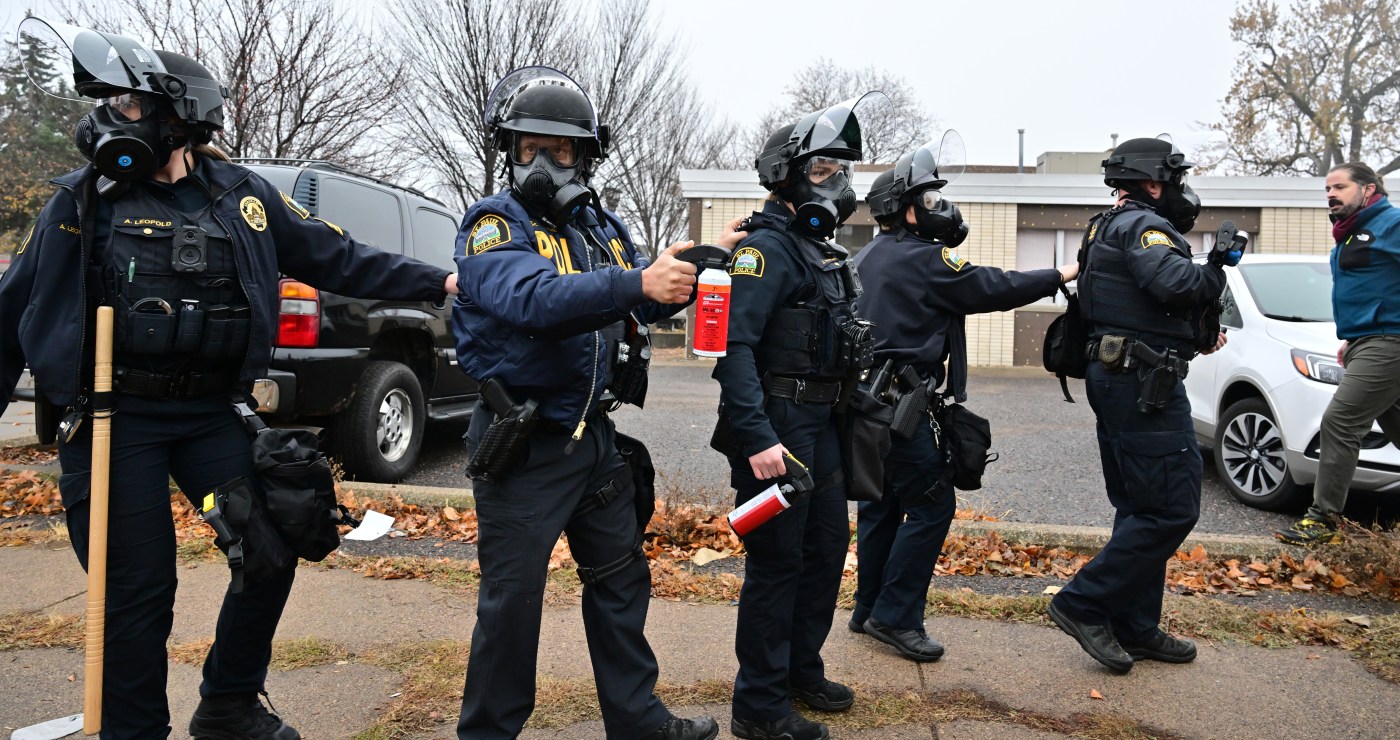
Police were called to assist when protesters broke the federal perimeter, “the street was compromised with foot and vehicle traffic, and a dangerous situation was unfolding,” the St. Paul Police Department has said in a statement.
Police Chief Axel Henry said at the time his officers were acting to protect protesters as well as ICE agents.
“Reports came out that people were starting to arm themselves with rocks and sticks,” Henry previously said. “… I asked additional officers to come to the scene to make the scene safe for both those who were there to protest those events and for the agents themselves.”
St. Paul police sprayed chemical irritants. After someone threw an object at a departing police vehicle’s back window and broke it, police launched 40-mm projectiles and chemical munitions.
“The old rules of engagement are being thrown out the window,” said Samuel Torres, co-chair of the board of Indigenous Roots, at Thursday’s meeting. “… We’re seeing that when our neighbors and our relatives are being tear gassed point blank in the face, being brutalized and pushed to the ground, even though they need a walking stick or a cane to stand up upright.”
People have spoken out at city council meetings about what happened on Nov. 25, and now they’re looking for the city council and Mayor Kaohly Her “to do more than offer words in a meeting,” said Danielle Matthias, Minnesota Freedom Fund’s policy and advocacy director. “We’re asking for real protections, for real accountability and real action to ensure that this never happens again because when our observers are harmed for documenting government misconduct, democracy in itself is at risk.”
Status of city council action
Six of the seven city council members sat at a table at the front of the packed room Thursday night. The legislative aide for Council Member Cheniqua Johnson, who is on maternity leave, read a message from Johnson.
Related Articles
Duluth police officer leaves force after allegations of sexual assault
Minnesota prosecutor calls on the public to share Renee Good shooting evidence with her office
Deceased Renville County Jail inmate identified as Roseville man
Gov. Tim Walz authorizes National Guard to be staged, ready
ICE agent calls 911 in St. Paul to report being followed
City council members gave updates on a resolution they unanimously passed last month that called for:
Investigation: An investigation into officers’ actions by the Minnesota Board of Peace Officer Standards and Training. “This process will follow the completion of an internal affairs investigation, which is underway,” said Council Vice President HwaJeong Kim.
Audit: A financial audit of St. Paul police personnel, operations, equipment and supply costs from their presence on Nov. 25. They’re awaiting a timeline from the city’s Office of Financial Services, Kim said.
Ordinance: Working to strengthen the city’s separation ordinance, which says city employees are not authorized to enforce federal immigration policies. “What we wanted to really focus on was what are the actions we can do … as quickly as possible,” said council member Nelsie Yang, who represents the area of the Nov. 25 operation. The council has a committee meeting scheduled for 10 a.m. Wednesday about changes they’re considering.
Outside investigator?
St. Paul’s Police Civilian Internal Affairs Review Commission unanimously voted at its December meeting for an independent, external investigation. Under the city’s ordinance, the mayor or the city’s Human Rights director can hire such an investigator under city contract, which drew a question during Thursday’s meeting about whether Mayor Her would hire an outside investigator.
Her, who was sitting in the audience, said she hadn’t been informed she had the authority to do so and her staff will be looking into it more. She became mayor on Jan. 2.
Jenny Lahner, who lives on the West Side, said she expected the police chief would be at Thursday’s meeting.
“I thought I was going to be able to look into his eyes and tell him exactly what I thought about what he did on Rose Street,” she said.
Her, addressing the group, said she told Chief Henry not to attend.
“Because there is a current investigation, he cannot speak,” she said. “And I think it would be frustrating for all of you that if he sat here and he said to you he could not answer these questions.”
She said she is talking to Henry, not only about the timeline of what happened, “but I also want to know what we’re going to do differently. I’ve asked him to work with community members.”
Mayor questioned on standing up to feds
Riley Soeffker, who grew up on the East Side and is still a resident, said he thinks “we need to empower our police officers to get (ICE) out of our city,” and asked Mayor Her if police can “step in there and stop them” if they’re breaking the law.
Related Articles
St. Paul: Maryland Avenue CVS ordered removed by March 1
Hennepin County prosecutor calls on the public to share Renee Good shooting evidence with her office
Deceased Renville County Jail inmate identified as Roseville man
Gov. Tim Walz authorizes National Guard to be staged, ready
ICE agent calls 911 in St. Paul to report being followed
“I ask those exact same questions (about) when can police step in,” Her said. “… Because the federal government is a greater entity than we are … it becomes an extremely difficult situation for them to be able to then go in and do it.”
Nekima Levy Armstrong, a Twin Cities civil rights attorney and activist who spoke during the meeting, said she was excited when Her was elected and hasn’t met her yet, “but what I just saw from you at the microphone honestly gives me pause.”
“We cannot have any more passive leadership when it comes to police accountability,” Levy Armstrong said. “… I don’t think the federal government is greater than us. The federal government right now is diabolical. We need local government to stand up for the people that they are responsible for.”