IRVINE, California — The allure of figure skating, what captivates millions who wouldn’t know Axel Paulsen from Ulrich Salchow, why it transcends the Olympic Games every four years, is its ability to tell a story. More than any other sport, there is a cinematic quality to skating.
It even comes with a soundtrack.
“That’s what makes skating unique to, let’s say, hockey, or something that’s based on a clock,” said Shae-Lynn Bourne, a former world champion ice dancer for Canada and now one of the sport’s top choreographers. “We get to express. So it’s kind of our athletic art.”
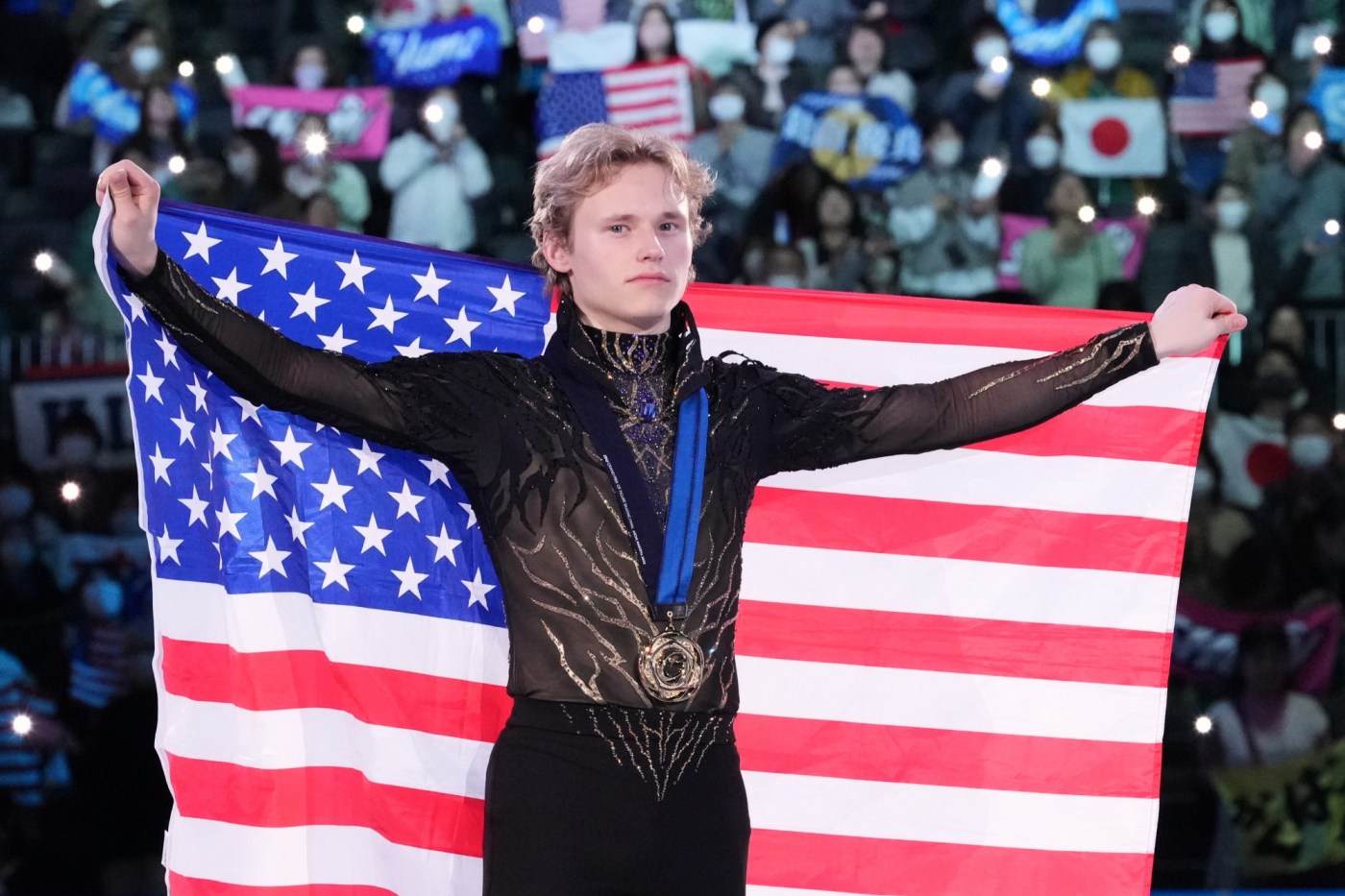
Ilia Malinin, figure skating’s current box office sensation, first emerged earlier this decade as the sport’s next great action hero, the self-proclaimed Quad God, a teenager not only capable of leaping tall buildings in a single bound but doing 4 1/2 rotations before touching down.
Malinin, then 18, in September 2022 became the first person to successfully land a quadruple Axel, skating’s most difficult jump, in competition, a feat two-time Olympian Johnny Weir has compared to the first moon landing.
“He is beyond out of this world,” said Jason Brown, a 2022 Olympian.
Malinin won his first World title in 2024 in Montreal by breaking 2022 Olympic champion Nathan Chen’s free skate world record. In the free skate at last spring’s World Championships in Boston, he successfully defended his title by becoming the first person to land all six of skating’s jumps as quads.
“There’s no way to compare him to any skater from the past,” Russian coach Tatiana Tarasova, who has coached more Olympic and world champions than any other coach in figure skating history, told the Sport24 network. “Right now, he has no rivals, and back then, there wouldn’t have been any either. In the past, top athletes were only performing one or two quadruple jumps at best.
“Maybe in 15 or 20 years, someone stronger than Ilia will emerge, but in the past, there was no one like him.”
Malinin, who turned 21 last month, the face of the sport, the name on the top of the marquee at the Olympic Games, which open a month from Tuesday in Milan, and the U.S. Championships this week in St. Louis, is determined to redefine himself just as he has forced the sport to reimagine itself.
“This year,” he said, “I really put myself on the ice as a different skater.”
Make no mistake, Malinin still promises to make the Milano Ice Skating Arena his own personal launch pad. Yet for all of Malinin’s athleticism and his Beamonesque ability to take flight what has been most telling in what has already been a world record-shattering Olympic season has been the maturity of his skating, the willingness to take emotional risks in his programs.
As much as his ability to land the inconceivable, Malinin’s great strength has always been the imagination and courage to take his skating to places few even considered, let alone dared to reach for. Especially with his free skate program, Malinin has turned that focus inward yet is still pushing the edge of the envelope.
He is the best in the world at what he does, perhaps the best ever, yet he is still a young man in search of himself, his voice. He has found it in two autobiographical programs, the short program and the free skate, which together trace his path to Milan and chart his course ahead with a vulnerability and honesty that reveals a young adult willing to admit while he might have mastered all the jumps, he doesn’t have all the answers, yet has the courage to embrace life’s uncertainty.
Interspersed with his free skate’s music is Malinin’s own voice.
On the eve of the most important two months of his life so far, with the world watching, as he prepares to glide across Milan’s golden pond, Illia Malinin has a story to tell.
“The only true wisdom is knowing you know nothing,” he says at one point in the free skate. At another, he says, “Embrace the storm.”
“It’s like both programs have the idea of being, like a process of, you know, changing and becoming a better person,” Malinin said in an interview after a training session at the Great Park Ice in Irvine, where the Virginia-based skater makes regular stops to work with Bourne and coach Rafael Arutyunyan. “But I’d say like the short program is a little bigger representation of, like, the physical battles that you will have to go through, of like having that change.
“The long program is a little more like deeper in thought, and you really have to be more like psychological thinking about it.”
Both programs are a reflection of Bourne and Arutyunyan’s influence, as well as Malinin looking at his skating and at his life through a wider lens.
From big air to moguls and slopestyle, what to know about freestyle skiing at the Winter Olympics
What to know about skeleton at the Winter Olympics: Hurtling head first down an icy chute on a sled
Feet first downhill on a sled at cheetah speed: What to know about luge at the Winter Olympics
What to know about bobsled at the Winter Olympics: The Germans vs. everyone else
What to know about curling, the popular Olympic sport with an Italian star seeking more gold at home
“I really believe that the story, what they’re skating about, being present and committed and having meaning to every move is what brings the sort of the ties everything together, and that’s also what lures the audience in,” said Bourne, who choreographed both programs. “And the judges are just the audience. If you’re captivating the people, you’re captivating them, you have to tell stories. It’s like when you go to a movie. It’s like a four-minute and in the short it’s two minutes and 50 seconds. So it’s you want to, you want to make people feel something at the end of the day, and you want them to remember what you did on that ice, whether you make them quiet or you make them clap, or you actually involve them in what you do.”
The short program titled “The Lost Crown” is the sort of action packed routine the sport has come to expect from Malinin.
“There’s some sort of magical quality to the actual story where he does possess some extra abilities to be this ultimate warrior,” Bourne said. “… He’s sort of like this, coming from the desert and laying low, I would say. And so that’s why the beginning is low, and this kind of mysterious beginning where he’s not been in hiding, but in training in a way very similar to his own life. Nothing beautiful. Training, is it’s a grind or you fall it’s not pretty, and it burns to train. It’s like some days you question yourself, but yeah, there’s elements of that. And I think it’s showing off that sort of getting started, getting into the training, getting into becoming that Ultimate Warrior and the strongest version of yourself.
“And then, you know, then the fight begins. Music shifts, and it’s the battle, you know, survival of the fittest, right? It’s very much that story and, and taking control of and believing, and when the last final part comes, it’s more him, it comes in and it’s like rapping and grooving, and it’s explosive, and he’s explosive. So you wanted to end on a bang and show that he’s the ultimate warrior, and not just of himself, you know, like, what is it you you, you have to be your own competition if you continue to be your best self, that is the competition, and that will take you pretty far.”
Malinin & Company have named his free skate program “A Voice” and it is just that: his own words, vulnerable and contemplative, honest and bold, popping up through a blend of compositions.
“And it felt very fitting for where he’s at in his own life,” Bourne said. “Just turned 21 and he’s having a lot of those thoughts about what’s life and he’s saying what he feels right now.”
Malinin worked with Bourne’s husband, Bohdan Turok, a director, producer, screenwriter, to record his voice for the production.
“Ilia wanted his own voice somehow to say something meaningful,” Bourne said. “So my husband took him to his studio and helped sort of guide him with the choice of words, letting it come from Ilia, but kind of guiding him so it comes across right and where to put that in the program, and then recording him and kind of directing how he delivers it, just like I would with the movement, he did it with the voice.”
And it is Malinin’s voice, his vision in every way.
“Yeah, it’s definitely something that I’ve noticed just in my life is I see things completely differently,” Malinin said. “See like everything to me, just looks different. When I see something, I feel like I can relate this to something, or, you know, have a similarity to this or this. It’s like I have a really deeper thinking about anything I do.”
Malinin was asked if this depth was the result of maturity or life experiences.
“I would say everything, all the above, you can say just the life experiences you go through, and you know, just maturity, but that also, that you know correlates with how long you’ve been alive from,” he said. “Call it that. So you really have that idea of how reality really is.”
What’s his reality now?
“My reality is getting ready to compete in that Olympics,” Malinin said, breaking into a grin, “and going for that gold.”
Although Malinin was basically raised at the skating rink but didn’t always feel destined for the Olympics.
Both his parents, Tatiana Malinina and Roman Skorniakov, were Olympians for Uzbekistan. Malinina won the 1999 Grand Prix final and Four Continents event. Skorniakov was a seven-time national champion. They later moved to the U.S. and were married in 2000. Four years later, Ilia was born in Fairfax, Virginia, in Washington D.C.’s suburbs, where his parents were coaching.
Malinin was 6 when he first skated at a Reston, Virginia, rink. Skating was the family business. Valery Malinin, Tatiana’s father, skated for the Soviet Union before turning to coaching. His grandson’s first love, however, was soccer.
“Neymar was my favorite player,” he said, referring to the Brazil superstar.
So while his parents were on the ice coaching, Malinin spent his free time dribbling around the rink. If his parents were frustrated by his lack of interest, they didn’t show it. Valery Malinin cautioned the couple not to pressure their son into skating, that he would eventually come around to the family business.
“They tried not to force me into this,” Illia said. “They really wanted me to find my own passion, pick what I wanted to do, but yet that kind of went down into being a skater.
“I think the whole thing around it was really just growing up in an environment where my parents are at the rink, 24/7, right? So I had nowhere really to go. Then, you know, chilling at the rink. You know, playing soccer with the kids there. So it’s like, that’s where I grew up in. And at some point, I realized, oh, let’s, you know, let me try to get on the ice, right? Because that looks interesting. What they do, right?”
He was 12 when he decided to get serious about skating.
“I really just thought, I’m progressing so much quicker than I realized that now I should,” he said. “I came to a conclusion with me and my parents. We sat down and we talked about it, and I thought, you know, why don’t we try to put in a little more effort, you know, time into this?”
His parents continue coach him with Arutyunyan, who coached Chen to Olympic gold, also part of the coaching team.
Malinin won the 2016 U.S. juvenile title, picking up the U.S. intermediate crown a year later. In 2018, he won the Asian Open Trophy’s advanced novice competition. But he missed both the 2020 and 2021 U.S. championships with injuries. There was no doubting his talent, but plenty of questions within American skating about his ability to stay healthy.
“That was kind of the concern,” Malinin admitted. “But I think now I’ve kind of gotten through that area being, I know what I’m doing with my training, and I really have a solid plan how to prevent those injuries. So it’s really, have a strategic plan of what’s the best way I can keep progressing, keep improving, but also, you know, just so I don’t break my body.”
Healthy, Malinin’s breakthrough came at the 2022 U.S. Championships in Nashville, essentially the sport’s Olympic Trials. He landed four quad jumps in the free skate to finish second overall.
“I definitely wasn’t expecting to skate this good and especially place second,” Malinin told reporters at the time.
Neither was the Olympic selection committee, which selected Vincent Zhou and Brown to join Chen at the Beijing Olympics.
“I came to that competition, of course, coming back from those injuries,” Malinin says now. “So my goal wasn’t the Olympics, but in the back of my mind, I also thought about, you know, what if you do so and so, you know, especially having that first day, you know, a good short program, and everyone behind me, like, oh, you can actually go (to the Olympics).
“So that kind of played a part, played a part in how I felt when I wasn’t named on the team, because everyone believed in me. Everyone had these, you know, thoughts and wanted me to go (to the Olympics), and then not going there just made me not understand, you know, everyone said I was gonna go. Why didn’t I? You know, but again, looking at another perspective, that if I did go to those Olympics, I don’t think I’d be skating after these Olympics.”
As a sort of consolation prize, U.S. Figure Skating sent Malinin to the 2022 World Championships after the Olympics. He placed ninth. At the World Junior Championships later that spring, he broke world junior records for short program, free skate and total score en route to claiming the gold medal.
Canada’s Kurt Browning was the first skater to successfully land a quadruple jump in competition, hitting a quad toe-loop at the World Championships in March 1988. Chen had five quad jumps in his free skate in winning the Olympic gold medal at the Beijing Games.
But the quad Axel remained elusive. The jump is skating’s most difficult because it requires a skater take off from the forward outside edge of one skate then land on the back outside edge of the other skate, necessitating 4 1/2 rotations.
“Do you think that anyone will manage to do a quadruple Axel?” Meryl Davis, the 2014 Olympic ice dance champion with Charlie White, asked Chen in a December 2018 interview for the Olympic Channel.
“Difficult to say,” Chen responded. “I think it’s doable, but it probably won’t happen anytime soon.”
Three and a half years later, Malinin at the U.S. International Classic, an early season event in Lake Placid in September 2022, rocked figure skating by landing the first quad Axel in competition.
“Four-point-five revolutions in the blink of an eye,” Weir said.
“The craziest thing I’ve ever seen anyone do on the ice,” Adam Rippon, a 2018 Olympian, told reporters.
Or at least the craziest until Malinin began doing on ice back flips during the 2024-25 season after the International Skating Union, the sport’s global governing body, lifted a ban on the stunt.
A month after Lake Placid, Malinin proved he was no one-hit wonder, landing a quad Axel at Skate America in becoming the youngest male to win the Grand Prix event. After winning the 2023 U.S. title, then finishing third at the 2023 Worlds, Malinin at the Grand Prix final later that year had the first quad Axel in a short program and then in the free skate became the first person to perform all six quads in competition.
Malinin shattered his own free skate world record in winning last month’s Grand Prix final, posting a 238.24 score for the long program, well above his previous free skate record of 227.79 and Chen’s world record 224.92), sticking a record seven clean quadruple jumps along the way.
“One of the most things that I’ve accomplished was being able to get this perfect layout of the seven quads in a program done,” Malinin said.
He owns the top three free skate scores of all-time and three of the five total competition scores over 330 points.
All of which led Tarasova to dismiss comparisons of Malinin by the Russian media to Olympic champions Alexei Yagudin (2002) and Evgeni Plushenko (2006), considered the gold standard for male skaters in the pre-Chen era.
“Plushenko, Yagudin, and Malinin are entirely different cases,” Tarasova told Sport24. “Perhaps, emotionally, Alexei Yagudin had a stronger presence than Ilia, but that’s not what matters here. No one has ever done what Malinin is capable of technically.”
And we might now be seeing only a glimpse of what Malinin is truly capable of.
“Maybe some of the things that I haven’t achieved yet is being at my very top level,” he said. “There’s still a lot more progress that I can do, especially in the next, let’s say, three Olympic cycles that I still want to skate.
“Hopefully in those years, I’ll be able to become the fullest skater that I can be.
“I’m playing everything by ear, and how I feel in general, and the passion that I have for skating. So, who knows? Might be a fourth or fifth, or I mean, we’ll see how long I can keep going.”
“Why not go until your body can’t do it anymore?’
After a recent session working with Bourne at Great Park Ice, he hinted at attempting a quintuple jump.
“We’ll have to see what’s, what’s there,” he said, “and that will all be determined after Milan.”
Until then, Malinin is focused on the story he wants to tell the world, a story of courage and uncertainty, struggle and triumph.
His story.
“In the end, it’s always shifting and where he’s at now, from where we began, it’s changing, because I can even see it now when I watch him perform, it’s becoming more and more real and more meaningful to him with each performance,” Bourne said. “Today, he actually skated that program, did a run through of it, and I felt I got goosebumps watching him, because it felt truthful.
“So it adds a real, personal button to the program, which he really wanted to do. And so I think it’s really about kind of going into the unconscious, diving really into it, and going into the unknown, the darkness. And finding, finding your way, finding the light within that. And you don’t, I think the whole point is, don’t take the easy road.
“There’s a lot you can discover in oneself, not by kind of closing things off, but actually entering the difficult things. And so that’s what I think, really trying to understand the unconscious and listening to it, trusting it, and following his own voice. I think you kind see a struggle, and you see him entering that world and then coming out of it with that sort of message, like showing this is what I’m doing. This is my path. You might not like it. You might not like this music. You might not like that. I’m speaking. It doesn’t matter.”The ultimate thing is I’m following my way and trusting it and whatever comes with it, accepting the good, the bad, the dark, the light and embracing it all.”
High-speed chaos on ice: What to know about short track speedskating at the Winter Olympics
Ready for a trip to the ‘park? Snowboarding set for its spotlight at the Winter Olympics
From big air to moguls and slopestyle, what to know about freestyle skiing at the Winter Olympics
What to know about skeleton at the Winter Olympics: Hurtling head first down an icy chute on a sled
Feet first downhill on a sled at cheetah speed: What to know about luge at the Winter Olympics