Cash App’s Moneybot might know your spending habits better than you do

posted in: All news | 0

By KEN SWEET

NEW YORK (AP) — Imagine if your bank could move money for you with only the slightest of digital nods for your approval. Or that could tell you that you’re overspending but more importantly know how to address that overspending and put you on better financial footing.

Related Articles


Google accused in suit of using Gemini AI tool to snoop on users


IRS boosts contribution limits for 401(k) retirement plan savers


Doritos and Cheetos dial back the bright orange in new versions without artificial ingredients


AT&T reached a $177M data breach settlement. What consumers should know about claiming their money


Airlines are optimistic about a quick recovery ahead of Thanksgiving once FAA ends flight cuts

That’s what you’ll get with Moneybot, a new financial services chatbot shown off this week by Cash App that will be slowly introduced into its banking app this winter. Unlike existing bank chatbots, which can handle routine tasks like changing an address, Moneybot can take advanced actions for a customer like creating a savings plan, buying or selling stock, or even evaluating a customer’s spending habits.

Moneybot is part of the next generation of chatbots using what the tech industry calls “agentic” AI, which turns tools like ChatGPT into an “AI agent” that can take action online on a person’s behalf. That means, instead of just writing text, answering questions or recommending products found online, an “agentic” chatbot could also buy a product.

Amazon now has Rufus to go with Alexa, which both either provide information on products or can buy things on customers’ behalf. Walmart is rolling out “Chat & Buy” and Microsoft has Copilot Shopping.

Agentic AI, for being so new, is already causing some controversy. Amazon is suing an AI chatbot company, Perplexity, for alleged computer fraud over AI shopping agents that Amazon says are disguising themselves as human buyers to access customer accounts without Amazon’s permission. Perplexity has denied the claims.

Traditional banks have had chatbots for a while, notably Bank of America’s “Erica” or “Ask Amex” from American Express, but have hesitated to roll out agentic AI. They worry about possible liability if a chatbot buys a product by mistake for a customer or is maliciously used to buy things it is not supposed to.

“Our top priority is to keep our customers’ and clients’ data safe above all else,” said Mark Birkhead, chief data officer at JPMorgan Chase, in an interview with the consulting firm McKinsey back in June on the issue of why the bank hasn’t rolled out agentic AI yet to customers.

Cash App on the other hand is diving in head first.

One notable feature of Moneybot is its prompts and suggestions. When Moneybot launches, it does an analysis of the the customer’s transactions and spending and gives them independent recommendations on actions they could take. Unlike other bank chatbots, which take you to other parts of a banks’ website, Moneybot’s transactions and analysis happen inside a single screen. Cash App’s executives see Moneybot becoming the primary way people interact with CashApp in the future.

Want to know your biggest spending categories instantly and how to cut your spending? Moneybot gives several suggestions in a matter of seconds, showing you the merchants you spent with. Need to save $1,000 toward a vacation in six months? Moneybot creates an automated savings plan for you with only a couple of prompts.

Want to put money into the stock market? It takes only a request and confirmation in Moneybot, which will buy Tesla stock for you or even bitcoin. Moneybot will remind you, however, that it does not give investing advice.

Moneybot may even anticipate why the customer is opening up the app in the first place.

“We have such a deep understanding of who you are that it’s almost a failure if we have to rely on customers to ask right questions,” said Owen Jennings, executive officer and business lead at Block, in an interview.

Company officials pointed out that, despite having these agent abilities, Moneybot will still need active confirmation from the user to do its money-moving tasks. But that confirmation is often just a simple push of a button or a “yes” in a chat box.

Cash App executives say Moneybot uses three different AI models, choosing the most appropriate one for the customer’s question. Some are easier to recognize, including the eager-to-please tone that often comes with ChatGPT 5.

A Cash App employee demo’ing Moneybot, much to his chagrin, showed that he spent heavily at Nordstrom last month. Moneybot kindly suggested he might want to cut back on his clothing purchases if he needs to save money.

There are things Moneybot cannot do because of the legal and privacy questions that have yet to be answered. Moneybot won’t offer you a loan but feels like it could do so if the toggle were ever turned on.

Because of the way the prompts are written, Cash App employees acknowledged there could be privacy and legal implications with what Moneybot suggests if appropriate guardrails are not put into place.

Policymakers have raised concerns about how these chatbots could steer customers into one product or another, even if one product may not be in the best interest for the customer. For instance, what’s to stop a future version of Moneybot from favoring a buy now, pay later loan from AfterPay — also owned by Cash App’s parent company Block — for purchases instead of Affirm or Klarna?

“If firms cannot manage using a new technology in a lawful way, then they should not use the technology,” said Rohit Chopra in 2024, when he was director of the Consumer Financial Protection Bureau. Chopra spent much of his tenure at the bureau raising concerns about the adoption of AI in financial services.

In the meantime, asking for a loan inside Moneybot will transfer a customer to a human agent.

Not surprisingly, Moneybot has the usual disclosure found at the bottom of most chatbots these days: Artificial intelligence can make mistakes. Somehow, that feels a bit more important in banking than an AI chatbot accidentally providing the wrong amount of cumin in a fajita recipe or buying the wrong size of shirt.

An earlier version of this story misspelled Moneybot.
Zanzibar’s ‘solar mamas’ are trained as technicians to help light up communities

posted in: All news | 0

By JACK DENTON

ZANZIBAR, Tanzania (AP) — When darkness came, so did the smoke.

Related Articles


Diverse and resilient energy production is needed to meet future demand, global report says


Climate change is in the news during COP30. We’ve got tips to tackle your climate anxiety


Traditional acai berry dishes surprise visitors to Brazil climate summit, no sugar added


As US skips climate talks in Brazil, leaders plead for other nations to unite


Pets contribute to greenhouse gases like us. Here’s how to reduce their carbon pawprint

Hamna Silima Nyange, like half of the 2 million people in Tanzania’s semi-autonomous archipelago of Zanzibar, did not have a house connected to the electricity grid. After sunset, she would turn to smoky oil lamps that provided the only light for her eight children to study.

”The light was too weak,” Nyange said. “And the smoke from the lamp hurt my eyes.”

Then one day a neighbor, Tatu Omary Hamad, installed solar panels and bulbs that lit her home with help from the strong sunlight along the Indian Ocean coast.

“Today we have enough light,” Nyange said.

Training women to be solar technicians

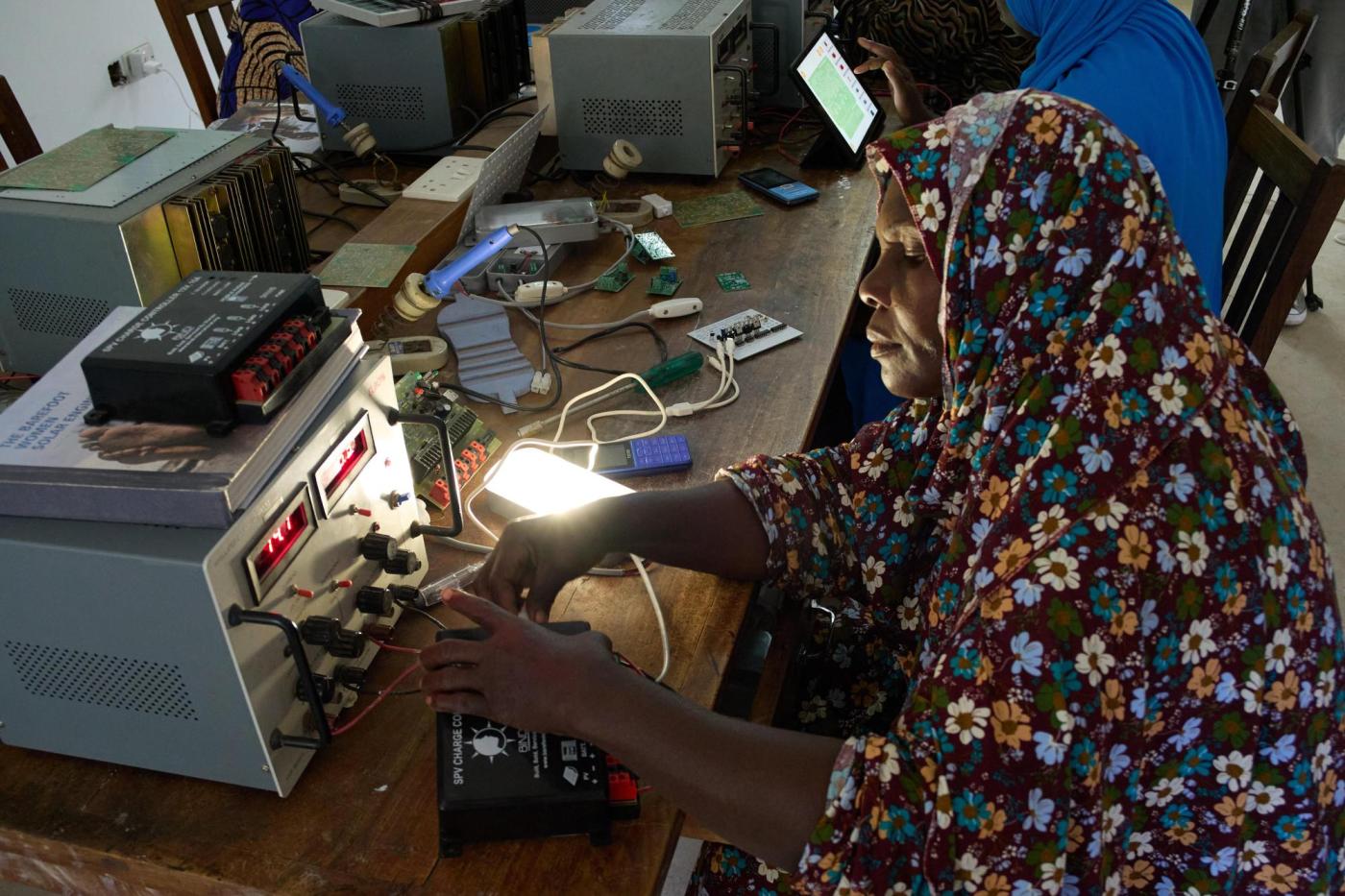
Hamad is one of dozens of “solar mamas” trained in Zanzibar by Barefoot College International, a global nonprofit, through a program that brings light to rural communities and provides jobs for local women. So far in Zanzibar, it has lit 1,845 homes.

The program selects middle-aged women, most with little or no formal education, from villages without electricity and trains them over six months to become solar power technicians. It is one of a small number of programs in Africa including Solar Sister.

“Solar Mama” technicians walk into a classroom on the campus of Barefoot College International in Kinyasini, Unguja, Zanzibar, July 23, 2025. (AP Photo/Jack Denton)

The women return to their communities with at least 50 sets of household solar panel kits as well as the skills and equipment to set them up and keep them running.

Barefoot College International focuses on middle-aged women because they tend to have the strongest links to their communities while not often involved in intensive child care.

“We want to train women who become change makers,” said Brenda Geofrey, the director of Barefoot College International Zanzibar.

The Zanzibar campus is in its 10th year of teaching local women. Before that, it sent women for training in India, where Barefoot College International was founded.

One was Khazija Gharib Issa, who had been an unemployed widow. Now she is a master trainer.

“I got a job. I got a place to stay. Before, I didn’t have one,” Issa said.

The importance of health

Improving health is at the heart of the program’s mission.

Alongside its flagship solar power course, Barefoot College International offers programs for women in tailoring, beekeeping and sustainable agriculture. Every woman who completes a program is trained in general health knowledge that they are expected to take back to their villages.

A “Solar Mama” technician wires up a solar charge controller at the campus of Barefoot College International in Kinyasini, Unguja, Zanzibar, July 23, 2025. (AP Photo/Jack Denton)

The “solar mamas” are health catalysts in another way, by replacing harmful light sources like kerosene.

“Using kerosene has many problems,” said Jacob Dianga, a health care worker at a local clinic who is familiar with the group’s work. The fuel can irritate the eyes, while inhaling its smoke can cause long-term lung damage. It’s also a fire hazard in cramped homes and shops, and can poison children who mistake it for a drink.

“Clean energy is very important,” Dianga said. “It helps protect our health.”

“Solar Mama” technicians walk on the campus of Barefoot College International in Kinyasini, Unguja, Zanzibar, July 23, 2025. (AP Photo/Jack Denton)

Challenges remain

Barefoot College International has scaled up across Africa, with other campuses in Madagascar and Senegal. In recent years, women have been brought to Zanzibar from Malawi and Somaliland, and this year some are being recruited from Central African Republic.

Funding remains a challenge as major donors, notably the United States and European ones, cut foreign aid and projects face more competition for money that remains.

Barefoot College International is run with public and private donations and revenue generated by its social enterprises.

A “Solar Mama” technician takes a training session on the campus of Barefoot College International in Kinyasini, Unguja, Zanzibar, July 23, 2025. (AP Photo/Jack Denton)

Another challenge is resistance in local communities, where some people find it hard to accept the women technicians in a radical new gender role.

While the solar training program recruits with the approval of village leadership, who put forward candidates, some husbands have stopped their wives from training.

“In most African communities, women are pictured as somebody who is just at home,” Geofrey said.

But the solar mamas say the results often speak for themselves.

“People used to say this work is for men. They were surprised and laughed at me,” Issa said. “But now they see how important my work is. I have become an example.”

For more on Africa and development: https://apnews.com/hub/africa-pulse

The Associated Press receives financial support for global health and development coverage in Africa from the Gates Foundation. The AP is solely responsible for all content. Find AP’s standards for working with philanthropies, a list of supporters and funded coverage areas at AP.org.

Homebuilders bet on 1% mortgage rates to wake up US buyers

posted in: All news | 0

By Prashant Gopal, Bloomberg News

With the average mortgage rate near 6%, U.S. homebuyers are looking at the most affordable monthly payments in a year. But San Antonio real estate agent Tavyn Weyman knows how to get them lower — much lower.

Related Articles


Average US long-term mortgage rate rises again, inching up to 6.24%


White House’s 50-year mortgage proposal has one notable benefit but a number of drawbacks


Average US long-term mortgage rate ticks up to 6.22% after four straight weekly declines


Americans staying put: US home turnover rate at lowest level in decades as housing slump drags on


Average long-term US mortgage rate dips to 6.17%, its lowest level in more than a year

The trick is simple: buy new.

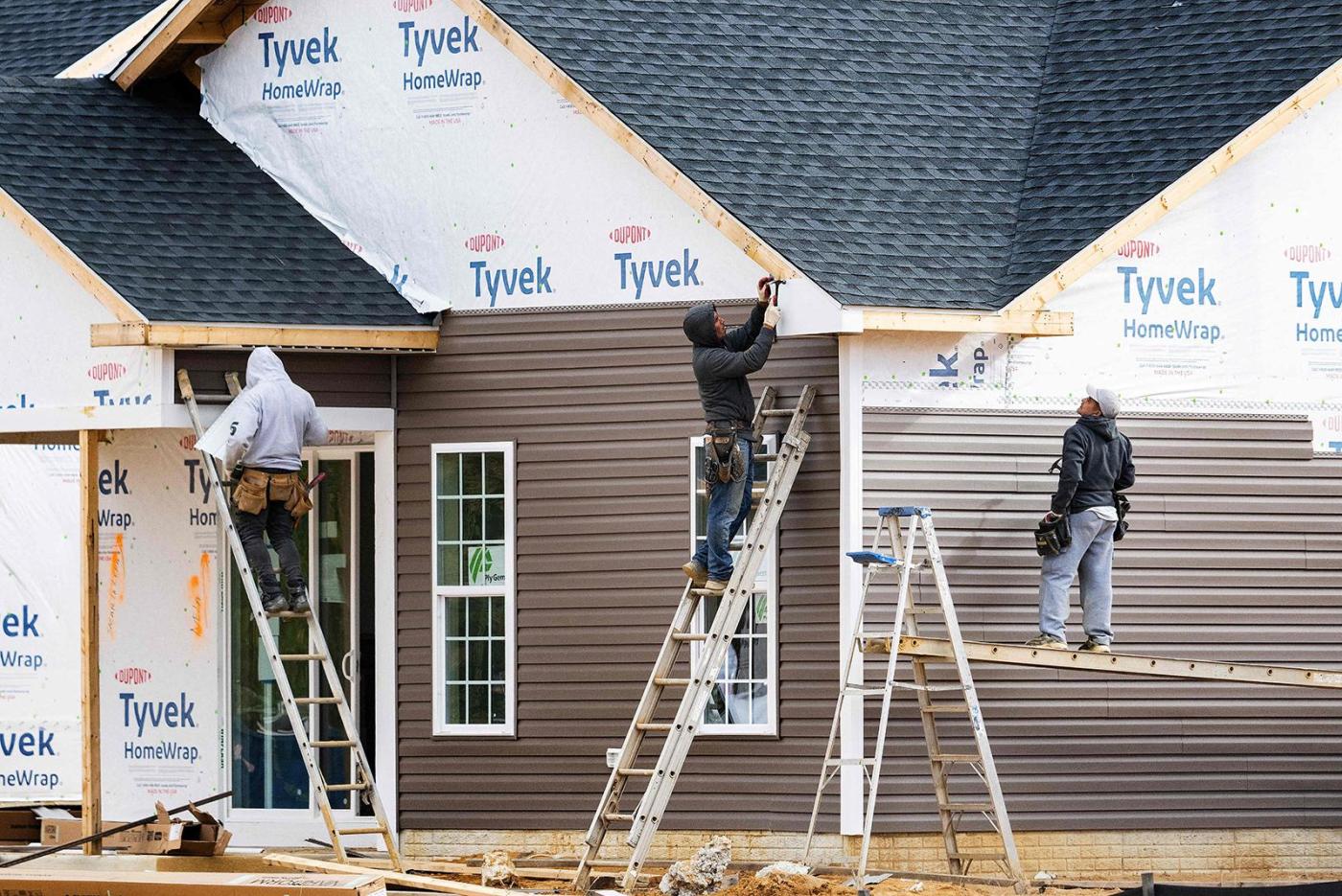
In markets across the U.S., homebuilders sitting on unsold inventory are subsidizing mortgage rates so heavily they sometimes match the record lows last seen during the Covid-19 pandemic. That’s in addition to perks like free appliances, finished basements and zero closing costs.

Weyman said a large private builder just gave one client a 3.49% fixed rate on a $414,000 home on the west side of town. The sales agent even bumped up Weyman’s commission to cover the cost of breaking the buyer’s lease and threw in another $2,000 to make the first month effectively free.

“You want to pay $2,000 a month on a brand new 4-bedroom home and have a 2% rate, I can find that now — as crazy as that sounds,” Weyman said. “It’s all negotiable.”

A single mother relocating from Florida is interested in a 3.99% fixed rate offered by D.R. Horton Inc., the biggest U.S. builder by stock market value. But it’s the introductory rate of less than 1% for the first year that really caught her eye, Weyman said.

These aren’t the perks of a healthy housing market. They’re the tactics of an industry trying to get the attention of buyers as tariffs, a government shutdown and artificial intelligence add to feelings of job insecurity.

Year-to-date job cuts have exceeded 1 million, the most since the pandemic, according outplacement firm Challenger, Gray & Christmas. Last month alone firms announced 153,000 cuts, the most for any October since 2003.

The anxiety is taking the wind out of a prophesied jump in homebuyer demand as mortgage rates decline.

“We would have expected to see a little bigger bump out of the reduction in mortgage rates that we’ve seen,” D.R. Horton Chief Executive Officer Paul Romanowski said on a call with analysts last month. “It truly is choppy.”

Other builders have shared disappointing feedback from the market. Century Communities Inc. in an earnings call said demand is especially weak from entry-level buyers. PulteGroup Inc. said first-time buyer orders plunged 14% in the latest quarter compared with a year earlier.

“Lower interest rates are a positive for housing demand, but rates don’t operate in a vacuum,” Ryan Marshall, chief executive officer of PulteGroup, said in an earnings call last month. “There is a clear offset if rates are coming down because the economy is slowing and people are worried about their jobs.”

A big obstacle for new sales agents is that renting is now much cheaper than buying. Rents are starting to dip, and landlords are reporting retention rates that are near record highs.

Meanwhile, resale listings are no longer in short supply, giving buyers plenty of other options. Still, few are biting. Pending sales stalled in September, still barely above record lows.

“The existing market is a much more formidable competitor to the homebuilders than it has been for a long time,” said Mark Zandi, chief economist at Moody’s Analytics. “There’s a lot of angst about job security, given there is no hiring. And artificial intelligence is coming on.”

For the first time, the price for a typical new home in July and August was cheaper than that of an existing home, according to a John Burns Research & Consulting analysis of Census and National Association of Realtors data. The average premium since 1973 was 16%. The analysis doesn’t include incentives.

Production builders spent an average of 7.5% of sales prices on incentives in the three months ended August, up from 4.8% in May 2024, according to the company’s builder surveys.

“There is an opportunity to buy new homes at really low rates,” said Eric Finnigan, vice president at John Burns. “The big surprise is why sales are still so soft.”

But not all rate buydowns are created equal. Some permanently lower borrowing costs for a full 30-year term, while others keep rates low only temporarily. Those deals can work well for households expecting rising income or a future refinancing — but they carry real risk for borrowers who aren’t prepared for the jump in monthly payments once the promotional period ends.

Lennar Corp. is in the midst of a nationwide “Inventory Close-Out Sale,” offering rates of 3.75% in Denver and up to $70,000 in price reductions in Charleston, South Carolina. Lennar spent 14% per home on incentives as a share of revenue this year, up from 10% in 2024.

The strategy of undercutting the resale market seems to be working, at least according to Weyman. The agent in San Antonio said seven of the eight homes he sold this year were newly built.

“New home buyers are expecting a lot of things so you’ve got to get them more,” Weyman said. “I always advertise that I’m never going to make a client pay for closing costs, especially now.”

—With assistance from Julia Fanzeres.

(Updates with October job cuts in eighth paragraph.)

©2025 Bloomberg L.P. Visit bloomberg.com. Distributed by Tribune Content Agency, LLC.

Man charged with criminal vehicular homicide in St. Paul crash that killed other driver

posted in: All news | 0

A driver was going more than 100 mph on Interstate 94 before he turned off his headlights, exited in St. Paul and struck another vehicle, killing the other driver, according to a criminal vehicular homicide charge filed Thursday.

The man who died, 31-year-old Benjamin Michael Villano of St. Paul, was a professional baker.

A trooper was stopped on Pascal Street by eastbound I-94, running speed radar, when he saw a Tesla traveling 84 mph in a 55-mph zone shortly before 2 a.m. Wednesday.

The trooper drove after the vehicle and had not activated his squad’s emergency lights or siren as he tried to catch up to the Tesla, which had increased its speed to more than 100 mph, according to the criminal complaint. The driver turned off his headlights as he approached the Dale Street exit.

The trooper, who lost sight of the Tesla as it went to the top of the exit ramp, saw sparks and smoke coming from the intersection, the complaint said. He found the driver had crashed into a Toyota RAV4 at Dale Street and Rondo Avenue.

It appeared the Tesla struck the Toyota’s front passenger door, pushing the Toyota across several lanes of traffic and into a retaining wall. The trooper couldn’t access the Toyota’s driver, Villano, to render aid. The St. Paul Fire Department responded and medics pronounced him dead.

The Tesla’s driver was identified as 22-year-old Musab Ibrahim Kosar, of Fridley, and the passenger was a 19-year-old from St. Paul. Both were injured, said they had no memory of the crash and were taken to the hospital, according to the complaint.

The passenger was diagnosed with fractures and a dislocated hip. Kosar had similar injuries and a large cut to his forehead.

Related Articles


Maplewood man, 56, admits in court to 2014 kidnapping and rape attempt


Man fatally shot after Clearwater County authorities say he discharged flare at officers


A judge said Luigi Mangione could have a laptop to view evidence in jail. He still hasn’t gotten it


What’s next in Congress on the push to release the Epstein files


Takeaways from the newly released Epstein documents

When the passenger was notified the Toyota’s driver had died, she “became very emotional,” according to the complaint. She said “she had asked Kosar to stop speeding that evening. (She) said they had broken up earlier in the day and were discussing their relationship after going to get food.”

Kosar is accused of operating a vehicle in a “grossly negligent manner.” He remained hospitalized when the complaint was filed Thursday. An attorney wasn’t listed for him in the court file.

Villano worked at the Bread Lab for Rose Street Patisserie in St. Paul and Patisserie 46 in Minneapolis. He previously worked at Wee Claddagh at Selby Avenue and Dale Street in St. Paul, baking for that location and Claddagh Coffee on West Seventh Street.