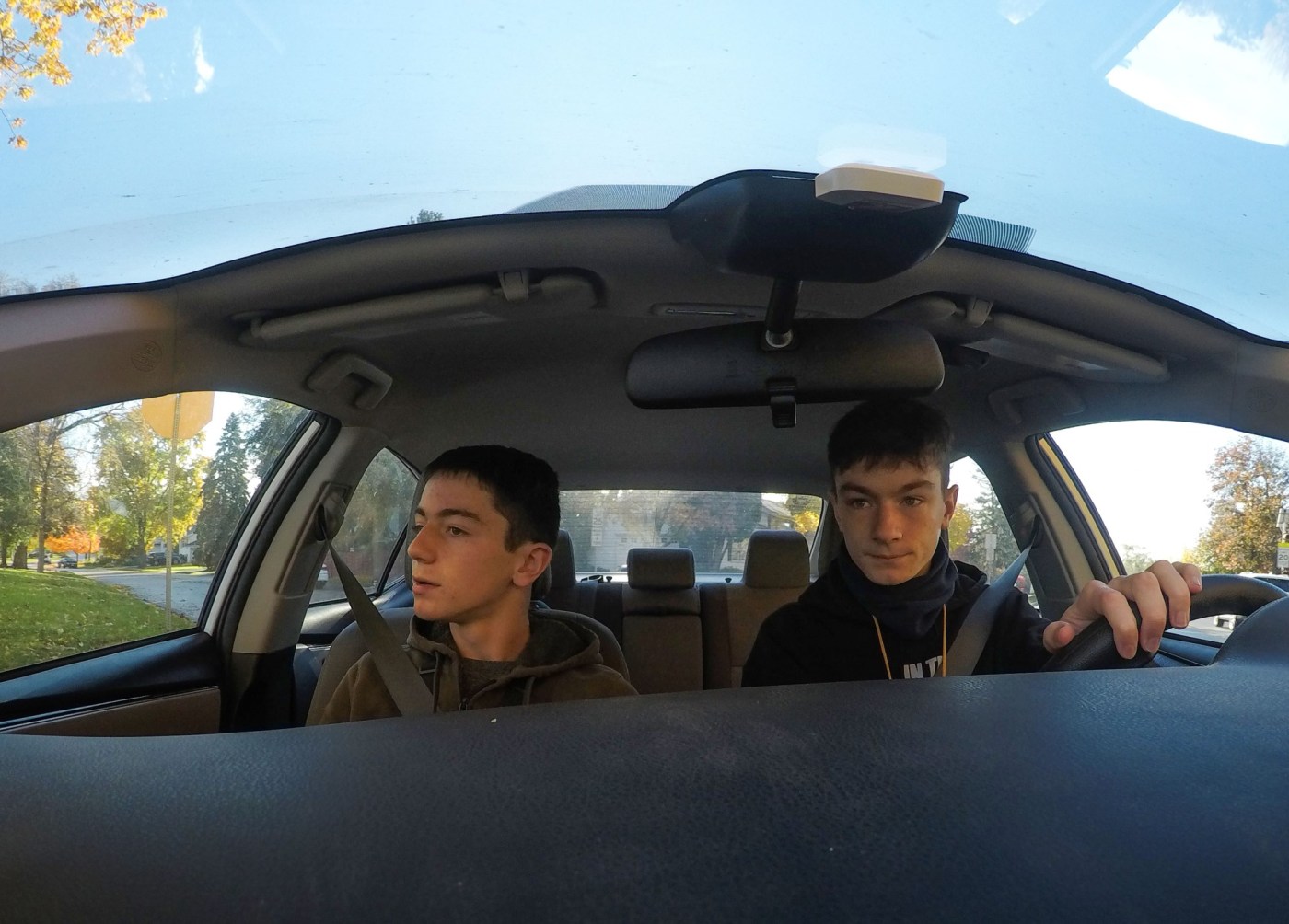
With a goodbye to their mom, Sam and Ben Luhmann walked out the screen door of their West Chicago home on a recent weekday morning.
A few minutes shy of 7:30 a.m., Ben pulled their midsize sedan out of the garage as Sam stood in the driveway, adjusting the straps around his shoulders and checking his phone.
But the brothers weren’t gunning to beat the first bell at school. They were racing to find ICE.
At 16 and 17 years old, Sam and Ben for the past two months have made it their mission to follow, investigate and capture federal immigration activity across the Chicago area. It’s an undertaking the brothers say happened naturally after growing up in a household where social justice and civic duty were as much a part of their homeschool curriculum as math and science.
“If I get the opportunity to fight like this for the rest of my life, I would be totally OK with that,” Ben said.
Their efforts in the vast resistance movement against the Trump administration’s mass deportation operation in Chicago, represent the wave of youth activists who have been galvanized into action by Midway Operation Blitz, following a long tradition paved around the world by young activists, experts say. From Students of a Democratic Society protesting the Vietnam War to today’s Malala Yousafzai and Greta Thunberg, the sense of injustice draws young people to act.
Brothers Sam and Ben Luhmann stand outside of the trailer of four landscapers were detained on Nov. 7, 2025, in St. Charles. (Stacey Wescott/Chicago Tribune)
“We know in these moments … where there is deep distrust toward political institutions — where individuals and particularly young people are feeling quite dissatisfied with both political parties — that young people actually do engage in politics quite passionately,” said Matthew Nelsen, an assistant professor of political science at the University of Miami who also works as a research consultant for the University of Chicago’s GenForward Survey.
Earlier this month, students at New Trier High School in Winnetka who regularly volunteer with refugees and migrants in Chicago spoke out that the school is curtailing their volunteer efforts because of the blitz. In October, hundreds of Little Village students staged a walkout in protest of the crackdown. And on Mexican Independence Day in September, students from all across Chicago Public Schools organized a rally in front of Trump Tower to denounce the raids, their cheers of “Viva la Raza” and “Viva Mexico” echoing through skyscrapers down East Wacker Drive.
“(The youth) hold a lot of power to shift the direction of the country and how it’s working,” said Kate Rice, 52, a Rogers Park-based rapid responder, who has witnessed a number of younger people spring into action. “It’s time for them to take control, especially Generation Alpha. They’re young, they’re motivated, they’re angry … and I think this is the perfect time for them to start getting politically active.”
When immigration agents started swarming Southern California in June, Ben found himself antsy to do something.
“Just the horror of it, I wanted to be able to fight it so bad,” he told the Tribune on a recent morning patrol. Sam sat in the passenger seat with a body camera strapped to his chest, his eyes glued to his phone for any reports of activity nearby.
His parents, both Wheaton College grads, have raised him and his seven younger siblings to see the humanity in everyone, Ben said. But from more than 2,000 miles away, he wasn’t sure what he could do. Then the blitz came to his hometown.
Sam Luhmann videotapes the vehicle of federal agents outside of the Kane County Judicial Center on Nov. 7, 2025, in St. Charles. (Stacey Wescott/Chicago Tribune)
On Sept. 15, Ben and Sam’s mom, Audrey Luhmann, got a text from a friend calling for someone to check reports of federal activity in West Chicago. Though she’d never received nor heeded that kind of request before, Luhmann’s gut reaction was that this is what she’s supposed to do, she recalled in an interview earlier this month. So she and her eight kids, even her 3-year-old, piled into their white passenger van.
By the time they arrived, activity had long passed. But that day introduced the family to other rapid responders. Within 48 hours, Ben and Sam encountered their first attempted federal immigration arrest in real time.
“I could finally do something,” Ben said.
Since the raids hit home, Ben and Sam, who have been homeschooled their whole lives, have balanced college applications and schoolwork with patrols. They’ve documented immigration enforcement from Carpentersville to Little Village. They’ve gone toe-to-toe with federal agents, asking officers questions and checking to make sure they’re abiding by court orders. And they’ve started to compile a list of plates on federal vehicles that appeared altered.
Every day is different. Last week, the pair spent a weekday morning primarily just monitoring usual hotspots and letting fellow rapid responders know areas were clear. But by the next day, they were going door-to-door speaking with neighbors about landscapers who had been detained in St. Charles and videotaping federal agents detain a man just outside the Kane County Judicial Center.
Nelsen, the University of Miami professor, said he thinks the uptick in youth political activism in Chicago is indicative of how younger residents are feeling about the current administration’s policies. Young people are also often drawn to extra-systemic forms of political action when they’re feeling cynical about their political institutions, Nelsen said.
“If they’re not feeling trusting of the government, they may be moved to take political action in realms that they feel are beyond the state,” he said.
Citlalli Santiago, 23, is a graduate student at the University of Illinois Chicago who became part of her local rapid response group after the presidential election. She said the raids have taken a toll on her own family but that moments like this illuminate the importance of a community banding together, to stepping in where government falls short. And she’s encouraged, she added, that younger voices are among those rising to the occasion because it’s a sign that progress is possible.
“I’m really proud of my peers (and the) people even younger than me because we’ve stepped up,” said Santiago, who recently moved to Pilsen but was born and raised in West Chicago. “I do think that things need to change, and if it’s younger people driving it, then I see more of a hope for the future.”
This week, the Tribune reported that after two months, the surge of federal immigration agents that descended on the city and its suburbs as part of President Donald Trump’s Operation Midway Blitz may soon leave as the controversial mission winds down, per multiple law enforcement sources. That doesn’t mean the enhanced immigration enforcement will end anytime soon, with sources saying the feds planned to leave in place a still-to-be-determined force of immigration agents.
And as long as that effort persists, even if and when their days of daily patrolling subside, the brothers will too, they say.
Sam Luhmann, 16, left, and his brother Ben,17, second from left, videotape federal agents detaining a man outside of the Kane County Judicial Center on Nov. 7, 2025, in St. Charles. While on patrol, they encountered the vehicles of four landscapers who had been detained earlier that morning as well as documented a man being detained outside of the Kane County Judicial Center after appearing for a routine court hearing. (Stacey Wescott/Chicago Tribune)
When the brothers first began, they thought they’d be patrolling for a week and a half, maybe two. But as operations stretched on, they’ve grown accustomed to being prepared for anything, to watching and waiting.
“It’s been weird getting home, from filming federal agents and being threatened to be arrested by them, and then having to work on college applications,” Ben said.
Ben, a senior this year, wants to go to the Berklee College of Music in Boston. Ben likes to write and produce songs, and he’d like to make a career out of it someday. Sam, a sophomore, prefers to spend his free time outside, whether that’s fishing or going for a bike ride.
But because of the patrols, the brothers have started to learn more about politics, law and policy, so that while they monitor, they know not just what they’re looking for, but why.
Lately, Ben has been delving into Jose Antonio Vargas’ “Dear America: Notes of An Undocumented Citizen.” He was assigned the book by his mom, as part of his homeschool studies.
Homeschooling all but one of her eight children, Audrey Luhmann has always tried to imbue a social justice lens in her lessons.
“Let’s study the forgotten voices, you know,” Luhmann, 40, told the Tribune on a recent afternoon after her sons returned home from another patrol. Around her, the remnants of previous lessons painted her house’s walls, from completed coloring pages of moments in history to a map of ancient Mesopotamia.
Schooling aside, Luhmann herself is no stranger to advocacy. For the past four years, she’s been an activist in the church space. She’s also been resisting in her own right alongside Ben and Sam, helping deliver Halloween candy last month to two west suburban apartment complexes hit by immigration enforcement.
At night, she and her husband, a geology professor at Wheaton College, have been sitting down with their oldest kids to digest the day’s events.
Sam Luhmann, 16, right, and his brother Ben, 17, record the vehicle of federal agents on Nov. 7, 2025, in St. Charles. (Stacey Wescott/Chicago Tribune)
And while her own aptitude for activism doesn’t keep her from worrying about Ben and Sam as they patrol (“I’m still a mom,” Luhmann noted), she knows the pull that has kept her sons on the front lines.
Last month, Ben and Sam were out monitoring a convoy of federal vehicles in Elgin when agents circled their car and pulled the brothers over. Pounding on their windows, the agents demanded the brothers get out.
“I’ve never seen a window shake like that,” Sam recalled. Sam had been recording the confrontation but when he opened his window, an agent took his phone and then pushed him against the car with his arms behind his back, he said. The agents threatened to arrest them for obstructing their investigations and endangering other drivers on the road.
But Ben, going on more than a year and half since he passed his driver’s test on the first try, maintained they always abide by the law and try to track federal activity from a distance.
Eventually, the agents let the brothers go with a warning.
For a while afterward, Ben and Sam just sat in their car, processing. They meant to head straight home, but then more reported activity started to come through. They decided to carry on.
That’s a through line for the brothers. Should the blitz subside, Ben and Sam say they plan to redirect their efforts to supporting those affected by operations full time.
“(I think) this really changes my perspective,” Ben said, “for the rest of my life.”
Chicago Tribune’s Andrew Carter and Jason Meisner contributed.