There’s an issue that people in big cities and rural areas agree on, according to a new poll

posted in: All news | 0

By THOMAS BEAUMONT, SIMRAN PARWANI and AMELIA THOMSON-DEVEAUX, Associated Press

DES MOINES, Iowa (AP) — Pessimism about the country’s future has risen in cities since last year, but rural America is more optimistic about what’s ahead for the U.S., according to a new survey from the American Communities Project.

Related Articles


In reversal, Trump says House Republicans should vote to release Epstein files


Trump’s Republican Party insists there’s no affordability crisis and dismisses election losses


Trump cuts ties with ‘Wacky’ Marjorie Taylor Greene, once among his top MAGA-world defenders


Judge indefinitely bars Trump from fining University of California over alleged discrimination


Trump administration appeals judge’s ruling barring troop deployment in Portland

And despite President Donald Trump’s insistence that crime is out of control in big cities, residents of the nation’s largest metropolitan centers are less likely to list crime and gun violence among the chief concerns facing their communities than they were a couple years ago.

Optimism about the future is also down from last year in areas with large Hispanic communities.

These are some of the snapshots from the new ACP/Ipsos survey, which offers a nuanced look at local concerns by breaking the nation’s counties into community types, using data points like race, income, age and religious affiliation. The survey evaluated moods and priorities across the 15 different community types, such as heavily Hispanic areas, big cities and different kinds of rural communities.

The common denominator across the communities? A gnawing worry about daily household costs.

“Concerns about inflation are across the board,” said Dante Chinni, founder and director of ACP. “One thing that truly unites the country is economic angst.”

Rising optimism in rural areas, despite economic anxiety

Rural residents are feeling more upbeat about the country’s trajectory — even though most aren’t seeing Trump’s promised economic revival.

A new survey from The American Communities Project shows that residents of America’s Big Cities are less likely to list crime or gun violence among the top issues facing their communities than they were in 2023. The ACP/Ipsos survey offers a nuanced look at local concerns by breaking the nation’s counties into 15 different community types, such as heavily Hispanic areas, big cities and different kinds of rural communities.

The $15 price tag on a variety pack of Halloween candy at the Kroger supermarket last month struck Carl Gruber. Disabled and receiving federal food aid, the 42-year-old from Newark, Ohio, had hardly been oblivious to lingering, high supermarket prices.

But Gruber, whose wife also is unable to work, is hopeful about the nation’s future, primarily in the belief that prices will moderate as Trump suggests.

“Right now, the president is trying to get companies who moved their businesses out of the country to move them back,” said Gruber, a Trump voter whose support has wavered over the federal shutdown that delayed his monthly food benefit. “So, maybe we’ll start to see prices come down.”

About 6 in 10 residents of Rural Middle America — Newark’s classification in the survey — say they are hopeful about the country’s future over the next few years, up from 43% in the 2024 ACP survey. Other communities, like heavily evangelical areas or working-class rural regions, have also seen an uptick in optimism.

Kimmie Pace, a 33-year-old unemployed mother of four from a small town in northwest Georgia, said, “I have anxiety every time I go to the grocery store.”

But she, too, is hopeful in Trump. “Trump’s in charge, and I trust him, even if we’re not seeing the benefits yet,” she said.

Big-city residents are worried about the future

By contrast, the share of big-city residents who say they are hopeful about the nation’s future has shrunk, from 55% last year to 45% in the new survey.

Robert Engel of San Antonio — Texas’ booming, second most-populous city — is worried about what’s next for the U.S., though less for his generation than the next. The 61-year-old federal worker, whose employment was not interrupted by the government shutdown nor Trump’s effort to reduce the federal workforce, is near retirement and feels financially stable.

A stable job market, health care availability and a fair economic environment for his adult children are his main priorities.

Recently, the inflation outlook has worsened under Trump. Consumer prices in September increased at an annual rate of 3%, up from 2.3% in April, when the president first began to roll out substantial tariff increases that burdened the economy with uncertainty.

Engel’s less-hopeful outlook for the country is broader. “It’s not just the economy, but the state of democracy and polarization,” Engel said. “It’s a real worry. I try to be cautiously optimistic, but it’s very, very hard.”

Crime, gun violence are less a concern in urban America

Trump had threatened to deploy the National Guard to Chicago, New York, Seattle, Baltimore, San Francisco and Portland, Oregon, to fight what he said was runaway, urban crime.

Yet data shows most violent crime in those places, and around the country, has declined in recent years. That tracks with the poll, which found that residents of America’s Big Cities and Middle Suburbs are less likely to list crime or gun violence among the top issues facing their communities than they were in 2023.

For Angel Gamboa, a retired municipal worker in Austin, Texas, Trump’s claims don’t ring true in the city of roughly 1 million people.

“I don’t want to say it’s overblown, because crime is a serious subject,” Gamboa said. “But I feel like there’s an agenda to scare Americans, and it’s so unnecessary.”

Instead, residents of Big Cities are more likely to say immigration and health care are important issues for their communities.

Big Cities are one of the community types where residents are most likely to say they’ve seen changes in immigration recently, with 65% saying they’ve seen a change in their community related to immigration over the past 12 months, compared with only about 4 in 10 residents of communities labeled in the survey as Evangelical Hubs or Rural Middle America.

Gamboa says he has witnessed changes, notably outside an Austin Home Depot, where day laborers regularly would gather in the mornings to find work.

Not anymore, he said.

“Immigrants were not showing up there to commit crimes,” Gamboa said. “They were showing up to help their families. But when ICE was in the parking lot, that’s all it took to scatter people who were just trying to find a job.”

Hispanic communities are less hopeful about the future

After Hispanic voters moved sharply toward Trump in the 2024 election, the poll shows that residents of heavily Hispanic areas are feeling worse about the future of their communities than they were before Trump was elected.

Carmen Maldonado describes her community of Kissimmee, Florida, a fast-growing, majority-Hispanic city of about 80,000 residents about 22 miles (35 kilometers) south of Orlando, as “seriously troubled.”

The 61-year-old retired, active-duty National Guard member isn’t alone. The survey found that 58% of residents of such communities are hopeful about the future of their community, down from 78% last year.

“It’s not just hopelessness, but fear,” said Maldonado, who says people in her community — even her fellow native Puerto Ricans, who are American citizens — are anxious about the Trump administration’s aggressive pursuit of Latino immigrants.

Just over a year ago, Trump made substantial inroads with Hispanic voters in the 2024 presidential election.

Beyond just the future of their communities, Hispanic respondents are also substantially less likely to say they’re hopeful about the future of their children or the next generation: 55% this year, down from 69% in July 2024.

Maldonado worries that the Trump administration’s policies have stoked anti-Hispanic attitudes and that they will last for her adult child’s lifetime and beyond.

“My hopelessness comes from the fact that we are a large part of what makes up the United States,” she said, “and sometimes I cry thinking about these families.”

Parwani and Thomson-DeVeaux reported from Washington.

The American Communities Project/Ipsos Fragmentation Study of 5,489 American adults aged 18 or older was conducted from Aug. 18 – Sept. 4, 2025, using the Ipsos probability-based online panel and RDD telephone interviews. The margin of sampling error for adults overall is plus or minus 1.8 percentage points.

New analysis shows more US consumers are falling behind on their utility bills

posted in: All news | 0

By JOSH BOAK, Associated Press

WASHINGTON (AP) — More people are falling behind on paying their bills to keep on the lights and heat their homes, according to a new analysis of consumer data — a warning sign for the U.S. economy and another political headache for President Donald Trump.

Related Articles


Today in History: November 17, the NFL’s infamous ‘Heidi Game’


Trump’s Republican Party insists there’s no affordability crisis and dismisses election losses


Today in History: November 16, Pakistan elects first woman prime minister


Today in History: November 15, Protesters march against Vietnam War


Disney reaches new deal with YouTube TV, ending a blackout that lasted over two weeks

Past due balances to utility companies jumped 9.7% annually to $789 between the April-June periods of 2024 and 2025, said The Century Foundation, a liberal think tank. The increase has overlapped with a 12% jump in monthly energy bills during the same period.

Consumers usually prioritize their utility bills along with their mortgages and auto debt, said Julie Margetta Morgan, the foundation’s president. The increase in both energy costs and delinquencies may suggest that consumers are falling behind on other bills, too.

“There’s a lot of information out there about rising utility costs, but here we can actually look at what that impact has been on families in terms of how they’re falling behind,” Margetta Morgan said.

Troubles paying electricity and natural gas bills reflect something of an economic quandary for Trump, who is promoting the buildout of the artificial intelligence industry as a key part of an economic boom he has promised for America. But AI data centers are known for their massive use of electricity, and threaten to further increase utility bills for everyday Americans.

These troubles also come as Trump faces political pressure from voters fed up with the high cost of living.

Ever since Republicans saw their fortunes sag in off-year elections this month and affordability was identified as the top issue, Trump has been trying to convince the public that prices are falling. Fast-rising electricity bills could be an issue in some congressional battlegrounds in next year’s midterm elections.

Trump has put a particular emphasis on prices at the pump. Gasoline accounts for about 3% of the consumer price index, slightly less than the share belonging to electricity and natural gas bills — meaning that possible savings on gasoline could be more than offset by higher utility bills.

The president maintains that any troubling data on inflation is false and that Democrats are simply trying to hurt his administration’s reputation.

“In fact, costs under the TRUMP ADMINISTRATION are tumbling down, helped greatly by gasoline and ENERGY,” Trump posted on social media Friday. “Affordability is a lie when used by the Dems,”

Nearly 6 million households have utility debt “so severe” that it will soon be reported to collection agencies, according to the foundation’s analysis, drawn from the University of California Consumer Credit Panel.

During Trump’s first six months in office, there was a 3.8% increase in households with severely overdue utility bills.

“Voters are frustrated and families are hurting because these tech giants are cutting backroom deals with politicians, and it’s causing their power bills to go up,” said Mike Pierce, executive director of the advocacy group Protect Borrowers, which contributed to the analysis. “If the Trump administration doesn’t want to do its job and protect families and make life more affordable, I guess that’s its choice.”

Both Margetta Morgan and Pierce previously worked at the Consumer Financial Protection Bureau, a government agency formed in part to track trends in household borrowing to prevent potential abuses. The Trump administration has essentially shut down the bureau.

The administration has so far said it has no responsibility for any increases in electricity prices, since those are often regulated by state utility boards. The White House maintains that utility costs are higher in Democratic states that rely on renewable forms of energy.

“Electricity prices are a state problem,” Treasury Secretary Scott Bessent told ABC News this month. “There are things that the federal government can control. Local electricity prices are not one of them.”

The Century Foundation analysis counters that the Trump administration is contributing to higher utility costs “by impeding renewable energy generation” including solar and wind power.

While the new analysis is a warning sign, other economic analyses on consumers suggest their finances are stable despite some emerging pressures.

The New York Federal Reserve has said delinquency rates of 90 days or more for mortgages, auto loans and student debt have each increased over the past 12 months, though it said mortgage delinquencies are “relatively low.” An analysis of debit and credit card spending by the Bank of America Institute showed that consumers’ “overall financial health looks sound.”

Takeaways from the Vikings’ 19-17 loss to the Bears

posted in: All news | 0

After nearly pulling off in incredible escape act on Sunday afternoon at U.S. Bank Stadium, the Vikings ended up getting exactly what they deserved in a heartbreaking 19-17 loss to the Chicago Bears.

Though they managed to take the lead in the final minute thanks to an impressive drive from J.J. McCarthy, the Vikings had no business beating the Bears with how poorly they played throughout the game.

It was another rough outing for McCarthy as he continues to struggle through what can kindly be considered growing pains. Is he salvageable? That’s a question that Vikings are going to have to start asking themselves if his poor play continues.

Here are some takeaways from the game:

J.J. McCarthy’s accuracy is a problem

As he reflected on his performance after the game, McCarthy gave a blunt assessment of himself, acknowledging that he needs to be more accurate if the Vikings are going to have any chance of success.

He’s spot on.

The accuracy was an issue for McCarthy through his first month as a starter for the Vikings and it didn’t get any better as he only completed 16 of 32 passes for 150 yards, a touchdown, and a pair of interceptions.

As bad as the misses from McCarthy looked bad in real time, they looked even worse after watching the film. There were players running wide open down the field on multiple occasions and he never even gave them a chance.

There’s no excuse for missing some of the throws McCarthy missed throughout the game. If it doesn’t improve dramatically over the next couple of months, difficult conversations will need to be had sooner rather than later.

Kevin O’Connell called a good game

A vocal minority of the fan base wanted to take play calling away from Kevin O’Connell last weekend. He responded to that nonsense by consistently putting McCarthy in a place to succeed this weekend.

There was a healthy dose of Aaron Jones and Jordan Mason in the run game, which, in turn, set up different looks in the pass game. The only problem was that McCarthy consistently missed some of the easy throws that were there to be made.

There was the misfire to Jordan Addison deep down the field off of play action. There was the misfire to T.J. Hockenson up the sideline with nobody around him. There was the misfire to Justin Jefferson on a mismatch that was perfectly schemed up.

There’s only so much O’Connell can impact the game from the sideline. If anybody walks away from that game criticizing him for his play calling, they are intentionally focusing on the wrong things.

Jordan Addison had a costly drop

With the Vikings trying to take control of the game in the early stages, McCarthy stepped up in the pocket, then fired down the field Addison, who was running wide open over the middle following a crisp route.

It should have been a big play that moved the chains and helped put the Vikings in scoring position. It ended up going down as a missed opportunity and Ryan Wright came on to punt.

Maybe things would’ve played out differently if Addison hadn’t recorded a drop on a play that absolutely should’ve resulted in a catch. There was also another uncharacteristic drop from Addison that stopped a drive in its tracks

Asked about both of his drops after the game, Addison lamented his mistakes, adding that he needs to be better for McCarthy moving forward. The same thing can be said about McCarthy, however, when looking at all of his plays in the aggregate.

The defense needs to force turnovers

It wouldn’t be fair to place too much blame on the defense considering how effectively it was able to keep Caleb Williams out of a rhythm. He never seemed comfortable because of the way the defense was playing on the other end.

Though he managed to avoid sacks like he was Harry Houdini in his prime, Williams was running for his life for large chunks of the game. That led to some of him only completing 16 of 32 passes for 193 yards, no touchdowns, and no interceptions.

As much as the Vikings were able to bother him inside and outside of the pocket, however, they were not able to turn him over. This is the latest game during which they failed to force a turnover.

It was a strength of the Vikings last season as they led the league in takeaways. It’s been a weakness of the Vikings this season as they haven’t been able to force turnovers at nearly the same rate.

That’s a concerning trend that needs to change.

The special teams giveth and taketh away

The duality of special teams was on display for the Vikings at different stretches throughout the game.

They got a 42-yard punt return by Myles Price that helped provide a spark a pivotal moment. They also allowed a 56-yard kickoff return to Devan Duvernay that contributed to losing the game as time expired.

The good news for the Vikings? It appears Price has a chance to be the best kick returner and punt returner they’ve had in a decade. The bad news for the Vikings? The unit is still very much a work in progress at this point.

Related Articles


Harrison Smith gets massive ovation ahead of 200th game with the Vikings


Shipley: This season shouldn’t become a referendum on J.J. McCarthy


Vikings drop heartbreaker to Bears on a field goal as time expires


The Loop Fantasy Football Update Week 11: Last-minute moves


Charley Walters: J.J. McCarthy auditioning to remain Vikings’ starter

St. Paul City Council simplifies standards in mixed-use zoning areas

posted in: All news | 0

It just got a pinch easier to open a coffee shop in St. Paul, and to add housing above it — but it could get easier still.

The city’s “traditional neighborhood” zoning districts invite, at various intensities, real estate development that combines housing, retail and office uses side-by-side or in a single building, often with apartments built over a restaurant or ground-level storefront. The T1, T2, T3 and T4 districts also include design standards governing everything from windows and trees to block lengths.

The St. Paul City Council on Wednesday approved a longstanding effort to encourage more pedestrian-oriented design in “T districts” while allowing, in some cases, greater height and density under a simplified zoning code. The changes run from mild to meaningful, merging some sections of the zoning code while canceling others outright.

The council’s 7-0 vote was immediately followed by a decision to perform a follow-up zoning study that aims to potentially refashion more of the city’s commercial corridors as mixed-use “T districts,” especially along transit lines.

“We are immediately doing the next step,” said City Council President Rebecca Noecker, addressing fellow council members.

Effort to simplify regulations

Over the years, advocates for affordable housing and mixed-use development have called on the city to simplify regulations and loosen some permitting and design standards within the T districts, while in some cases adding more standards to encourage pedestrian access. The city set out to address those demands through study and outreach that began in 2022, resulting this week in zoning changes that development advocates like Sustain St. Paul have praised for their flexibility.

On Sept. 5, by a vote of 12-0, the St. Paul Planning Commission recommended approval of the staff-driven zoning changes included in the “T district zoning study.” The city council held a public hearing on Nov. 5.

“These common-sense changes will make the ‘T districts’ easier for city staff to administer, and easier for prospective real estate developers (especially regular folks working on small, locally-financed, neighborhood-scale projects) to understand and follow,” wrote Benjamin Werner, a community development manager with Dayton’s Bluff Neighborhood Housing Services, in a letter to the city council.

Werner and others encouraged the city to rezone existing business and transit corridors and expand “T districts” throughout the city, “so that people can open neighborhood-serving businesses like coffeeshops and corner stores in more places without first having to get their property rezoned.”

The council, which voted 7-0 to adopt the new T district zoning study, immediately pivoted to do exactly that, again voting 7-0 to initiate a “T district follow-up and transit corridor zoning study.”

The changes

Among the newly-approved changes:

• Parking: Surface parking in T districts must not be located within 30 feet of a corner.

• Building facade: A section of the code called “building facade articulation” has been renamed “frontage elements,” and now requires a building’s base 30 feet — not just the base 25 feet — facing abutting public streets to “include elements that relate to the human scale at grade … doors, windows, projections, awnings, canopies, porches, stoops, etc.”

• Floor area ratios for affordable housing: The maximum allowed floor area ratios can be increased if at least 10% of the residential units are designated affordable housing for at least 10 years, and leased at or below 60% of area median income, as defined by Minnesota Housing.

• Height: In T districts, a maximum height of 90 feet is already permitted with a conditional use permit, though structures must be stepped back by one foot from all setback lines for every 2½ feet of height over 75 feet. The new code amendments state that “additional building height is permitted when stated in an adopted T District master plan,” and they remove restrictions on height allowances in the river corridor overlay district and within light rail station areas between Lexington Parkway and Marion Street.

• Definitions: The zoning code now tweaks definitions of T1, T2, T3, and T4 districts to emphasize commerce, transit and intensity.

• Until now, for instance, T4 districts allowed “greater transit use” alongside “high-density, mixed-use development.” Under the new definition, T4 districts will be defined as those in which both “more frequent transit service” and reliance on transit make “high-intensity, mixed-use development possible and desirable.”

• Design standards: The new code amendment eliminates existing language that says “in general, it is desirable for each block to include some diversity in housing type, building type and mix of land uses.” It also relaxes standards around block lengths, transitioning from higher to lower density neighborhoods, and using established building facade lines, as well as requiring new buildings on corner lots to be oriented to the corner and two public streets.

• Retail and restaurants: In T1 neighborhoods, any individual retailer within a building may take up no more than 5,000 square feet. In T2-T4 districts, a conditional use permit is required for new construction covering more than 20,000 square feet “to ensure size and design compatibility with the particular location.” Conditional use permits are required in all T districts for restaurants, printing and other factory-style production larger than 15,000 square feet.

• Coffee shops: A conditional use permit is required for a coffee shop or tea house spanning more than 1,500 square feet in floor area in T1 and B1 business districts. The previous threshold was 800 square feet.

• Rental storage: Within a mixed-use building, rental storage may not exceed 15% of the building’s total floor area and may not have storage units on the first floor or at skyway level. In all T districts, the storage facility’s primary entrance, loading areas and freight elevators must not be located within the front third of the building, and may not be shared with other uses.

• Setback restrictions: Up to 40% of the building facade on any lot would be allowed to exceed the maximum setback requirement in order to create outdoor seating, gathering areas or courtyards. Civic and institutional buildings in T1 and T2 districts would be exempt from the maximum front yard setback requirement.

Related Articles


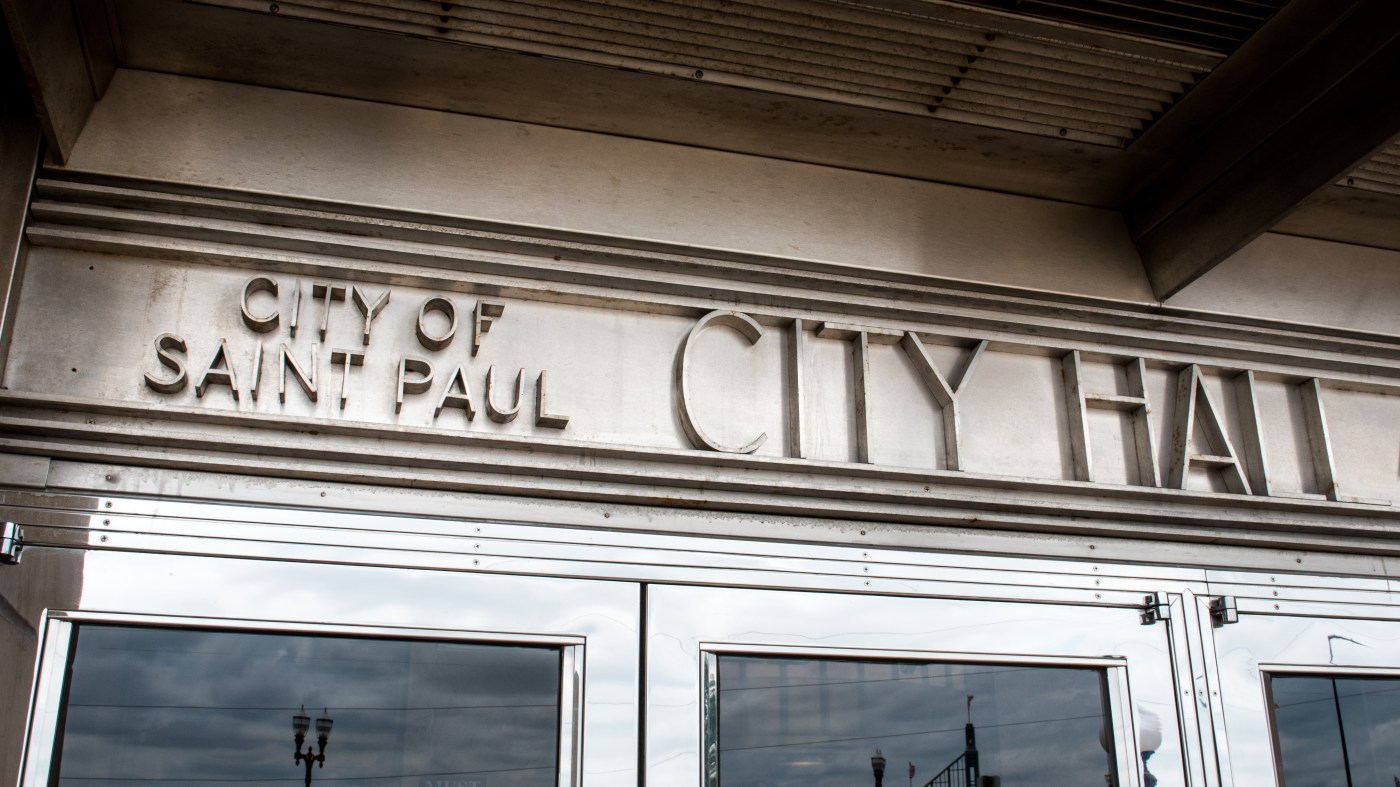
Shari Moore to retire after nearly 40 years at St. Paul City Hall


St. Paul: Hamm’s Brewery site designated ‘local heritage preservation district’


Bye Bye Bitcoin? St. Paul City Council discusses banning crypto ATMs


St. Paul offering $2,500 for those facing eviction. Here’s how it works.


Lawsuit filed after St. Paul City Council unanimously approves firearms regulation ordinance

• Certain setback restrictions would still apply to corner lots near transitway platforms, as well as local heritage preservation sites.

• Height at property lines: Under the new rules, structures adjoining residential districts (RL-H2) at a common property line or alley must be no more than 30 feet high along rear and side lines. They may exceed that requirement if they’re stepped back at a distance equal to the additional height, or if additional building height is permitted in an adopted T district master plan.

• Rooflines: Buildings of two or more stories must include a cornice, parapet or roof overhang in the area between the top floor and highest point of the building.