By REBECCA SANTANA
WASHINGTON (AP) — In a one-minute video, Homeland Security Secretary Kristi Noem, decked out in Western riding gear and a cowboy hat, rides a horse through a pine forest near Mount Rushmore. She trumpets her department’s hard-line message: “You cross the border illegally, we’ll find you.”
Related Articles
Kennedy Center exodus continues as National Symphony director Jean Davidson heads to the Wallis
Judge weighs bid to block policy limiting journalists’ access to Pentagon
US issues a license that authorizes sales of Venezuelan gold
Evidence suggests the deadly blast at an Iranian school was likely a US airstrike
Congress is on track for record retirements. In Illinois, that’s created a candidate frenzy
The ad was one of the many times the outgoing secretary made herself the public face of her department. In the end, that approach led to her undoing.
President Donald Trump on Thursday announced he was firing Noem, a decision that came on the heels of back-to-back hearings in Congress this week where she faced rare but blistering criticism from Republican lawmakers, especially over the $220 million ad campaign that featured the secretary on horseback.
An administration official said the ad campaign, along with other “many unfortunate leadership failures” such as fallout from the immigration enforcement operation in Minnesota and mismanagement of her staff, led to her firing. The official spoke on condition of anonymity because they weren’t authorized to discuss the private considerations for the firing.
Noem had faced criticism for months, primarily from Democrats, about the administration’s tough immigration crackdown, especially in the aftermath of the shooting deaths of two Minneapolis protesters at the hands of federal officers. Despite outrage over how she characterized the protesters as agitators, publicly Trump stood by her throughout her 13-month tenure.
Noem’s social media was awash in videos of her out on the streets seemingly joining arrest sweeps of illegal migrants, and photographs of her posing in front of inmates at a notorious El Salvadoran prison. Airports across the country also beamed videos of Noem blaming Democrats for a federal government shutdown.
In the end, keeping the spotlight on herself drew fierce scrutiny that may have pushed the president over the edge in deciding whether to keep her on board. Trump said he will nominate Oklahoma Republican Sen. Markwayne Mullin in her place and will make Noem a “Special Envoy for The Shield of the Americas,” a new security initiative that will focus on the Western Hemisphere.
FILE – As prisoners stand looking out from a cell, Homeland Security Secretary Kristi Noem speaks during a tour of the Terrorism Confinement Center in Tecoluca, El Salvador, March 26, 2025. (AP Photo/Alex Brandon, File)
Noem was grilled in Congress this week over the ads
In the Mount Rushmore ad, a montage of video clips shows classic images of American history and culture — a rocket launching into air, a woman standing in a golden wheat field — interspersed with images of Trump being sworn into office, pumping his fist in the air after being shot at, and walking along a row of saluting cadets.
“Anyone who searches for freedom can always find a home here, but that freedom’s a precious thing. And we defend it vigorously. You cross the border illegally, we’ll find you,” Noem says in the video.
“But if you come here the right way, your American dream can be as big as these open skies. From President Trump and me, Welcome home.”
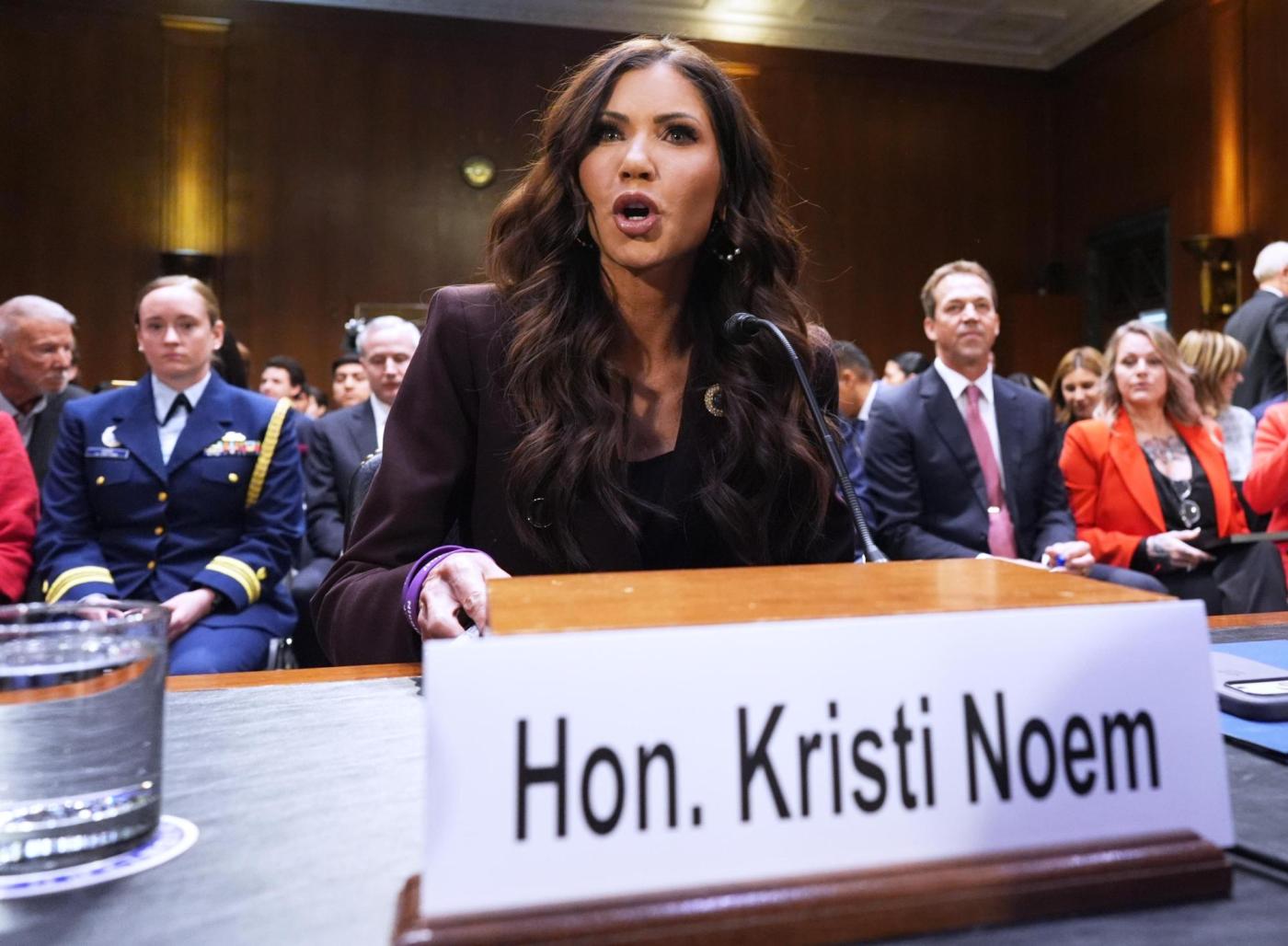
Over two days of questioning this week, senators and representatives pushed her to explain the ad campaign.
Republican Sen. John Kennedy of Louisiana asked whether spending $220 million was appropriate when the administration was in a battle against waste. And he asked what the president knew.
“The president approved ahead of time you spending $220 million running TV ads across the country in which you are featured prominently?”
“Yes, sir,” Noem replied. “We went through the legal processes. Did it correctly.”
FILE – Homeland Security Secretary Kristi Noem, center, watches as officers speak with a person passing through the San Ysidro Port of Entry, March 16, 2025, in San Diego. (AP Photo/Alex Brandon, File)
She was repeatedly pressed about contracts awarded surrounding the campaign.
The Associated Press reported last year that the Department of Homeland Security, citing “an unusual and compelling urgency” over the situation at the U.S.-Mexico border, skipped a fully competitive bidding process when it launched an ad campaign early in 2025 and gave two Republican-linked firms the first part of the funding.
Noem insisted to Kennedy that the campaigns were effective.
“Well, they were effective in your name recognition,” Kennedy replied.
Kennedy said Trump and Noem had different versions of the president’s role
Kennedy went on to suggest that the campaign “puts the president in a terribly awkward spot.”
“It’s just hard for me to believe knowing the president as I do, that you said, ‘Mr. President, here’s some ads I’ve cut and I’m going to spend $220 million running them’ that he would have agreed to that,” said Kennedy.
Trump later told NBC News that he didn’t know about the campaign and that he wasn’t “thrilled” with it.
“I spent less money than that to become president. I didn’t know about it,” he said.
Kennedy told CNN that he got a call from Trump Tuesday evening and the president was angry.
FILE – Homeland Security Secretary Kristi Noem pilots a U.S. Coast Guard Response Boat Small with the Maritime Security Response Team, March 16, 2025, in San Diego. (AP Photo/Alex Brandon, File)
“Her version and the president’s version of whether the president, A) was informed and B) consented are decidedly different,” Kennedy said.
Kennedy, speaking after Noem’s firing, said he spoke with the president after the secretary’s testimony and he was “mad as a murder hornet.”
When Trump nominated Noem for his Cabinet, he said he’d known her for years and she was “very strong” on border security. As recently as after the Minneapolis fallout in January, Trump said she was doing “great.”
Noem made herself the public face of DHS
Beyond the Mount Rushmore ad, Noem appeared in other ads and a stream of social media videos and photos put out by the DHS communications team or in news reports. The constant appearances and content showed an image of a secretary out in the field, carrying out Trump’s vision. She swooped into the heart of immigration enforcement operations, with visuals of the action following shortly after.
It was a tactic she employed right from the beginning of her tenure, when she went out with Immigration and Customs Enforcement agents making arrests in New York City. Wearing a flak jacket and baseball cap, Noem said in a video that they were “getting the dirtbags off the streets.”
Later images showed her at the controls of a plane in Alaska or decked out in firefighting gear taking part in a training exercise. In Chicago she accompanied agents on a raid near a local Walmart store.
In one video, she stood in front of a cell packed with inmates in a Salvadoran prison and warned people not to come to the U.S. illegally or they could end up there.
She may have successfully raised her profile. But in the end, she became the latest senior administration official to rankle the president and be shuffled into obscurity.