CDC studies show value of nationwide wastewater disease surveillance, as potential funding cut looms

posted in: All news | 0

By DEVI SHASTRI

Wastewater testing can alert public health officials to measles infections days to months before cases are confirmed by doctors, researchers said in two studies published Thursday by the Centers for Disease Control and Prevention.

Related Articles


Kaiser affiliates will pay $556M to settle a lawsuit alleging Medicare fraud


Trump announces outlines of health care plan he wants Congress to consider


Final day to select ACA health plans arrives in most states, with no subsidy deal yet


To knock down health-system hurdles between you and HIV prevention, try these 6 things


Public mistrust linked to drop in deceased donor organ donations and kidney transplants

Colorado health officials were able to get ahead of the highly contagious virus by tracking its presence in sewer systems, researchers wrote. And Oregon researchers found wastewater could have warned them of an outbreak more than two months before the first person tested positive.

The findings add to evidence that wastewater testing is a valuable weapon in tracking disease, including COVID-19, polio, mpox and bird flu.

But the national wastewater surveillance system, run by CDC since 2020, is newly at risk, under a Trump administration budget plan would slash its funding from about $125 million a year to about $25 million.

Peggy Honein, director of the CDC’s division of infectious disease readiness and innovation, said the proposed funding level would “sustain some of the most critical activities” but “it would likely require some prioritization.”

The national system covers more than 1,300 wastewater treatment sites serving 147 million people. It includes six “centers for excellence” — Colorado among them — that innovate and support other states in expanding their testing.

States brace for cuts

The funding cut is still a proposal, and Congress has started pushing back against cuts to health care in general.

But state health departments say they are preparing for a potential loss of federal support regardless. Most state programs are entirely federally funded, Honein said.

Colorado started its wastewater surveillance program in 2020 with 68 utilities participating voluntarily. The program has since narrowed in its focus even as it grew to include more diseases, because it is 100% federally funded, said Allison Wheeler, manager of the Colorado’s wastewater surveillance unit.

The work is funded through 2029, Wheeler said, and the department is talking to state leaders about what to do after that.

“I know that there are other states that haven’t been as fortunate as us,” Wheeler said. “They need this funding in order to sustain their program for the next year.”

Measles found in wastewater before patients are diagnosed

In the Colorado study, which Wheeler co-authored, officials started testing wastewater for measles in May, as outbreaks in Texas, New Mexico and Utah were growing and five cases had been confirmed in Colorado.

In August, wastewater in Mesa County tested positive about a week before two measles cases were confirmed by a doctor. Neither patient knew that they had been exposed to measles. As they traced 225 household and health care contacts of the first two patients, health officials found five more cases.

In Oregon, researchers used preserved sewage samples from late 2024 to determine if sewage testing could have discovered a burgeoning outbreak.

The 30-case outbreak spanned two counties and hit a close-knit community that does not readily seek health care, the study’s authors wrote. The first case was confirmed on July 11 and it ultimately took health officials 15 weeks to stop the outbreak.

The researchers found that wastewater samples from the area were positive for measles about 10 weeks before the first cases were reported. The virus concentration in the wastewater over the weeks also matched the known peak of the outbreak.

“We knew that we were missing cases, and I think that’s always the case in measles outbreaks,” said Dr. Melissa Sutton, of the Oregon Health Authority. “But this gave us an insight into how much silent transmission was occurring without us knowing about it and without our health care system knowing about it.”

State see value in sewage tracking

Other states, such as Utah, have integrated wastewater data into their public-facing measles dashboards, allowing anyone to track outbreaks in real time.

And in New Mexico, where 100 people got measles last year and one died, the testing helped state health officials shrink a vast rural expanse. The state’s system flagged cases in northwestern Sandoval County while officials were focused on a massive outbreak 300 miles (483 kilometers) away in the southeast, said Kelley Plymesser, of the state health department.

The early warning allowed the department to alert doctors and the public, lower thresholds for testing and refocus their resources. The outbreak ended in September. But because measles continues to spread across the Southwest, the state is still using the system to look for new cases.

Sutton, of Oregon, said she’s hopeful federal leaders will see the power of the system, its adaptability, affordability and reach.

“The widespread use of wastewater surveillance in the United States is one of the greatest advancements in communicable disease surveillance in a generation,” she said.

The Associated Press Health and Science Department receives support from the Howard Hughes Medical Institute’s Science and Educational Media Group and the Robert Wood Johnson Foundation. The AP is solely responsible for all content.

Oglala Sioux president walks back claims of DHS pressure, member arrests

posted in: All news | 0

By SAFIYAH RIDDLE, REBECCA SANTANA and GRAHAM LEE BREWER

The president of the Oglala Sioux Tribe has walked back claims he made in a memo and press release earlier this week that immigration enforcement arrested four tribal members and that the federal government tried to extract an “immigration agreement” out of the tribe in return for information about their members’ whereabouts.

Related Articles


Confusion erupts in mental health and substance abuse programs as HHS cuts, then reinstates grants


10% of US House members have announced they’re not running for reelection, an AP analysis shows


National park staff are asking about citizenship status. Here’s why


The debate that never ends: Washington’s constant health care fight


Control of the House is at the center of midterms. These charts help explain the fight

The U.S. Department of Homeland Security said it can’t verify claims that any of their officers arrested or “even encountered” members of the Oglala Sioux Tribe or found anyone in their detention centers claiming to be a tribal member. They denied asking the tribe for any kind of agreement.

Tribal President Frank Star Comes Out has not responded to repeated requests for comment, including after his updated memo was released on Thursday.

The accusations of arrests came at a time when many Native Americans are already concerned over the Trump administration’s immigration enforcement agenda and racial profiling by federal agents ensnaring them as well, and as some tribes have grappled with whether to engage in agreements with DHS tied to the crackdown.

Star Comes Out said Tuesday in a message on Facebook that the men were arrested in Minneapolis, where Immigration and Customs Enforcement has launched its biggest operation ever and is increasingly clashing with protesters and residents angry at the agency’s tactics.

Star Comes Out also said that when the tribe reached out about the arrests, “federal officials told us that the Tribe could access that information if we entered an immigration agreement with U.S. Immigration and Customs Enforcement and the U.S. Department of Homeland Security.”

But in the memo Thursday, Star Comes Out said his earlier statement had been “misinterpreted” and that there was no such demand from federal officials. He said the tribe had been in “cooperative communications” with federal officials about the issue and that federal officials had said that “one option for the Tribe to have easier access to information is to enter into an immigration agreement” with Immigration and Customs Enforcement and DHS. He did not specify what type of agreement.

He also said the tribe was “working with Tribal, State, and Federal officials to verify” reports that tribal members living in Minneapolis were arrested by ICE. Earlier in the week he said he had been “made aware that U.S. Immigration and Customs Enforcement (ICE) detained four Oglala Sioux tribal members in Minneapolis” and that the tribe had their first names. He called the arrests “a treaty violation.”

A series of ICE arrests of tribal citizens

The Department of Homeland Security pushed back, saying that they “have not uncovered any claims by individuals in our detention centers that they are members of the Oglala Sioux Tribe” and haven’t been able to verify that their officers arrested anyone from the tribe. They also denied asking for any type of agreement from the tribe in return for giving out information.

“ICE did NOT ask the tribe for any kind of agreement, we have simply asked for basic information on the individuals, such as names and date of birth so that we can run a proper check to provide them with the facts,” Homeland Security spokeswoman Tricia McLaughlin said.

Last year, Navajo Nation President Buu Nygren said that several tribal citizens reported being stopped and detained by ICE officers in Arizona and New Mexico. He and other tribal leaders have advised their members to carry tribal IDs with them at all times.

Last November, Elaine Miles, a member of the Confederated Tribes of the Umatilla Indian Reservation in Oregon and an actress known for her roles in “Northern Exposure” and “The Last of Us,” said she was stopped by ICE officers in Washington state who told her that her tribal ID looked fake.

A member of the Salt River Pima-Maricopa Indian Community in Arizona was arrested in Iowa in November and was mistakenly slated to be turned over the ICE before the error was caught and she was released, according to local media reports.

Recent clashes between Kristi Noem and Native American reservations

There is a history of tension between the Oglala Sioux and DHS that dates back to when Homeland Security Secretary Kristi Noem was governor of South Dakota. In 2024, Star Comes Out banned Noem from the Pine Ridge Reservation in South Dakota after Noem said — without evidence — that cartels were infiltrating reservations in the state.

During her time as governor, Noem was banned from most of the nine reservations in the state.

Noem told federal lawmakers that a gang calling itself the Ghost Dancers was affiliated with drug cartels and was committing murder on the Pine Ridge Reservation.

Star Comes Out said at the time that he took deep offense at her reference, saying the Ghost Dance is one of the Oglala Sioux’s “most sacred ceremonies,” and was used by Noem “with blatant disrespect and is insulting to our Oyate,” using the Lakota word for “people” or “nation.”

At the time Noem said Star Comes Out’s decision was “unfortunate” and that her focus was on working together.

Controversial collaborations with immigration agencies

The controversy between the Oglala Sioux Tribe and ICE comes as some Native American tribes with contracts with Homeland Security are rethinking those agreements.

A tribal business entity associated with the Prairie Band Potawatomi Nation ended a nearly $30 million federal contract signed in October to come up with an early design for immigrant detention centers across the U.S, after the deal was derided online as “disgusting” and “cruel” by tribe members. Many questioned how a tribe whose own ancestors were uprooted two centuries ago from the Great Lakes region and corralled on a reservation south of Topeka could participate in the Trump administration’s mass deportation efforts.

In Alaska, Indigenous shareholders penned an op-ed in the Anchorage Daily News advocating that the Bering Straits Native Corporation — owned by thousands of Native American shareholders in Alaska — divest from all immigration detention centers across the country.

A spokesperson for the company didn’t respond to an e-mailed request for comment.

FBI offers $100,000 reward for Minneapolis vandalism, theft info

posted in: All news | 0

The FBI is offering a reward of up to $100,000 for information leading to the recovery of stolen government property in Minneapolis and/or the arrest of people involved.

FBI director Kash Patel tweeted a bulletin seeking information and offering a reward related to the theft and destruction of government vehicles in Minneapolis on Jan. 14, 2026. (Courtesy of X)

On Wednesday night, authorities say a federal officer shot a man in the leg when he was attacked with a shovel and broom handle in North Minneapolis. It was one week after an ICE agent fatally shot Renee Good, 37, in Minneapolis.

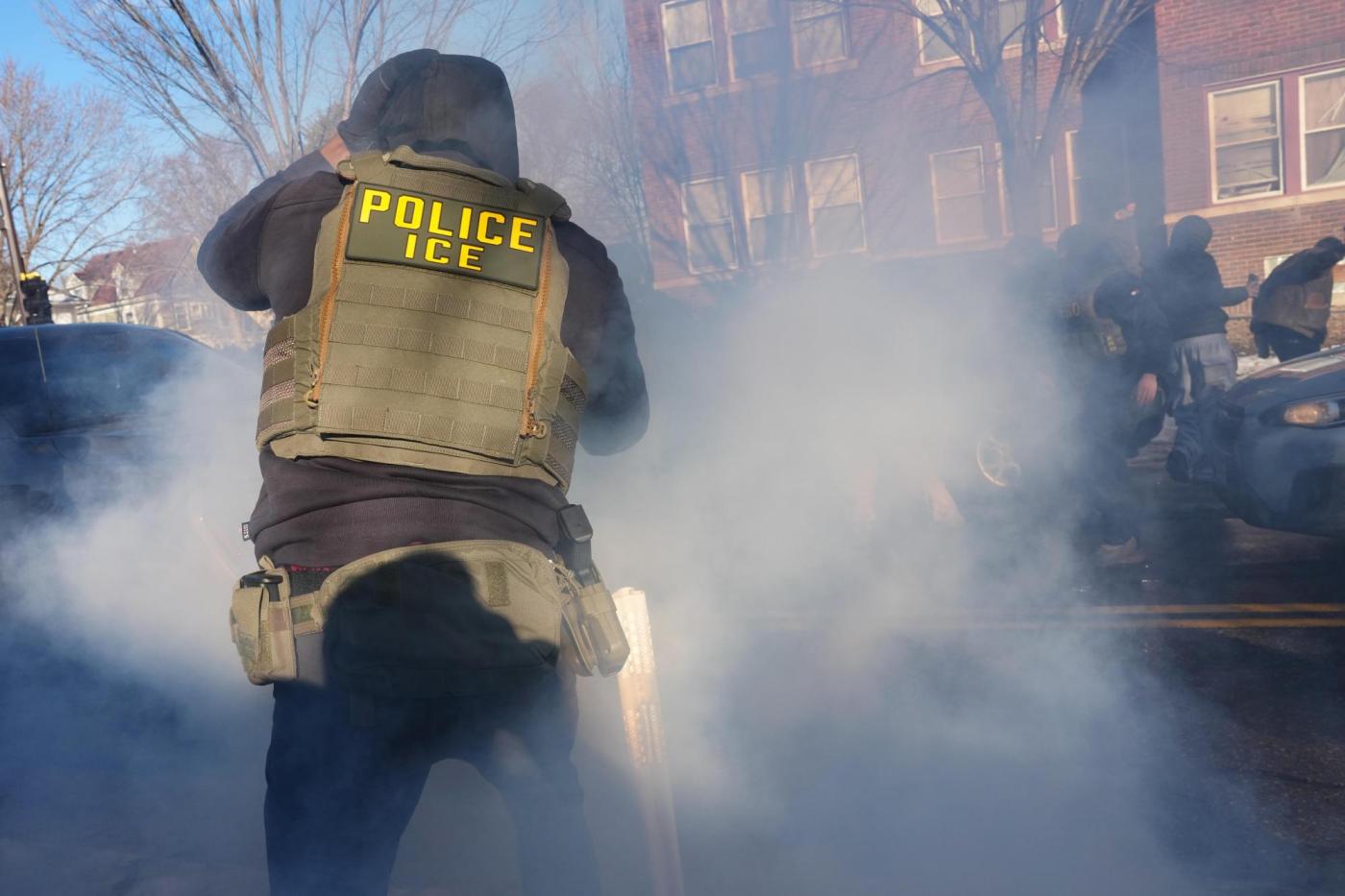
On Wednesday, federal officers wearing gas masks and helmets fired tear gas. Protesters threw rocks and shot fireworks.

“Several government vehicles were subsequently vandalized and broken into, and government property was stolen from inside the vehicles,” according to a FBI bulletin. “The FBI seeks information that will lead to the recovery of the stolen government property and/or the arrest of the individuals responsible for the destruction and theft of government property.”

Videos showed a locked storage box was pulled from the trunk of a federal vehicle and other items were stolen.

The FBI asks people to contact 800-CALL-FBI (800-225-5324) or go to tips.fbi.gov.

Related Articles


Letters: We are living in a time that calls for clarity, courage and leadership


Trump threatens to use the Insurrection Act in Minnesota to end protests


Federal officer shoots person in leg after being attacked in Minneapolis, officials say


Federal prison for alleged sovereign citizen found with ‘cricket bombs’ after east-metro arrest


Renee Good’s family hires George Floyd law firm to investigate Minneapolis ICE shooting

Joan Beringer was excellent for the Timberwolves in Milwaukee. That doesn’t mean he’ll play Friday.

posted in: All news | 0

Joan Beringer was excellent in his first meaningful minutes for Minnesota on Tuesday in Milwaukee, tallying 13 points and five rebounds in 30 minutes on a night where the Wolves were without a suspended Rudy Gobert.

The 19-year-old rookie center was a defensive deterrent in the paint and a relentless pursuer of the basketball both on the glass and the floor.

“The effort we got from Joan … was spectacular,” Timberwolves coach Chris Finch told reporters after the game. “Just kept a number of plays alive, tip-ins around the basket, just energy plays, hustle plays, challenged everything, loose balls. Everything was contested.”

All the little things, and exactly what Minnesota wants the Frenchman to bring to the court. It’s what Finch seemingly admires most about Beringer in his first season with the Timberwolves — he stars in his role.

“Seeing him play with so much excitement and activity, he knows who he is as a player,” Finch told Paul Allen this week on KFXN-FM 100.3. “And I always say this as a young player, figuring out who you are, and sticking to that and that being your foundation as you move forward. … playing to your strengths, and really leaning into them, and doing it over and over again with great energy is a way to get on the floor as a young player.”

It’s what Beringer showed in mop-up duty in the games leading up to Gobert’s one-game suspension, which informed Finch and Co. that the center was ready for some run. He probably wasn’t ready at the season’s outset. Forget his age, Beringer is still relatively new to basketball in general. He didn’t pick up the sport until his teenage years.

The raw talent and athleticism has been on display since his first Summer League game, but seasoning is required to achieve at the highest level. He received some of that during a three-game stint with the club’s G-League team in Iowa in mid-December.

MILWAUKEE, WISCONSIN – JANUARY 13: Giannis Antetokounmpo #34 of the Milwaukee Bucks shoots the ball against Joan Beringer #19 of the Minnesota Timberwolves during the third quarter at Fiserv Forum on January 13, 2026 in Milwaukee, Wisconsin. NOTE TO USER: User expressly acknowledges and agrees that, by downloading and or using this photograph, User is consenting to the terms and conditions of the Getty Images License Agreement. (Photo by Patrick McDermott/Getty Images)

Beringer said that stretch helped him “a lot” as he got more reps in an environment that somewhat mirrored the NBA’s levels of speed and physicality. When the center returned to Minnesota, Finch saw a player who was more composed and sure of how to use his boundless energy within the context of the game.

The extended minutes — Beringer averaged 30 per game over his final two games with Iowa — also improved his wind, which allows the big man to play his style of basketball for longer stints.

“He just really needed to go play to settle into this phase of life,” Finch said.

And now he has. And his strong performance in his first real crack with the Timberwolves has given the coaching staff something to “ponder.” But Minnesota’s roster still makes rotational permanency unlikely for the rookie.

Naz Reid, Julius Randle and Rudy Gobert eat up the Timberwolves’ big man minutes. Gobert’s suspension marked the first game any of those three have missed through the halfway point of the campaign.

On the surface, there simply aren’t minutes available for Beringer. It shouldn’t be a surprise if the center doesn’t see action Friday night in Houston.

Finch plans to try to find ways to sneak him onto the court, which could include some time for Reid at the small forward spot, something Minnesota has dabbled with in the past.

“People are going to have to sacrifice minutes,” Finch said. “But if he plays like this, then we should be benefiting from everybody. We’ll step by step this, but since draft night, we’ve long believed in this kid. So, this is just the beginning.”

But Finch also noted he can’t promise 20 minutes a night for Beringer, or even that the center will play on a game-to-game basis. The reality is, Minnesota’s roster is too good for such a guarantee and the Wolves have settled into a nice rotation that’s produced a good stretch of play.

So, maybe the coach can find his rookie a short stint here or there. But that won’t be enough to get Beringer the playing time the still fairly raw center needs to continue to progress as a player.

“You’ve got to play games, man. There’s no substitute for playing games. When you’re 19 years old and in the prime of your learning and development of your career, you’ve got to play games,” Finch said. “We’ll keep him up here (in Minnesota) for the time being, but he’s probably not done going back to Iowa.”

Related Articles


Win in Milwaukee was another reminder the Timberwolves’ roster is ‘really good’


Timberwolves roll to 139-106 victory over Bucks without Edwards or Gobert


Rudy Gobert suspended for Tuesday’s Timberwolves game. What happens next time he gets a flagrant?


Frederick: Timberwolves’ unparalleled confidence unlocks the impossible … again.


Timberwolves rally to stun Spurs