Karl W. Smith: Biden’s revival of factory jobs isn’t all it’s cracked up to be

posted in: Politics | 0

President Joe Biden has been traveling the U.S. touting a manufacturing revival that he no doubt hopes will help his chances for re-election. Unfortunately, there is much less substance to this “Biden Boom” than the White House would have Americans believe. Even under the rosiest of projections, the administration’s signature programs will do little to increase manufacturing employment — and even less to uplift the overall economy.

Construction spending on manufacturing facilities more than doubled from an annualized rate of $81 billion this time last year to an all-time high of nearly $200 billion in August. Some of that increase can be attributed to the incentives provided by the Inflation Reduction Act and the CHIPS Act, both championed by the president.

But there are more relevant factors. Shortages caused by COVID, backlogs at major ports in 2021 and a three-year-long (and continuing) surge in retail sales created a compelling case for reshoring production even without those incentives. Spending on consumer goods is 30% higher now than when the pandemic started, and global supply chains have yet to fully recover. So a near-term expansion in domestic manufacturing was all but inevitable.

Another reason the recent run-up in manufacturing investment is not as impressive as it might seem: When adjusted for inflation, the figures are overshadowed by a decline in investment in the rest of the economy.

The U.S. Bureau of Economic Analysis estimates that inflation-adjusted investment in manufacturing facilities was a more modest $125 billion (annualized) in the second quarter. Outside of manufacturing, investment in non-residential structures was $480 billion last quarter, down $90 billion from its peak in the third quarter of 2019 (again, figures are annualized).

The long-term effects of Biden’s industrial policies are even less impressive. An analysis conducted by the Labor Energy Partnership, a strong supporter of Biden’s policies, said they would create 150,000 additional manufacturing jobs by 2030. That amounts to an increase of just 1.3% relative to the 13.1 million workers in employed in manufacturing right now. By comparison, the U.S. economy created 272,000 manufacturing jobs in 2018 alone.

The administration hopes that by funneling its resources toward semiconductors and green energy, it can foster the growth of a manufacturing ecosystem that will ensure U.S. leadership in high-tech manufacturing. Research suggests otherwise.

Analysts at the World Trade Organization summarize evidence this way: For economies in transition from undeveloped to developed, direct investment in manufacturing can indeed benefit domestic suppliers. For fully developed economies, however, direct investment has no benefits for either domestic suppliers or purchasers of manufacturing products. That’s because investors are already aware of what they have to offer, and capital markets — in the U.S. especially — can easily finance the creation of new industries if there is a strong business case for them.

In fact, the Biden administration’s tendency to include incentives favorable to unions and other progressive interests in these programs can actually make it more difficult for investors to ascertain the full costs of expanding production in the U.S. Then again, as Peterson Institute President Adam Posen points out, under a more business-friendly administration, the policy’s incentive programs would be ripe for corruption.

The president is no doubt sincere in his desire to revive U.S. manufacturing, and it’s tempting to look at the surge in reshoring as evidence that his administration’s policies are having a transformative effect. Yet even the most optimistic projections suggest that Biden’s industrial policy will have only a minor effect on U.S. manufacturing employment.

Karl W. Smith is a Bloomberg Opinion columnist. Previously, he was vice president for federal policy at the Tax Foundation and assistant professor of economics at the University of North Carolina.

Related Articles

Opinion |


Erwin Chemerinsky: A federal judge’s gag order against Trump may be satisfying. But it isn’t constitutional

Opinion |


Victor, Ramanathan: Climate change isn’t just about emissions. We’re ignoring a huge part of the fight

Opinion |


Nadav Ziv: Hamas’ barbarity broke my heart. Some of my friends are breaking it a second time

Opinion |


Bret Stephens: President Biden’s finest hour

Opinion |


Martin Schram: It’s even worse than you thought

Four Patriots who should play bigger roles vs. Bills in Week 7

posted in: News | 0

Even the most optimistic Patriots fans had to come to the conclusion that the 2023 season was effectively over following winnable Week 5 and 6 losses to the Saints and Raiders.

Next on their schedule, the Patriots have the Bills at home followed by the Dolphins on the road, meaning the team is likely facing a 1-7 start to the season.

Head coach Bill Belichick might as well try something new at the one-third mark of the season. Here are four players we want to see play major roles in a tough matchup against the Bills.

Related Articles

New England Patriots |


Patriots-Bills preview: How Bill Belichick can upset Josh Allen and Buffalo

New England Patriots |


NFL notes: How the Patriots and Bills switched places in the AFC East

New England Patriots |


Patriots-Bills injury report: Bill Belichick lists 16 players as questionable for Sunday

New England Patriots |


Bill Belichick honors Dante Scarnecchia, Mike Vrabel ahead of Patriots Hall of Fame ceremony

New England Patriots |


Patriots need to find Demario Douglas more snaps coming off of injury

QB/WR Malik Cunningham

There’s really no other way to describe what the Patriots did with Cunningham last week other than weird.

To recap: The Patriots signed him off of their practice squad Saturday and made him the only active quarterback behind Mac Jones. Cunningham loosened up his arm in the halls of Allegiant Stadium to keep his role “low-key” from the Raiders and only lined up at wide receiver during pregame warmups. Then he played six total snaps with three of them coming at quarterback. Oh, and during the week, he didn’t exclusively practice at quarterback. He also received reps at wide receiver and on special teams.

The Patriots don’t need to go all-in on the Cunningham experiment, but they might as well give him more than three snaps at quarterback in Week 7. The team believes he can add some upside with his athleticism. Let him show it with option runs and gadget plays.

Get creative. Be interesting.

WR Demario Douglas

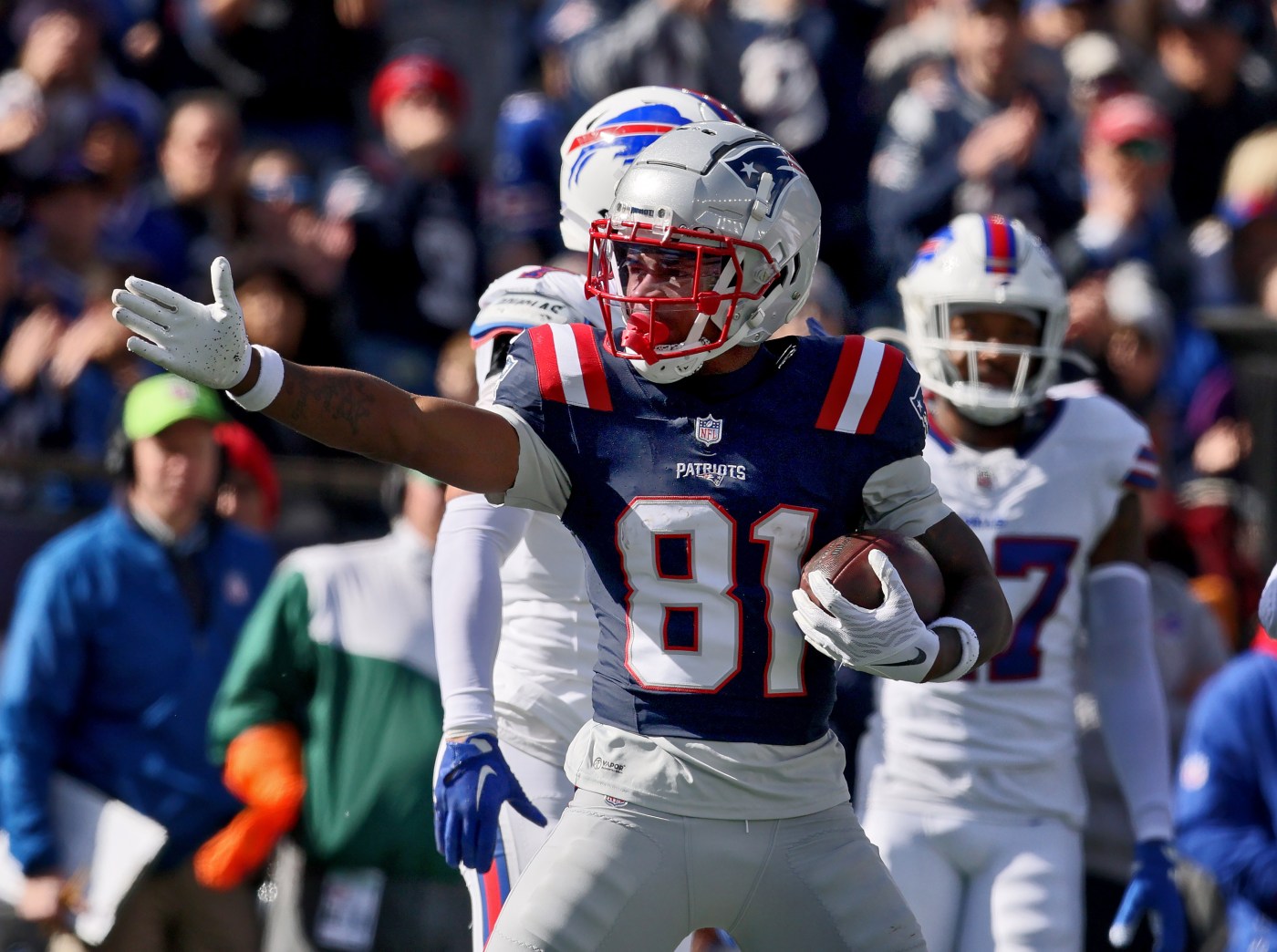
If Douglas isn’t the Patriots’ best wide receiver, then he’s No. 2 behind Kendrick Bourne right now. The sixth-round rookie missed Week 6 with a concussion. Now that he’s back on the practice field, the team should see what the offense looks like with Douglas as their every-down slot receiver.

The Liberty product is only 5-foot-8, but he can beat man coverage and make plays with the ball in his hands thanks to his top-tier agility.

Whether it’s Jones, Cunningham, Bailey Zappe or Will Grier at quarterback, Douglas can provide a useful weapon for the Patriots’ quarterback moving forward.

A new right tackle

We’ve seen enough of Vederian Lowe, right?

He’s started the last five games, the first at left tackle and the rest at right tackle. In that span of time, he ranks 62nd of 64 qualified tackles in overall PFF grade, 45th in run blocking grade and dead last in pass blocking grade. He’s allowed the most pressures and has the second-lowest pass-block efficiency rate.

Riley Reiff, Conor McDermott and Sidy Sow have yet to get a shot at right tackle. Calvin Anderson could be moved back there after an ineffective first two weeks of the season. Or Mike Onwenu could shift to right tackle with Sow taking his place at right guard.

Try anything else. Lowe could still be a future starter. He’s young. But he’s not cutting it right now.

CB J.C. Jackson

This isn’t so much about a bigger role but more about making a greater impact. Jackson played all but three snaps in his second game back with the Patriots. He covered Raiders top wide receiver Davante Adams well and let up just one 6-yard catch on six targets.

It’s been a strong start to Jackson’s return to New England. But the team desperately needs more takeaways, and Jackson was one of the best ballhawks in the NFL in his previous tenure with the Patriots.

It’s only been two games, but Jackson doesn’t have any interceptions or pass breakups with the Patriots so far this season.

It still hurts to be without Christian Gonzalez, but cornerback Jack Jones returned to practice this week after beginning the season on injured reserve with a hamstring ailment.

A cornerback group featuring Jackson, Jones and Jonathan Jones as its starters is pretty solid. Myles Bryant then could be used in a versatile role as a slot cornerback and safety.

After changes by Minnesota DNR, feds release $21 million for state wildlife habitat

posted in: Society | 0

Minnesota will get its share of federal sporting goods tax dollars after the U.S. Fish and Wildlife Service accepted changes in how the state plans and documents timber sales in state wildlife management areas.

In an Oct. 3 letter, federal officials notified Minnesota Department of Natural Resources Commissioner Sarah Strommen that they will release $4 million from the past budget cycle and $17.6 million from the current budget cycle to the DNR. The money is aimed at statewide wildlife habitat projects.

The federal agency had earlier withheld the state’s share of money because agency officials were concerned the DNR was offering timber sales on wildlife management areas that didn’t have a documented wildlife purpose filed in advance of the logging.

The U.S. Fish and Wildlife Service is releasing more than $21 million in wildlife habitat grants to the Minnesota Department of Natural Resources after reaching an agreement with the state agency over logging on wildlife management areas. (Amanda Odeski / Forum News Service)

The federal grants used to acquire, expand and manage wildlife areas come from excise taxes on hunting and fishing gear, and by law must be used to benefit wildlife habitat. Any management on those lands, including logging, must be done to benefit wildlife.

But now Charles Traxler, acting regional director of the U.S. Fish and Wildlife Service, says the DNR has moved to better document how and why the timber sales are done in wildlife areas.

“I am confident that future actions will comply with the grant and that there is a shared commitment to continue working together to improve grant management,” Traxler noted in the letter to the DNR.

The issue has been festering for more than four years as conservationists, including several current and retired DNR wildlife biologists, argue the DNR is planning to log too much and in the wrong places on some wildlife areas to benefit the timber industry, often to the detriment of wildlife habitat.

Pressured by those critics, the Fish and Wildlife Service stepped in and issued orders to the state, including a lengthy letter of agreement signed by both sides in March scolding the DNR for dragging its feet on the issue.

The March agreement stated that “desired future conditions (of the forest within management areas) will be based on sound wildlife biology and ecology principles” and that management plans for the wildlife and aquatic management areas will be consistent with federal legal requirements on how the lands are used.

In late June, three DNR timber sales on state wildlife management areas near Warroad were canceled just before they went up for auction. DNR officials later agreed to temporarily stop all such timber sales as requested by the Fish and Wildlife Service.

Craig Sterle, a former DNR forester who has helped lead the charge to call out the agency on wildlife area logging, said the agreement may mean the DNR is on the right track for managing areas for wildlife as they are intended.

“But we’ve been kept in the dark on any details agreed to behind the scenes, so we really don’t know,” Sterle said. “I’m hopeful that this will lead to real changes on the ground. But I think there are still concerns that these are just changes on paper that may not make any real difference in the woods.”

The dispute, first reported in the News Tribune in August 2019, began when top DNR officials began implementing a timber availability report that called for more trees to be cut on state lands to feed the state’s timber industry, including more timber from wildlife management areas.

The effort began under then Gov. Mark Dayton, and top DNR officials have continued to press for more logging under Gov. Tim Walz. The effort called for increasing the state’s share of wood for the industry from 800,000 cords annually to 870,000 cords, and asked for part of the increase to come from wildlife management areas.

In a 2019 letter to Strommen, 28 DNR wildlife managers described any industry-aimed increase in logging on wildlife areas as scientifically dishonest. They said concerns raised by wildlife staff were being ignored by DNR forestry staff and top DNR officials.

But Strommen said that, while wildlife area logging will be included as part of the total state timber sold to the timber industry, the agency has no quotas on how much timber must come from wildlife management areas. She continues to call critics’ complaints unwarranted and misguided, saying they have misunderstood the timber availability analysis from the start.

Minnesota has 1,440 public wildlife management areas totaling nearly 1.3 million acres, although only some of them are forested. The state has another 700 aquatic management areas covering some 700 miles of shoreline on lakes and rivers — much of it forested. Most of the state’s DNR-managed timber comes from state forests and is not subject to the issues over wildlife management areas.

Related Articles

Outdoors |


Skywatch: The great autumn galactic happening

Outdoors |


Gunfire from hunting can hurt hearing forever

Outdoors |


There’s a moose on the loose in southern Minnesota

Outdoors |


Skywatch: A Saturday solar eclipse

Outdoors |


William O’Brien State Park gets major boost from longtime farmer Myron Lindgren

Patriots-Bills preview: How Bill Belichick can upset Josh Allen and Buffalo

posted in: Adventure | 0

For the third time in 30 years, the Patriots are two-score underdogs at home.

The Bills (4-2) enter Foxboro as one of the NFL’s best teams, while the Pats (1-5) continue to flounder in a way few expected. Offensively, the Patriots snapped their games-long touchdown drought last week at Las Vegas, but again fell into an early hole. Staying competitive through the first half will be non-negotiable versus Buffalo, which has averaged more than 30 points per game against Bill Belichick’s defense the last three seasons.

If the Pats fall behind by two scores, they’re done. But if they can create a couple turnovers, and win on the margins, they could find life at an unexpected time in an unforeseen season.

Here’s what else to watch for Sunday:

When the Patriots run

Feed Zeke?

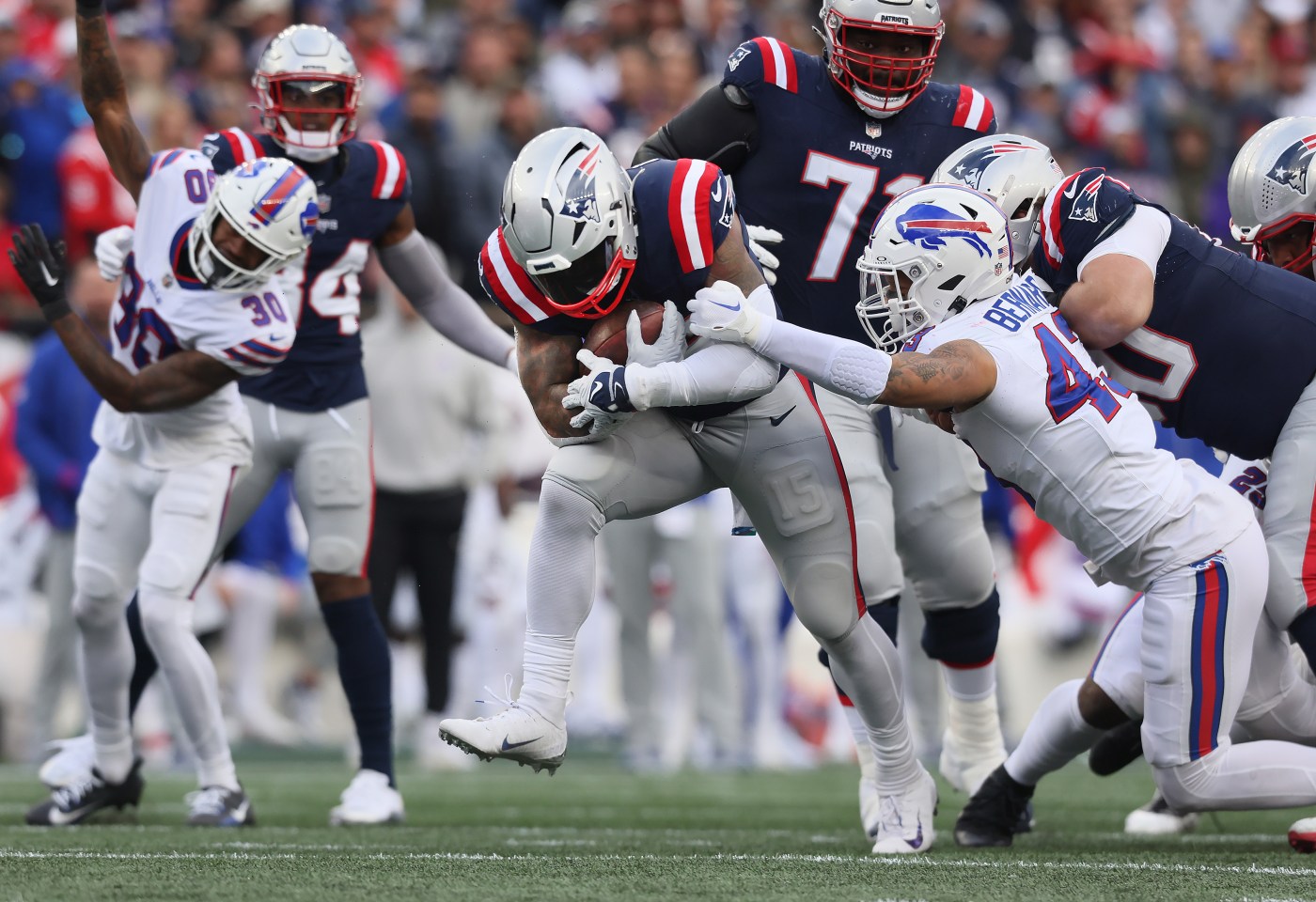
Ezekiel Elliott ended the aforementioned touchdown drought by punching in a 2-yard score at Las Vegas last weekend. On that drive, the Patriots powered their way downfield with four first-down runs that picked up 36 yards. It seems unlikely the Pats will find similar success versus an above-average Buffalo run defense, but Elliott and Rhamondre Stevenson must kill clock for them to have a chance.

New England Patriots running back Ezekiel Elliott (15) runs with the ball as Las Vegas Raiders cornerback Amik Robertson defends during the second half of an NFL football game Sunday, Oct. 15, 2023, in Las Vegas. (AP Photo/David Becker)

And there is one weak spot in Buffalo’s front: the middle. The Bills are allowing a league-worst 5.7 yards per carry inside the tackles, per Sports Info. Solutions. Look for the Pats to pound away at the middle, especially with the return of right guard Mike Onwenu, who’s been recovering from an ankle injury.

If Onwenu can move well enough, the Patriots might also return to the one run scheme — counter — that’s yielded consistent gains. On just six carries, the offense has averaged 5.7 yards per counter run, more than any other base run in the playbook. If the Pats call counter, watch for Onwenu or the starting left guard to pull in the direction of the play and block an unblocked defender at the end of the line of scrimmage.

When the Patriots pass

Step one: block. Step two: pray.

The Bills boast the NFL’s best pass rush, according to both Mac Jones and Bill Belichick. They’re deep on the edge and the interior, where defensive tackle Ed Oliver is “as good as anybody we’ll play,” per Belichick. Last week, Jones averaged 2.2 seconds from snap to throw at Las Vegas, the fastest-time for any quarterback in the NFL.

Bill Belichick isn’t telling Bills how Patriots plan to use Malik Cunningham

It reasons the Patriots will draw up another game plan that emphasizes their quick passing game and forces Buffalo to tackle in space (the Bills’ tackling ranks 29th, per Pro Football Focus). Returning rookie receiver Demario Douglas should help there, as would a few downfield run-pass-options (RPOs). Buffalo is highly inexperienced at linebacker, where they should be vulnerable to those plays that force a defender to pick between defending a run or pass.

Their inconsistent linebacker play should also invite targets for tight ends Hunter Henry and Mike Gesicki. Then again, the same could be said of the Raiders last week, and Henry and Gesicki combined for just four catches.

Meanwhile, Kendrick Bourne is coming off his best game of the season (10 catches for 89 yards), and figures to be a focal point so long as fellow receivers JuJu Smith-Schuster and DeVante Parker continue to underwhelm.

When the Bills run

In the offseason, Buffalo’s front office emphasized building out its running game to better prepare themselves for playoff football. Among other moves, the Bills signed ex-Patriots running back Damien Harris and bolstered their offensive line.

Patriots QB Mac Jones sticking with routine despite early-season struggles

While Harris will miss Sunday’s game with a neck sprain, Buffalo shouldn’t lose too much steam on the ground. The Bills rank among the NFL’s 10 best rushing offenses by most metrics, thanks to second-year back James Cook making a leap and quarterback Josh Allen powering through defenders at 6-foot-5 and 240 pounds. Cook leads the team with 363 rushing yards at a 4.8 yards per carry average.

Defensively, the Patriots will need linebackers Ja’Whaun Bentley and Jahlani Tavai to reinforce a banged-up front. Last week, Tavai replaced rookie defensive lineman Keion White (concussion) on one edge, while Bentley manned the middle with defensive tackles Davon Godchaux and Lawrence Guy. Winning the line of scrimmage is a must for a Patriots defense down several defensive backs.

When the Bills pass

J.C. Jackson’s return has helped stabilize a secondary that briefly lost its top four cornerbacks this season. Last week, Jackson made his first start for the Patriots since being traded and played 96% of the team’s snaps.

Related Articles

New England Patriots |


NFL notes: How the Patriots and Bills switched places in the AFC East

New England Patriots |


Patriots-Bills injury report: Bill Belichick lists 16 players as questionable for Sunday

New England Patriots |


Bill Belichick honors Dante Scarnecchia, Mike Vrabel ahead of Patriots Hall of Fame ceremony

New England Patriots |


Patriots need to find Demario Douglas more snaps coming off of injury

New England Patriots |


Is the Patriots’ health improving before Sunday’s Bills game?

But Jackson will need to do more than take the field against Buffalo. He must overcome the most difficult matchup of his career.

Bills All-Pro receiver Stefon Diggs has roasted Jackson in all their recent matchups. Diggs is averaging more than six catches and 88 yards per game versus New England. He’s also scored six touchdowns in those seven meetings.

On the season, Diggs has more than double the catches (49) of any other Bills player, including second-leading receiver Gabriel Davis. The 6-foot-2, 225-pound Davis represents a size mismatch for any Pats defensive back, sans their safeties. Thus, expect the Patriots to again execute a zone-heavy game plan with a strong dose of Cover 2 to protect against Allen’s deep ball.

Up front, they’ll also need to generate more pressure on Allen than they have against any quarterback in almost a month. Ever since Matt Judon was lost to a torn bicep tendon, the Patriots have collected two sacks and failed to crack a 25% pressure rate in a single game.