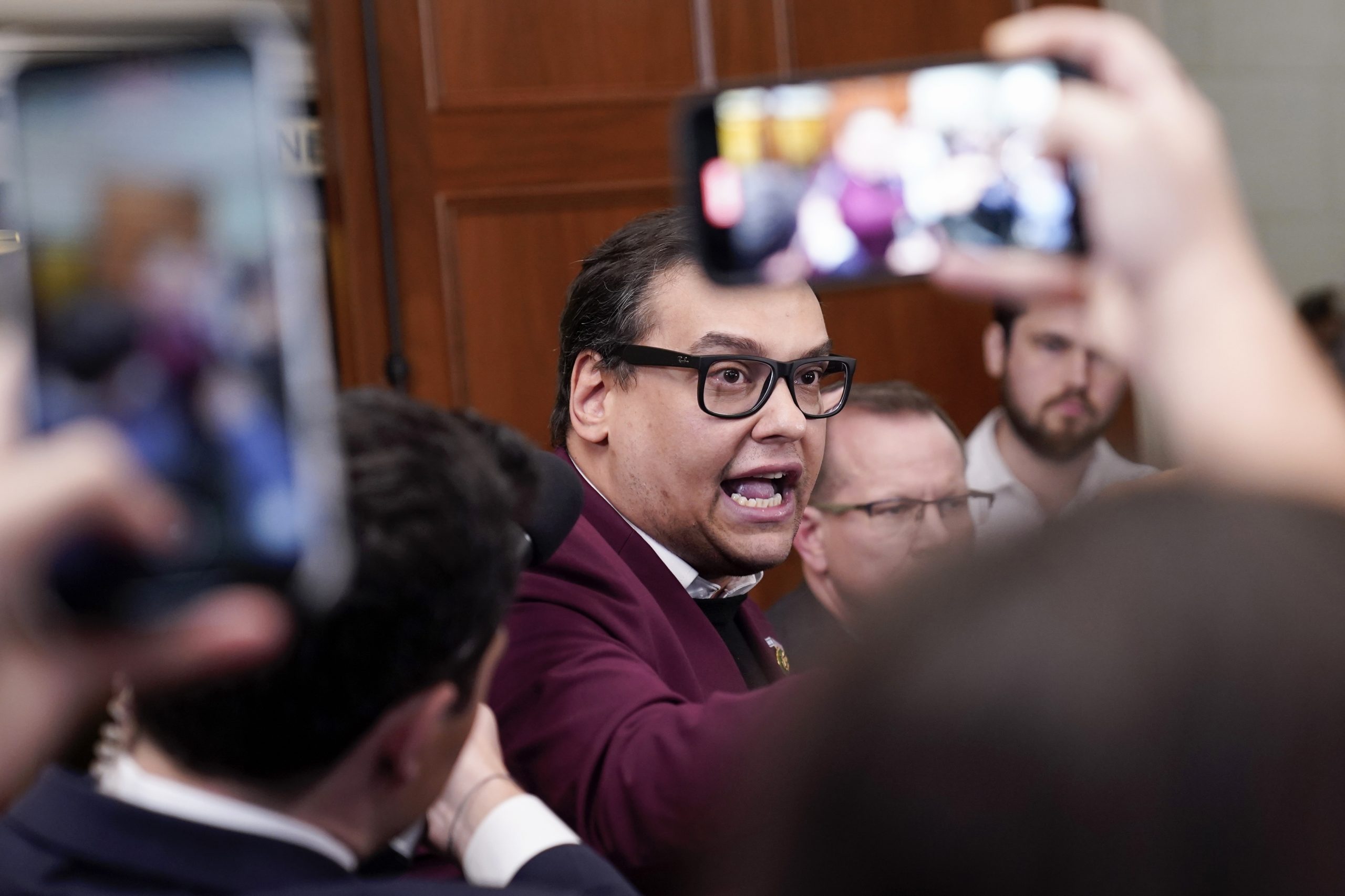
Santos says he isn’t leaving. Candidates are still lining up for his seat.

posted in: Politics | 0

NEW YORK — The wait to replace indicted Rep. George Santos has lasted longer than his rivals expected.

Both Democratic and Republican candidates have been using that time to lay the groundwork for his ouster.

Long Island political leaders are preparing for the possibility of a special election to succeed Santos amid his legal woes. The Republican congressman is due in court Friday to answer still more criminal fraud charges.

“We will select the best candidate, and we will give 110 percent effort as we do in every race,” Nassau County GOP Chair Joe Cairo said. “We’ve probably heard from 20 different prospective candidates.”

Between the two parties, about 30 candidates — with varying degrees of viability — have been jockeying for Santos’ seat. The race is vital: It’s one of about six battleground New York House races next year critical to determining who controls Congress. It’s also dizzying with the possibility of three elections in 10 months.

Top contenders said in interviews they’re well aware of the variables in the moderate district that President Joe Biden won by 10 points in 2020.

They’re ready for both a lower-turnout special election as early as January or February, if Santos is removed soon from office, as well as a June primary, if Santos sticks it out. And then there will be a November general election, when potentially redrawn district lines could be a complicating factor.

“Our job is to show up,” said Democratic candidate Zak Malamed, who once ran a donor network for aspiring politicians.

Republican hopeful Mike Sapraicone, a retired NYPD detective, said he was putting “my heart and my soul” into the run — not to mention his own cash.

Running with or without Santos

The field for New York’s 3rd Congressional District — which spreads across Nassau County and into Queens — is still in formation as better-known candidates enter or weigh bids.

Former Democrat Rep. Tom Suozzi recently declared he’ll run. The 2022 Democratic nominee Robert Zimmerman and 2016 Republican nominee Jack Martins, a state senator, have also been floated as special election contenders.

Santos, who took office despite fabricating much of his resume, will appear before a federal judge Friday on Long Island to be arraigned on a recent 23-count superseding indictment. The expanded case against the first-term House member now includes additional charges of wire fraud, identity theft and falsifying records.

Santos’ attorney, Joe Murray, said his client will plead not guilty on Friday.

Court papers show Santos has engaged in plea talks with prosecutors, but he has maintained his innocence and publicly declared he won’t accept a plea deal.

“They can try to expel me, but I pity the fools that go ahead and do that and think that that’s the smartest idea,” he told reporters earlier this month.

He remains defiant about running for reelection in the face of an expulsion measure proposed by Rep. Anthony D’Esposito with fellow House Republicans from Long Island and other parts of the state.

There’s a glaring problem, though: Santos refunded more campaign cash than he raised last quarter.

Democrats in his district, meanwhile, are raking in money for the election — special or otherwise — and Republicans appear just as determined to get rid of him.

The Nassau GOP has been plotting to remove him from office since he took the congressional oath in January, with party chair Cairo and more than two dozen other local Republicans demanding Santos’ resignation.

Cairo said in an interview he hasn’t spoken with Santos since December.

Ten or 15 of the 20 GOP contenders deserve serious consideration, and the process will be “hastened” if there’s a special election, the party leader said.

Cairo stressed, however, that his party is more immediately focused on local races next month.

Indeed, earlier this month, at their respective fall dinner gatherings (both held at Crest Hollow Country Club a week apart), the Nassau Democratic and Republican parties touted this year’s municipal candidates.

“The local races are important because when you get your candidates in there, you can begin to build an infrastructure, motivate voters and attract more volunteers,” Jay Jacobs, who chairs the county and state Democratic committees, said in an interview.

“We’ve enjoyed a fair amount of success the last couple years, ’21 and ’22,” Cairo said. “We think it’ll continue in ’23 and carry over into the next year.”

Winning Santos’ seat key in 2024

Santos’ swing seat is the prize party officials are laser-focused on.

The Democrats thus far have a larger, better-known, better-funded field — and they previously represented the district under Suozzi.

“I think the Democrats will take this seat,” Jacobs said. “You’ve got a mess on Capitol Hill, you’ve got George Santos, which is an embarrassment, and I’m confident we’ll have a strong candidate for that election.”

He counted four or five viable candidates in a total of about eight, so far.

Jacobs said the decision on who to give the party line to in a special election would be made by the Nassau and Queens Democrats, led by Rep. Gregory Meeks, as well as the Democratic Congressional Campaign Committee, House Minority Leader Hakeem Jeffries and Gov. Kathy Hochul.

Suozzi’s entry remakes the primary landscape. He’s a big name in local politics and a strong fundraiser. But he left Congress last year when he ran against Hochul in the gubernatorial primary, straining some Democratic ties in the state.

Former state Sen. Anna Kaplan, Nassau County Legislator Josh Lafazan and Austin Cheng, a health care CEO, are also declared contenders.

Malamed, a first-time candidate and a former national fundraising juggernaut, has proved his prowess by reporting $530,000 cash on hand without the self-funding that others relied on.

“If there’s a takeaway from all of this, it’s that complacency is not going to win this race,” Malamed said of the Santos saga.

A wild card is Zimmerman, who lost to Santos last year.

If there’s a special election, Suozzi is expected to be the party favorite. But Zimmerman, a Democratic National Committee member with strong labor support, could also be chosen, as well as several others.

Zimmerman and Suozzi both declined to comment.

In efforts to keep the seat, Republicans are under pressure to back a more familiar candidate after choosing a relative newcomer in Santos, whom Cairo reiterated was recommended by the Queens GOP.

Retired NYPD detective Mike Sapraicone and Afghanistan war veteran Kellen Curry are the top fundraisers; Sapraicone far more familiar to Long Island political leaders as a donor to both parties.

Sapraicone has $520,000 in cash on hand, recent filings showed.

“I’m so tired of looking at the far, far left and the far, far right,” he said in an interview. “I thought it was about time we have somebody who cares about the people who elect them.”

Another name being circulated is Jack Martins, the state senator who ran for Congress in 2016 and 2008. He said in an interview that his preference is to stay on Long Island.

“My priorities are my district, continuing to serve in the Senate and the quality of life that I have with my wife and children,” Martins explained. “And I’m very concerned about the impact that Washington will have on that.”

But he did not rule out a run: “We will have that conversation if and when it comes up.”

Santos has few friends in politics as he returns to federal court, but Queens Republican Party Chair Anthony Nunziato still has not called for his ouster.

Acknowledging that Queens makes up a small part of the district and the boundaries could change in the redistricting process, Nunziato said in an interview that he’ll defer to Cairo on endorsing a candidate.

“Show the proof, let him prove himself,” Nunziato added of Santos, with whom he still talks. “To me, to have the tail wag the dog doesn’t make any sense.”

Jeff Coltin contributed to this report.

3 things to watch at POLITICO’s CHIPS update

posted in: All news | 0

It’s been more than a year since Congress passed the CHIPS and Science Act, which set aside nearly $53 billion in subsidies in a bid to restore America as a global leader in chip manufacturing and research. As the Commerce Department works to get that money out the door — and as Congress tries to pass more bills bolstering the domestic chip sector — POLITICO’s CHIPS Update will examine how Washington delivering on its promises.

The summit starts Tuesday at 8:30 a.m. EST in Washington, D.C., and guests can still register to attend here.

Here are three things to watch at POLITICO’s CHIPS Update: Feds, Fabs, and the Future of the Industry:

The impact of new export controls: Last week’s decision by the Biden administration to impose new restrictions on the sale of advanced AI chips to China is not being welcomed by the chip industry. In fact, chip executives have warned that cutting off their access to Chinese chip revenue will require them to slow down or even pare back their plans to build new fabs and foundries in the United States. David Isaacs, head of government affairs at the Semiconductor Industry Association, will lay out the chip industry’s worries over the new export controls — and Adrienne Elrod at the CHIPS program office of the Commerce Department will address how the Biden administration is responding to those concerns.

Who’s getting paid? The Commerce Department is expected to spend the first tranche of $39 billion in chip manufacturing subsidies by the end of the year — and some of the biggest companies are lining up for a share. Manish Bhatia, executive vice president of global operations at chip giant Micron, will discuss what his company needs from Washington, and how the industry plans to leverage federal subsidies for maximum benefit.

Workforce woes: Leaders across the chip industry say Washington’s efforts to reinvigorate high-tech manufacturing won’t work without skilled workers at new abs and foundries. The need is especially acute for employees with advanced STEM degrees, who are often non-citizens and are unable to work in the U.S. without reforms to the immigration system. Experts on the high-tech workforce including Shari Liss, executive director of the SEMI Foundation, and Michael Spencer, interim chair of the department of electrical and computer engineering at Morgan State University, will discuss what changes are needed to attract women, people of color and other underrepresented groups to the microchip industry.

How Mitt Romney Reckoned With His Own Complicity in Trump’s Rise

posted in: News | 0

McKay Coppins sat across from Mitt Romney in the senator’s Capitol Hill office looking for a higher level of alarm.

It was the night of Dec. 14, 2021, a little less than a year after the insurrection and not quite a year before the next set of midterms, and Coppins wanted to know if Romney was seeing the same warning signs that he was — a slew of Republicans on ballots across the country who had supported Trump’s efforts to overturn the 2020 election. Romney, in Coppins’ recollection, seemed to downplay the threat.

“I’m sure there are some people who might succumb to corruption,” Romney said, “but the great majority of states and elected officials and even legislators are not going to do so.”

“Well,” Coppins said, invoking the Trump-incited riots, “after January 6, you told me you were very concerned about the fragility of democracy. Are you still concerned about it?”

Romney acknowledged he was — because of Trump, because of Trump’s “Big Lie” — “but I don’t know how widespread that is,” he said. “I’m not at the point of moral panic,” he added. “I do think that people fundamentally don’t want to be dishonest and acknowledge to themselves that they’re a dishonest person, that they’ve lied, and that they’ve thwarted democracy.”

This moment does not appear in Coppins’ biography of Romney, which is just out today. I know about it because of a handful of recent conversations I had with Coppins about the highly unusual, often clandestine conversation the two men had in more than 45 interviews over the course of more than two years. Romney: A Reckoning is filled with fun fodder for publication-day hype: unvarnished and unflattering assessments by Romney of many of the most prominent Republicans alive. But the book’s most meaningful contribution to what remains of civic discourse is the uncommonly intimate glimpse it offers of a man in elected office engaged in a hard grappling with the reality and consequences of Trump’s rise, the country’s (and in particular his party’s) increasingly antidemocratic, even authoritarian bent, and ultimately the complicated question of his own complicity.

Getting an answer to that last question required Coppins on numerous occasions to press Romney in ways he did not always like, to connect dots Romney did not always see as connected — to ultimately force him to recognize the rationalizations he had made in his career, the junctures at which he might have sacrificed his principles amidst his quest for power.

That night in Romney’s office was one of those moments.

Behind Coppins on the wall was a Rand McNally “histomap,” charting the rise and fall of the world’s leading civilizations through some 4,000 years of history, the key to the falls frequently meant the emergence of tyrants. “A man gets some people around him and begins to oppress and dominate others,” Romney told Coppins the first time he showed him the map. America’s experiment in self-rule “is fighting against human nature,” he said. “Authoritarianism,” he explained, “is like a gargoyle lurking over the cathedral, ready to pounce.” Was Romney, literally looking at a graphic depiction of a reason for democracies’ destruction, soft-pedaling the present danger?

“I see what you’re saying,” Coppins told him. “Nobody wants to think of themselves as a thief or a liar or whatever, but the conditions of the partisan media landscape are such that you don’t have to believe that you’re a liar. You can decide to believe in these various conspiracy theories or say, ‘Well, I’m only doing this because the other side does it,’ or, ‘What I’m doing is only correcting the corruption of the other side.’”

Romney, Coppins recalled, sat back in his chair, sort of slumped — “almost like a psychic sigh.”

“I don’t disagree with you,” Romney told Coppins. “I am concerned.”

It started in church.

Coppins on June 13, 2021, was sitting in adult Sunday school in the gym of his Church of Jesus Christ Latter-day Saints in Oakton, Va., when he received an unexpected text message from Romney. Coppins had launched the work for the book, and Romney was a willing participant in the project. “Thought this might set the stage for our chat,” the text message from Romney said.

In Coppins’ email inbox was an attachment to Romney’s private journal running from right after his loss in the 2012 presidential campaign through the tumultuous election of 2016 — the first, it turned out, of tranches of personal documents Romney offered up. Coppins couldn’t help but start reading. “… probably should note my own feelings now that I am in the air and have a few minutes to write. Disappointed is the best word. Not angry, not despondent, maybe a little numb …” They had had a general conversation about papers or notes he might like to show or share, but Romney during his career had been known for control more than candor, and Coppins at that early stage of the work hadn’t yet thought to even specifically ask for this. “My immediate reaction was, ‘Oh, he’s entering into this in good faith,’” Coppins told me. “It showed me he was taking this seriously.”

There are different ways to take in this book. It’s an astonishing, nearly unprecedented catalog of intraparty critique. Steadily more depressing the deeper one reads, it’s a reminder of the grave current state of the republic. But it’s also, and maybe all the more importantly, a deft study of the capacity for rationalization — in this case an accounting of the chronology of Romney’s rationalizations in the business world at Bain Capital as (depending on somebody’s perspective) either a “blue-chip corporate turnaround artist” or “ruthless plutocrat who profited from destroying livelihoods,” as a political candidate starting in Massachusetts, as a presidential candidate starting in 2008, as a smart, sober, logical, capable, coherent, hyper-prepared person attempting to navigate this American era dominated by a figure he considered from the start if not outright odious then obviously absurd.

“Romney discovered,” Coppins writes, “a remarkable ability to justify his choices to himself.”

“I have learned through my life experience,” Romney told Coppins, “that it’s human to rationalize what’s in our best interest.”

In business? People had to be fired because he and Bain had a fiduciary responsibility to their investors. These companies, after all, already weren’t doing well. And in politics? Making nice with people he didn’t really like? Saying stuff he didn’t totally believe? “You say things that make the audience respond positively,” he told Coppins. “I admit it.”

In 2012, for instance, Romney agreed to accept the endorsement of Trump — at Trump’s insistence at Trump’s hotel in Las Vegas — because he calculated it would help him beat Barack Obama. And to do that, he needed not just Romney Republicans, of course, but also Donald Trump fans. Some of his advisers — even Nancy Reagan — told him to steer clear. “Romney was quick to rationalize keeping Trump inside the tent,” Coppins writes. “Alienating a guy with a massive bullhorn and a habit of holding grudges seemed risky. And while, yes, Trump was clearly ridiculous and vapid and filled with outlandish ideas, Obama had accepted endorsements and checks from every dolt and crackpot in Hollywood, from Kanye West to Lena Dunham to Adam Levine — why couldn’t Romney have his own silly celebrity surrogate? But the truth, which surprised even Romney himself, was that he liked Trump. Or at least, he liked having him around. Trump was funny and outrageous and talking to him broke up the monotony of the campaign trail.”

As for the insidious, racist and Trump-led “birther” smear? Romney “did not see” that having “a racial arc to it,” he told Coppins. “And perhaps I’m not as sensitive in that regard as I should be.”

Also: “I need to get to 50.1 percent or more,” Romney told reporters at the time.

By 2016, having lost and owing Trump nothing, Romney was freer to offer his true thoughts about the shocking presidential hopeful. Romney, in Coppins’ telling, considered Trump a “buffoon,” an “unabashed demagogue,” a “manifestly unqualified madman” and a “profoundly depraved and broken person whose election would coarsen America’s culture.” His “number one priority” was to stop him. When Chris Christie became arguably the first major establishment Republican to endorse Trump, Romney sent Christie an email: “He is unquestionably mentally unstable, and he is racist, bigoted, misogynistic, xenophobic, vulgar and prone to violence. There is simply no rational argument that could lead me to vote for someone with those characteristics. I believe your endorsement of him severely diminishes you morally — though probably not politically — and that you must withdraw that support to preserve your integrity and character.” When Reince Priebus, then the chair of the Republican National Committee, called Romney to urge him to endorse Trump, Romney laughed and called Trump “nuts.”

Yet in the end, Romney met with Trump after he was elected, first at Trump’s Bedminster club in New Jersey, then at the restaurant Jean-Georges in New York, to talk about being his secretary of state. He had in mind what at the time was a familiar refrain. He could help Trump, he thought, by being “an adult in the room.” But there was, of course, this, too: “I wanted to be president,” Romney told Coppins. “If you can’t be president, being secretary of state’s not a bad spot to come thereafter.” Romney obviously didn’t get the job — partly because he didn’t fully retract what he had said about Trump — but Trump got a picture widely viewed as humiliating to Romney.

Romney was elected to the Senate in 2018. One of the first things he did was write an op-ed criticizing Trump. He voted for his impeachment. Twice. He marched with Black Lives Matters protesters. Again and again, Romney was struck by the cravenness and cowardice of his colleagues. And on Jan. 6, 2021, he raged at Josh Hawley: “You did this!” He thought about Alfred Lord Tennyson’s Idylls of the King. “The madness has come on us for our sins.” What Romney didn’t do that day, Coppins writes, was think to turn any of those ruminations or recriminations more toward himself. Is any of it my fault, too?

A week and a day, though, after Coppins had gotten Romney’s text in Sunday school at church, the two of them eating pepperoni pizza from Andy’s in his Capitol Hill townhome with the blinds drawn, Romney edged slightly closer to that difficult question. They were talking about a piece he’d recently read on The Bulwark. They were talking about Matt Gaetz. Part of what Romney said made it in the book: “I don’t recognize my party in some respects. … The things that people say in my party — it’s, like, how can I even associate myself with a party that’s doing some of those things and saying some of those things?”

But most of what he said that night did not. “Matt Gaetz … 20 years ago he would be run out of our party. … Now he’s celebrated,” Romney told Coppins. He was staring down at his kitchen table, based on Coppins’ notes, his face “twisted” into a “pained expression.”

“If I watch Fox and — what is it? — OAN,” Romney continued, “I mean, is this my party?”

For a moment, Coppins thought, Romney seemed to be talking to himself.

They had an agreement. Romney would have no editorial control but would get to read the manuscript before it was published. Coppins in return would at least listen to his concerns. And so Coppins headed back to Romney’s townhome earlier this year for one final time.

Coppins had figured Romney would have misgivings mostly about what he had said about his fellow Republicans — about Ted Cruz (“frightening”), about John Kasich (“too undisciplined”), about Scott Walker (“too opportunistic”), about Rick Perry (“prima donna, low-IQ personality”), about Rick Santorum (“sanctimonious, severe and strange,” “driven by ego, not principle”) about Michele Bachmann (a “nut case”), about Bobby Jindal (a “twit”) …

Not so much.

“The stuff that he was more focused on was just this idea of his rationalization,” Coppins told me. “I think he was surprised when he read it by how much attention I gave to these moments in his career when he found himself rationalizing in his own self-interest,” he said. “He felt that I was giving those moments too much weight. And I think maybe he worried that the reader would come away thinking that his entire life and political career have been one sort of downward drift into moral relativism and nihilism.”

For what it’s worth, I didn’t come away thinking that, but I told Coppins I did come away thinking that this is what makes this book so interesting, and also important. Even Romney — manifestly diligent and disciplined, apparently more self-aware, let’s say, than some of his peers, committed to his faith in a way that seems not at all fake — even Romney was and might to a certain extent still be susceptible to these kinds of rationalizations. And even for Coppins and Romney, with their shared Mormon backgrounds, values and trust, it was hard to have this conversation.

“I really do think that a huge part of this kind of crisis moment that our politics have landed in is there’s an epidemic of self-justification and rationalizing in the American political class,” Coppins told me. “So many people have internalized the idea that getting reelected is what matters, and fitting comfortably in your partisan tribe is what matters, and that it’s almost kind of like self-righteous and quaint to talk too much about your conscience and your principles.”

Coppins in the book asks Romney if he would have voted for Trump’s impeachment 30 years earlier — at the beginning of his political career instead of the end, in other words, when he still harbored the very highest ambitions.

His answer sits on the page as honest as it is unnerving.

“I don’t know the answer to that,” Romney told Coppins. “I think I recognize now my capacity to rationalize decisions that are in my self-interest. And I don’t know that I recognized that to the same degree back then.”

“In our two years of interviews, Romney’s efforts to process his party’s evolution — and his own — were halting and messy. He’d seem to confess complicity in one meeting, then walk it back in the next. He’d get angry and then cool off.” Romney’s rationalizations, “he argued, have been the exceptions in his life, not the rule, and they’re hardly unique to him. Fair enough,” Coppins writes in the epilogue. “But his rationalizations fascinate me because they’re so common in Washington. The path to this fraught moment in American history is paved with compromises made for political advantage that didn’t seem like compromises at the time.”

In one of our last conversations last week, Coppins offered additional context: “I think he has a hard time kind of accepting blame for the Trump era when he’s one of vanishingly few Republicans who did anything to try to stop it. And none of the other Republicans who are way more complicit are willing to accept blame,” he told me. “He doesn’t think that it’s his fault that Donald Trump ended up becoming president. I think the way he sees it is, in the grand ledger … by standing on that stage in 2012, he may have added a little bit of weight on the side of helping him — but then, in 2016, he added way more on the other side in trying to stop him.”

This stance makes sense. It’s hard not to sympathize. It’s ironic, too, that the very fact of Romney’s earnest self-examination — an act almost no one else in his party has ventured — is leading to a measure of scrutiny more intense than is typically directed at Trump’s worst enablers.

Romney: A Reckoning is a fine and sensible title. But Coppins at one point had a different pick. “I wanted to name the book,” he told me, in a nod to the histomap on Romney’s wall, “The Cathedral and the Gargoyle.” His publisher said no. Wouldn’t sell. And maybe so. But still. “I sometimes,” Coppins said of Romney, “tried to be the person who would remind him of the gargoyle.”

‘Delusional’: Capitol Hill hawks skewer Gavin Newsom’s China trip

posted in: Politics | 0

BEIJING — California Gov. Gavin Newsom is handing his current and possible future Republican opponents a potent line of political attack in his trip to China this week.

The Democratic governor is pitching the visit as strategic diplomacy aimed at connecting China’s competitive edges in clean energy technology and policy with his administration’s ambitious carbon emission reduction goals.

While Newsom’s focus on the world’s largest climate polluter stands to bolster his reputation among Democrats, it’s also sparked a new opposition campaign from Republicans, who are already using the trip to tie Newsom to the Chinese government.

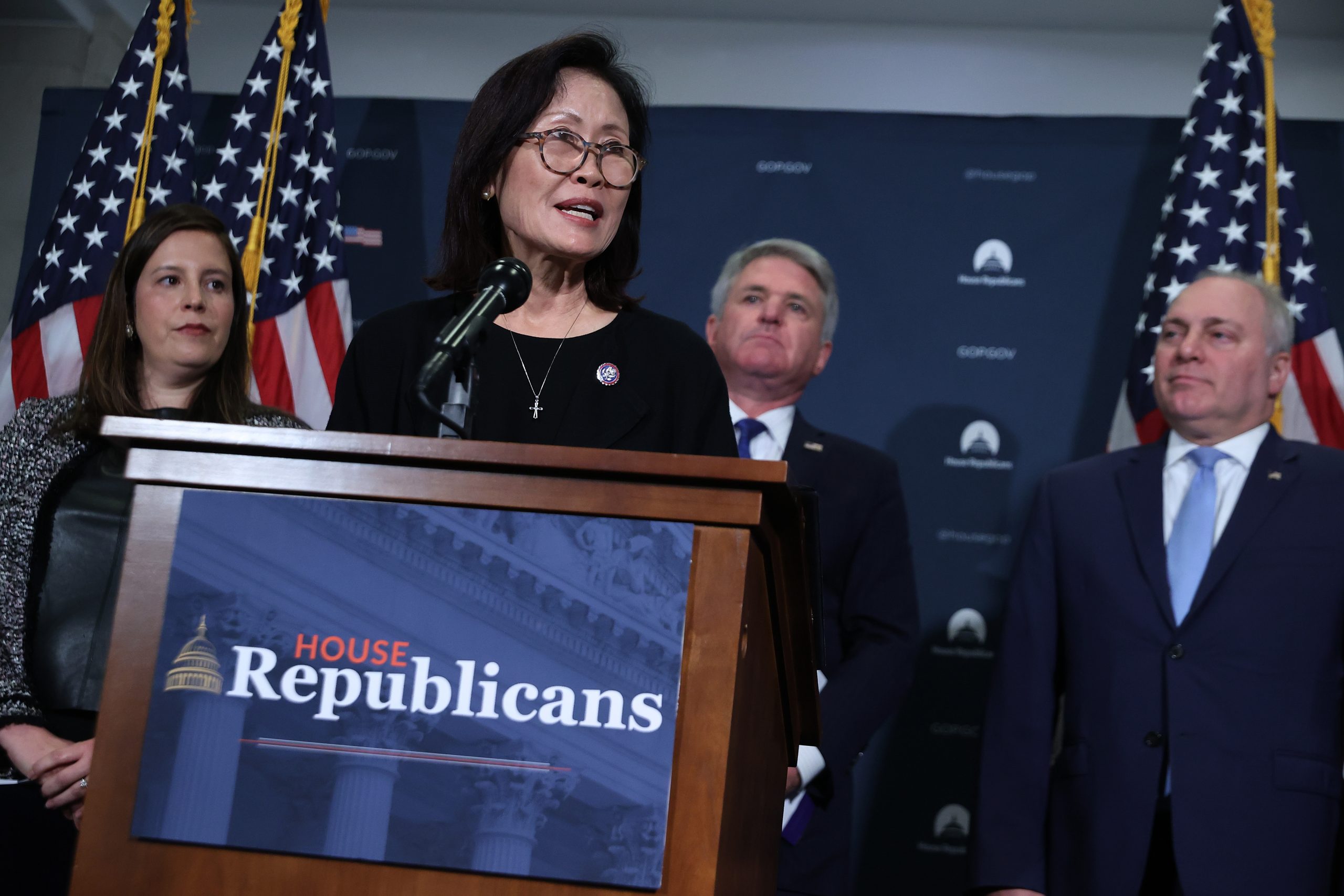
“Governor Newsom’s effort to cozy up to the Chinese Communist Party is delusional,” said Rep. Michelle Steel (R-Calif.). Newsom should instead “be concerned about the CCP’s control of the critical mineral supply chains as he prepares to ban gasoline-powered cars by 2035.”

Where Newsom has hewed to traditional Democratic positions on domestic issues like gun safety and curriculum wars, he’s veering into shakier political terrain by embracing Chinese officials, particularly with two international wars underway.

Other Democrats are engaging with China, including four Biden cabinet officials and a congressional delegation led by Senate Majority Leader Chuck Schumer.

But Newsom’s possible presidential aspirations may hinge on how he weathers a GOP narrative that his China visit may harm the U.S. Recent congressional races in Pennsylvania and Missouri became slug matches between rival candidates accusing each other of having questionable past business ties to Beijing. And Republican presidential contenders hammered Vivek Ramaswamy over his financial dealings in China during the second candidates’ debate last month.

Beijing is already playing into Republican talking points by praising Newsom’s visit as a path to “bolster California’s exchanges and cooperation with China,” as Chinese Foreign Ministry spokesperson Mao Ning told reporters on Thursday.

At a climate-focused speech at Hong Kong University on Monday, Chinese officials applauded Newsom’s leadership and his vision of mutuality for the U.S. and China. “How to handle our relationship well is a question of the century, to which the two countries must provide a good answer,” said Ministry of Foreign Affairs Commissioner Liu Guangyuan.

At the same time, GOP China hawks on Capitol Hill are sharpening their knives over Newsom’s willingness to engage with a government that Mike Gallagher (R-Wis.), chair of the House Select Committee on China, described in August as a greater threat to the U.S. than climate change.

Many GOP lawmakers see Newsom’s outreach to Beijing as inappropriate in the face of bilateral trade disputes, the Chinese spy balloon incident in February and Beijing’s alignment with Russian President Vladimir Putin’s war on Ukraine and now in the Israel-Hamas war. Newsom’s emphasis on climate cooperation — an issue reviled by many Republicans — makes his travel plans doubly triggering for GOP lawmakers who see China as an existential threat. And there are concerns that Beijing will exploit Newsom’s eagerness to engage by trying to create an influence channel with his administration unburdened by chronic bilateral irritants.

Other GOP lawmakers see Newsom’s engagement with Beijing as a potential national security threat. Newsom’s trip focus “is not on addressing climate issues, but instead ceding America’s energy and emissions reduction to the CCP,” said Rep. Cathy McMorris Rodgers (R-Wash.), chair of the House Energy and Commerce Committee. That will give China “more control over our energy future.”

Some Democrats support Newsom’s outreach. “It’s totally appropriate, said Rep. Ami Bera (D-Calif.), ranking member of the House Foreign Affairs Committee Indo-Pacific subcommittee. “There’s no way for us to address climate change at the global level without engaging China.”

GOP criticism may reflect some partisan shin-kicking of a rising star of the Democratic Party who has long-rumored — but consistently denied —ambitions for higher office. Newsom’s possible trajectory to the White House is also of interest to his Chinese hosts.

“He’s a potential presidential candidate, maybe 2028, who knows when, and that’s not lost on the Chinese,” said Max Baucus, former U.S. Ambassador to China. Chinese officials will be “checking this guy out. Who is this guy Gavin? What’s he all about? They want to know,” Baucus said.

Newsom’s decision to limit his discussions with Chinese officials to mostly climate-related issues is a gift to his critics. Newsom administration officials have said he will largely steer clear of hot-button issues like technology transfers, trade subsidies and human rights. Republican lawmakers say that’s unacceptable. “Given your refusal to discuss human rights and the fentanyl crisis with the CCP, we do not see how this trip will benefit Californians — we call on you to cancel your trip,” a group of eleven Californian GOP House members including Rep. Young Kim chair of the House Foreign Affairs Committee Indo-Pacific subcommittee and Rep. Kevin McCarthy said in a letter to Newsom on Friday.

A politician who won’t push China on points of conflict is exactly the kind of partner China wants, say conservatives. Beijing is on the lookout for “American political or business leaders who have a somewhat different view [of China] than that of the D.C. political class,” said Zack Cooper, a China expert and former assistant to the deputy national security adviser for combating terrorism at the National Security Council in former President George W. Bush’s administration.

It’s also red meat for lawmakers who demand U.S. officials take a tougher line with Beijing. Newsom should “re-iterate U.S. national security priorities, including deterring CCP military aggression against allies in the Indo-Pacific, stopping China from supplying U.S. fentanyl precursors, and getting them to play by the rules on trade and economic issues,” said Rep. Michael McCaul (R-Texas), chair of the House Foreign Affairs Committee on China. A Pentagon report published Thursday warning of the country’s dramatic expansion of its nuclear arsenal adds to fears of a growing military threat from China.

McCaul’s position has sympathy on the other side of the aisle. “All public officials must be able and willing to confront the abuses of the CCP … we can either have leadership or an avoidance of hard issues but we cannot have both,” said Rep. Ritchie Torres (D-N.Y.), a House Select Committee on China member.

Advocates say Newsom’s reluctance to engage on human rights undermines his goal of improving bilateral cooperation to tackle the climate crisis. Productive climate talks with Beijing require him “to speak up on the Chinese government’s crackdowns on environmental protests, arrests of climate activists, whistleblowers and journalists over the years,” said Yaqiu Wang, research director for China, Hong Kong and Taiwan at the nonprofit organization Freedom House.

Those concerns may overthink the implications of Newsom’s first official visit to China.

“The tone should be one of just ‘Hey, we’ve got to work together. Let’s figure out a way of respecting each other’,” said former ambassador Baucus.