Patriots-Bills film review: How Bill O’Brien and Mac Jones found a winning formula

posted in: News | 0

After seven weeks, the Patriots finally found their formula.

Let’s skip the cliched “complementary football,” a tidy way of saying it’s generally a good idea to play well on offense, defense and special teams in the same game.

Obviously, a banged-up Patriots defense must continue producing turnovers, as Jabrill Peppers did intercepting Josh Allen on Buffalo’s first play from scrimmage Sunday. Obviously, more special teams performances that include rookie kicker Chad Ryland hitting all of his field goals, Bryce Baringer dropping 100% of his punts inside the opponent’s 20 and the Pats winning the field position battle will help.

But the Patriots’ real formula involves alchemy: transforming the anchor that dragged them down for six weeks into wind behind their sails for the rest of the season. That anchor, of course, was the offense.

Mac Jones played arguably the best game of his career Sunday, considering the caliber of the opponent, his surrounding talent and performance in high-leverage situations. He finished 25-of-30 for 272 yards and two touchdowns. The Patriots scored a season-high 29 points and completed their first fourth-quarter comeback in years.

After the game, Jones credited Bill O’Brien for writing a winning script. That script came in five parts.

Start with a stabilized offensive line.

Starting right guard Mike Onwenu flipped to right tackle and plugged one of the largest holes in any starting lineup across the NFL. Onwenu allowed a single pressure in pass protection and helped the Pats post a 50% success rate when rushing, the second-highest of any offense in Week 7.

Over the last three weeks — including their hideous 34-0 shutout against New Orleans — the Patriots rank ninth in rushing success rate, which takes pressure off of Jones and allows for offensive balance.

Part two: more motion.

According to ESPN, the Patriots’ offense entered Sunday ranked 23rd in the rate of motion used at the snap with a season-long mark of 14%. Against the Bills, the Pats almost doubled that percentage, snapping the ball with a player in motion 24% of the time. That added eye candy stressed a Buffalo defense saddled with inexperienced linebackers and a tackling problem.

The Patriots averaged 10.6 yards per play on these snaps. Of note: the NFL’s two highest-scoring offenses, Miami and San Francisco, rank first and third in rate of motion used, respectively.

Part three: more run-pass-options (RPOs).

The Patriots called five RPOs on their first 11 snaps, averaging 8.2 yards per play. Jones feasted on RPOs at Alabama, where O’Brien last coached and has since implemented some elements of that offense into the Patriots’ playbook. Calling RPOs, which force Jones to almost instantaneously choose between passing or hand the ball off, also mitigated the Pats’ problems in pass protection, where they still rate sixth-worst in the league, according to Pro Football Focus.

Part four: a base quick passing game.

For a second straight week, Mac Jones led the NFL in fastest snap-to-throw time, per PFF. He unloaded the ball in an average of 2.2 seconds, protecting himself from what he and Belichick called the league’s best pass rush. In that time, O’Brien also featured his two best wideouts versus man-to-man coverage: Kendrick Bourne and Demario Douglas.

Douglas saw a career-best 37 offensive snaps, while Bourne earned a team-high seven targets and played more than any other skill-position player. Their ability to separate downfield helped Jones finish 7-of-8 for 77 yards and two touchdowns versus man-to-man coverage, a major weakness for this offense.

Part five: scheming explosive plays.

Considering Douglas, a sixth-round rookie, stands far and away as the Patriots’ most explosive player, generating chunk plays has and will continue to fall on coaching. The Pats derived most of their explosion (defined as passes of 20-plus yards and runs of 12 or more yards) from well-timed play-action passes and concepts that sprung playmakers into open space. Jones hit passes of 16, 25 and 26 yards off play-action. Around those completions, Douglas ran for 20 yards on a jet sweep, Bourne took a shallow cross for 33 yards and Rhamondre Stevenson rumbled 34 on a well disguised swing pass.

Credit O’Brien for packaging and timing these plays in ways that caught Buffalo off-guard, unlike prior opponents.

Bill O’Brien packaged the #Patriots favorite concepts in new ways to keep Buffalo off-balance.

This is a bubble-screen RPO to Pop Douglas disguised by the tight formation. Mike Gesicki takes an Arc release to block downfield, and the Pats out-leverage Buffalo for a 1st down. pic.twitter.com/TGg1TNRPkQ

— Andrew Callahan (@_AndrewCallahan) October 23, 2023

The question now is: how often can the Patriots repeat this formula? Can it become a habit? What about their identity?

It all starts with Jones. He has the power, like any quarterback, to maintain a steady floor. Over the past two weeks, the Patriots offense ranks fourth-best by Expected Points Added (EPA) per play. But over that past three weeks, when factoring the three turnovers Jones committed during the Saints’ shutout, the Patriots fall all the way to 31st.

So what comes next?

If the Patriots can pull another upset at Miami, a lost season might reset its course faster than anyone expected. If not, last Sunday will slip away, a happy memory swallowed by a sea of disappointment and unrealized potential with an all-too-familiar anchor down below.

Here’s what else the film revealed about Sunday’s win:

Mac Jones

25-of-30 for 272 yards, 2 TDs

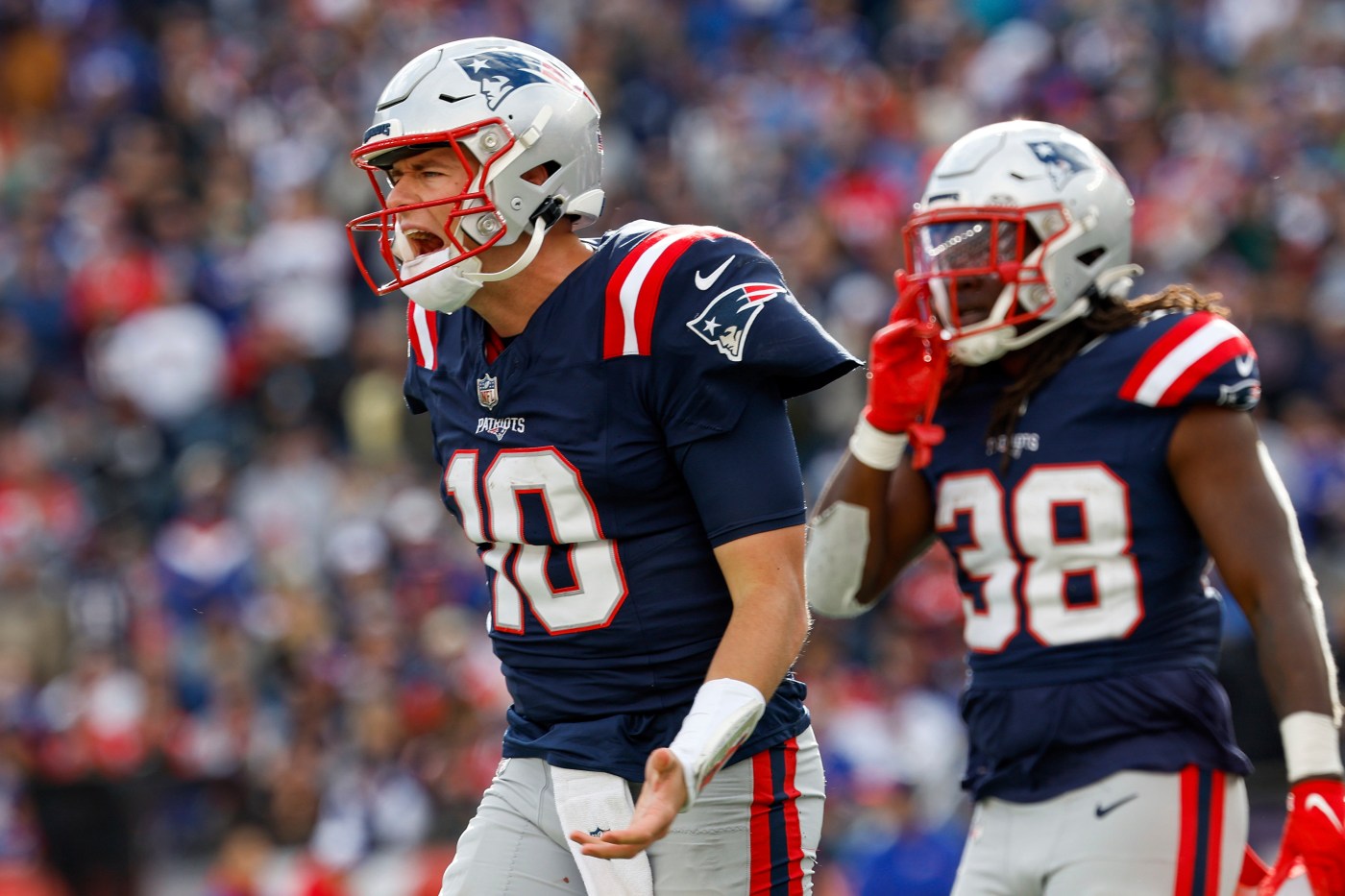
New England Patriots quarterback Mac Jones (10) screams during the second half of an NFL football game against the Buffalo Bills on Sunday, Oct. 22, 2023, in Foxborough, Mass. (AP Photo/Greg M. Cooper)

Accurate throw percentage: 86.2%

Under pressure: 4-of-4 for 36 yards, TD, 4 rush yards, 1 sack

Against the blitz: 8-of-9 for 117 yards, 4 rush yards

Behind the line: 7-of-8 for 55 yards

0-9 yards downfield: 13-of-15 for 129 yards, 2 TDs

10-19 yards downfield: 5-of-6 for 88 yards

20+ yards downfield: N/A

Notes: This is the Jones we expected to see.

A surgeon over the middle of the field — where he went 17-of-20 — with a lightning-quick release and plus accuracy. Yes, Jones benefited from a game plan tailored to him more than any other we’ve seen, but within that, he executed and risked a turnover on a single play.

Jones also delivered in a way we had never seen before, leading the first game-winning touchdown drive of his career. His third-and-8 completion to Hunter Henry with under a minute left allowed the Patriots to chase that touchdown instead of settling for a field goal. Jones routinely stood in against pressure — a bellwether for him this season — and found a way.

This was a quarterback the Patriots can win with, however long this version of Jones sticks around.

Critical areas

Foxboro, MA – October 22: New England Patriots safety Jabrill Peppers celebrates his interception during the first quarter of the game against the Buffalo Bills at Gillette Stadium. (Nancy Lane/Boston Herald)

Turnovers: Patriots 1, Bills 2
Explosive play rate: Patriots 10.9%, Bills 4.5%
Success rate: Patriots 52%, Bills 52%
Red-zone efficiency: Patriots 3-3, Bills 2-4
Defensive pressure rate: Patriots 41.9%, Bills 21.2%

Offense

Game plan

Personnel breakdown: 64% of snaps in 11 personnel, 36% snaps in 12 personnel.***
Personnel production: 6.9 yards/play in 11 personnel, 5.9 yards/play in 12 personnel.
First-down down play-calls: 63% pass (7.6 yards per play), 37% run (3.3 yards per play)
Play-action rate: 21.2%

Player stats

Broken tackles: RB Rhamondre Stevenson 3, WR Kendrick Bourne 2, WR Demario Douglas 2, RB Ezekiel Elliott, QB Mac Jones
Pressure allowed: Team 3 (sack, 2 hurries), LT Trent Brown (QB hit), LG Cole Strange (hurry), RG Sidy Sow (hurry), RT Mike Onwenu (hurry)
Run stuffs allowed: Team 2, Sow, Andrews, Strange
Penalties: QB Mac Jones (delay of game), OL Vederian Lowe (ineligible man downfield)
Drops: None

Notes

Foxboro, MA – October 22: New England Patriots running back Rhamondre Stevenson runs up field during the fourth quarter of the game against the Buffalo Bills at Gillette Stadium. (Nancy Lane/Boston Herald)

Bill O’Brien ruthlessly attacked the Bills’ linebacking corps and poor tackling with his opening script, calling three RPOs, two plays with motion at the snap and a play-action bootleg on the first drive alone.
Chasing after all that motion and playmakers in space, Buffalo finished with nine missed tackles, including a few that led directly to explosive plays.
On the ground, the Pats pounded the soft middle of the Bills’ defense, which entered having allowed 5.7 yards per carry inside. The Patriots’ first eight runs all hit between the tackles.
However, that well dried up fast, and Buffalo finished allowing four yards per carry. O’Brien adjusted by hitting the edges, including one 20-yard jet sweep for Demario Douglas in the third quarter.
Another plus in O’Brien’s column: how he disguise base concepts — like bubble screen RPOs, slant-flat and swing passes — in new formations and motions to keep Buffalo off-balance.

Bill O’Brien packaged the #Patriots favorite concepts in new ways to keep Buffalo off-balance.

This is a bubble-screen RPO to Pop Douglas disguised by the tight formation. Mike Gesicki takes an Arc release to block downfield, and the Pats out-leverage Buffalo for a 1st down. pic.twitter.com/TGg1TNRPkQ

— Andrew Callahan (@_AndrewCallahan) October 23, 2023

Douglas accounted for two of the Patriots’ six longest plays of the game and drew three penalty flags on Bills defenders in coverage. He should remain their starting slot receiver moving forward, regardless of how healthy JuJu Smith-Schuster is.
Douglas is still showing mental mistakes — he ran the wrong route on third-and-2 that killed the Pats’ 2-minute drill before halftime — but the Patriots must stomach those.
Because Douglas is also showing growth with his game, like using tempo at the start of his 19-yard catch in the fourth quarter that preceded Bourne’s touchdown. He ran at 80% upfield, the burst through his break on an in-breaking route behind a nearby zone defender to maximize separation, and Jones hit him right on the numbers.

Sunday’s six explosive plays finished as a season high. They had O’Brien’s play-calling, Douglas, Rhamondre Stevenson, Kendrick Bourne and third-string tight end Pharaoh Brown to thank for that.
Stevenson accounted for the longest play of the game on his 34-yard catch-and-run that started the Pats’ final drive. O’Brien cleverly disguised that basic swing pass — a staple for this offense — by motioning Douglas at the snap, which also helped the receivers out-leverage Buffalo as they blocked for Stevenson in space.
Bourne’s fourth-quarter fumble put a sour end on an otherwise sparkling day. The Pats desperately need his yards-after-catch ability.
Brown caught both of his passes off play-action; one in the flat and another down the right seam. The Patriots rotated him with Hunter Henry and Mike Gesicki throughout the game to disguise their run-pass intentions, considering Gesicki is more of a pass-catcher and Brown is their best run-blocker.
Gesicki beat Bills slot cornerback Taron Johnson on his game-winning touchdown with the same route Douglas ran against Johnson the play before. The Patriots picked on Johnson like no other defender they’ve faced this season.
Nice return for starting left guard Cole Strange.
Moving Mike Onwenu to right tackle was long overdue. It also speaks to an old philosophy among offensive line coaches: play your best five. Prioritize talent over fit, and let rough edges smooth out. It’s about time the Patriots did just that.

Defense

Foxboro, MA – October 22: New England Patriots’ Deatrich Wise Jr. and Christian Barmore sack Buffalo Bills quarterback Josh Allen during the second quarter of the game at Gillette Stadium. (Nancy Lane/Boston Herald)

Game plan

Personnel breakdown: 31% three-safety nickel package, 31% dime package, 30% three-corner nickel, 5% dollar, 3% base.****
Coverage snaps breakdown: 52% zone, 48% man
Blitz rate: 39%
Blitz efficacy: 3.1 yards allowed per dropback, 37.5% success rate allowed, 2 touchdowns

Player stats

Interceptions: S Jabrill Peppers
Pass deflections: CB J.C. Jackson, LB Ja’Whaun Bentley
Pressure: DL Deatrich Wise 5 (4 hurries, QB hit), DL Christian Barmore 4 (sack, 3 hurries), Bentley 3 (3 hurries), DT Davon Godchaux (QB hit), Peppers (QB hit), S Adrian Phillips (QB hit), CB Jack Jones (QB hit), LB Jahlani Tavai (hurry), DB Myles Bryant (hurry), Team (hurry)
Run stuffs: OLB Anfernee Jennings
Missed tackles: Bentley 5, S Kyle Dugger 2, Bryant 2, Phillips 2, Jackson
Penalties: CB Jack Jones (roughing the passer, illegal contact), S Jalen Mills (illegal contact), S Marte Mapu (holding), Barmore (roughing the passer), Wise (neutral zone infraction),  S Brenden Schooler (false start on punt)

Notes

Foxboro, MA – October 22: New England Patriots’ Myles Bryant, Ja’Whaun Bentley and Jack Jones celebrate making a stop on the Buffalo Bills during the fourth quarter of the game at Gillette Stadium. (Nancy Lane/Boston Herald)

Jabrill Peppers intercepted Josh Allen by reading a play-action pass Buffalo hurt the Patriots with several times last season. It features a three-route concept that stretches the short, intermediate and deep level of the field along the sideline.
Peppers told the Herald post-game he diagnosed the play by studying wide receiver Gabriel Davis’ pre-snap motion, alignment and relaxed body language. Davis appeared to motioning in to block, but Peppers knew better and immediately moved to cover the short route in the flat once the ball was snapped.
Once Allen looked deeper, Peppers dropped back and intercepted his sideline pass. The interception not only allowed the Patriots to grow their initial lead from 3-0 to 10-0, it built a margin for error they haven’t enjoyed virtually all season.
The Patriots needed that margin for error in the fourth quarter, when Allen and Co. marched to back-to-back touchdowns having finally overcome the Pats’ high-pressure game plan.
Armed with a diminished pass rush, defensive play-caller Steve Belichick sent regular blitzes at Allen, particularly on second-and-long and in the high red zone.
Before Allen’s 8-yard touchdown pass to running back James Cook and ensuing 25-yarder to Stefon Diggs, it worked. Allen started 1-of-6 for 10 yards and a sack against the blitz.
The blitzing gamble seemed to solve two problems: the aforementioned limited pass rush and Allen’s escapability. Allen killed the Patriots in their previous four matchups by extending most of his dropbacks longer than 2.5 seconds, then either scrambling or rifling completions downfield.
On third down, the Patriots spun the dial: 3-man rushes, double-teams of Stefon Diggs, simulated pressures and more blitzes. Their initial plan relied heavily on a spy for Allen.

Up front, defensive linemen Deatrich Wise and Christian Barmore also synchronized their best games of the season. They combined for nine total pressures, as Barmore devastated the interior of several pockets for Allen who was forced to duck outside.
Down to three edge defenders, Anfernee Jennings played a career-high 97% of the defensive snaps. He tallied the team’s only run stuff, and made another run stop by himself after a 1-yard gain.
Backup inside linebacker Mack Wilson helped offset some of that depth by flexing onto the edge in passing situations.
The Pats played a higher dose of man-to-man coverage than expected, perhaps emboldened by the return of cornerback Jack Jones from injured reserve. He rotated with Jonathan Jones, while J.C. Jackson played the most snaps (64) of any cornerback for a second straight week.
The Bills repeatedly hurt the Patriots with in-breaking routes at the second level, where Allen hit Diggs and rookie tight end Dalton Kincaid (8 catches, 75 yards).
The tackling was brutal across the board. Ja’Whaun Bentley, Kyle Dugger, Adrian Phillps and Myles Bryant were the worst offenders, but wrapping up and taking better angles must be addressed with the entire defense this week in practice.

Studs

WR Demario Douglas

Foxboro, MA – October 22: New England Patriots wide receiver Demario Douglas celebrates a first down during the first quarter of the game against the Buffalo Bills at Gillette Stadium. (Nancy Lane/Boston Herald)

Four catches. Three flags drawn. One weapon the Patriots must feature as much as possible.

Feed. Pop. Douglas.

DL Deatrich Wise

His five pressures lead the team and ruined multiple pass plays for the Bills. Without Matt Judon and Josh Uche, the Pats needed Wise to provide edge pressure. He delivered.

DL Christian Barmore

A wrecking ball in a No. 90 jersey. Barmore recorded some of the cleanest wins of any Patriots pass rusher this season. The last two weeks may be the best back-to-back games of his career.

Duds

LB Ja’Whaun Bentley

Rough game. Bentley missed five tackles, blew a couple chances at a sack and was in the vicinity of multiple catches.

Related Articles

New England Patriots |


Patriots QB Mac Jones opens up on playing for Bill Belichick

New England Patriots |


Why Patriots first-round flier ate into DeVante Parker’s snaps in win over Bills

New England Patriots |


Bill Belichick gives more context to key Patriots personnel switch in win over Bills

New England Patriots |


Callahan: Patriots scored a throwback win in home upset of Bills

New England Patriots |


Demario Douglas sparks Patriots’ offensive rejuvenation in win over Bills

WR DeVante Parker

Parker lost significant playing time to practice-squad receiver Jalen Reagor (35 snaps to 25). With his 35 snaps, he failed to separate consistently and finished with one catch.

Statistics for passing depth, broken tackles and missed tackles courtesy of Pro Football Focus.

*Explosive plays are defined as runs of 10-plus yards and passes of 20-plus yards. Explosive play rate is one of the most strongly correlated metrics with wins and losses.

**Success rate is an efficiency metric measuring how often an offense stays on schedule. A play is successful when it gains at least 40% of yards-to-go on first down, 60% of yards-to-go on second down and 100% of yards-to-go on third or fourth down.

***11 personnel = one running back, one tight end; 12 personnel = one running back, two tight ends; 13 personnel = one running back, three tight ends; 21 = two halfbacks, one tight end; 22 = two halfbacks, two tight ends.  

****Base defense = four defensive backs; nickel defense = five defensive backs; dime defense = six defensive backs; goal-line defense = three defensive backs; dollar defense = seven defensive backs.


David French: The worst scandal in American higher education isn’t in the Ivy League

posted in: Politics | 0

Those of us who write about higher education can pay too much attention to America’s elite universities. Schools including Harvard, Yale and Stanford are seen as virtual cultural superpowers, and the battle over these schools is sometimes seen as a proxy for battles over the future of the country itself. It’s not that this argument is wrong, exactly. That’s why I’ve written about these schools. But it’s incomplete.

In rightly ascribing importance to the Harvards of the world, we can forget that other schools in other contexts also exercise immense influence, and their virtues and flaws can sometimes be more consequential than anything that happens in the Ivy League.

Liberty University in Lynchburg, Va., on Friday, March 27, 2020. (Julia Rendleman / The New York Times)

In fact, I’d argue that the moral collapse at Liberty University in Virginia may well be the most consequential education scandal in the United States, not simply because the details themselves are shocking and appalling, but because Liberty’s misconduct both symbolizes and contributes to the crisis engulfing Christian America. It embodies a cultural and political approach that turns Christian theology on its head.

This month, Fox News reported that Liberty is facing the possibility of an “unprecedented” $37.5 million fine from the U.S. Department of Education. The department has been investigating violations of the Clery Act, a federal statute that requires federally funded colleges and universities to publicly report data about campus crime. To put that number into perspective, consider that Michigan State University paid $4.5 million for its own “systemic failure” to respond to the infamous Larry Nassar sexual abuse scandal, in which Nassar was convicted of sexually abusing dozens of women in his care. While Liberty’s fine is not yet set, the contents of a leaked Education Department report — first reported by Susan Svrluga in The Washington Post — leave little doubt as to why it may be this large.

The report, as Svrluga writes, “paints a picture of a university that discouraged people from reporting crimes, underreported the claims it received and, meanwhile, marketed its Virginia campus as one of the safest in the country.” The details are grim. According to the report, “Liberty failed to warn the campus community about gas leaks, bomb threats and people credibly accused of repeated acts of sexual violence — including a senior administrator and an athlete.”

A campus safety consultant told Svrluga, “This is the single most blistering Clery report I have ever read. Ever.”

If this was the only scandal at Liberty, it would and should be a national story. But it’s not the only scandal. Far from it. I’ve been following (and covering) Liberty’s moral collapse for years, and the list of scandals and lawsuits plaguing the school is extraordinarily long. The best known of these is the saga of Jerry Falwell Jr. Falwell, a former president of the school and a son of its founder, resigned amid allegations of sexual misconduct involving himself, his wife and a pool attendant turned business associate named Giancarlo Granda.

Falwell is nationally prominent in part because he was one of Donald Trump’s earliest and most enthusiastic evangelical supporters. Falwell sued the school, the school sued Falwell, and in September, Falwell filed a scorching amended complaint, claiming that other high-ranking Liberty officers and board members had committed acts of sexual and financial misconduct yet were permitted to retain their positions.

But that’s not all. In 2021, ProPublica published a comprehensive, gut-wrenching report describing how Liberty mishandled claims of sex abuse and sex harassment on campus and used its strict code of conduct, the Liberty Way, against victims of sex abuse. If, for example, victims had been drinking or engaged in any other conduct prohibited by Liberty policies, those details in their sex abuse complaints could be used against them in school disciplinary proceedings.

Liberty has faced a series of lawsuits related to those claims, and last year it settled one of those cases. Throughout these controversies, Liberty has responded by denying many of the worst allegations against it. Liberty claims, for example, that the Education Department’s preliminary report is marred by “significant errors, misstatements and unsupported conclusions.” It has also acknowledged “historic gaps in compliance” with the Clery Act and says it is making material changes on campus, including spending millions to upgrade campus security and reviewing and enhancing its Title IX procedures.

I know that there are people who will read the accounts above and be angry. They can’t believe a Christian institution could fail its students, the church and the nation so profoundly. Others will read and grow angry for a different reason. The scandals above are only a partial description of the problems at Liberty. They’ll actually think I let the campus off easy.

But there’s another group that will be angry as well — at yet another attack on an evangelical institution in a powerful secular newspaper. That anger, though, is a key part of the problem with the American church, and it’s a problem that no less a Christian figure than the apostle Paul identified almost 2,000 years ago.

In his first letter to the Corinthian church (or, as Trump might say, One Corinthians), he issued a ferocious denunciation of sexual immorality inside the church. In Chapter 5, he says that he’s heard of misconduct “of a kind that even pagans do not tolerate.” He’s condemning an act of incest within the church, but if you read the accounts of incidents at Liberty, you’ll read stories of gross misconduct that Christians and non-Christians alike should and do find utterly abhorrent.

The chapter continues in an interesting way. Paul demonstrates ferocious anger at the church’s internal sin, but says this about those outside the congregation: “What business is it of mine to judge those outside the church? Are you not to judge those inside? God will judge those outside. ‘Expel the wicked person from among you.’”

Not every Christian institution is rocked by scandal, and there are many Christian colleges that are healthy and vibrant, led by men and women of integrity. Yet as we witness systemic misconduct unfold at institution after institution after institution, often without any real accountability, we can understand that many members of the church have gotten Paul’s equation exactly backward. They are remarkably tolerant of even the most wayward, dishonest and cruel individuals and institutions in American Christianity. At the same time, they approach those outside with a degree of anger and ferocity that’s profoundly contributing to American polarization. It’s also perpetuating the corruption of the church.

Under this moral construct, internal critique is perceived as a threat, a way of weakening American evangelicalism. It’s seen as contributing to external hostility and possibly even the rapid secularization of American life that’s now underway. But Paul would scoff at such a notion. One of the church’s greatest apostles didn’t hold back from critiquing a church that faced far greater cultural or political headwinds — including brutal and deadly persecution at the hands of the Roman state — than the average evangelical can possibly imagine.

Why? Because he realized the health of the church wasn’t up to the state, nor was it dependent on the church’s nonbelieving neighbors. Liberty University is consequential not just because it’s an academic superpower in Christian America, but also because it’s a symbol of a key reality of evangelical life — we have met the enemy of American Christianity, and it is us.

David French is an Opinion columnist. He is a veteran of Operation Iraqi Freedom and a former constitutional litigator. His most recent book is “Divided We Fall: America’s Secession Threat and How to Restore Our Nation.” You can follow him on Threads (@davidfrenchjag). 

This column originally appeared in the New York Times.

Related Articles

Opinion |


Thomas Friedman: To win the war, defeat Hamas and stop settlements

Opinion |


Torivio Fodder: The true crime story of the Osage Nation would take a century to tell

Opinion |


Karl W. Smith: Biden’s revival of factory jobs isn’t all it’s cracked up to be

Opinion |


Erwin Chemerinsky: A federal judge’s gag order against Trump may be satisfying. But it isn’t constitutional

Opinion |


Victor, Ramanathan: Climate change isn’t just about emissions. We’re ignoring a huge part of the fight

Christie says he has enough donors to qualify for third debate

posted in: Politics | 0

Chris Christie’s campaign says he has met the criteria for the third Republican primary debate, securing a spot next month on what’s expected to be a winnowed stage of candidates.

Christie, the former New Jersey governor, has now surpassed the Republican National Committee’s 70,000 unique donor requirement, his campaign confirmed exclusively to POLITICO. He had previously met the RNC’s polling requirement of reaching 4 percent support in multiple qualifying surveys, according to POLITICO’s tracking of the criteria.

Christie becomes just the fifth candidate so far to qualify for the Nov. 8 debate in Miami, though fewer than that could be on stage. Former President Donald Trump is holding his own rally during the event, and Vivek Ramaswamy, the biotech entrepreneur who has also met the RNC’s criteria, said he is considering skipping the debate. Florida Gov. Ron DeSantis and former South Carolina Gov. Nikki Haley have also qualified.

Christie’s donor support appears largely organic, as he is spending less money than any other major candidate in the primary — bringing in $3.8 million in the third fundraising quarter while spending just $1.5 million. Other candidates still attempting to qualify for the debate, including South Carolina Sen. Tim Scott and North Dakota Gov. Doug Burgum, spent significantly more than Christie.

“Christie’s ability to organically earn support from voters proves his message taking on Trump is not only distinct, but works,” said Karl Rickett, campaign spokesperson.

To date, Christie’s campaign has spent just $28,300 on digital advertising and none on television, according to AdImpact. Tell It Like It Is, the super PAC supporting him, has spent $2.8 million on ads, mostly on television and streaming.

Since launching his campaign in early June, Christie, the GOP field’s most vocal critic of Trump, has given more than 200 interviews — most of which were on television, radio and podcasts, according to a campaign official. The Trump critic has been a regular on network Sunday morning shows.

Christie is polling in low single digits nationally and suffers from higher GOP unfavorability ratings than the rest of his primary opponents. But he is banking heavily on New Hampshire, where he remains competitive in the race to be the top Trump alternative. In that first primary state, he sits behind Haley, but neck and neck with DeSantis, with a polling average of 9 percent. Christie’s lean campaign operation, so far with low overhead, may help him to stay in the race longer than some of his opponents — based on their current burn rates — even if his fundraising remains modest.

New Jersey’s GOP tries to blunt Democrats’ election abortion attacks

posted in: Politics | 0

New Jersey Republicans did not get the memo on abortion.

Democrats and their allies are attacking GOP candidates on the issue in every competitive legislative district — even claiming the deep blue state “is just one election away from losing abortion access.”

The Republican response: Admit the procedure is legal in New Jersey and there’s no way they can change that.

“It’s just a political issue to scare their own voters,” John DiMaio, the Republican minority leader in the state Assembly, said in a phone interview. “In reality, we have full-term abortion in New Jersey that was passed about two years ago. The governor signed it. And there’s no real push that we’re going to do anything about that.”

DiMaio’s decision to write an op-ed saying so is just one high-profile example of how New Jersey Republicans are hoping to blunt the issue, which has proved politically potent for Democrats in other parts of the country since the Supreme Court overturned Roe v. Wade last year.

New Jersey Republicans’ approach bears little resemblance to national party talking points and largely contrasts with how their counterparts in other states have dealt with abortion since the fall of Roe. The issue is indisputably a winning one for Democrats in states where abortion rights are genuinely at risk, but New Jersey’s legislative elections in November — among the few key races this year — offer one of the last chances before 2024 for the GOP to prove it can mount a real defense in a state where those rights are firmly protected.

In Virginia, one of the few other states to hold legislative elections this year, Republicans are countering campaign attacks by saying Democrats are extreme because they don’t want to place limits on abortion and that they’re spreading “disinformation.” Republicans in Kentucky are making a similar argument in that deep-red state’s governor’s race. And Ohio Republicans passed a ballot initiative asking voters next month to decide whether to enshrine abortion protections into the state constitution or be the first to reject an abortion-rights measure since the end of Roe. 

One implication of the Supreme Court’s Dobbs ruling is that the GOP feels pressure to surrender the abortion question in blue states. And now New Jersey Republicans are doing just that — attempting to gingerly sidestep the issue. The tactic follows several instances of the general public siding with abortion rights on ballot questions in far redder states. Backlash to the Supreme Court’s Dobbs decision is also widely attributed to staving off a “red wave” in the 2022 midterm elections.

Candidate responses in some of the state’s most competitive districts show how Republicans have recognized the strong support for abortion rights in New Jersey even if they do not necessarily agree.

In South Jersey, six state legislative candidates this month issued a statement distancing themselves from nearby Republican state Sen. Ed Durr (R-Gloucester) who wrote in 2020, before he was elected, that women have a choice to “close their legs” instead of getting an abortion.

Central Jersey Republican state Senate candidate Mike Pappas — who as a member of Congress in the 1990s opposed abortion even in cases of rape and incest — has refused to answer a reporter’s inquiry on whether he still holds that stance. Another candidate in a swing district in Central Jersey, Steve Dnistrian, wouldn’t take a stance on abortion when asked during an interview.

State Democrats have been battered by Republicans this summer on clean energy, dead whales washing up at the beach, sex education standards and Democratic Gov. Phil Murphy’s lawsuits against school districts over LGBTQ policies. Now they’re trying to counter by saturating airwaves and mailboxes with ads suggesting that abortion rights will be less-protected if Republicans gain power.

Democrats hold a 25-15 majority in the Senate and a 46-34 majority in the Assembly. With their hopes buoyed by unexpected gains in 2021, in which they won six Assembly seats and one Senate seat, Republicans believe they may actually have a shot at taking control of one or both houses of the Legislature for the first time in 20 years.

Still, Democrats’ warnings that abortion rights are at risk can’t be simply dismissed. Even when Republicans have held partial power in New Jersey government, they’ve worked around the edges to curtail abortion access without attempting to ban the procedure.

Republican lawmakers, including both house’s GOP leaders, have in this legislative session introduced about a dozen bills that would restrict abortion in some way, from sweeping measures like a ban on abortions after 12 weeks to more narrowly tailored ones such as barring teaching students about it before sixth grade and then requiring schools to notify parents.

Former Republican Gov. Chris Christie, who opposed abortion rights, cut millions of dollars in state funds from clinics that performed them and vetoed repeated Democratic attempts to restore the funding.

And more than 20 years ago, during the waning days of their hold on both houses of the state Legislature, Republicans fought to enact a parental notification law for minors seeking abortions. After it was overturned by the state Supreme Court, they unsuccessfully sought a constitutional amendment and have re-introduced the proposal ever since.

While New Jerseyans are overwhelmingly in favor of preserving abortion rights, certain restrictions on abortions aren’t necessarily unpopular with the public. A Monmouth University poll from February found a 39 percent plurality said abortion should be legal “with some limitations.”

When DiMaio referred to “full-term” abortion being legal in New Jersey, he was talking about the fact that the state does not bar abortion at any stage. While abortions in the third trimester are rare — and, according to advocates, usually performed for medical reasons — Republicans in New Jersey often appeal to the public by noting Democrats have allowed it up to the point of birth.

Despite that, some New Jersey Republican leaders demur when asked if they would pass any abortion restriction bills if they take power.

“I’m not going to speculate on that issue. We have members that are pro-life. We have members that are pro-life with exceptions. And we have members that are pro-choice,” state Senate Minority Leader Anthony Bucco said in a phone interview. “But as of right now, this issue is settled law in New Jersey. And that’s why I don’t think it’s going to resonate like they’re hoping for.”

Bucco himself is a co-sponsor of the “New Jersey Born-Alive Abortion Survivors Protection Act.” And DiMaio sponsors the parental notification constitutional amendment as well as legislation that would require physicians to offer women seeking an abortion an ultrasound at least 48 hours before performing an abortion (There is currently no required waiting period for an abortion in New Jersey).

Some of the Republican abortion-related bills would:

— Bar the use of fetal tissue from elective abortions for use in scientific research

— Require female jail inmates to cover the full cost of abortions

— Roll back insurance mandates for abortions

— Bar the use of Medicaid funds to pay for abortions unless it’s medically necessary to save a woman’s life

New Jersey’s Republican base mostly favors at least some restrictions on abortion, with 57 percent of registered Republicans in the Monmouth poll considering themselves “pro-life” compared with 34 percent who said they’re “pro-choice.”

Even as New Jersey Republicans try to avoid talking about abortion rights, New Jersey Democrats over the past decade have become more explicit in their support for them. For instance, when Christie first cut $7.5 million in funding for family planning centers, Democrats characterized them as cuts to “women’s health” centers and stressed that the money did not directly fund abortions. Today, Democrats often refer directly to Christie’s cuts as targeting Planned Parenthood.

State Sen. Andrew Zwicker (D-Middlesex), who’s made abortion rights the centerpiece of his campaign against the staunchly anti-abortion Pappas, said the defunding of Planned Parenthood clinics shows that the issue is far from a red herring.

“Believe what they do, not what they say. You start with the fact that with a Democratically-controlled Legislature and a Republican governor, Planned Parenthood was defunded,” Zwicker said in a phone interview. “That’s had an enormous impact for health care for women in New Jersey.”

Zwicker acknowledged that abortion rights wouldn’t be at risk with Murphy in office. But the next governor will be elected in 2025, and Murphy, who faces term limits, won’t be on the ballot.

“It’s a meaningless statement to say that if the Republicans control the Legislature they wouldn’t do anything. Well of course not, because Gov. Murphy would be governor for two more years,” Zwicker said. “But in the election after that in 2025, who knows who wins? And under the possibility of full-Republican control of the Legislature and a Republican governor, we see extreme abortion bills already introduced.”