Weeks of infighting among House Republicans over their next speaker, which paralyzed the chamber during a time of global turmoil, opened a lane for their fourth-round draft pick to finally claim the gavel on Wednesday.
The House voted 220-209 to elect Rep. Mike Johnson speaker, bringing to an end an impasse that sank three other candidates before him and reopening the House for business. Not a single Republican voted against him — a feat which eluded his predecessor at the start of this Congress — while all Democrats who were present backed Minority Leader Hakeem Jeffries, D-N.Y.
Johnson, a fourth-term lawmaker representing his hometown of Shreveport and a big chunk of western Louisiana, has been a vocal advocate for marquee GOP issues from his time as a constitutional lawyer arguing for state abortion restrictions to his public defenses of former President Donald Trump.
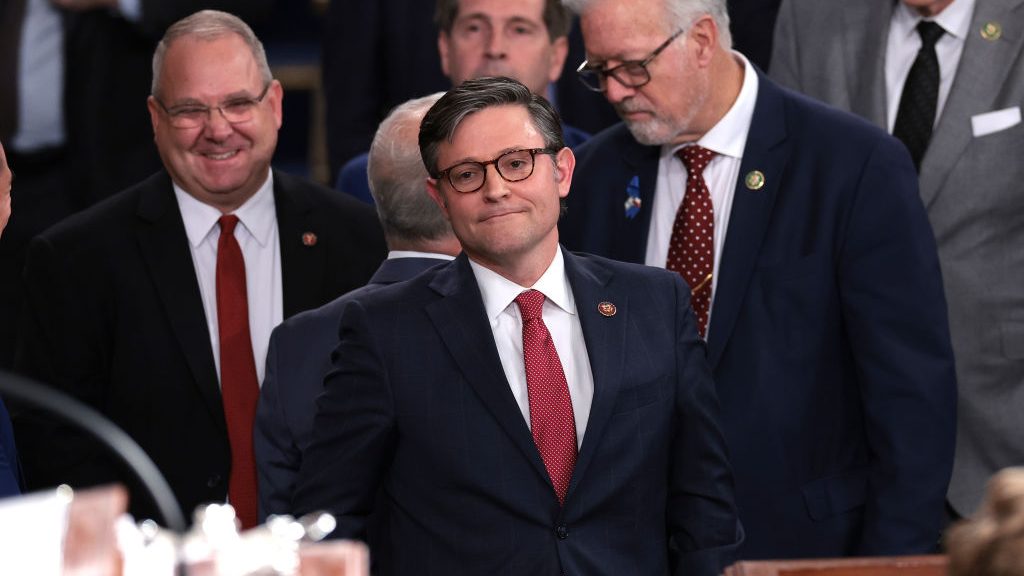
House Republicans applaud as U.S. Rep. Mike Johnson (R-LA) (C) is elected the new Speaker of the House at the U.S. Capitol on October 25, 2023 in Washington, DC. (Alex Wong/Getty Images)
“This is servant leadership,” Johnson, 51, said in a news conference after winning the House Republican Conference nomination Tuesday night. “We’re going to serve the people of this country. We’re going to restore their faith in this Congress, this institution of government.”
A member of the Judiciary and Armed Services panels, Johnson doesn’t shy away from topics popular on the right that set him at odds with Democrats. He pushed back as Judiciary Democrats in 2022 addressed a leaked Supreme Court opinion that preceded the overturning of Roe v. Wade. He used his Armed Services perch to push an amendment opposing COVID-19 vaccine requirements in the military.
The two wings of the House GOP coalesced around Johnson. He’s less of a lightning rod for centrists than a former speaker-designate, his ally House Judiciary Chairman Jim Jordan, R-Ohio, while maintaining valuable street cred on the right, including support from Trump.
Meanwhile defense hawks, who mistrusted Jordan and his support for government spending cuts, have one of their own in Johnson who’s pushed for growing the military budget. He’s got major installations in his home state as well as Barksdale Air Force Base in his district, where he’s sought federal funding including a $7 million earmark for expanding medical facilities in the fiscal 2024 Military Construction-VA bill.
Johnson, a constitutional lawyer, was among a select group of Republicans who served as Trump’s defense team of sorts during his first impeachment, an idea that Johnson had first pitched. It meant playing a vocal role in the media in support of Trump.
Johnson played another key role defending the former president as Trump allies and GOP lawmakers worked to undermine the results of the 2020 election that Trump lost to President Joe Biden.
Johnson led an amicus brief with 125 fellow House members supporting a lawsuit to throw out election results in swing states that voted for Biden; the Supreme Court rejected the effort. Johnson later objected to certifying the 2020 election results in key states just after the Jan. 6 insurrection, alongside many of his Republican colleagues.
When a reporter asked Johnson about his role during his Tuesday news conference, Republicans drowned out the end of the question, shouting “shut up!” Johnson didn’t answer.
Trump himself posted on his social media platform Wednesday that he wouldn’t make an endorsement in the speaker’s race at this stage, but his “strong suggestion” was to vote for Johnson.
Democrats took aim at Johnson’s role defending Trump’s efforts to overturn the election results during floor speeches Wednesday.
“House Democrats believe that when members of this body voted to reject the results of the 2020 election, they forfeited their ability to lead this chamber,” House Democratic Caucus Chair Pete Aguilar of California said.
Nonetheless, Rep. Ken Buck, R-Colo., a vocal critic of Trump and his allies’ efforts, said Wednesday he planned to vote for Johnson.
Johnson was the fourth speaker-designate since the removal of Rep. Kevin McCarthy, R-Calif., on Oct. 3. Previous nominees were, in addition to Jordan, House Majority Leader Steve Scalise, a fellow Louisianan, and Majority Whip Tom Emmer, R-Minn., who bowed out of the race just hours before Johnson’s nomination.
U.S. House Minority Leader Hakeem Jeffries (D-NY) (L) hands the gavel to newly elected Speaker of the House Mike Johnson (R-LA) after the House of Representatives held an election in the U.S. Capitol on October 25, 2023 in Washington, DC. (Chip Somodevilla/Getty Images)
The group of Republicans led by Rep. Matt Gaetz, R-Fla., that orchestrated McCarthy’s ouster seems have united behind Johnson. Rep. Bob Good, R-Va., in a CSPAN interview Wednesday morning called him “the right man at the right time for the right reasons.”
Rep. Thomas Massie, R-Ky., who voted “present” in the conference meeting Tuesday night, said he’d decided to back Johnson after speaking with him Wednesday morning.
Centrist Republicans, including a group of New Yorkers representing districts Biden carried in 2020, said they planned to support Johnson. Rep. Andrew Garbarino, R-N.Y., who voted against Jordan on all three ballots last week, said he would vote for Johnson after speaking with him about “critical issues facing Long Island” such as relief from state and local tax deduction limits.
House Budget Chairman Jodey C. Arrington, R-Texas, nominated Johnson for speaker before he won the nomination and said afterwards that he’d locked in support because he’s trusted, respected and was refocusing on GOP plans and principles.
“He is a man of deep conviction and faith in God. He’s a friend who sticks closer than a brother, and he’s a guy that understands that we cannot fail in this moment,” said Arrington, who flirted with a speaker run himself previously.
Messaging skills
A Johnson win puts the House in the unprecedented situation of having both of the chamber’s top leaders representing the same state, with Scalise remaining the No. 2 Republican. But then again, nothing about this situation has precedent, starting with the first-ever removal of a speaker earlier this month.
Overall Johnson has largely stuck with his party, voting with Republicans between 96 percent and 100 percent of the time since his election, according to CQ Roll Call voting data.
Before coming to Washington, Johnson honed his messaging skills in the courtroom and appearances as a guest host on Louisiana radio shows and entered politics as a state lawmaker. In his law career, Johnson argued in state courts in favor of a law that barred same-sex marriage and in favor of abortion restrictions and public prayer policies.
He hasn’t left radio behind, launching a podcast with his wife Kelly last year, “Truth Be Told,” covering a range of conservative social and political issues.
In his most recent podcast, Johnson decried a recent trend of fewer Americans saying they believe in God, arguing conservatives should “be more bold about presenting these eternal truths” for the good of the country. He also spoke of the “sanctity of every single human life,” a reference to abortion policy.
House Republicans shake hands with newly elected Speaker of the House Mike Johnson (R-LA) after the House of Representatives held an election in the U.S. Capitol on October 25, 2023 in Washington, DC. (Chip Somodevilla/Getty Images)
Johnson says Supreme Court Justice Amy Coney Barrett has been a friend since 1988, and he was a vocal supporter of her nomination in late 2020.
Johnson is vice chairman of the House Republican Conference, a lower-profile leadership role that didn’t scare off Republicans frustrated with their top leaders. He’d previously led the Republican Study Committee, a large group of conservatives in the House that helped him build relationships and chops to get the speaker nomination.
Johnson’s had little difficulty getting elected in a deep-red district. He was the top Republican vote-getter in the 2016 primary when he was first elected, and went on to win the general election runoff by 30 percentage points. He won his next two races with nearly two-thirds of the vote and was ran unopposed last year. Trump won the 4th District by 24 points in 2020.
Fundraising is not one of the areas Johnson is known for, though he’s likely to make that a higher priority if he gets elected. He’s pulled in substantially less, on average, than his House colleagues during his time in Congress, raising an average of $1.3 million per cycle. He had raised $553,000 this year and had $1.2 million on hand as of Sept. 30, according to Federal Election Commission filings.
Johnson’s leadership PAC had $83,000 on hand when the third quarter ended at the end of last month. This year, the PAC has given $1,000 donations to 35 House Republicans, including those who will face some of the toughest races in 2024. It gave $2,000 to Virginia Rep. Jen Kiggans. It also gave $1,000 to a joint fundraising committee with ties to Georgia Rep. Rich McCormick.
Johnson also has a joint fundraising committee with his campaign, leadership PAC and the National Republican Congressional Committee, which allows all three to split donations of a larger size than what’s allowed to individual campaigns under FEC rules.
‘Ambitious schedule’
As speaker, Johnson faces a looming Nov. 17 government spending deadline with a House that has lost almost an entire month to the House Republicans’ infighting over who should be the next speaker.
Johnson laid out an ambitious plan to have the House pass all of its appropriations bills by then in a Monday letter to colleagues, including by scrapping next week’s scheduled recess.
However, he acknowledged another stopgap funding bill may be needed, and said he would propose a continuing resolution that would go until either Jan. 15 or April 15 to “ensure the Senate can not jam the House with a Christmas omnibus.”
Johnson planned to start with the Energy-Water bill this week, before tackling the Legislative Branch, Interior-Environment and Transportation-HUD bills next week. Financial Services and Commerce-Justice-Science would then be considered the week of Nov. 6, followed by Labor-HHS-Education and Agriculture the week of Nov. 13.
“This is an ambitious schedule, but if our speaker can work across the conference to unify our membership and build consensus, we can achieve our necessary objectives,” Johnson wrote.
The Appropriations Committee hasn’t yet approved the Commerce-Justice-Science and Labor-HHS-Education bills amid intraparty disputes over spending levels and policy riders. Johnson said he would seek “consensus” to discharge the bills directly to the floor.
However, the fact those two bills haven’t been able to move out of committee, and the chamber’s failure to pass the Agriculture bill in September with wide opposition from farm- and swing-district Republicans shows the difficulty Johnson will face in moving appropriations bills. Johnson said he would create a “working group” to try to resolve member concerns with the Agriculture bill.
By the end of November, Johnson aims to start three sets of negotiations with the Senate: the defense authorization bill, appropriations and FAA authorization. He also plans to advance a resolution condemning Hamas prepared by Foreign Affairs Chairman Michael McCaul, R-Texas.
In December, Johnson is proposing the House pass the farm bill and conference report for the defense authorization bill. In the winter and spring, the House will wrap up the fiscal 2024 appropriations process and pass a fiscal 2025 budget resolution under Johnson’s plan.
Next year, Johnson is aiming for the House to pass all of the fiscal 2025 appropriations bills, the defense authorization bill and Water Resources Development Act by the end of July, and says the chamber will not break for August recess unless all of the appropriations bills have passed the House.
Mary Ellen McIntire, Paul Fontelo, Paul M. Krawzak and David Lerman contributed to this report, which was first published at cqrollcall.com.
Trump is fined $10,000 over a comment he made outside court in his New York civil fraud trial
Mike Johnson, a staunch conservative from Louisiana, is elected House speaker with broad GOP support
Justin Fox: How we got COVID’s risk right but the response wrong
Who Is Tom Emmer of Minnesota, the latest Republican nominee for Speaker?
In court faceoff, Michael Cohen testifies against Trump in fraud trial. Trump shrugs: ‘Proven liar’