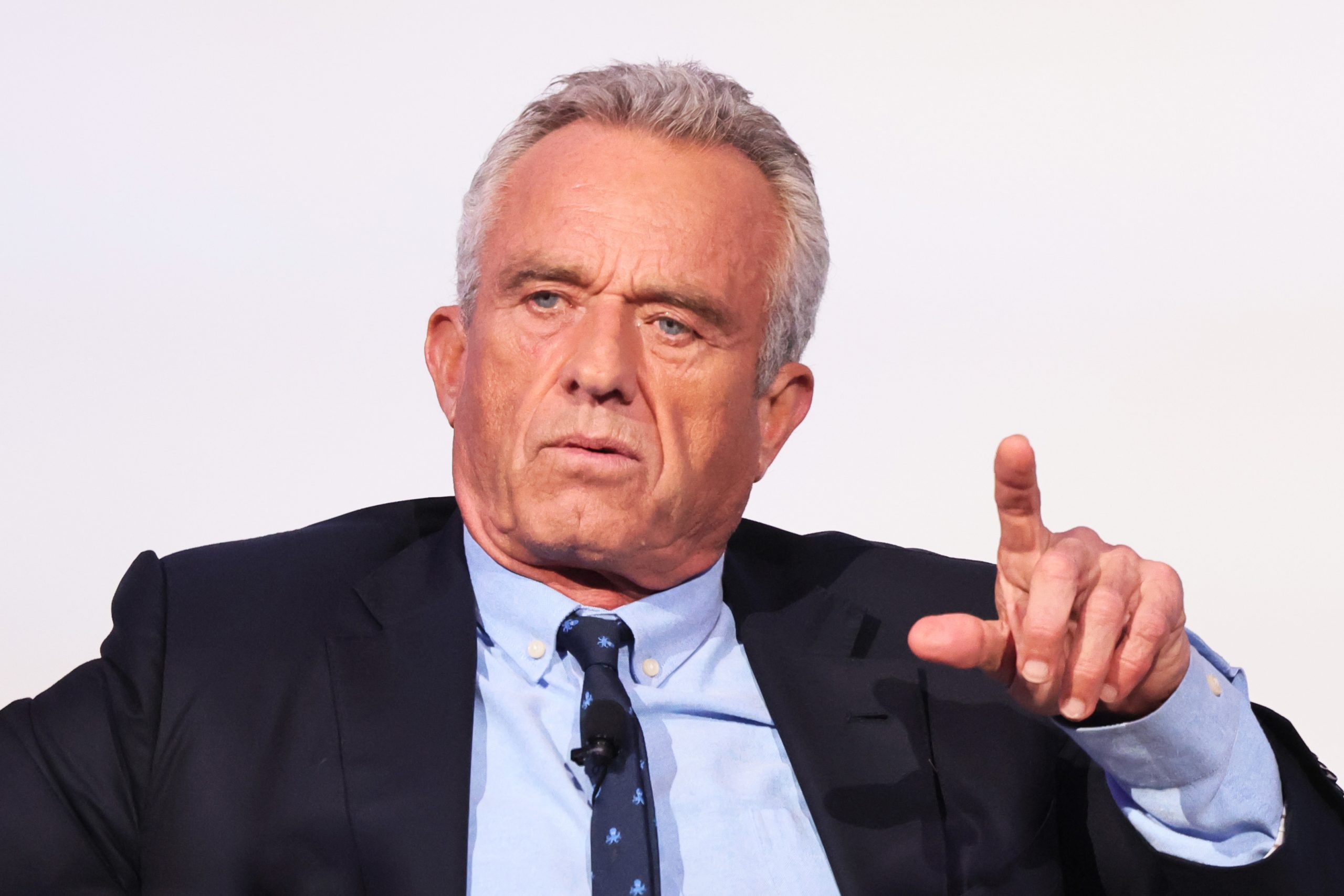
Jamelle Bouie: Millennials and Gen Z are tilting left and staying there

posted in: News | 0

As the saying goes, if you’re not a liberal when you’re young, then you have no heart, and if you’re not a conservative when you’re old, you have no brain.

The idea, of course, is that liberalism is a game for the youth and that age brings security, stability and a natural resistance to change. The upshot, in American politics, is that while most voters might start on the center-left, with Democrats, they’ll end their political journey on the center-right, with Republicans. One party represents disruption and change; the other party represents a steady hand and the status quo.

Or at least that’s the story. The reality is a little more complicated. Not only does our narrative of political change over time exaggerate the degree of rightward drift among different people as they age, but there’s good evidence that for the youngest generations of Americans, it is hardly happening at all.

The evidence comes from a new Wall Street Journal analysis of the latest data from the General Social Survey, a comprehensive examination of American attitudes and beliefs, conducted since its creation in 1972 by the National Opinion Research Center at the University of Chicago.

It is true, according to these researchers, that voters typically become more conservative as they get older, which is to say, as they gain income, buy property and start families. But the extent of that drift — of where it finally reaches — depends on where they start. When the Pew Research Center studied this question in 2013, for example, it found that the cohort of baby boomers who turned 18 under Richard Nixon was much more Democratic than the later cohort of boomers who turned 18 under Jimmy Carter.

Overall, according to the General Social Survey, boomers, who came of age during the turmoil and transformation of the 1960s and 1970s, are still more liberal than not. Gen Xers, who came of age during the Reagan revolution, started off more conservative than their older counterparts and have become the most consistently conservative generation in the electorate.

The case of Millennial voters is where things start to get interesting. As children of 9/11, the War on Terror and the 2008 financial crisis, Millennials — born between 1981 and 1996 — entered the electorate much more Democratic than their immediate predecessors. But while they have gotten a little more conservative in the years since, it has been at a much slower rate than you’d expect.

What’s more, the gap in the number of Millennials who identify as Democrats rather than Republicans is huge, with more than twice as many self-identified Democrats as Republicans. The next cohort on the roster, Gen Z, is even more liberal and Democratic than Millennials and shows no indication of becoming substantially more conservative as it ages.

Now, we should always be a little wary of talking about “generations” as uniform, monolithic or even particularly coherent. But groups of Americans do share common experiences, and it is not hard to explain the persistence of left-leaning beliefs and liberal self-identification among young Americans.

In addition to the events of the 2000s, there are those of the 2010s — specifically, the slow and grinding recovery from the 2008 recession and the rise of a right-wing populist movement that continues to threaten the rights of many different people all over the country. The slow recovery, in particular, produced a broad dissatisfaction with life in the United States among many young people, energizing phenomena like Sen. Bernie Sanders’ two campaigns for the Democratic presidential nomination and prompting many younger Americans to express their open dissatisfaction with capitalism as an economic system.

There’s something else to consider. For the past 15 years, neither the Republican Party nor political conservatism has stood for stability and a steady hand. Just the opposite: From the Tea Party onward, it has stood for chaos, disruption and instability.

A person who turned 18 in 2008 lived through, over the next decade, an economic crisis that erupted during a Republican presidential administration, a government shutdown instigated by Republican legislators and a Republican presidential administration that was, from beginning to end, defined by chaos and turmoil.

Now, as they enter the middle of their fourth decade, they are witness to a Republican-led Supreme Court that has ended the constitutional right to an abortion and a Republican congressional party that is so dysfunctional that it can’t even elect a speaker of the House, rendering Congress inert at a time when it needs to act.

Democrats are in comparatively better shape, but that’s not the same as good shape. There is a real disconnect between many younger Americans and the Democratic Party, on issues you might expect — like student loan debt — and issues you might not, like U.S. support for the Israeli government.

Millennials and Gen Zers may well age into more conservative views, but that doesn’t mean they’ll vote for Republicans. And if you want to understand the Republican Party’s growing hostility to free and fair elections — to the idea that the party should abide by the will of the majority — you should look no further than its extraordinarily poor standing with the two youngest groups of Americans.

When you’re no longer sure you can win on a level playing field, it’s harder to sustain any enthusiasm for democracy.

Jamelle Bouie writes a column for the New York Times.


Vandal who swung on crucifix at Cathedral of Holy Cross ordered held on $5,000 cash bail

posted in: News | 0

A pair of construction workers had a unique assignment Wednesday at the largest church in New England: repairing a crucifix that a vandal broke while swinging on it.

A judge at Boston Municipal Court ordered the man behind the damage, Michael Patzelt, 37, of Attleboro, held on $5,000 cash bail and to stay away from the Cathedral of the Holy Cross and witnesses who caught him committing the unholy act in the South End.

Officers assigned to the neighborhood for the Boston Police Department arrested Patzelt around 6:15 p.m. Tuesday after receiving a call for a suspicious person who had knocked a hat off a woman in the area of the cathedral.

“The suspect then proceeded to climb up the cross where he began to swing and hang from it, breaking off several parts of the cross,” a police release states. “The suspect broke both the statue’s arms prior to officers responding and placed him under arrest.”

Patzelt pleaded not guilty to charges of assault and malicious destruction of property during an arraignment in court Wednesday afternoon. He appeared wearing a ripped green shirt.

The judge asked the defense whether the vandalism stemmed from a “depraved heart or sick,” to which an attorney representing Patzelt responded that the Attleboro man is homeless and unemployed after the death of his grandmother.

The judge also requested the defense seek mental health counseling for Patzelt.

Samuel Jones, a prosecutor for the Suffolk District Attorney’s Office, estimated the cross that Patzelt damaged to be around 150 years old and will cost about $20,000 to repair.

“Unfortunately, the Cathedral experienced vandalism at the exterior crucifix. I have no information regarding why someone would take such an action,” said Terry Donilon, a spokesman for the Archdiocese of Boston. “The Archdiocese will work with the Cathedral to assess the damage.”

The Cathedral of Holy Cross opened in 1875 and seats nearly 2,000 people, the largest church in New England. It also houses the largest organ built by the world-renowned Hook and Hastings Company, according to its website.

Over the years, the Cathedral has hosted some prominent events, including a Mass in memory of President John F. Kennedy with the Kennedy family and dignitaries in 1964. More recently, then-President Barack Obama addressed the nation during an interfaith service following the Boston Marathon bombings in 2013.

Workers repair the vandalized statue of Jesus at the Cathedral of Holy Cross in the South End. (Nancy Lane/Boston Herald)

Wisconsin DNR approves new wolf management plan with no population goal

posted in: News | 0

Wisconsin wildlife officials unanimously approved a contentious new wolf management plan Wednesday that doesn’t include a specific population goal despite demands from hunters and farmers to cap the number of wolves roaming the state.

In backing the plan, Department of Natural Resources policy board members praised it as a scientifically sound compromise that could give federal officials confidence that Wisconsin would manage its wolf population responsibly if the federal government removes protections for the species.

“Impressive work,” board member Todd Ambs told DNR large carnivore specialist Larry Johnson, who spent months developing and revising the plan in an attempt to please hunters, farmers and conservationists. “Amazing what you’ve been going through. … Congratulations on still being upright when you got here.”

Wolf management has become one of the fiercest policy debates in Wisconsin hunting circles as the population has grown over the last three decades.

Farmers in northern Wisconsin have long complained that wolves are preying on their livestock. The DNR has recorded 67 confirmed or probably wolf attacks on livestock, pets and hunting dogs so far in 2023, up from 49 in all of 2022. Hunters believe the animals are devastating the deer population in the northern reaches of the state. Conservationists counter that wolves haven’t firmly established themselves in the state and should be protected.

The DNR adopted a wolf management plan in 1999 that called for capping the population at 350 wolves. The latest DNR estimates, however, indicate the population currently stands at around 1,000 wolves.

With the population growing, Republican legislators in 2012 passed a law requiring the DNR to hold an annual wolf hunting season. Hunters and farmers have pointed to the 350-wolf limit as justification for setting high kill quotas, angering animal rights activists.

A federal judge last year placed gray wolves in the lower 48 states back on the endangered species list, making hunting illegal and limiting farmers to nonlethal control methods, such as fencing in livestock or using guard dogs. The DNR has been working on an updated wolf management plan in case wolves are removed from the list and hunting resumes.

The new plan recommends a statewide population of about 1,000 animals but doesn’t set a hard limit on the population. Instead, the plan recommends allowing the population to grow or decline at certain numerical thresholds. DNR officials insist the plan creates flexibility in dealing with local packs, allowing for more hunting pressure in areas overpopulated with wolves.

The proposal has met with sharp criticism from farmers and hunters who want to see a specific statewide population goal. The Wisconsin Farm Bureau Federation, the largest farmers association in the state, has called for maintaining the 350-wolf cap and Republican lawmakers are advancing a bill that would force the DNR to insert a specific number in the plan.

Republicans who control the state Senate on Oct. 17 refused to confirm four members of the DNR board who said they supported the new management plan, removing them from the board. Democratic Gov. Tony Evers named four replacements the same day.

The board spent more than three-and-a-hours before the vote listening to public comments on the plan from both sides.

Alex Mardosky, associate director of the Nature Conservancy in Wisconsin, called the plan “exceptional.” He praised the DNR for moving toward a flexible management approach, calling a hard population goal “a really blunt instrument.” He recommended the DNR set a zero quota if hunting resumes.

Ed Harvey of the Conservation Congress, a group of influential sportsmen who advise the DNR, said the organization doesn’t think the plan should keep the 350-wolf goal. He complained that the department hasn’t given enough weight to the opinions of people who live among wolves.

Patrick Quaintance, of Bayfield, said he’s seen the remains of calves killed by wolves on farms around his property and has taken photos of wolves in broad daylight. “I don’t feel safe walking my dog or turning my dog loose on my property,” he said. “Let’s keep this in perspective. People are having problems with wolves.”

There has never been a documented wolf attack on a human in Wisconsin, according to the DNR. Wolves typically prey on old, young, sick or otherwise weakened animals, although the department has said that wolves could start acting more aggressively toward people as they become habituated to them.

Fred Clark, executive director of conservation group Wisconsin’s Green Fire, said his group supports the plan and that the 350-wolf goal in 1999 means nothing because scientists have had 24 years to learn more about wolves. He said the plan will help persuade federal wildlife officials that they can hand wolf management back to the states in good conscience.

“The feds are paying attention,” Johnson, the DNR’s large carnivore specialist, told the board. “(They’re) looking for a plan that lays out our intentions. It’s really important to put our best foot forward as a state so when that delisting comes we can maintain it long-term.”

The board also voted unanimously to approve new regulations governing the state’s wolf season. The DNR has been relying on emergency rules crafted after Republicans passed the 2012 law establishing a hunt.

The new regulations largely duplicate the emergency provisions but do include some changes to reflect goals in the management plan. Notable changes include shrinking the 24-hour period for registering kills to eight hours. Hunters would be allowed to train dogs to track wolves only during the wolf season and would be barred from destroying dens.

The new rules retain existing prohibitions on hunting wolves with dogs at night.

Related Articles

Outdoors |


Semi-truck driver among 2 killed, 6 injured in fiery crash along I-94 in western Wisconsin

Outdoors |


Hudson city administrator to step down

Outdoors |


Aging U.S. power grid to get $3.5B update; Minnesota to share largest grant

Outdoors |


Few Republicans have confidence in elections. It’s a long road for one group trying to change that in Wisconsin.

Outdoors |


Wisconsin Supreme Court is asked to redraw legislative boundaries created by Republicans

Twins’ Alex Kirilloff undergoes shoulder surgery

posted in: News | 0

Twins president of baseball operations Derek Falvey said earlier this month that the Twins were expecting Alex Kirilloff to need a labrum repair when he underwent surgery on Tuesday with Dr. Neal ElAttrache.

They got some good news.

After imaging and evaluation, the surgeon did not need to repair the labrum or rotator cuff in his right shoulder. Instead, Kirilloff underwent a bursectomy, a procedure to clean up the bursal sac in his shoulder, on Tuesday.

The left-handed Kirilloff first hurt his non-throwing shoulder during the middle of the season and wound up missing more than a month with the injury. He returned in September, though manager Rocco Baldelli later said though they had gotten him “to a reasonably good spot,” he was never back to 100 percent.

After playing through shoulder pain, Kirilloff eventually was placed on the injured list before what would become the final game of the American League Division Series as the issue had gotten progressively worse to the point where he was having difficulty swinging the bat.

“Certain things — diving, reaching, swinging — kind of aggravated (it),” Kirilloff said earlier this month. “It’s something I was obviously dealing with for a while, but kind of gets to the point where you can’t be effective with it.”

The Twins have not yet publicly laid out a recovery timeline for Kirilloff, but they expect him to focus on range of motion and strengthening exercises in the short term before then progressing to his normal offseason conditioning-and-strength program.

Related Articles

Minnesota Twins |


Twins position breakdown: outfield

Minnesota Twins |


Twins position breakdown: shortstop

Minnesota Twins |


Twins position breakdown: Third base

Minnesota Twins |


Twins position breakdown: second base

Minnesota Twins |


Twins position breakdown: first base