Lively revival of Stephen Sondheim’s ‘Company’ is sure to please Orpheum Theatre audiences

posted in: News | 0

Musical theater master Stephen Sondheim surely went to his grave knowing that he was deeply appreciated. In March of 2020, the New York Times devoted a nine-page supplement to him on the eve of his 90th birthday, when a revival of his 1970 musical, “Company,” was set to open on Broadway. While COVID abruptly wiped live theater away, dozens of the biggest names in Broadway and Hollywood created an online-only tribute to him, featuring songs from a half-century of his musicals.

That production of “Company” finally opened in November of 2021, and Sondheim attended a preview 11 days before his death. What he experienced was more than just a revival: It was a reimagining, transforming the central character from male to female, his romantic liaisons from female to male, and changing one of the five couples in their orbit to two gay men.

Britney Coleman as Bobbie and the North American Tour of “Company.” (Matthew Murphy)

It took home five Tonys last year, including “Best Revival of a Musical,” and now the touring version has landed at Minneapolis’ Orpheum Theatre. It’s quite an entertaining almost-three-hours of musical theater, full of strong voices, vivid characterizations and imaginative staging ideas, the 14-person cast selling every song with passion.

When “Company” debuted in 1970, it was the rare Broadway musical that could be about any of the “Another Hundred People” that theatergoers had passed on a New York City street that day. It’s also less a story than a series of vignettes about a woman turning 35 and visiting with five couples who present the pros and cons of committed relationships.

Perhaps Sondheim (who wrote both the music and lyrics) and book writer George Furth set out to defy the conventional manner of making musical theater, which is to take a story and set it to music. For it often seems that Sondheim could have written the songs first, based on the agreed-upon theme, Furth then figuring out how to assemble them into a musical.

Yet this is an almost unimpeachable production. It was director Marianne Elliott’s idea to make the gender switches (originally for a 2018 London revival; Sondheim loved the idea) and she’s fashioned each scene and song into an engaging miniature, bursting with colorful characters. And Liam Steel’s clever choreography is meticulously executed on Bunny Christie’s set full of adjoining frames, brownstones and balconies, and benches made from the letters that spell “Company.”

Britney Coleman carries the show engagingly as protagonist Bobbie. It’s a tricky role, in that she’s something of a straightwoman for her flamboyant friends, but Coleman seizes scenes when given the chance, particularly on showstopping ballads like “Marry Me a Little” and “Being Alive.” The latter (the last of his songs that Sondheim ever experienced in a theater) brings energy back to a second act that gradually peters out before it.

Then again, it’s hard to top the hilarious first-act production number that is “Getting Married Today.” Matt Rodin’s rapidly pattered evocation of a groom getting cold feet is a hoot, aided by a choir that explodes out of every portal in his apartment. It’s a brilliant piece of musical comedy that will surely stand as one of the most memorable moments on a Twin Cities stage this year.

Rob Hubbard can be reached at wordhub@yahoo.com.

‘Company’

When: 7:30 p.m. Wednesday-Friday, 2 and 7:30 p.m. Saturday, 1 and 6:30 p.m. Sunday

Where: Orpheum Theatre, 910 Hennepin Ave., Minneapolis

Tickets: $139-$30, available at hennepintheatretrust.org

Capsule: While relatively plotless, it’s a passionately performed showcase for Stephen Sondheim’s songcraft.

Related Articles

Theater |


Review: Children’s Theatre’s ‘Grinch’ is funny, flamboyant, ultimately touching slice of Seuss

Theater |


Chasing the music: Widely praised as Frankie Valli in CDT’s ‘Jersey Boys,’ St. Paul native Will Dusek is an actor to watch

Give to the Max Day is Thursday. Here are 11 things to know on its 15th anniversary

posted in: News | 0

It was 2009: Many of us were still transitioning from flip phones to smartphones, from DVDs to streaming, from Black Friday to Cyber Monday.

In that year of shifting habits, on the third Thursday in November, Minnesotans were asked to take part in an online giving campaign to help raise money for nonprofits.

Give to the Max Day was supposed to be a one-time event, but it went over in such a big way — $14 million was raised that year — that it became an annual “giving holiday” that will mark its 15th anniversary on Thursday.

But, in the face of tough economic conditions and a post-pandemic dip in charitable giving nationally, will Minnesotans be able or willing to give to the max in 2023?

We’ll know by 11:59 p.m. on Thursday.

Ahead of the 15th annual event, here are 11 things to know:

1. It began with a question.

“What if giving was easier and more fun?”

That was the question that launched GiveMN in 2009, a collaborative venture led by Minnesota Community Foundation and many other organizations.

“Give to the Max Day” was organized to generate excitement for that launch.

It became more than a one-time promotion after $14 million was raised in 24 hours.

“The campaign exceeded everyone’s expectations and became an annual celebration,” says Jenna Ray, GiveMN’s deputy executive director, community impact.

“It’s become this really lovely tradition.”

2. What exactly is Give to the Max?

Give to the Max is an annual fundraising campaign for thousands of nonprofits and schools across Minnesota.

(K-12 public schools were added to the ranks of nonprofits in 2012.)

3. How can people find a nonprofit or school they’d like to support?

People can search for nonprofits and schools by name, category, location and more at Givemn.org/gtmd.

Donors can now also browse organizations who say they primarily serve LGBTQ+ communities or search for organizations led by or primarily serving Black, Indigenous and people of color (BIPOC) communities.

4. Why is Give to the Max Day held in November?

Give to the Max Day typically takes place on the Thursday before Thanksgiving as a kick off to the holiday giving season.

5. What time does Give to the Max Day start?

Early giving kicked off on Nov. 1, but most of the donations pour in on Thursday, when Give to the Max Day 2023 begins at 12:00 a.m. and ends at 11:59 p.m.

Find online and in-person events at Givemn.org/opportunities.

6. What is a Golden Ticket?

Golden Tickets are random-chance drawings, which provide prize grants for participating nonprofits and schools.

Donations are drawn at random from different intervals and GiveMN adds $500, $1,000 and even $10,000 to the total.

The prizes are possible, in part, due to the support of the Bush Foundation.

Donors can also search for nonprofits or schools that will receive matching donations.

7. A look at how donations help

Golden Tickets were also awarded during early giving.

In the east metro, the winners of the early $500 tickets include Wildflyer Coffee, Como Friends, and Animal Ark, an animal-welfare organization with a no-kill shelter in Hastings.

The extra money is needed more than ever at Animal Ark, which has set a fundraising goal of $40,000. This is one of only two fundraisers it holds annually.

“It’s helpful, it’s absolutely helpful,” says Lorraine Royal, Animal Ark’s executive manager. “The money we receive is used to shelter animals, toward food, medical costs.”

Inflation is making their work more challenging.

“Everything has gotten more expensive,” Royal says. “Pet food is more expensive than it has ever been, vet costs feel like they’ve doubled and bills in general are higher than they were two years ago.”

As an example, Royal says, the shelter recently spent $1,700 for emergency veterinary services for Hendrix, a foster kitten. Other animals, like a 5-year-old dog named Diesel, have everyday expenses at the shelter, where he has been waiting a long time to be adopted.

“He’s been with us for two years, and we really don’t know why,” Royal says. “He’s a stunning black Lab mix.”

Find out more about Diesel and Animal Ark at animalarkmn.org.

8. How much money has been raised since 2009?

Over the last 14 years, $289.6 million has been donated to more than 14,000 nonprofits and schools.

9. How much money was raised in 2022?

In 2022, donations given during Give to the Max raised $34 million for 6,439 nonprofits and schools.

10. Are there any hidden costs for nonprofits or donors?

“There is no subscription cost for organizations to use GiveMN.org and no registration fee to take part in Give to the Max Day each year,” explained Tom Zimmerman, a GiveMN spokesperson, in an email. “This is important to us to allow all Minnesota organizations access to use our platform and take part in the day.

“There is a 6.9% fee assessed on gifts made through GiveMN.org that covers costs assessed by credit card companies, keeps our platform free for Minnesota organizations and helps sustain GiveMN programming, as we are a small, local nonprofit, too.

“Donors are given the option to pitch in a bit more to cover the processing fee on behalf of the causes they support — 93% of donors do so, ensuring that 100% of their intended donation goes to the cause they support.”

11. What happens after Nov. 16?

GiveMN provides a giving website available year-round to link people with nonprofits and schools.

Since almost all nonprofits raise money online these days compared to 2009, GiveMN now also offers other types of assistance to organizations such as fundraising strategy and infrastructure (info at RaiseMN.org).

Related Articles

News |


Minnesota adds 20 wild rice lakes and streams to impaired list

News |


With wild ‘super pigs’ expanding their range, Minnesota readies for action

News |


Minnesota man charged with Jan. 6, 2021, attack on U.S. Capitol

News |


Pair of Minnesota-grown turkeys will be pardoned at White House in annual Thanksgiving tradition

News |


In survey, more Minnesota hospitals say they are losing money this year

Minnesota adds 20 wild rice lakes and streams to impaired list

posted in: News | 0

Minnesota regulators identified another 20 bodies of water used for wild rice production that exceeded the state’s wild rice sulfate water quality standard, placing the 13 lakes and seven streams on its biennial impaired-waters list.

In doing so, the Minnesota Pollution Control Agency opted to follow the federal Clean Water Act over a 2015 state law that sought to prevent the MPCA from adding impaired wild rice waters to the list and to prevent the agency from enforcing sulfate reduction if it cost the permit holder any money.

Sulfates — discharged into water by industrial activities like mining, wastewater treatment and other industrial facilities — at high levels harm wild rice when the sulfate is converted to hydrogen sulfide in the sediment.

Minnesota’s sulfate limit for wild rice waters is 10 milligrams per liter, which the mining industry had long argued was too stringent .

The 2015 state law was designed to largely prevent the MPCA from enforcing the existing standard until it established new wild rice water-quality standards for sulfate.

The MPCA had tried to change that standard to a formula that would include the water’s organic carbon and iron content, but withdrew its rule change proposal in 2018.

When the MPCA submitted its 2020 impaired waters list to the Environmental Protection Agency without any wild rice waters exceeding sulfate standards, the federal agency pushed back, identifying 30 bodies of water that it said should have been on the list.

The MPCA revised its 2020 list, despite state law, with those bodies of water, and added another 35 bodies of water exceeding wild rice standards to its 2022 impaired water list.

“Since 2020, that kind of overruled any state law because that’s a federal expectation and requirement from EPA: You follow the Clean Water Act,” Leya Charles, the MPCA’s water assessment and impaired waters list coordinator, said in an interview with the Duluth News Tribune.

The 2024 impaired water list includes 54 water bodies and 199 impairments, which range from finding “forever chemicals” in fish to mercury and other pollutants, and is open for public comment through Jan. 12, 2024. That brings the total water bodies on the list to 2,798, with almost 6,500 impairments.

After weighing any changes after the comment period, the MPCA will submit the list to the EPA, which will either approve or disapprove of the list.

Upon approval, any water bodies considered impaired need a total maximum daily load report, which determines how much of a pollutant the water body can receive before exceeding water quality standards.

Federal officials have also made clear the MPCA needs to enforce the sulfate standard, something the 2015 state law sought to curb.

“We also received from EPA in February of 2022 a letter stating that we needed to implement the sulfate standard to the (National Pollutant Discharge Elimination System) permitting program,” said Bill Cole, supervisor of the MPCA’s water quality standards unit. “So, like the impaired waters list, the EPA expects us to implement the standard. They told us that repeatedly.”

Birch Lake added

That’s giving an environmental group opposed to copper-nickel mining near the Boundary Waters Canoe Area Wilderness some hope that adding Birch Lake to the impaired waters list will make it more difficult for a project to get permitted.

In its list released Tuesday, the MPCA said Birch Lake, which flows into the BWCAW via the Kawishiwi River, exceeds the wild rice sulfate standard.

That’s largely based on data submitted by the Campaign to Save the Boundary Waters and the 1854 Treaty Authority.

“It has long been known that there is sulfate pollution in Birch Lake, but so far, effectively nothing has been done to address it. In 2021, we rapidly expanded our water quality testing program after discovering that the state had in its possession almost no data on sulfate concentrations in the west end of Birch Lake, where mining pollution is discharged,” Lisa Pugh, water quality monitoring program manager at Northeastern Minnesotans for Wilderness and Save the Boundary Waters said in a news release Tuesday. “The listing of Birch Lake means that the machinery of the Clean Water Act will begin to turn, requiring — we hope — cleanup of the mining pollution still being dumped into the lake.”

The organization believes the sulfate is coming from the Dunka Pit, an iron ore mine pit last mined in 1991 by the former LTV Steel Corp. The Dunka Pit has long been known to contain high levels of the pollutant. It’s where the Biwabik Iron Formation meets the Duluth Complex, which contains copper-nickel sulfide ores.

The Dunka River, which runs alongside the pit and into Birch Lake, was also added to the list Tuesday.

The Campaign to Save the Boundary Waters said the addition of Birch Lake to the list would make it “more difficult for dangerous mining projects to be permitted.“

The group was referring namely to the Twin Metals — which was trying to underground mine — tailings storage facility processing plant along Birch Lake until the Biden administration effectively killed that plan by not renewing its federal mineral leases and putting a 20-year ban on mining on federal land within the same watershed as the BWCAW. Twin Metals continues to explore for minerals state leases along the lake’s shore.

Twin Metals declined to comment. But Julie Lucas, executive director of MiningMinnesota, said its members, which includes Twin Metals, were “committed to meeting our state’s stringent water quality regulations, which includes progressing solutions for restoring water quality in impaired water resources. Our projects cannot and should not be permitted unless they are able to meet all the requirements of state and federal water protection laws.”

Asked if permitting would be more difficult for a project near an impaired water body, Cole, of the MPCA, said: “I don’t think there is any real change in the process itself because we’re required by federal law to evaluate whether a discharge has the potential to cause or contribute to an impairment. So this reasonable analysis procedure is done even on waters that aren’t impaired. So what it could mean for waters that are impaired is that it may be the discharge would need to be less than what the water quality standard is, for example.”

Related Articles

Outdoors |


With wild ‘super pigs’ expanding their range, Minnesota readies for action

Outdoors |


Minnesota man charged with Jan. 6, 2021, attack on U.S. Capitol

Outdoors |


Pair of Minnesota-grown turkeys will be pardoned at White House in annual Thanksgiving tradition

Outdoors |


In survey, more Minnesota hospitals say they are losing money this year

Outdoors |


Central Minnesota physician killed by hit-and-run driver, sheriff says

MN revenue department to reissue 150,000 rebate checks

posted in: Politics | 0

The Minnesota Department of Revenue is reissuing nearly 150,000 one-time tax rebate checks that went uncashed and expired.

The department on Wednesday announced it is mailing a first round of unclaimed checks this week. A second batch will go out in the mail in early December.

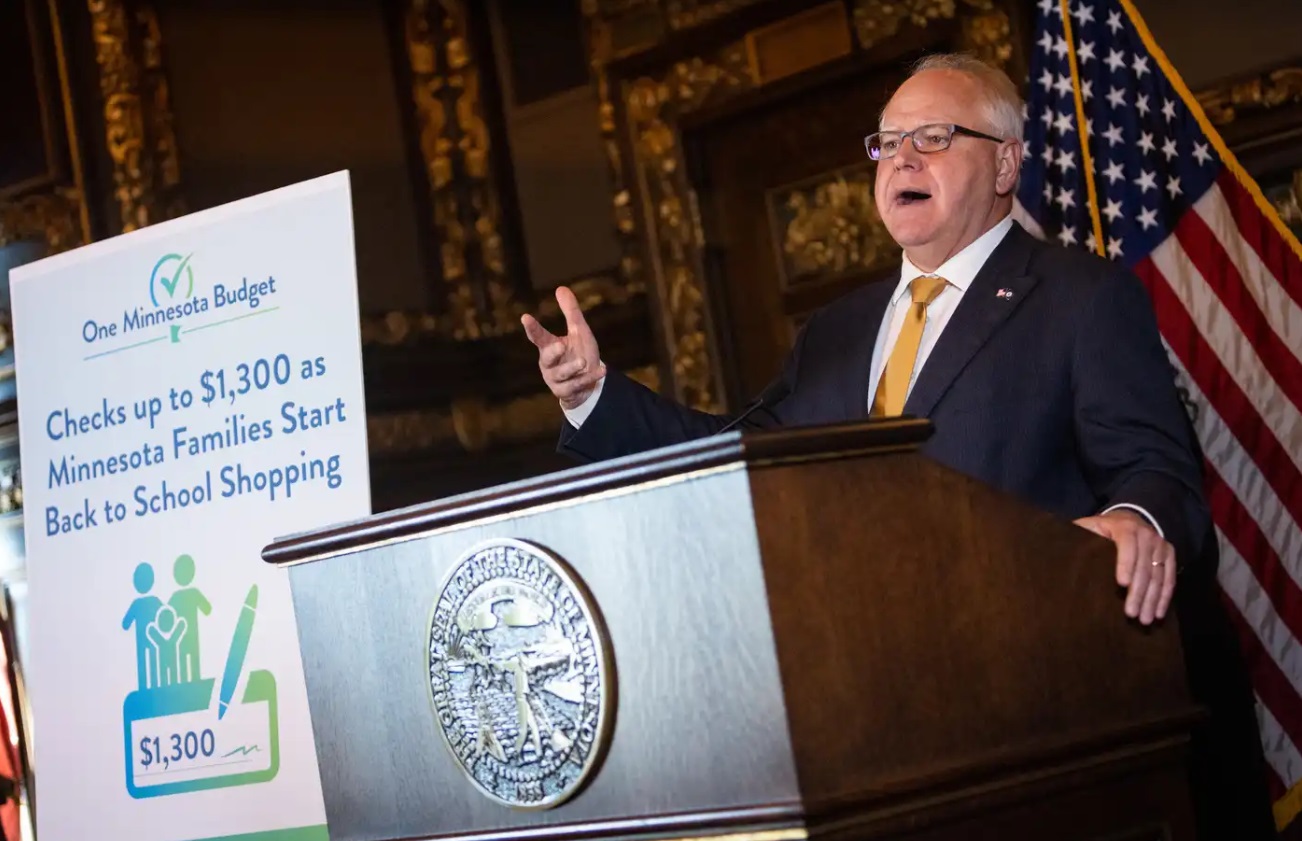
Minnesota Gov. Tim Walz in May signed a $3 billion tax bill authorizing an estimated $1.1 billion in one-time tax rebates for more than two million Minnesotans. The final amount ended up being just less than $1 billion.

Payments started reaching mailboxes and bank accounts in August and September. People who got checks had 60 days from the issue date to cash them in.

Single filers earning up to $75,000 a year were eligible for $260 checks, joint filers earning up to $150,000 were eligible for $520 checks, and households got $260 for each dependent up to three. A married couple with three children could receive up to $1,300.

The Revenue Department determined eligibility based on adjusted gross income in 2021.

Reissued checks will arrive in a plain white envelope from Submittable Holdings, a company located in Missoula, Mont. They’ll have the signature of Revenue Commissioner Paul Marquart and will carry “standard banking safeguards” to prevent fraud.

If rebates continue to go unclaimed for 60 days, the money will end up with the Minnesota Department of Commerce Unclaimed Property Division.

Rebate payments came from Minnesota’s historic $17.5 billion budget surplus, and were part of a record two-year budget of nearly $72 billion passed by Democratic-Farmer-Labor majorities in the legislature and signed by the DFL governor.

Walz had initially pushed for bigger checks of up to $2,000 for joint filers and $1,000 for single filers. In the 2023 legislative session, Walz and DFL legislative leaders reached an agreement to smaller rebates and a slate of tax breaks for low income Minnesotans.

Related Articles

Politics |


In aftermath of assault, Angie Craig says she had to move from D.C. apartment, received death threats

Politics |


Hundreds march to state Capitol in pro-Palestinian rally calling for cease-fire

Politics |


Soucheray: In this time of political loneliness, we surrender

Politics |


Cheniqua Johnson, Anika Bowie win council seats; St. Paul poised to seat first all-female city council

Politics |


Here are some interesting and offbeat submissions for MN’s new flag and seal