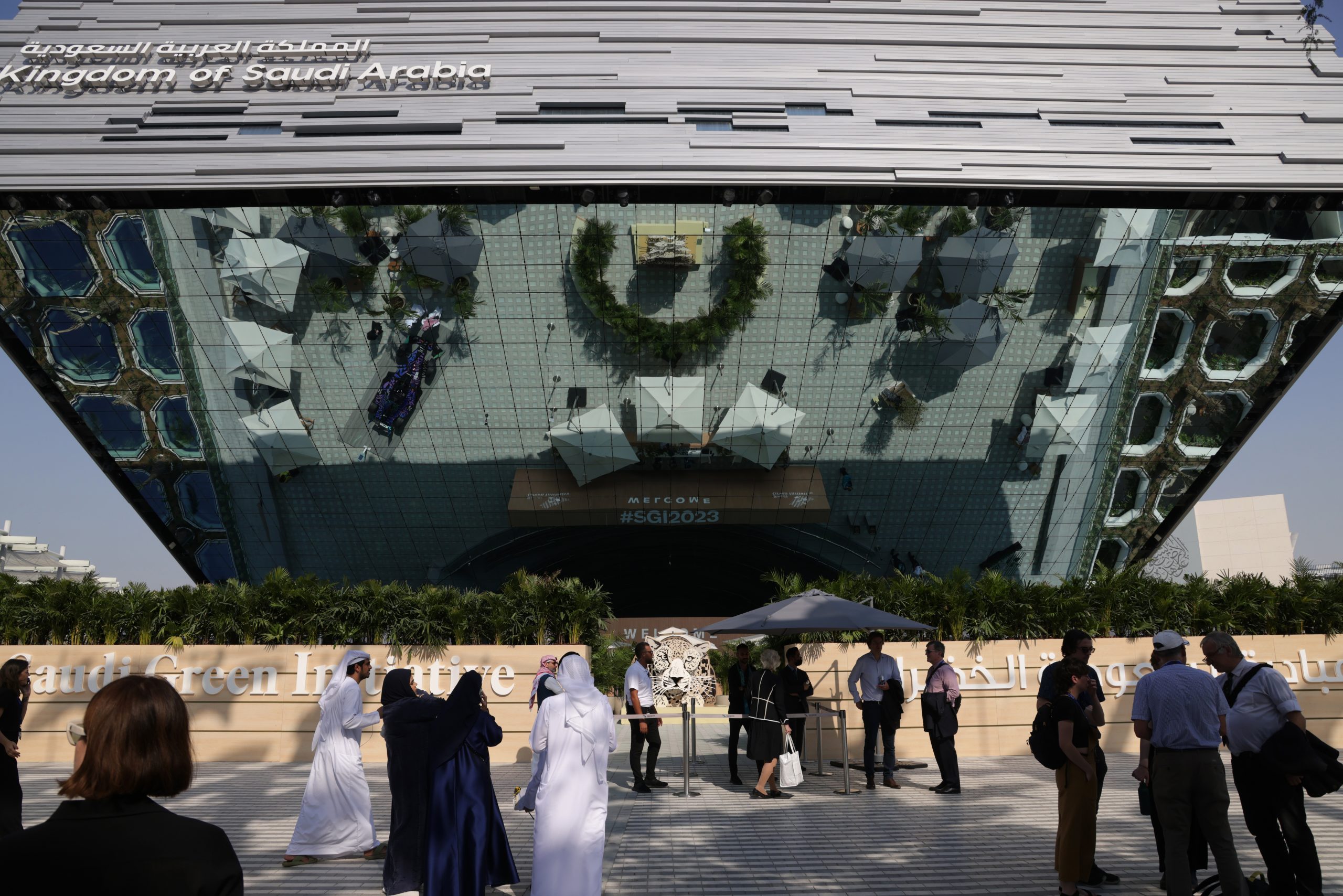
Oil-rich Saudi Arabia is urging nations to take action on what it suggests is a growing threat to the Earth’s climate — wind and solar power.
The pitch from the world’s biggest oil player includes a Saudi government document, obtained by POLITICO’s E&E News, expressing concern about the “lifecycle” greenhouse gas emissions of wind, solar and other renewable energy sources, whose popularity has grown as countries look for alternatives to planet-heating fossil fuels.
It comes as the kingdom is stepping up its broader arguments that expensive, largely unproven methods of removing greenhouse gases from the atmosphere and oceans are an essential part of the strategy for countering climate change. In contrast, scientists, environmental activists and representatives of vulnerable island nations say the most urgently needed fix for climate change is to stop producing and burning oil, natural gas and coal.
Other major fossil fuel nations — including the United States — have also expressed support for a technological approach to reducing carbon pollution, in conjunction with shifting toward greener energy sources. But the Saudis have gone a step further by contending that carbon removal is also needed to address climate pollution from wind turbines, solar panels and other renewable energy hardware, according to text of a previously unreported speech scheduled before the COP28 climate summit began last week.
“Renewables are an integral part of the solution,” a Saudi official was set to argue in the Oct. 31 closed-door speech to fellow diplomats, according to a copy of the prepared text. But the Saudi text added that “we must also act immediately to address their lifecycle emissions in the near term. This will require emissions removal.”
Saudi Arabia’s U.S. embassy didn’t respond to questions about the document, which aligns with public statements that Saudi officials have made touting related technology that captures carbon from smokestacks. Advocates for more aggressive climate action say they worry that the kingdom is promoting efforts to manage carbon — and undercut renewables — in order to weaken support for weaning the world off of greenhouse-gas-spewing fossil fuels.
“They’ve been at this for years and years and years,” Bill Hare, a climate science adviser to the Caribbean nation of Grenada, said of Saudi climate negotiators. “They come up with all sorts of ways to argue for delay, one way or the other. It’s another twist and turn in their delay playbook.”
In addition, the Saudis’ argument about planet-warming emissions from the manufacturing and installation of renewable power are “totally exaggerated,” said Hare, who is also CEO of the European think tank Climate Analytics. Analyses of electricity from solar panels, for instance, have found it has a carbon footprint that’s a fraction of the size of coal-fired power.
“In the end, the production systems for these technologies are getting cleaner,” Hare said. “So it’s not the overwhelming problem that they claim.”
Hare said he worries that the rhetoric from Saudi Arabia and its allies will influence markets by sending a signal to the financial community that international support exists for these novel carbon technologies. That, in turn, could divert money and attention from proven measures for reducing demand for fossil fuels, such as new renewable energy projects and increased efficiency programs.
“It would be a massive victory for those that want to delay action – and delay reducing oil, gas and coal,” Hare said.
A new techno-focus
Saudi efforts to elevate carbon removal and capture technologies at this month’s talks in Dubai are happening as island nations and the European Union seek to build global support for phasing out the use of fossil fuels – the leading cause of climate change and the economic lifeblood of the kingdom. Energy Minister Prince Abdulaziz bin Salman said Monday that the country would oppose any COP28 text that calls for reducing global fossil fuel consumption.
Saudi Arabia’s push to focus on limiting emissions rather than the fuels that produce them has been aided by the United Arab Emirates, the talks’ host nation, which selected its top oil executive to lead the negotiations.
But for all their pronouncements, both oil-rich countries have made only minor investments in rolling out the emissions technologies, according to data compiled by the Global CCS Institute, a think tank that promotes carbon capture and storage installations. To skeptics, that raises questions about whether the petrostates are interested in carbon capture and removal as a climate solution — or as a convenient distraction.
Carbon capture projects aim to minimize the climate damage caused by fossil-fuel-dependent facilities such as coal power plants and steel mills. Carbon removal technologies, by contrast, seek to reverse that harm by pulling already-released carbon dioxide from the atmosphere. Energy analysts often lump the two under the broader umbrella of carbon management.
While similar from an engineering perspective, the commercial and climate appeals of carbon capture and carbon removal are very different.
The plummeting price of renewable energy has limited the potential of carbon capture for already-struggling coal plants, which are increasingly being replaced with wind or solar projects. Cheap renewable energy can also be used to create clean-burning hydrogen for steel makers. Meanwhile, carbon removal at a significant scale will be necessary to avoid the worst impacts of global warming, climate scientists have said, most recently on Sunday in a report to the U.N. on the dire state of the climate.
Both types of climate technologies — carbon capture and carbon removal — have caught the eye of Saudi Arabia. The kingdom has been pitching those systems as a way to prevent the industrial-era rise in average global temperatures from surpassing 1.5 degree Celsius, the aspirational goal set by the 2015 Paris climate agreement. At the same time, the Saudis have downplayed the need to ditch fossil fuels.
“We must act immediately to tackle emissions from all sources, to keep 1.5 within reach, and not cherry pick one energy source over the other,” the Saudi Arabian official was prepared to say during the pre-COP28 meeting. The closed session, in the UAE capital of Abu Dhabi, was intended for diplomats to outline their national bargaining positions for the climate summit that began last Thursday.
The document doesn’t name the Saudi official. But metadata associated with the file indicates that it was drafted by AlJawhara AlSudairy, the head of international negotiations and policy at the Saudi Ministry of Energy.
When asked for comment, AlSudairy directed questions to the ministry, which didn’t respond to questions regarding who delivered the speech. It’s unclear whether the speech as written matches what was said in the room.
In 2021, Saudi Arabia announced a program known as the Middle East Green Initiative that aims “to scale up carbon capture, invest in the green economy and encourage innovation and growth in renewables.” But the kingdom is starting from a very low base.
The U.S. Energy Information Agency estimates that less than 1 percent of electricity in Saudi Arabia is generated from renewable sources. That’s not due to a lack of resources: The sun-drenched and windswept country has advertised to investors that it has among the highest potential for solar and wind energy development of any nation.
Saudi Arabia also has no significant carbon removal facilities in operation or development, according to the Global CCS Institute.
The kingdom has one carbon capture project online at a natural gas processing facility of Saudi Aramco, the state oil company, the Global CCS Institute said in its most recent annual report. The CO2 collected there is pumped underground to help produce more oil, limiting the project’s climate benefits. A much larger carbon capture hub is in “advanced development” and slated to come online in 2027, the institute said.
Saudi Arabia has plenty of cash that it could invest into renewables or carbon removal or capture projects.
With a valuation of more than $2.1 trillion, Saudi Aramco is the world’s third-largest publicly traded company, behind only the tech giants Apple and Microsoft. The state oil company reported earning $161 billion last year, the highest-ever recorded annual profit by a publicly listed firm.
The International Energy Agency, an intergovernmental think tank, last month urged petrostates to quit pretending that carbon management efforts will enable them to keep the world hooked on hydrocarbons..
“Oil and gas producers around the world need to make profound decisions about their future place in the global energy sector,” IEA Executive Director Fatih Birol said in a statement. “The industry needs to commit to genuinely helping the world meet its energy needs and climate goals – which means letting go of the illusion that implausibly large amounts of carbon capture are the solution.”
Yet in recent months, Saudi energy officials have been pursuing projects in Africa and Asia to increase oil and gas demand, according to an undercover investigation published last week by the Center for Climate Reporting and the United Kingdom’s Channel 4 News.
Saudi Arabia didn’t respond to those outlets about the investigation. But in 2016 the country announced a plan to reduce its reliance on oil: Dubbed Vision 2030, the effort aims to grow the non-oil sector of its economy from less than 20 percent of gross domestic product to half of
Saudi Arabia’s economic output by the end of the decade.
UAE, Bahrain promote carbon removal
At COP28, Saudi negotiators’ push to elevate carbon management has a key diplomatic ally: The UAE has also touted the potential for a type of carbon removal favored by the oil industry – at a time when the Emirates are planning to expand crude development.
In July, the UAE submitted new climate goals to the United Nations climate agency that outlined its plans to cut greenhouse gas emissions 19 percent by 2030 from 2019 levels and reach net zero emissions by midcentury.
As part of that plan, the Emirates will “explore innovative Direct Air Capture (DAC) solutions which extract CO2 directly from the atmosphere, which in the long term is critical to reach net zero emissions,” the UAE said in the UN filing. “To build up knowledge and expertise early on and support the UAE’s ambition of becoming a hub for low-carbon technology, the country will also start to pilot and implement DAC technology ahead of 2030.”
Direct air capture facilities use fans, carbon-absorbing materials, electricity and heat to separate CO2 from ambient air. The pure stream of carbon can then be mixed with water and injected into reservoirs deep beneath the surface of the earth – a process that’s familiar to many oil and gas companies.
The UAE has only one operating carbon capture facility and no direct air capture plants, according to the Global CCS Institute.
Amid the flurry of publicity that’s accompanied COP28, the Emiratis have announced several carbon management projects. For instance, the UAE’s Abu Dhabi National Oil Co. and the U.S. firm Occidental Petroleum said in October that they would jointly fund an engineering study for a potential UAE direct air capture facility. The following month, ADNOC and the Australian oil producer Santos agreed to explore the potential for a carbon dioxide shipping and transportation network.
But analysts from Climate Analytics and the NewClimate Institute, another European think tank, have raised questions about the UAE’s climate goals, noting that the country plans to spend $150 billion over the next five years on efforts that include expanding its oil and gas production capacity.
“It is unclear how the UAE plans to reach its 2050 net zero emissions target,” the analysts said in a review of the Emiratis’ U.N. filing, which is known as a nationally determined contribution. “The UAE’s latest NDC mentions they plan to develop carbon capture and storage as well as direct air capture, but without specifying the scale of emissions reductions and removals this would represent.”
The UAE’s U.S. embassy didn’t respond to a request for comment. But an Emirati official on Tuesday said the country’s support for carbon management efforts was driven by pragmatism.
“I want to be clear that we aren’t promoting carbon capture to prolong the current energy system,” Majid Al Suwaidi, the director-general of COP28, told reporters in Dubai. “We are encouraging carbon management because the reality requires us to deal with the emissions system that we have, while we build the system we want.”
The Emirates is not the first petrostate to boost carbon removal in its climate pledges.
“Technological innovation and deployment at scale is the key to the Paris Agreement goals,” Saudi Arabia told the U.N. in 2021. “Deployment of and collaboration on the following technologies is crucial: carbon capture, utilization and storage (CCUS), direct-air capture (DAC), clean hydrogen.”
The following year, Bahrain submitted a climate goal that said it “supports key technologies such as carbon capture and utilization, direct air capture and others which are necessary for hard-to-abate sectors.”
Bahrain has no carbon capture or direct air capture facilities in operation or development, Global CCS Institute data shows.
Bahrain’s U.S. embassy did not respond to a request for comment.
It’s too late in the climate crisis for world leaders to seriously entertain the “fantasy” that “it’s still possible to burn oil, and tackle climate change at the same time, through [carbon capture],” said Joanna Depledge, a research fellow at the University of Cambridge’s Center for Environment, Energy and Natural Resource Governance, in an email.
After decades of obstruction by Saudi Arabia and other countries, “action to radically cut back on fossil fuel use is needed,” wrote Depledge, who previously worked for the U.N. climate agency. “Focusing on [carbon dioxide removal] is a dangerous distraction, and can only have a damaging impact on global efforts to keep temperatures at something approaching safe levels.”
Karl Mathiesen contributed to this report from Brussels. Sara Schonhardt contributed from Dubai.